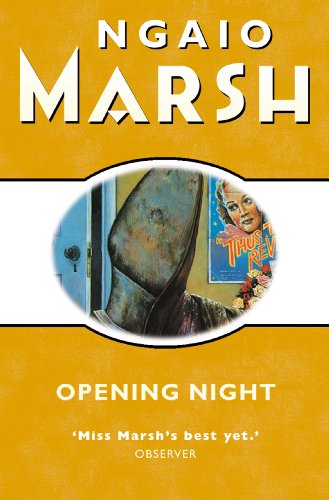
Opening Night by Ngaio Marsh

Opening Night (also published as Night at the Vulcan) is the sixteenth book in Ngaio Marsh’s Inspector Roderick Alleyn series and like many of her novels has a theatrical setting, which makes it perfect for Reading the Theatre, hosted this month by Lory of Entering the Enchanted Castle.

Published in 1951, the novel opens with Martyn Tarne, a young woman from New Zealand, arriving in London to look for acting work. After an exhausting day of unsuccessful auditions and meetings with agents, she eventually finds herself at the door of the Vulcan Theatre where rehearsals are about to begin for a new play, Thus to Revisit. Disappointingly, the play has already been cast, but there’s a vacancy for a dresser to the leading actress, Helena Hamilton, and Martyn finds herself accepting the job.

The next 100+ pages (of a 240 page book) are devoted to describing the backstage preparations for the play, Martyn’s work as first a dresser and then an understudy, and the relationships and interactions between the various members of the cast. There is no hint of any crime until we reach the middle of the book and no sign of Inspector Alleyn either until after the halfway point. I think how much you enjoy this novel will depend on whether you picked it up just because you wanted to read a murder mystery or because you were drawn to the setting.

The crime, when it eventually occurs, involves the death on opening night of one of the actors, Clark Bennington, who is found unconscious backstage after inhaling gas. Suicide is assumed – everyone knows that Bennington has been unhappy and has a drinking problem – but when Alleyn arrives to investigate, he quickly decides that the man was murdered. There are plenty of suspects and motives; for a start, Bennington was married to Helena Hamilton, who has openly been having an affair with one of the other actors, Adam Poole. Also, Bennington is known to have had several heated arguments and altercations before and during the opening night. And to complicate things further, Martyn Tarne’s arrival at the Vulcan has not been welcomed by everyone, least of all Gay Gainsford, a young actress who feels that her role in the company is threatened by Martyn.

Although I would have preferred the murder to have come earlier in the book, once it does happen and Alleyn’s investigation gets under way, the mystery becomes quite an interesting and compelling one. I guessed who the murderer was, but not the motive – and I think it would be very difficult to work that out before it’s revealed right at the end of the book. The mystery is definitely secondary to the setting in this novel, though; Ngaio Marsh herself was a theatre director and her love and knowledge of the theatre comes through very strongly.

Have you read any of Marsh’s Inspector Alleyn novels, theatrical or otherwise? I’ve read very little of her work compared to other Golden Age crime writers so would love to hear your recommendations.
Water Baby by Chioma Okereke

One of the things I love about reading is that it can take you to places you’ve never visited in real life and are never likely to. Chioma Okereke’s new novel, Water Baby, is set somewhere I knew absolutely nothing about: Makoko, a community built on and around a lagoon in the Nigerian city of Lagos. Although it may sound idyllic, that’s sadly not the case. Makoko, as Okereke describes it, is a place where most of the inhabitants are living in poverty, where the lagoon is dirty and polluted and drug use is a widespread problem. It has become known as Africa’s ‘biggest floating slum’.

The heroine of Okereke’s story is nineteen-year-old Yemoja, nicknamed Baby by her father. Since leaving school, Baby has been earning her living by rowing passengers across the water in her canoe, Charlie-Boy, named after her beloved younger brother, but she and her friends dream of one day experiencing a different way of life. However, with her father trying to push her into marriage with Samson, a neighbour who repairs boats, and with a large family of younger cousins to help care for, the possibility of leaving Makoko seems remote.

Things finally begin to change for Baby when she hears about a newly launched project using drones to create maps of Makoko, increasing the profile and visibility of their settlement. Young women from the community, known as ‘Dream Girls’, are being trained to pilot the drones and Baby is desperate to get involved, despite her father’s distrust of the project. When someone takes a photograph of her on the lagoon, mistaking her for a Dream Girl, the image soon goes viral on social media and Baby finds she has become a celebrity overnight. The opportunity arises for her to represent Makoko at a conference in Switzerland, but will this be the start of a new life for Baby or will she decide that her future lies at home after all?

I thought this book was fascinating, mainly because of the setting and the insights it gave me into a lifestyle so completely different from my own. Okereke describes Makoko so vividly I could already picture what it looked like even before searching for photos to see it for myself. The lives of the people of Makoko are already difficult – making your home on a lagoon means facing problems with sanitation, electricity supplies and running water, not to mention access to education and medical care – but they are also in an unusually vulnerable position regarding climate change:

There used to be more vessels on the horizon, but year on year that’s changing. From the shrinking lagoon size and lesser quantities of fish to water levels rising alongside the rubbish enveloping us. From manmade disasters to unthinkable diseases. Life is always throwing something at us, but we hold our ground.

I liked Baby, but some of the other characters were less well developed; in particular I felt that I never fully got to know her love interest, Prince. I did find Baby’s relationship with her little brother Charlie Boy very moving, though, for reasons that I can’t really explain here without spoiling the story! Although Baby and her friends are fictional characters, the Code for Africa mapping project and the Dream Girls are real and I found it interesting to read more about them after finishing the book.

Thanks to Quercus for providing a copy of this book for review via NetGalley.

Rosabelle Shaw by D.E. Stevenson – #1937Club

My third and final book for 1937 Club, hosted by Stuck in a Book and Kaggsy’s Bookish Ramblings, is Rosabelle Shaw (also published as The Story of Rosabelle Shaw) an early novel by D.E. Stevenson. Wikipedia describes Stevenson as an author of ‘light romantic novels’, but I have read several of her books and although some of them fit that description, others (such as her dystopian novel, The Empty World) do not. This is another that is not a typical Stevenson novel and I found it suprisingly dark.

The novel begins in 1890s Edinburgh with Fanny Dinwiddie, a pretty, lively young woman, who catches the eye of John Shaw, a farmer visiting the city on business. For John, it’s love at first sight and it’s not long before he is heading back to Shaws, his farm near the Scottish coast, with Fanny as his wife. It takes Fanny a while to adjust to her new home – she has left behind her father and beloved sister, Alison, and she misses the social life of Edinburgh – but eventually she begins to settle in and make friends and soon a daughter, Rosabelle, is born. At this point, I was expecting a gentle, domestic novel about the life of a farmer’s wife on a Scottish farm…but I was wrong.

When Rosabelle is three years old, a ship is lured onto the rocks near Shaws farm during a storm. John thinks he knows who is responsible for causing the wreck and is filled with guilt for not doing more to stop it, but is able to make amends by rescuing and informally adopting the only survivor of the disaster, a small child with whom Fanny immediately forms a bond. Nobody knows the little boy’s name or the identities of his real parents, so John and Fanny raise him with their own children and name him Jay. From the moment Jay enters their lives, tensions begin to form in the Shaw household. Unlike Rosabelle and her real brother and sister, Jay is a deceitful, jealous and manipulative child determined to get his own way. John struggles to like the boy, while for Fanny he can do no wrong, causing the first real disagreements of their married life.

Moving forward several years, we meet the Shaw children again as young adults. Rosabelle has begun to look at Jay in a different light, captivated by his good looks and charisma, and begins to fall in love, much to the dismay of her neighbour Tom, who was hoping to marry Rosabelle himself. But there could still be a chance for Tom after all, because Jay is about to bring shame on the Shaw family and betray their kindness and generosity, breaking the hearts of both Rosabelle and Fanny.

I found Rosabelle Shaw quite enjoyable, but it seems to have had mainly negative reviews, maybe because the melodramatic, almost Gothic feel isn’t what you would expect from Stevenson. A lot of people have also complained about the racism, which I noticed as well – it’s definitely implied that because Jay arrived on a foreign ship and is possibly Spanish, he is naturally sly and untrustworthy, unlike the good, honourable Scottish characters. The book reminded me very much of Wuthering Heights, with Jay being similar to Heathcliff, who is also of unknown parentage and nationality and causes nothing but trouble for the Earnshaw family (Rosabelle is obviously in the role of Catherine Earnshaw, who falls in love with her adopted brother).

The book takes on a slightly different tone towards the end when, in 1914, war breaks out and brings big changes to our characters’ lives. From this point, the focus of the book shifts away from Jay to concentrate on the war and how it affects the family at Shaws. I thought it was a fascinating novel, but it won’t appeal to everyone and there are probably better places to start if you’re new to Stevenson. For me, though, it was another good choice for 1937 Club!

Caroline England by Noel Streatfeild – #1937Club

My second book for this week’s 1937 Club (hosted by Stuck in a Book and Kaggsy’s Bookish Ramblings) is by an author who was a childhood favourite but whose adult fiction I’ve only recently begun to explore. I loved her 1940 novel, The Winter is Past, set during the early stages of World War II, so when I saw that Caroline England was published in 1937 it seemed a perfect choice for the club.

The novel begins in 1870 with the birth of Caroline Torrys, the first child born to James and Selina Torrys of Milston Manor in Kent. The Manor has belonged to the Torrys family since the 16th century and James, desperate for a male heir, is disappointed with the arrival of a baby daughter. As the years go by and Selina becomes weak and worn down with her efforts to please her husband and produce a son, Caroline is raised in the nursery by a strict and often cruel nurse. Growing up nervous and anxious, with her spirit broken, Caroline eventually finds a way of escape when she falls in love with a writer, John England, and elopes with him. Caroline’s upper class family disapprove of John, whose father owns a shop, and she is cut off from the Torrys and her beloved Milston Manor.

The next part of the book follows Caroline through her marriage to John and the birth of her own children, whom she vows to treat with the kindness and affection she herself was starved of as a child. However, as her children grow older she finds that they don’t necessarily want her ‘interfering in their lives’ – and that John is the one demanding her time and attention. We then get to know Caroline’s children as adults and see how the family copes during World War I and its aftermath until finally, in the last section of the book, we join Caroline as a grandmother, living in a world that has changed beyond recognition.

I’ve probably given the impression that this book is very depressing – and it’s true that despite her privileged start in life, things are difficult for Caroline at times – but it’s not as bleak and miserable as it sounds. Although Caroline’s experience of being a wife and mother is not quite as blissful as she had hoped, she makes the most of what she has and finds happiness where she can. She also grows and changes as a person, as the post-war world grows and changes around her and the social system she once took for granted begins to collapse. By the end of the book, Milston Manor no longer belongs to the Torrys family and is being converted into a hotel, while Caroline herself is forced to think differently when she gets to know her son’s working-class fiancée, a woman she would have once considered ‘not our sort’.

I found the first section of the book, describing Caroline’s childhood, the most compelling because Streatfeild writes about child characters so convincingly. It was so interesting to read her portrayal of Caroline’s life in the nursery and the different methods used by her first nurse, the warm and loving Naomi, and the cold, abusive woman who takes her place, and then to see how Caroline’s upbringing affects her own choices as an adult. The later chapters, which concentrate more on Caroline’s sons and daughters, interested me slightly less, but I often find that to be the case when a family saga moves on to the next generation.

Of the two adult Streatfeild novels I’ve read, I preferred The Winter is Past as it was more tightly plotted, whereas this one covers a much longer period of time and has less focus. I enjoyed both, though, and look forward to trying some of her others.

They Found Him Dead by Georgette Heyer – #1937Club

This week, Simon of Stuck in a Book and Karen of Kaggsy’s Bookish Ramblings are hosting another of their very popular clubs, where we all read and write about books published in the same year. This time it’s 1937 Club and for my first book I’ve turned to a favourite author who can be almost guaranteed to have had at least one title published in any chosen club year. In 1937, she had two and although An Infamous Army, a novel set before and during the Battle of Waterloo, is one I read a few years ago and didn’t particularly enjoy, I’m pleased to say that I had a much better experience with this one.

They Found Him Dead is one of twelve contemporary detective novels written by Heyer. It begins with the family, friends and business associates of Silas Kane assembling at his country house to celebrate his sixtieth birthday. As with many large gatherings, there are various tensions between members of the group, but when Silas is found dead at the bottom of a cliff after going out for his usual evening walk, the police decide that it was just a tragic accident. Only fourteen-year-old Timothy Harte, half-brother of Silas Kane’s nephew Jim, suspects murder – and when Kane’s heir, Clement, is shot in the head several weeks later, it seems that he could have been right.

Superintendent Hannasyde and Sergeant Hemingway arrive from Scotland Yard to investigate and quickly discover that there’s a large number of suspects including several nephews and nieces in the line of inheritance, some of Kane’s business partners and even his elderly mother, a woman in her eighties. However, they first need to decide whether they really are dealing with two murders or just one – and if there have been two, were they both committed by the same person?

I thought this was an entertaining novel, although I did panic at first due to the huge number of people introduced in the opening chapter. I wished I had drawn a family tree to keep them all straight in my mind, but after a few more chapters everything had settled down anyway and the characters and their relationships became more clearly defined. As a mystery it’s not a very clever or original one – in fact, it’s quite formulaic in many ways, with the country house, family party, motives revolving around inheritances and business deals and the Scotland Yard detectives all being very familiar to anyone who has read a lot of Golden Age crime. The murderer is also quite easy to guess, once you’ve picked up on one very obvious clue.

What I really enjoyed about this book was not the plot but the characters. I particularly loved Timothy, who has an active imagination leading him to see drama and conspiracy in every situation and is nicknamed Terrible Timothy by Sergeant Hemingway. He does actually help to solve the mystery, but not in the way he had expected! There’s also a bit of romance (although it’s quite understated and not a big part of the book), with Timothy’s half-brother, Jim Kane, falling in love with Patricia Allison, companion to Silas Kane’s mother. I liked these two characters as well; in general, the characters in this book are a more pleasant bunch than in the other Heyer mysteries I’ve read! A few of them also appear in her 1951 novel, Duplicate Death, which I read before this one and I’m now wishing I’d read them in the correct order!

I still have a lot of Heyer’s mysteries left to read and am looking forward to them. They don’t really compare to Agatha Christie’s when it comes to plotting a crime, concealing clues and creating red herrings, but they’re still fun to read. This was a great start to the 1937 Club for me and I’m also enjoying my second book, which I’ve almost finished and will be reviewing later in the week.

The Fraud by Zadie Smith

When I saw this year’s longlist for the Walter Scott Prize, one of the books I was most interested in reading was The Fraud. I haven’t read any of Zadie Smith’s other books, but the subject and setting of this one sounded appealing to me.

At the heart of the novel is a real-life court case in which a man many believe to be Arthur Orton, a butcher’s son from London, claims to be Roger Tichborne, the missing heir to a baronetcy thought to have died in a shipwreck in 1854. The ‘Claimant’, as he becomes known, is immediately identified as Roger by his mother, but the rest of the Tichborne family insist that he’s an imposter. The dispute goes on for several years and captures the imagination of the public, with people travelling for miles to come and watch the case play out in court. Two of the people following the proceedings with interest are Sarah Ainsworth and Eliza Touchet, who are central characters in Smith’s novel.

Eliza Touchet is a cousin by marriage of the novelist William Harrison Ainsworth and has lived with him as his housekeeper – and occasional lover – since the 1830s, while also growing close to his first wife, Frances. By the time of the Tichborne trial several decades later, William has been widowed and married again, this time to Sarah, his former maid. Sarah is obsessed with the Tichbornes and convinced that the Claimant is telling the truth and it is she who persuades Eliza to accompany her to court. Here Eliza finds herself drawn not to the supposed Sir Roger, but to one of the key witnesses – Andrew Bogle, an elderly black man who was Roger’s uncle’s servant and is one of the few people to speak up in support of the Claimant.

The novel moves backwards and forwards in time between the 1830s and 1870s, with the story unfolding through a series of very short chapters, sometimes only a page or two long. I wasn’t really a fan of this structure, as it made it difficult to become fully immersed and keep track of what was happening. And there’s a lot happening! As well as the coverage of the Tichborne trial, there’s a long digression into the early life of Andrew Bogle as a slave on a plantation in Jamaica, discussions of the Victorian literary scene and domestic details of life in the Ainsworth household. There were too many separate storylines for one book and some of them didn’t really seem to lead anywhere or integrate with the others. Having said that, I still found things to enjoy and my overall feelings about the book are probably slightly more positive than negative!

Most of the people who appear in The Fraud really existed, although not necessarily as Zadie Smith describes them. Eliza Touchet, for example, was a real person but died much earlier than she does in the novel and wouldn’t have been around by the time of the Tichborne case, so while there’s a lot to learn from this book it’s worth remembering that it’s not all factually correct. I did find it interesting to read about the life and work of William Harrison Ainsworth, whose books were hugely popular at the time – particularly Jack Sheppard, one of the ‘Newgate novels’ Claire Harman discusses in her true crime book, Murder by the Book – but have largely been forgotten today. Smith explores Ainsworth’s rivalry with Charles Dickens, as well as allegations that he stole some of the ideas for his novels from his illustrator, George Cruikshank. Is it just the Tichborne Claimant who is the ‘fraud’ of the title or could it also be Ainsworth himself?

Although there were parts of The Fraud that I enjoyed, I think there was really enough material here for two or three books and I ended up feeling overwhelmed. Maybe a different Zadie Smith book would have been a better starting point for me after all.

Book 15/50 for the Historical Fiction Reading Challenge 2024

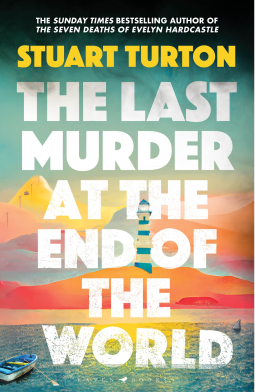
The Last Murder at the End of the World by Stuart Turton

Stuart Turton is, in my opinion, one of the most original and imaginative authors writing today; although I know his style doesn’t work for everyone, I loved his first book, The Seven Deaths of Evelyn Hardcastle, which was unlike anything else I’ve ever read. His second novel, The Devil and the Dark Water, a mystery set aboard a 17th century Dutch trading ship, disappointed me, but I recently read his short story, The Master of the House and loved that one too, so I was curious to see what this, his newest novel, would be like.

The Last Murder at the End of the World combines a murder mystery with a post-apocalyptic setting. The world as we know it has been destroyed by a black toxic fog that has swept across the planet, killing everyone it touches. The only place the fog hasn’t reached is a small Greek island, home to the Blackheath scientific research facility. The island is inhabited by one hundred and twenty-two villagers and three scientists from Blackheath, who have become known as the Elders. While the scientists continue their research into the fog and the security system that is holding it back from the island, the villagers farm the land and obey the rules set out for them by the scientists, while being discouraged from thinking too deeply for themselves.

Disaster strikes when one of the scientists is murdered and the barrier keeping the fog at bay is broken down. If the islanders can solve the murder within ninety-two hours, the barrier will be restored – if not, the fog will envelop the entire island. One of the villagers, Emory, is more resourceful than the others; rather than just accepting the situation and her place in society, she has always been curious and eager to learn. The task of investigating the crime, then, falls mainly to Emory – but to make her job even more difficult, the security system has also wiped the memories of the villagers, so someone could be a murderer without even knowing it.

The Last Murder at the End of the World is a difficult book to write about without spoiling too much. From the beginning, we are faced with lots of intriguing questions. Why do none of the villagers live past the age of sixty? Who or what is ‘Abi’, the omniscient voice who is present in everyone’s mind? Are the three Elders working with the villagers or against them? Everything is explained eventually but I won’t discuss the plot in any more depth here. I think if you’ve read other dystopian/post-apocalyptic novels you’ll already have an idea of the sort of things being explored, such as why some people survived and not others and whether society can be rebuilt to make the new world a better place than the last one.

The murder mystery element is interesting mainly because of the limitations that are placed upon it – the short period of time in which Emory has in which to solve the mystery and the fact that nobody can remember anything they may have done or witnessed on the night of the crime. There are also some surprising plot twists and revelations that meant I was constantly questioning and re-evaluating everything I thought I had figured out. However, this is definitely a book where the characters take second place to the plot; the three scientists are particularly difficult to like and, apart from Emory, the villagers are bland and not easily distinguished from each other. For this reason, The Last Murder at the End of the World is a novel I enjoyed from an intellectual perspective but not from an emotional one.

Thanks to Raven Books for providing a copy of this book for review via NetGalley.