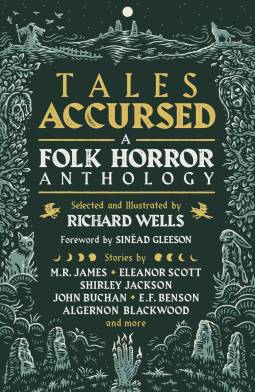
Tales Accursed: A Folk Horror Anthology selected and illustrated by Richard Wells

Folk horror is not a subgenre I’ve ever really taken the time to explore, so I wasn’t sure what to expect from this new anthology selected and illustrated by the artist Richard Wells. What I found was a collection of sixteen stories, most of them from the 19th and early 20th centuries, all blending folklore with elements of the supernatural and lonely rural settings. Each story is accompanied by a beautiful lino print illustration by Wells which I’m sure will look even more impressive in the physical edition of the book than in the ebook version I read.

The stories are arranged chronologically, beginning with Sheridan Le Fanu’s The White Cat of Drumgunniol from 1870 and ending with Shirley Jackson’s The Man in the Woods, published posthumously in 2014. I had read both of these authors before (although not these particular stories) and there were two other authors I’d also read previously – John Buchan and E.F. Benson – but the others were all new to me. In fact, there were several I’d never even heard of until now, so it was good to be made aware of them and to be able to try their work for the first time.

As with most anthologies, the stories vary in quality. However, I found that there wasn’t much variety in terms of plot or setting. Many of them, particularly the older ones, are based on Celtic folklore and have similar structures, with our narrator travelling in an unfamiliar part of the countryside and meeting someone who tells them a story about strange sightings or occurrences, which the narrator then experiences for themselves. Although this did make the collection as a whole feel slightly formulaic and repetitive, there were still some stories that were different and stood out. One of these is Woe Water by H.R. Wakefield, which unfolds in the form of diary entries written by a man with a troubled past who moves into a remote lakeside cabin and begins to struggle with his conscience. I also enjoyed Elinor Mordaunt’s The Country-Side, told from the perspective of a parson’s wife whose relationship with her unfaithful husband takes a sinister turn when she meets an old woman in the village who is said to be a witch.

Ancient Lights by Algernon Blackwood is another highlight – it has a wonderfully eerie atmosphere as the narrator describes his journey through enchanted ancient woodland. The Shirley Jackson story, The Man in the Woods, in which a man accompanied by a stray cat stumbles upon an old house inhabited by three strange people, is also very good. It’s packed with references to mythology and witchcraft and there are lots of layers to unravel, but the open ending left me frustrated and wanting to know more!

Despite the ‘folk horror’ label in the title, I found the stories in this collection creepy or unsettling rather than frightening. I deliberately haven’t said much about any of the individual stories because some of them are very short and it would be easy to spoil them, but overall I did enjoy the book and am interested in reading more by some of these authors.

Thanks to Unbound for providing a copy of this book for review via NetGalley.
I’m counting this as my second book towards this year’s RIP challenge.
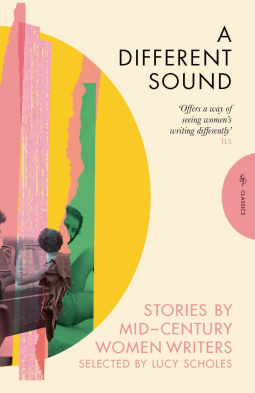
A Different Sound: Stories by Mid-Century Women Writers edited by Lucy Scholes

This is a fascinating collection of short stories, all written by women and originally published in the 1940s and 50s. When I saw the list of authors included in the book, there were several I’d already read, others I’d heard of but never read, and a few that were completely new to me. There are eleven stories in total and as always when writing about collections like this, I’ll have more to say about some of them than others!

There’s only one story in this collection that I’ve read before – and that’s The Birds by Daphne du Maurier. As she’s one of my favourite authors, I decided to read it again and found it just as wonderful and atmospheric as I did the first time. Rather than discuss it again here, I’ll direct you to my previous review and will just add that even if you’ve seen the Hitchcock film, I would still recommend reading the story which is quite different in several ways.

Elizabeth Jane Howard is an author I’m familiar with through her Cazalet Chronicles (I’ve read the first two books in the series and am planning to read the others) and she is represented here with Three Miles Up, an eerie story in which two men are taking a trip through the countryside on a canal boat when they encounter a young woman called Sharon. Once Sharon joins them on the boat, things begin to go wrong and they find themselves sailing up a canal that doesn’t appear on any maps. I loved this one, although I wasn’t aware that Howard wrote ghost stories so it wasn’t what I’d expected at all.

The other two authors I’ve read previously are Stella Gibbons and Elizabeth Taylor. The Gibbons story, Listen to the Magnolias, is set during the war and involves an elderly widow nervously awaiting the arrival of five American soldiers who will be billeted in her home, while Taylor’s The Thames Spread Out follows a woman who is trapped upstairs in her house during a flood while swans swim at the bottom of her staircase. I liked both of these, particularly the second.

Apart from The Birds, my favourite story in the book turned out to be The Skylight by Penelope Mortimer, in which a woman and her young son rent a house in a remote area of France but arrive to find the doors all locked and no sign of the owners. The only point of access is an open skylight in the roof and the mother makes a decision she quickly comes to regret. Mortimer creates a real sense of fear and tension in this story and I couldn’t wait to reach the end to find out if everything was going to be okay!

Considering the publication dates, the Second World War naturally plays a part in many of these stories – I’ve already mentioned the Stella Gibbons, but another is Diana Gardner’s wonderful story, The Land Girl, about a young woman placed on a farm as a Land Girl who takes an instant dislike to the woman whose home she is staying in and decides, out of spite and jealousy, to cause trouble for her.

The stories above are the ones that really stood out for me in this collection, but I enjoyed all of them to some extent, apart from maybe Elizabeth Bowen’s Summer Night which I found well written but confusing due to the structure and changing perpectives. I was also slightly disappointed by Sylvia Townsend Warner’s Scorched Earth Policy about an elderly couple preparing for a wartime invasion, simply because it was too short for any real plot or character development. It was nice to discover some authors I’d never come across before, though: Frances Bellerby, who in The Cut Finger tells the story of a little girl learning some important lessons about the world; Inez Holden whose Shocking Weather, Isn’t It? follows a woman who visits her cousin in various different places over the years; and Attia Hosain who explores the feelings of a newly married woman struggling to fit in with her husband’s friends in The First Party.

I can definitely recommend this collection; I found something to interest me in every story, even the ones I didn’t enjoy as much. I also now have a list of authors I need to explore further!

Thanks to Pushkin Press Classics for providing a copy of this book for review via NetGalley.

Doomed Romances: Strange Tales of Uncanny Love edited by Joanne Ella Parsons – #ReadIndies

This new short story collection, Doomed Romances: Strange Tales of Uncanny Love, is part of the British Library’s Tales of the Weird series. These books have been around for a few years now but I’ve let them pass me by as I’ve had enough to read with their Crime Classics series! I’m glad I’ve finally found time to try one as although this collection is a bit uneven I did find it entertaining.

The book contains twelve stories by different authors and includes an introduction by the editor, Joanne Ella Parsons. The stories were originally published between 1833 and 2022 and appear here in chronological order. All have a ‘doomed romance’ theme, with some being much darker than others. There are two that I’ve actually read before – one of them is Sheridan Le Fanu’s lesbian vampire novella, Carmilla, and the other is Angela Carter’s The Lady of the House of Love, also a vampire story, first published in The Bloody Chamber. I didn’t read Carmilla again as I just read it fairly recently, but I did re-read the Carter and was impressed again by the beautiful imagery and the atmospheric Gothic setting she creates.

The oldest story in the book is Mary Shelley’s The Invisible Girl, in which the narrator, out walking along the coast of Wales, finds a painting of a beautiful woman hanging on the wall inside a ruined tower. It was good to have the opportunity to try more of Shelley’s work, having only read Frankenstein so far, but I didn’t find this a particularly strong story. Two that I did enjoy were The Little Woman in Black by Mary Elizabeth Braddon and One Remained Behind by Marjorie Bowen. These are also authors I’ve read before; Braddon is a favourite Victorian author of mine and has a very readable writing style. Her story seemed as if it was heading in one direction, but then surprised me with an ending I wasn’t expecting at all! Bowen was a very prolific author of historical novels and supernatural tales – the story in this collection is a ghost story from 1936 and one of the highlights of the book for me.

Joanne Ella Parsons has clearly tried to include stories with a wide range of geographical settings, exploring different cultures, rather than just sticking with more traditional Gothic stories. Wilkie Collins, another Victorian author I usually enjoy, is represented here with Mr Captain and the Nymph, in which a ship’s captain lost on an unidentified Pacific island falls in love with the daughter of a local priest. It’s an interesting story, although not a good example of his best work. Alice Perrin’s The Tiger-Charm is set on safari in India, while Nalo Hopkinson’s The Glass Bottle Trick transposes the famous Bluebeard folktale to a Caribbean setting. The latter are two new authors for me and I found both stories entertaining, but I’m not sure if I would search out more of their work based on these.

Another highlight was Could You Wear My Eyes? by Kalamu ya Salaam, where a man whose wife has died agrees to have her eyes inserted into his face after her death, allowing him to see life from her perspective. It’s a strange story but a fascinating one! The collection is completed with another 19th century story, Ella D’Arcy’s White Magic, and two contemporary ones, I’ll Be Your Mirror by Tracy Fahey and Dancehall Devil by V. Castro.

Doomed Romances is a real mixed bag, then – there are some very strong stories and some much weaker ones, and including Carmilla seemed an odd decision to me, as it’s so much longer than any of the other stories and made the book feel unbalanced. I enjoyed the collection overall, though, and will probably consider reading more of them.

British Library Publishing publish a range of fiction and non-fiction including the Tales of the Weird, Crime Classics and Women Writers series. They are an independent publisher, so I’m counting this book towards #ReadIndies month, hosted by Kaggsy’s Bookish Ramblings and Lizzy’s Literary Life.

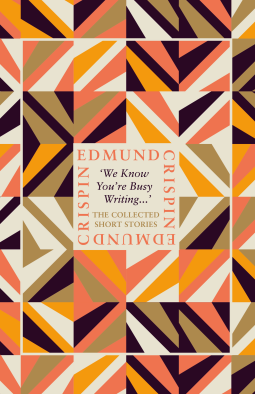
We Know You’re Busy Writing… by Edmund Crispin

I hadn’t read much of Edmund Crispin’s work – two novels and one or two short stories – so I jumped at the chance to read this new anthology from HarperCollins. It collects together in one volume all of Crispin’s forty-six published short stories, many of them featuring his series detective Gervase Fen. The entire contents of two previously published Crispin collections are included here – Beware of the Trains (1953) and Fen Country (1979) – as well as several standalones. It has taken me nearly two months to work my way through the whole book, a few stories at a time, as I think reading them all at once would have been too much!

Gervase Fen is a Professor of English Language and Literature at Oxford University and a friend of Detective Inspector Humbleby of Scotland Yard, whom he often assists in the solving of crimes. Most of the short stories that feature Fen are very short – just a few pages long – and begin with Humbleby or another friend describing an unsolved case, after which Fen is soon able to tell him the solution, sometimes without even leaving the room, sometimes by making a quick telephone call or consulting a reference book. I was reminded of Baroness Orczy’s Old Man in the Corner stories, where her detective solves mysteries from the comfort of a London tea shop. The stories are too short for any real character development and the focus is on the puzzling scenario and how Fen solves it. I think there were only one or two that I guessed correctly; the majority rely on noticing tiny clues and sometimes require some specialist knowledge, for example knowing how cameras work or how a foreign word is pronounced.

Overall, I enjoyed the non-Fen stories more. The title story, We Know You’re Busy Writing, But We Thought You Wouldn’t Mind If We Just Dropped in for a Minute, is the highlight. Written in the first person, it’s narrated by an author who is working on a new novel and desperately trying to meet his publisher’s deadline. Unfortunately, he is constantly being interrupted by the telephone and people at the door. When his latest visitors sit themselves down and show no sign of leaving, he is forced to take drastic action! This is a great story, written with a lot of humour and a dark conclusion. Child’s Play, another standout, is dark from the beginning. Judith has just started a new position as governess to four children, one of whom is an orphan and is bullied by the other three. The story becomes very disturbing when a murder takes place and it seems that one of the children may be responsible.

This collection closes with a Gervase Fen novella from 1948, The Hours of Darkness, which was unpublished until it appeared in a Bodies from the Library anthology in 2019. The novella is set at Christmas, which makes it perfect for this time of year! Although the story itself isn’t very festive, Fen walks around singing carols as he works, much to the irritation of Inspector Wyndham, whom Fen is helping to investigate a murder which takes place during a game of hide and seek at a Christmas Eve house party. I didn’t find this a particularly outstanding or original mystery, but it was very enjoyable and the longer length allowed more depth of plot and characters.

I think the best place to start with Crispin, based on what I’ve read so far, is his 1946 Fen novel The Moving Toyshop, but these short stories are very entertaining, although I recommend taking your time over them as the Fen ones do become quite repetitive. You should also be aware that justice isn’t always done and Fen is sometimes satisfied just to find the solution and allow the culprits to get away with their crimes. Still, this is a great collection and has reminded me that I really need to read more of Crispin’s novels.

Thanks to HarperCollins for providing a copy of this book for review via NetGalley.

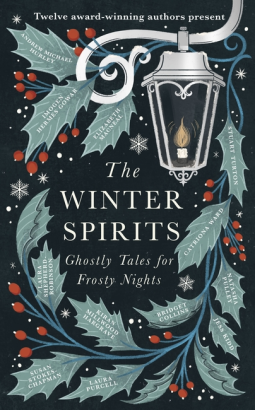
The Winter Spirits: Ghostly Tales for Frosty Nights

The Winter Spirits: Ghostly Tales for Frosty Nights is a collection of twelve new ghost stories written by popular authors of historical and Gothic fiction, all with a Christmas or Advent theme. It’s a follow-up to The Haunting Season, which I haven’t read but which includes eight of the same authors. This is the perfect time of year for ghost stories, so maybe I’ll look for the previous book next winter.

Back to The Winter Spirits and most of the stories are set in the 19th or early 20th centuries, giving them a traditional feel. More variety would have been nice – not just in the time periods, but also in the geographical settings, as the majority take place in Britain, with one or two in America or elsewhere in Europe – but otherwise I really enjoyed this collection. I’ve previously read full-length novels by most of the featured authors, but three of them were new to me: Andrew Michael Hurley, Catriona Ward and Susan Stokes-Chapman. I felt that Hurley’s The Old Play and Stokes-Chapman’s Widow’s Walk were two of the weaker stories, but looking at other reviews, some readers have singled them out as favourites, so I think it’s just a case of different stories appealing to different people! Ward’s contribution, Jenkin, was completely bizarre but added some diversity as it felt quite unlike any of the others.

The biggest surprise, for me, was Natasha Pulley’s The Salt Miracles; I really didn’t get on with her writing style in her novel The Bedlam Stacks, so I wasn’t expecting too much from this tale of disappearing pilgrims on a remote Scottish island (based on St Kilda). However, I ended up loving it – it’s such an unusual and chilling story! Inferno by Laura Shepherd-Robinson, one of my current favourite historical fiction authors, is another I particularly enjoyed – a wonderfully eerie story set in 18th century Italy, where a man is forced to confront his sins. Even better than both of these is Stuart Turton’s creepy and imaginative The Master of the House, in which a young boy who is being neglected by his father makes a deal with the devil. This one feels almost like a very dark fairytale and is one of the highlights of the book.

Of the twelve authors, Laura Purcell is probably the most well established as a writer of horror fiction and she doesn’t disappoint here with Carol of the Bells and Chains, in which a governess trying to deal with two unruly children tells them the story of the Krampus, with unintended consequences. Imogen Hermes Gowar’s A Double Thread, where a woman gets her comeuppance after badly treating her hardworking seamstress, is another I really enjoyed – it made me long for another novel by Gowar, as it’s been a few years since The Mermaid and Mrs Hancock!

The remaining stories are by Elizabeth Macneal, Bridget Collins, Jess Kidd and Kiran Millwood Hargrave. With a range of different styles and subjects, unless you just don’t like ghost stories I think this collection should contain something to please almost every reader.

Thanks to Sphere for providing a copy of this book for review via NetGalley.

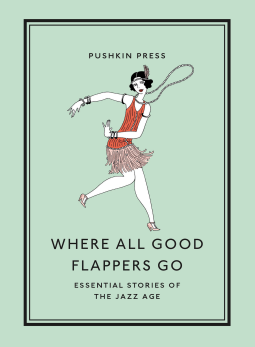
Where All Good Flappers Go: Essential Stories of the Jazz Age – edited by David M. Earle

I’ve never considered myself to be a fan of Jazz Age fiction – but, to be fair, I’ve read very little of it, other than a few F. Scott Fitzgerald novels. When I saw that Pushkin Press had put together this collection of Jazz Age short stories, I thought it would be a good opportunity to branch out and try some new authors from that era.

This edition begins with an introduction discussing the changes following WWI that led to the birth of the ‘flapper’ as women pursued social and sexual equality, then a short 1925 essay by Zelda Fitzgerald, What Became of the Flappers?. In this essay, Fitzgerald attempts to give her own definition of what a flapper is, before revealing what she believes will happen to them in the end:

The best flapper is reticent emotionally and courageous morally. You always know what she thinks, but she does all her feeling alone. These are two characteristics which will bring social intercourse to a more charming and sophisticated level. I believe in the flapper as an artist in her particular field, the art of being – being young, being lovely, being an object.

The essay is followed by twelve short stories, most of which were originally published in various periodicals between 1920 and 1932. Apart from F. Scott Fitzgerald, all of the other authors were new to me; I had at least heard of a few of them, such as Zora Neale Hurston, Anita Loos and Dorothy Parker, but was unfamiliar with the rest. The Fitzgerald story is Bernice Bobs Her Hair, which stands out as one of the best in the book, but I expect a lot of people will have read that one so I’m going to focus on some of the less well known stories instead.

My favourite story is probably Night Club by Katharine Brush, which describes a typical night at a New York club through the eyes of Mrs Brady, who works there as a maid. Mrs Brady’s job involves looking after a dressing room, where young women come to reapply their make-up throughout the evening, therefore she gets to hear a lot of scandalous gossip involving affairs and proposals. In the world of the flapper, however, these dramas have become so commonplace that Mrs Brady is more interested in the ‘real life’ stories in her magazine!

Another I particularly enjoyed is Dawn Powell’s Not the Marrying Kind, about Aileen, who is not the kind of girl men want to marry – unlike Joan who has always known she will marry and has a ‘hope chest’ of linen ready and waiting for her special day. Then there’s Gertrude Schalk’s The Chicago Kid, in which a chorus girl at the Yellow Parrot cabaret elopes with a millionaire, which inspires Flora, a black girl from Chicago to set out to do the same. I liked the twist at the end of this one!

Despite all dealing with the common theme of the flapper lifestyle, the stories in this collection are quite diverse and include contributions by male authors and black authors, so we see things from a range of different perspectives. Rudolph Fisher’s Common Meter describes a battle-of-the-bands contest between two jazz band leaders trying to win the affections of a beautiful woman, while Viña Delmar’s Thou Shalt Not Killjoy is written in the style of a Biblical parody. I can’t claim to have enjoyed all of the stories – Dorothy Parker’s The Mantle of Whistler, a story written mostly in dialogue as a satire on the flirtatious language used by the flappers, was particularly disappointing, considering she is one of the more famous authors in the collection.

Stories by Dana Ames, John Watts and Guy Gilpatric make up the rest of the book and although, as I’ve said, I found this collection a real mixed bag, it’s always good to try something different and it was an entertaining read overall.

Thanks to Pushkin Press for providing a copy of this book for review via NetGalley.

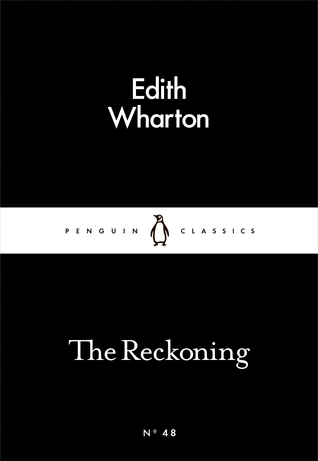
The Reckoning by Edith Wharton

The last book I read in 2022 was this slim collection of Edith Wharton short stories from Penguin’s Little Black Classics series. There are only two stories in the book and at just under 50 pages in total, they can be read very quickly. Despite being so short they are still substantial and satisfying and I enjoyed reading both of them.

The first story, Mrs Manstey’s View, was my favourite. It was actually Wharton’s first published story, appearing in the July 1891 edition of Scribner’s Magazine. It’s a simple but very moving story about a widow, Mrs Manstey, who lives alone on the third floor of a New York boarding house. As her health begins to fail and visits from friends and family become less frequent, Mrs Manstey’s sole pleasure in life is observing the view from her window:

Mrs. Manstey’s real friends were the denizens of the yards, the hyacinths, the magnolia, the green parrot, the maid who fed the cats, the doctor who studied late behind his mustard-colored curtains; and the confidant of her tenderer musings was the church-spire floating in the sunset.

When Mrs Black, the owner of the house next door, announces that she’s planning to build a large extension, Mrs Manstey is devastated. Her view is the only thing that keeps her going from one day to the next; if the view is lost, she feels there will be no point in living at all. The construction work must be stopped, but will Mrs Black be prepared to listen?

The title story, The Reckoning, is much longer, but I found it less powerful. First published in 1911, it deals with an unconventional marriage between Julia and Clement Westall, who have both agreed that marriage should be a voluntary arrangement between two people which either can break off at any time if they become unhappy. Julia has already put this theory into practice when divorcing her previous husband, but when she begins to suspect that Clement has his eye on another woman she starts to wonder whether it’s such a good idea after all.

The Reckoning is an interesting story and when you consider the stigma still attached to divorce in the early 20th century, the depiction of the Westalls’ marriage is very progressive for its time. However, I didn’t find it as appealing as Mrs Manstey’s View, with its theme of seeing the beauty in the small everyday things that others take for granted.

Apart from these two stories, I have only read Ethan Frome by Edith Wharton so far. I’m sure I’ll be reading more of her books now that I’ve been reminded of how good her writing is.