Watch the Wall, My Darling by Jane Aiken Hodge

Watch the Wall My Darling - Jane Aiken Hodge I had never heard of Watch the Wall, My Darling until it started appearing in my recommendations on Goodreads, and with such an intriguing title I knew it was a book I would have to consider reading eventually!

First published in 1966, Watch the Wall, My Darling is a gothic romantic suspense novel set on the south-east coast of England during the Napoleonic Wars. As the story begins, Christina Tretton, a young American woman whose father has recently died, is returning to her family’s ancestral home, Tretteign Grange. After encountering a gang of smugglers on the journey, Christina arrives at the Grange – also known as the Dark House – and is met by her Aunt Verity, her invalid grandfather and her handsome cousin, Ross.

Settling into her new home, Christina quickly takes control of the management of the house and the servants. Impressed with his granddaughter, old Mr Tretteign decides to change his will and leave the Grange to Christina – on the condition that she must marry either Ross or her other cousin, Richard. Christina insists that she has no intention of marrying either of them, but her two cousins, who each have their own reasons for wanting the Grange, have other ideas. Despite herself, she finds herself drawn to Ross, but soon discovers that he is involved in something very dangerous – and with England expecting a French invasion at any moment, the lives of everyone at the Dark House could be at risk.

I enjoyed this book – it was a fun, undemanding read with plenty of adventure and intrigue and a touch of romance. I kept being reminded of Daphne du Maurier’s Jamaica Inn, Georgette Heyer’s Cousin Kate and Mary Stewart’s Nine Coaches Waiting, though this is not as well written or memorable as any of those, in my opinion. The historical background didn’t feel particularly strong and Christina felt more like a woman of the 1960s than the 1800s, while I didn’t find Ross quite as fascinating and attractive as she did. The introduction of two new characters towards the end of the book didn’t really add anything to the story either. Still, with smugglers, soldiers and spies, a crumbling abbey believed to be haunted, family secrets and an inheritance to be decided, there was more than enough to keep me happy!

And if you’re wondering, the title comes from a poem by Rudyard Kipling called A Smuggler’s Song:

“Five and twenty ponies
Trotting through the dark
Brandy for the parson,
‘Baccy for the clerk;
Laces for a lady; letters for a spy,
And watch the wall, my darling, while the gentlemen go by!”
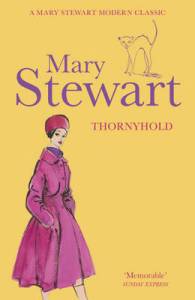
Thornyhold by Mary Stewart

Thornyhold After reading all the reviews and posts during Anbolyn’s recent Mary Stewart Reading Week, I had almost decided that the next Stewart books I read would be her Merlin series, but instead I found myself picking up this one from the library shelf.

Thornyhold starts off differently from the other Mary Stewart books I’ve read. Instead of getting straight into the action, our narrator, Geillis (Gilly) Ramsey, spends the first few chapters looking back on her childhood. As the daughter of a vicar and his cold, distant wife, bullied at school and feeling lonely and isolated, it was not a very happy childhood for Gilly and the one bright spot in her life was her relationship with her mother’s cousin, another Geillis.

Several years go by and both of Gilly’s parents die, leaving her an orphan in her early twenties. Just as she’s wondering what to do with her life, she hears that Geillis has also died, leaving her cottage in the countryside to Gilly. The name of the cottage is Thornyhold and it comes complete with an overgrown garden, a black cat called Hodge and a collection of dusty books of magic spells and herbal remedies. Could Gilly’s cousin Geillis have been a witch? With the help of William, a ten-year-old boy who shares her love of nature, Gilly begins to uncover some of the secrets of Thornyhold.

Thornyhold is one of Mary Stewart’s most recent books, published in 1988 (only Stormy Petrel and Rose Cottage came after that) and I’ve found that these final three books have a different feel from her earlier ones, being a lot gentler with less of the suspense and adventure that are usually associated with her work. In this book, although there are a few mysteries for Gilly to solve and one or two people who try to cause trouble for her (including the housekeeper Agnes Trapp, who seems desperate to get her hands on one of cousin Geillis’ herbology books), I never felt that I needed to worry about Gilly or that there was any danger of there not being a happy ending. But while I do prefer the more exciting, suspenseful books such as Nine Coaches Waiting and The Moonspinners, I enjoyed this one too, for different reasons.

This book may not have the exotic setting that many of her others have, but that doesn’t mean the descriptions aren’t still beautiful. It was a pleasure to watch Gilly exploring her new home, settling into the cottage and discovering the natural beauty of her surroundings. The story is set in the 1940s and has a lovely nostalgic feel with references to rationing and other details of post-war life. I also liked the characters, especially Gilly herself, who blossoms from a lonely child into a confident young woman with a lot to offer in terms of friendship and love (yes, there’s a love story too). Although this hasn’t become a favourite Stewart novel, it was a nice, relaxing read with a magical atmosphere and just what I was in the mood for!

Stormy Petrel by Mary Stewart

Stormy Petrel It’s hard to believe it’s only been two years since I discovered Mary Stewart! I read the brilliant Nine Coaches Waiting in November 2011 and since then I’ve read seven of her other books and loved most of them. When I first started to think about what I wanted to read for Anbolyn’s Mary Stewart Reading Week, Stormy Petrel wasn’t a title that came to mind, but I decided to see what the library could offer and this was the only one they had that I hadn’t already read. Knowing that this was one of her later books (published in 1991) and not considered to be one of her best, I was careful not to go into it with my expectations too high.

Stormy Petrel is narrated by Rose Fenemore, a poet and writer of science fiction novels. Due to her busy schedule as a tutor of English at Cambridge, Rose doesn’t have as much time to write as she would like, so she decides to take a break and spend two weeks at a cottage on the Hebridean island of Moila. Her brother Crispin, a doctor, agrees to meet her there as he is a keen wildlife photographer and is looking forward to taking pictures of the rare birds that nest on the island.

Rose arrives several days before Crispin and begins to settle into the cottage, but on her first night the island is hit by a storm and she wakes up to find a strange man in the kitchen. His name is Ewen Mackay and he tells her that his foster parents used to live in the cottage and he has come to visit them unaware that they had moved away. As Rose listens to Ewen’s story, another man arrives at the door. Introducing himself as John Parsons, he explains that he was camping and his tent has blown away in the wind so he is looking for somewhere to shelter from the storm. Rose lets them both stay until morning but over the next few days she learns more about both men and discovers that neither of them has been completely honest with her. How can she decide who to trust?

This was not one of my favourite Mary Stewart books and slightly disappointing compared with some of her earlier ones, but I still liked it and rate it above Rose Cottage, which was her final book, published several years after this one (I didn’t dislike Rose Cottage either, but it was a bit too gentle for me). The problem with Stormy Petrel is that as a ‘romantic suspense’ novel the romance is only hinted at and there’s not much suspense either. After one or two surprises near the beginning of the book the rest of the story is predictable, the villain is not really all that villainous and I never felt that Rose was in any danger.

Something I did love about this book was the wonderful Scottish setting. Every time I read a Mary Stewart novel I find myself enthusing over her beautiful descriptions of the area in which the story is set, and Stormy Petrel is no exception:

The Isle of Moila is the first stop past Tobermory. It is not a large island, perhaps nine miles by five, with formidable cliffs to the north-west that face the weather like the prow of a ship. From the steep sheep-bitten turf at the head of these cliffs the land slopes gently down towards a glen where the island’s only sizeable river runs seawards out of a loch cupped in a shallow basin among low hills. Presumably the loch – lochan, rather, for it is not large – is fed by springs eternally replenished by the rain, for nothing flows into it except small burns seeping through rush and bog myrtle, which spread after storms into sodden quagmires of moss. But the outflow is perennially full, white water pouring down to where the moor cleaves open and lets it fall to the sea.

Moila doesn’t really exist but the descriptions are so vivid I’m sure it must be based on a real Hebridean island. Stewart’s love for the landscape and the wildlife are obvious and throughout the story she explores the importance of preserving the beauty of nature. If you don’t already know what the title ‘stormy petrel’ refers to, she explains that too.

At just over 200 pages, this is a quick read and perfect for those times when you just want to relax with a book that’s not too complex or demanding!

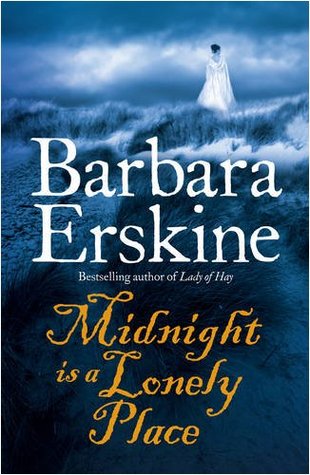
Midnight is a Lonely Place by Barbara Erskine

Midnight is a Lonely Place My first introduction to Barbara Erskine’s work last year, River of Destiny, left me unimpressed but I was assured by Erskine fans that her earlier books were better, so when I found this one at the library I decided to give her another chance. I also thought it sounded like an ideal book to read for the RIP challenge, even though it wasn’t on my original list.

When author Kate Kennedy’s relationship with her boyfriend, Jon, comes to an end and she is forced to move out of their London home, she decides to rent a cottage on the Essex coast where she can spend the winter working on her new biography of Byron. The owners of the cottage, Diana and Roger Lindsey, live in a farmhouse nearby and do their best to make Kate feel welcome, but unfortunately not all the members of the Lindsey family are happy to see her. The eldest son, Greg, an aspiring artist, had been using the cottage for his painting and resents Kate for pushing him out. His fifteen-year-old sister, Alison, is an amateur archaeologist and is furious when she discovers that Kate has been interfering with her dig at what she believes is an ancient Roman grave.

When strange things start to happen at Redall Cottage, Kate suspects Greg and Alison of trying to frighten her away, but after several encounters with ghostly figures she begins to accept that she is being haunted by the ghosts of the Roman soldier Marcus Severus Secundus, his wife Claudia, and the Druid prince, Nion. It seems that Kate has stumbled upon a two thousand-year-old love triangle that ended in a murder and a curse – and secrets that have been buried under the earth for centuries are about to be revealed at last.

Midnight is a Lonely Place was much better than River of Destiny, but still not a book that I can say I loved. I was right about it being a perfect RIP choice, though. It has all the elements of a classic ghost story: a lonely, isolated cottage, an ancient burial site, ghostly apparitions, strange smells and unexplained noises, relentless snow, sleet and blizzards. It’s quite scary in places and you might not want to read it late at night if you’re on your own (while I was finishing the book on Friday evening the real-life weather outside obliged with heavy rain and strong winds which made it even more atmospheric).

While Marcus Severus Secundus, Claudia and Nion do have a strong presence in this novel, the story is set entirely in the early 1990s (which actually feels surprisingly dated from a 2013 perspective) and we only learn about the Roman characters’ lives in brief flashbacks at the start of the chapters. I would have liked their storyline to have been more fully developed as I felt I didn’t get to know them well enough to really care about them or their secrets and this meant that, for me, the novel wasn’t as effective as it would have been with a stronger historical element.

The second half of the book is suspenseful and action packed, as the level of paranormal activity increases and more and more of Kate’s friends and neighbours become involved (at one point it felt as if the whole population of Essex were wandering about getting lost in the snow) but I found the ending disappointingly abrupt. I’m not sure I correctly interpreted the final page and after reading what was quite a long book (more than 400 pages) I had expected a more satisfying conclusion. I certainly enjoyed this book a lot more than River of Destiny but I’m not sure I’ll be looking for any more of Barbara Erskine’s books – though I might still be interested in reading Lady of Hay, her first and best known book.

This Rough Magic by Mary Stewart

This Rough Magic Lucy Waring is a twenty-five-year-old actress who, frustrated with the way her career is going, has decided to visit her sister Phyllida in Corfu. Phyllida and her husband own a large estate which consists of the beautiful, crumbling Castello dei Fiori and two smaller villas. Lucy joins her sister at one of the villas while the other is occupied by the photographer Godfrey Manning, who is working on a new book about Corfu. The old Castello in the middle is being rented by a retired actor, Sir Julian Gale, and his son, Max. Lucy is intrigued to hear of the Gales’ presence as it gives her an opportunity to discover why Sir Julian has left the acting world under such mysterious circumstances.

It quickly becomes obvious that this is not going to be the relaxing break Lucy had planned. Soon after her arrival in Corfu she learns that a local boy, Spiro – who happens to be Julian Gale’s godchild – has fallen overboard and is presumed drowned during a boat trip with Godfrey Manning. When a second fisherman is found dead, Lucy is sure there must be a connection between both accidents…but what is it?

This Rough Magic has everything I’ve come to expect from a Mary Stewart novel – mystery, suspense, romance and a lovely, atmospheric setting. Whenever I start reading one of Stewart’s books I look forward to her beautiful, evocative descriptions of whichever location she is writing about, whether it’s an English country house, a chateau in the Haute-Savoie region of France or a palace in a valley in Damascus. With its Corfu setting, this book had a similar feel to The Moonspinners which is set on another Greek island, Crete. I haven’t been to Corfu but reading This Rough Magic made me want to book a flight there immediately, though maybe I would also need to book a trip in a time machine to be able to experience the island exactly as it was when Lucy was there in 1964.

There were some great characters in this novel and my favourite was Sir Julian Gale. He felt so believable I kept wondering if he was based on a real actor and if so which one. Our narrator, Lucy, is a typical Mary Stewart heroine – intelligent, quick-thinking, courageous and down-to-earth, but also very easy to like. She’s also an animal lover and there are some wonderful scenes involving a dolphin who becomes one of the most important characters in the book!

Stewart’s novels always include a lot of literary allusions and references and this book is no exception. It has been suggested that Shakespeare based the island in The Tempest on Corfu and this is a theme that runs right through the novel, with Tempest quotes at the beginning of each chapter. Even the title of the novel, This Rough Magic, is a line from the play (“this rough magic I here abjure”, spoken by Prospero before announcing that he intends to break his magic staff and drown his book of magic in the sea). Luckily I have read The Tempest otherwise none of this would have meant very much to me. I don’t think it’s really necessary to have read it but it definitely adds something to the story and I was fascinated by Julian Gale’s conversation with Lucy when he explains why he believes Corfu to be Prospero’s island.

Anbolyn is hosting a Mary Stewart Reading Week in September so whether you’re already a Mary Stewart fan or whether you have yet to try one of her novels, I hope you’ll consider joining in.

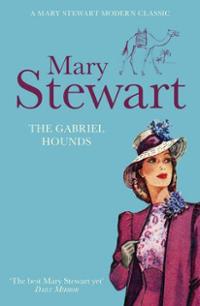
The Gabriel Hounds by Mary Stewart

The Gabriel Hounds The Gabriel Hounds is set in the 1960s and narrated by twenty-two-year-old Christy Mansel who is on a tour of Syria and Lebanon. After unexpectedly meeting her cousin Charles in a street in Damascus, they decide to visit their eccentric Great-Aunt Harriet who has lived near Beirut for several years. ‘Lady Harriet’, as she now calls herself, became a local celebrity after moving into an old, decaying palace by the Adonis River, dressing as a male Arab and modelling herself on the legendary Lady Hester Stanhope. Now over eighty years old, Harriet lives in seclusion with only her servants and her young English companion, John Lethman.

The cousins travel to the palace separately and Christy is first to arrive. She is not made to feel welcome but after a bizarre conversation with the old woman, she is allowed to spend the night there. It quickly becomes obvious that something is not right and when Charles joins her the next day they find that, in typical Mary Stewart fashion, they have stumbled upon a mystery!

Although Christy is in many ways very similar to Mary Stewart’s other heroines – beautiful, confident, brave and intelligent – I never managed to warm to her, or to her cousin Charles either. As Christy herself tells us at the beginning of the story, she and Charles both have “the ‘spoiled’ quality that we were so quick to recognise in one another; a flippant cleverness that could become waspish; an arrogance that did not spring from any pride of achievement but was, I am afraid, the result of having too much too young.” Luckily, though, the fact that I didn’t like the characters very much didn’t stop me enjoying the story and The Gabriel Hounds has joined Nine Coaches Waiting and The Moonspinners as one of my top three Mary Stewart novels so far.

As well as being an exciting page turner, I also loved the atmosphere and the unusual setting. The novel is very dated, I suppose – it’s hard to imagine young tourists like Christy wandering happily through the streets of Damascus and Beirut on their own today – but remembering that the book was written in the 1960s, they sound like fascinating places to have visited and Mary Stewart’s usual beautiful descriptions abound: the beauty of red anemones, the herds of goats grazing on the riverbanks, the scent of jasmine and roses, the fields of sunflowers grown for their oil.

The descriptions of the palace of Dar Ibrahim – with its labyrinth of dusty tunnels and corridors, wall mosaics, cracked marble floors and quiet courtyards – are wonderfully detailed and vivid, especially the scenes set in the old Seraglio, where Christy is given a room for the night. Then, of course, there’s the sound of Harriet’s saluki hounds howling in the distance as Christy explores the palace. Some parts of the book are quite creepy and there are some surprising plot twists too that made me want to immediately turn back and read previous sections again. The story also has what I’m coming to consider one of Stewart’s trademark dramatic, action-packed endings.

The final aspect of this novel I want to mention is the factual element. Lady Hester Stanhope was a real person and if you don’t know anything about her, I can almost guarantee that after reading this book you’ll be completely intrigued and will want to find out more about her amazing life, as I did. Mary Stewart has attributed a lot of Lady Stanhope’s characteristics and habits to the fictional Lady Harriet, including shaving her head and wearing a turban, and only admitting visitors to her room after dark. I’ve discovered that there’s a recent biography by Kirsten Ellis called Star of the Morning: The Extraordinary Life of Lady Hester Stanhope. Has anyone read it or is there another one you would recommend?

The Moonspinners by Mary Stewart

The Moonspinners “Sometimes, when you’re deep in the countryside, you meet three girls, walking along the hill tracks in the dusk, spinning. They each have a spindle, and onto these they are spinning their wool, milk-white, like the moonlight. In fact, it is the moonlight, the moon itself…all they have to do is to see that the world gets its hours of darkness, and they do this by spinning the moon down out of the sky.”

With spring still a few weeks away and the weather still cold, damp and miserable, The Moonspinners with its beautifully described Greek island setting was just what I needed!

The story is narrated by Nicola Ferris, who is taking a break from her job at the British Embassy in Athens to spend a few days visiting Crete. She has arranged to meet her cousin, Frances, there but Nicola arrives a day earlier than planned and decides to go exploring on her own. In the mountains above Agios Georgios, the village where they are going to be staying, Nicola stumbles into adventure when she meets a young Englishman, Mark Langley, who has been wounded after witnessing a crime.

Mark is being tended by his Greek friend, Lambis, but his younger brother, Colin, has been kidnapped by the criminal gang and Mark is worried that he might have been murdered. Nicola wants to help but it’s time to go down to the village and meet Frances, so she reluctantly leaves Mark and Lambis in their hiding place. After arriving at her hotel and speaking to the hotel owner and his assistant, Nicola thinks she has discovered who was responsible for Colin’s disappearance, but will she be able to find him before it’s too late?

I love Mary Stewart’s books because they’re fun and easy to read while still being well-written, intelligent novels with exciting plots and atmospheric settings. Her descriptive writing is so impressive in this book; whether she’s describing the colour of the sea, the warmth of the sun, the fishing boats in the bay, the unspoilt countryside or the picturesque sight of windmills with white sails, she always chooses the perfect words and makes everything sound beautiful and idyllic:

“A clump of tamarisk trees stood where the gravel gave way to the flat rock of the foreshore; this, smoothed and fissured by water, burned white in the sun. In every cranny of rock blazed the brilliant pink and crimson sunbursts of ice daisies, and just beside them, the sea moved lazily, silky and dark, its faint bars of light and shadow gently lifting and falling against the hot rock.”

I have never been to Crete but reading the wonderful, evocative way it is depicted in this book made me wish I was there, though as the book was written in the 1960s before the Greek islands became such popular tourist destinations (Nicola and Frances are the only guests at their tiny hotel in Agios Georgios) I’m sure the culture and landscape must have changed a lot since then!

Of the five Mary Stewart novels I have now read, this is one of my favourites so far and might be a good one to start with if you’ve never read any of her books. There’s also a 1964 Disney film version of The Moonspinners with Hayley Mills, though I haven’t seen it and have heard that it’s very different to the book. Has anyone seen it?

The Gabriel Hounds will be the next Mary Stewart book I read – I found it in the library last week and am looking forward to starting it in the next few days.