Six Degrees of Separation: From True History of the Kelly Gang to The Moonlit Cage

It’s the first Saturday of the month which means it’s time for another Six Degrees of Separation, hosted by Kate of Books are my Favourite and Best. The idea is that Kate chooses a book to use as a starting point and then we have to link it to six other books of our choice to form a chain. A book doesn’t have to be connected to all of the others on the list – only to the one next to it in the chain.

This month we’re starting with True History of the Kelly Gang by Peter Carey. I haven’t read it and it doesn’t really appeal to me, but here’s what it’s about:

To the authorities in pursuit of him, Ned Kelly is a horse thief, bank robber and police-killer. But to his fellow Australians, Kelly is their own Robin Hood. In a dazzling act of ventriloquism, Peter Carey’s Booker Prize-winning novel of adventure and heroism brings the famous bushranger wildly and passionately to life.

The title of the Peter Carey book immediately made me think of The True and Splendid History of the Harristown Sisters by Michelle Lovric (1). This unusual novel tells the story of Manticory Swiney and her six sisters who escape from poverty in 19th century Ireland to find fame on stage with their song and dance act, ending each performance by letting down their ankle-length hair. The book is not quite the ‘true history’ it claims to be, as the Swineys are fictional characters – but they are based on the real-life American singing group, the Sutherland Sisters, who really were famous for their very long hair.

And long hair is my next link! Bitter Greens by Kate Forsyth (2) is a retelling of the fairy tale, Rapunzel. Rapunzel, of course, is famously locked in a high tower by a witch and throws her long hair out of the window to form a rope that the witch can climb up and down. In Bitter Greens, she is given the name Margherita and her story alternates with the story of Charlotte-Rose de Caumont de La Force, the real historical woman who wrote Persinette, the original fairy tale on which Rapunzel was based. Even if you don’t like fantasy, I think this novel is still worth reading for the fascinating details of Charlotte-Rose’s life at the 17th century French court.

Another book in which fairy tales play a part is Gretel and the Dark by Eliza Granville (3). This very dark and unsettling novel opens in 1890s Vienna with a psychoanalyst treating a patient who claims to be a machine, not a human being. Several decades later in Nazi Germany, we meet a little girl who is neglected by her father, another doctor, and entertains herself by remembering the fairy tales her nurse read to her – including her favourite, Hansel and Gretel. The two storylines seem unrelated at first but do come together towards the end! I remember finding this a very disturbing book, but also a clever one with some surprising twists.

Madensky Square by Eva Ibbotson (4) is also set in Vienna, where our narrator, Susanna Weber, is a dressmaker with a busy shop on the city’s Madensky Square. Beginning in the spring of 1911, Susanna keeps a journal in which she writes about the daily lives of her friends, customers and neighbours. It’s a lovely novel and I enjoyed getting to know all of the characters – I particularly loved Susanna’s relationship with Sigismund, a lonely Polish orphan. Including this book in my chain has reminded me that I really need to read more by Eva Ibbotson!

I’m going to stay with books about dressmakers and link to a non-fiction book this time: The Dressmaker of Khair Khana (5). In this book, journalist Gayle Tzemach Lemmon describes her trip to Afghanistan in 2005 in order to report on female entrepreneurs working in war zones. Here she meets Kamila Sidiqi, a young Afghan woman who started her own dressmaking business with her sisters and friends in an attempt to make money while also staying on the right side of the Taliban. Kamila’s story is fascinating and a real inspiration! She even opens a school to teach other women to sew, so that they can also support themselves and their families.

Back to fiction, now. I’ve read a few other books set in Afghanistan and I’m going to finish my chain with one that I particularly liked, The Moonlit Cage by Linda Holeman (6). I read a lot of Holeman’s novels a few years ago and enjoyed them all, but she seems to have stopped writing now. The Moonlit Cage is the story of Darya, a 19th century Afghan woman who escapes from an arranged marriage and flees through the Hindu Kush mountains to India. I loved the descriptions of Afghan life and culture, as well as finding Darya’s story quite moving. I still need to read The Linnet Bird, which I think is the only one of Holeman’s adult novels I haven’t read.

~

And that’s my chain for May! My links included: ‘true history’ titles, long hair, fairytales, Vienna, dressmaking and Afghanistan.

In June we’ll be starting with Sorrow and Bliss by Meg Mason.

The Vanished Days by Susanna Kearsley

The Vanished Days, Susanna Kearsley’s latest book, is a prequel to The Winter Sea, which happens to be one of the few Kearsley novels I haven’t read yet! However, it didn’t matter at all as this is a completely separate story and works perfectly as a standalone.

The novel opens in 1707, the year of the Act of Union between Scotland and England. A few years earlier, Scotland had been involved in the unsuccessful Darien Scheme – an attempt to establish a colony on the Isthmus of Panama – and as part of the union settlement, England will pay compensation to those who had lost money due to the failed venture. When a young widow, Lily Aitcheson, comes forward to claim the wages owed to her husband Jamie Graeme, who was killed during the Darien expedition, Sergeant Adam Williamson is asked to investigate her claim. There is some doubt as to whether Lily and the man she insists was her husband were really married – and unless she can prove that their marriage was valid, she won’t be entitled to the money.

As Adam begins his investigation, searching for witnesses to the wedding or anyone who can say that it ever took place, he finds himself becoming more and more attracted to Lily. And, in chapters which alternate with the 1707 ones, we go back to 1683 and follow Lily through her childhood and the sequence of events that lead to her arriving in Edinburgh and claiming to be the widow of Jamie Graeme. Unlike most of Kearsley’s novels, which either involve some form of time travel or are set in two completely different time periods, one contemporary and one historical, this book is entirely historical, with the two threads of the story set just a few decades apart. There are none of the other supernatural elements that often appear in her novels either, so this one has a slightly different feel.

It was interesting to read about an aspect of Scottish history that doesn’t seem to get a lot of attention in fiction. Although I was aware of the Darien Scheme and some of the events leading to the Act of Union, I’m not sure if any of the historical novels I’ve read have actually covered this subject. Some real historical figures appear in The Vanished Days too and Kearsley explores some of the political and religious tensions building in Scotland during this time – a reminder that the Jacobite rebellions are on the horizon. The focus, though, is on Lily’s personal story, whether seen through her own eyes or those of Adam and the people he interviews who once knew her.

This is quite a long book and I found it a bit slow for a while in the middle, but I was rewarded by a great ending with an unexpected twist. It was something I hadn’t seen coming at all and the sort of thing that makes you want to read the whole book again to see if there were any clues. I won’t do that just yet, but I will definitely try to read The Winter Sea soon, along with the other two Kearsley novels I still haven’t read, The Shadowy Horses and Bellewether.

Thanks to Simon & Schuster UK for providing a copy of this book for review via NetGalley.

This is book 20/50 read for the Historical Fiction Reading Challenge 2022.

Top Ten Tuesday: One-word reviews

This week’s topic for Top Ten Tuesday (hosted by That Artsy Reader Girl) is “One-Word Reviews for the Last Ten Books I Read”.

The ten books I’m listing below are not technically the last ten I read, but they are ten that I haven’t yet reviewed on my blog. Full reviews for most of these should appear over the next few weeks, but for now I have chosen one word to represent each book:

1. Infuriating
The Trial of Lotta Rae by Siobhan MacGowan

2. Sadness
The Night Ship by Jess Kidd

3. Adventure
Winchelsea by Alex Preston

4. Dickensian
The Second Sight of Zachary Cloudesley by Sean Lusk

5. Immersive
The Fugitive Colours by Nancy Bilyeau

6. Surprises
The Vanished Days by Susanna Kearsley

7. Freedom
Privilege by Guinevere Glasfurd

8. Secrets
In Place of Fear by Catriona McPherson

9. Complex
All the Seas of the World by Guy Gavriel Kay

10. Insightful
The Rebecca Notebook: and Other Memories by Daphne du Maurier

~

Are you interested in reading any of these? Which would you like to know more about?

My Commonplace Book: April 2022

A selection of words and pictures to represent April’s reading:

commonplace book
noun
a book into which notable extracts from other works are copied for personal use.

~

Could it be each fate is not ordained, but random? No masterful design, but patched together with mere moments. That we were victims or victors of chance, nothing more?

The Trial of Lotta Rae by Siobhan MacGowan (2022)

~

It’s the way of the world, though unfair, and I hope one day women will have more agency to make decisions, especially about issues that affect them. Men control our lives, though I believe this should not be so. We should not be married off at the convenience of our fathers, brothers and uncles.

The Stone Rose by Carol McGrath (2022)

~

Replica of the Batavia

The world can think you’re all wrong when one person thinks you’re just right.

The Night Ship by Jess Kidd (2022)

~

He did not think: This must come to an end in time. A circle had no beginning or end; it existed. He did not allow thought to enter the hours that he waited for her, laved in memory of her presence. He seldom left the apartment in those days. In the outside world there was time; in time, there was impatience. Better to remain within the dream.”

In a Lonely Place by Dorothy B Hughes (1947)

~

“You’ve never been in a scrape yet but what it came about by accident. The thing is, no one else has these accidents.”

The Toll-Gate by Georgette Heyer (1954)

~

The Silchester eagle which inspired Rosemary Sutcliff

“We do not understand. And when the time comes that we begin to understand your world, too often we lose the understanding of our own.”

The Eagle of the Ninth by Rosemary Sutcliff (1954)

~

We talked of literature, of the novels we had read, of Shakespeare and Milton, and I recognised that books sparked the same joy in him that they did in me, for reading is an expression of fondness for life. It is love of life in the shape of words, not words in the shape of a life.

Winchelsea by Alex Preston (2022)

~

An entire wall is covered by three towering bookshelves, packed with volumes. It’s an awe-inspiring library, though another saying of Voltaire’s dances maliciously in my mind: “The more I read, the more I acquire, the more certain I am that I know nothing.”

The Fugitive Colours by Nancy Bilyeau (2022)

~

Brunhilde, Queen of Austrasia by Mary Evans

Some historians have viewed these letters as evidence of Brunhild’s fierce maternal instincts; others insist the emotion expressed in them was manufactured for politically expedient ends. It is most likely that both are true. Can a person ever completely divorce her genuine emotions from socially and politically useful ones?

The Dark Queens by Shelley Puhak (2022)

~

Lady almoners like Mrs Sinclair had spent their days engaged in a simple, if brutal, sorting of humanity. The indigent and destitute were the business of the Poor Laws and the workhouses. The wealthy had to be sniffed out and sent packing to their own doctors and their own bank accounts. The middling layer, thick and worried, were sent to provident societies, workers’ benefit unions or the right charity for their complaint. ‘The aim, Helen,’ Mrs Sinclair used to say, ‘is to end each month with no ill untreated and no bill unpaid.’

In Place of Fear by Catriona McPherson (2022)

~

Favourite books read in April:

In a Lonely Place, The Fugitive Colours, The Eagle of the Ninth, The Trial of Lotta Rae and In Place of Fear. Yes, it’s been a good month – I loved all of these and can’t leave any of them out!

Authors read for the first time in April:

Siobhan MacGowan, Shelley Puhak, Alex Preston, Catriona McPherson

Countries visited in my April reading:

Australia, England, Scotland, US, France

~

Reading notes: This month I managed to read my Classics Club Spin book and two books for 1954 Club, as well as continuing to work through the titles on my NetGalley shelf. I don’t have many plans for May, but I will try to take part in Ali’s Daphne du Maurier Reading Week and I’ll probably read the May selection for Read Christie 2022, which is The Murder on the Links.

How was your April? What are you hoping to read in May?

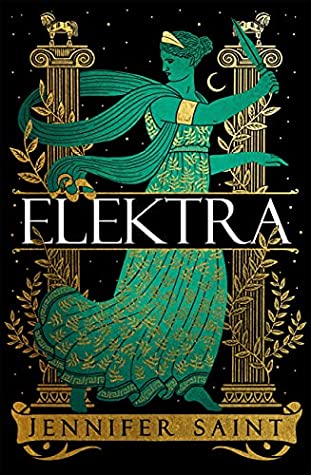
Elektra by Jennifer Saint

I enjoyed Jennifer Saint’s first novel, Ariadne, a retelling of Greek myth from a female perspective, so I was looking forward to reading her new one, Elektra. If you’re familiar with Greek mythology, you’ll know Elektra as the daughter of Agamemnon, King of Mycenae, and his wife Clytemnestra, the sister of Helen of Troy. In this novel, Jennifer Saint tells the stories of both Elektra and Clytemnestra, as well as another woman – Cassandra, the Trojan priestess and prophet.

Elektra begins with the Greeks preparing to go to war against Troy. In order to please the gods so they will produce a wind to allow the fleet to set sail, Agamemnon sacrifices his eldest daughter, Iphigenia. The devastated Clytemnestra vows to take revenge on her husband, but she will have a long time to wait as the Trojan War will last ten years. Meanwhile, Iphigenia’s younger sister Elektra grows up watching in disapproval of her mother’s relationship with her new lover Aegisthus and waiting for her father to return. When Agamemnon does eventually come home – bringing Cassandra with him as a prize of war – further tragedy will strike the family and this time it is Elektra who is left vowing revenge.

This is another beautiful and insightful Greek retelling from Jennifer Saint, but I didn’t like it quite as much as Ariadne, probably because there were large parts of the Ariadne/Phaedra story that were new to me whereas I felt that this book was too similar to others I’ve read recently – Colm Tóibín’s House of Names, Natalie Haynes’ A Thousand Ships and Pat Barker’s The Silence of the Girls, to name a few. If I’d known nothing about Troy or the House of Atreus, I’m sure I would have enjoyed this book much more. Still, there are scenes and moments that never lose their impact no matter how many times you’ve read them: Clytemnestra’s grief and agony when her husband murders their daughter or Cassandra’s desperation as she tries to convince her fellow Trojans that there are Greeks hiding in the giant wooden horse.

I do wonder why Elektra was chosen as the title of the novel, as it’s as much the story of Clytemnestra and Cassandra as it is of Elektra (each of them narrating their own chapters). In fact, for the first half of the book at least, Elektra’s role is the smallest – and she is certainly the most difficult to like of the three narrators. I had a lot of sympathy with the doomed Cassandra, both blessed with the gift of prophecy and cursed to never be believed, and while some of Clytemnestra’s choices may be questionable, how could you not feel for a mother who has lost a child in such a horrifying way? Elektra, though, is harder to understand; I didn’t think it was made very clear why she felt such loyalty to her father and why she could forgive his murderous actions but not her mother’s. Although I did enjoy Cassandra’s chapters, perhaps if they’d been left out there would have been more time to explore the relationship between Clytemnestra and Elektra.

Although this book wasn’t completely successful for me, I’ll look forward to more by Jennifer Saint, particularly if they focus less on Troy and more on other areas of Greek myth.

Thanks to Headline for providing a copy of this book for review via NetGalley.

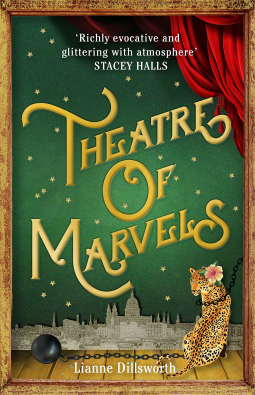
Theatre of Marvels by Lianne Dillsworth

When the audience take their seats at Crillick’s Variety Theatre looking forward to an evening of entertainment featuring the Great Amazonia, a ‘savage queen’ captured in Africa, little do they know the act is a fraud. The ‘Great Amazonia’ is actually Zillah, a young mixed-race Londoner who has never been to Africa in her life. Zillah can see nothing wrong with what she is doing; she enjoys being the headline act, she’s being paid for her work and she’s making some powerful new friends, among them Vincent, Viscount Woodward, who is setting her up as his mistress. It’s not until she meets Lucien Winters, an African merchant and former slave, that she begins to question her actions and wonder whether there is a better life she could be leading.

Then, her manager Marcus Crillick unveils a new act – the ‘Leopard Lady’ – and Zillah’s eyes are opened to the full extent of Crillick’s cruelty and the way she and others are being exploited for financial gain. When the Leopard Lady goes missing, Zillah becomes convinced that she is being held captive somewhere and sets out to search for her – a search that will take her across Victorian London, from the bustling dockyards to the slums of St Giles and the elegant parlours of the upper classes. Meanwhile Zillah must choose between Vincent and Lucien and decide how she wants her future to unfold.

I enjoyed Theatre of Marvels, although it did seem very similiar at first to Elizabeth Macneal’s Circus of Wonders, another novel about the exploitation of ‘circus attractions’. However, this one is written from a very different perspective, allowing Lianne Dillsworth to explore different themes such as racial and class inequality and slavery. The thousands of black and mixed race people who lived in Victorian London are often ignored in fiction set in that period, but Dillsworth gives them a voice here through the characters of Zillah, Lucien and others. Zillah is a particularly interesting heroine as she is clearly struggling with her identity throughout the novel, feeling that she doesn’t truly fit in with one community or the other and trying to decide who she is and what she wants.

Although I felt that some of the characters, particularly the villain Marcus Crillick and Zillah’s friend and rival Ellen, were too thinly drawn, there were others I found much more interesting. I was intrigued by Vincent Woodward, as there were times when I thought he must genuinely care about Zillah, but I doubted from the beginning that he would have the courage to defy convention and commit to a future with her. I could only see their relationship ending unhappily. On the other hand, Lucien seemed to have a deeper understanding of Zillah and much more personal integrity, yet I never really managed to warm to him. However, I thought I had predicted how the story would end and was taken by surprise because it wasn’t quite what I’d expected!

While I would have liked to have seen more of the Leopard Lady and to have heard some of her story from her own point of view, I did enjoy getting to know Zillah. This was an absorbing and surprisingly quick read and I’ll be looking out for more books from Lianne Dillsworth.

Theatre of Marvels is published in the UK on Thursday 28th April 2022. Thanks to Hutchinson Heinemann for providing a copy of this book for review via NetGalley.

This is book 19/50 read for the Historical Fiction Reading Challenge 2022.

This is also my contribution to Reading the Theatre 2022 hosted by Lory of Entering the Enchanted Castle.

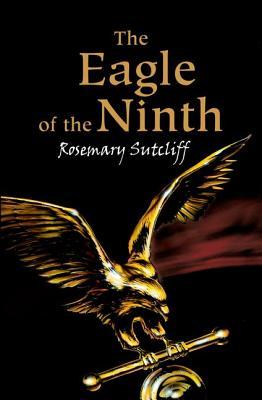
The Eagle of the Ninth by Rosemary Sutcliff – #1954Club

The second book I’ve read for Karen and Simon’s 1954 Club this week is a children’s classic by Rosemary Sutcliff. This book has been on my TBR for years because, although I’ve enjoyed a few of Sutcliff’s other novels set in other time periods, the Roman period has never been a favourite of mine and I wasn’t sure whether I would love this book the way everyone else seems to have done. Of course, I needn’t have worried; The Eagle of the Ninth is a beautifully written novel with wonderfully vivid and colourful descriptions, a gripping plot inspired by historical fact, a very likeable young hero and even a touch of romance – what’s not to love?

The novel tells the story of Marcus Flavius Aquila, a young centurion posted at a fort in Roman Britain. When Marcus is badly injured during a battle, he is discharged from his duties and goes to stay with his uncle while he recuperates. Here he forms three new relationships, all of which will have an impact on his future life: the first is with Esca, a defeated gladiator Marcus purchases as a slave at the Saturnalia Games in order to save him from a worse fate; the second, with Cub, a tame wolf-cub adopted by the household as a pet; and finally, with Cottia, a young woman from the Iceni tribe who is being raised as a Roman, something she resents very much. Marcus also listens to tales of the Ninth Legion who, several years earlier, marched north to suppress a rising of the Caledonian tribes and disappeared into the mists of Northern Britain, never to be seen again.

The story of the missing Ninth Legion has special significance for Marcus because it was his father’s legion and his father was one of the men who vanished. When his injuries heal enough for him to be able to travel, Marcus decides to head north himself in the hope of learning more about the legion’s disappearance and of retrieving the eagle standard of the legion, which was also lost – and in the hands of Rome’s enemies could take on new symbolic meaning.

Esca is freed from slavery by Marcus, but the two have become good friends and he chooses to accompany Marcus on his journey. The second half of the novel follows their adventures as they travel beyond Hadrian’s Wall and further north into Caledonia. Although there is plenty of drama as they encounter hostile tribes and search for the lost eagle, I particularly enjoyed watching the changes in the relationship between Marcus and Esca as their bond grows stronger while at the same time their difference in status forms a barrier:

You could give a slave his freedom, but nothing could undo the fact that he had been a slave; and between him, a freed-man, and any freeman who had never been unfree, there would still be a difference. Wherever the Roman way of life held good, that difference would be there.

Sutcliff based this novel on the fact that the Legio IX Hispana (Ninth Legion) disappeared from historical records around the year 117 and at the time when she was writing, it was thought that the legion had probably been destroyed in what is now modern-day Scotland. Historians have other theories now, but the way Sutcliff depicts the loss of the legion in this book still feels believable to me. She was also inspired by the discovery of a wingless Roman eagle in Silchester.

I also loved her descriptions of the places Esca and Marcus see as they travel north through Roman Britain, like this one as they approach the mountain Ben Cruachan:

It was an evening coloured like a dove’s breast; a little wind feathered the shining water, and far out on the dreaming brightness many scattered islands seemed to float lightly as sleeping sea-birds. In the safe harbourage inshore, a few trading-vessels lay at anchor, the blue sails that had brought them from Hibernia furled as though they, too, were asleep. And to the north, brooding over the whole scene, rose Cruachan, sombre, cloaked in shadows, crested with mist; Cruachan, the shield-boss of the world.

The Eagle of the Ninth is a lovely novel and I never really felt that I was reading a book for children – I think it’s one of those books that can be enjoyed equally by readers of all ages. I know there are other books in the series following later generations of the Aquila family, but the only one I currently own is Sword at Sunset, which I’m hoping can be read out of order.

~

This is also book 18/50 read for the Historical Fiction Reading Challenge 2022.