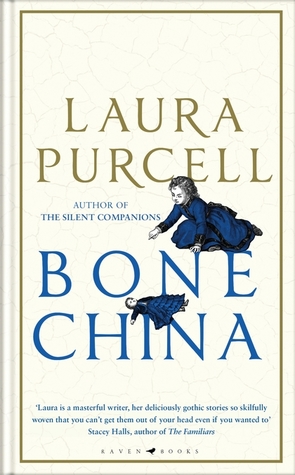
Bone China by Laura Purcell

Hester Why, the narrator of Laura Purcell’s latest gothic novel Bone China, is a woman with secrets. We know that Hester Why is not her real name, but what is the reason for her new identity? Why is she fleeing to Cornwall from London, who is she hiding from and how did she come to be addicted to gin and laudanum? These are questions we ask ourselves in the very first chapter and they are answered eventually, but first we must follow Hester to Morvoren House, perched high on the Cornish cliffs, where she is taking up a new position as nurse to Miss Louise Pinecroft.

Hester quickly discovers that her job is not going to be easy and soon she is asking questions of her own. What is wrong with Miss Pinecroft, who barely moves, never speaks and spends her days sitting in a cold room surrounded by china cups and plates? Who is Rosewyn, the strange, child-like young woman described as Miss Pinecroft’s ward? Is there any truth behind the claims of the superstitious servant Creeda that Rosewyn needs to be protected from fairies who are trying to steal her away and replace her with a changeling?

Bone China moves between three different timelines; as well as following Hester at Morvoren House, we also go back to an earlier time in her life, when she was known as Esther Stevens, and learn what went wrong in her previous employment, leading to her decision to run away and start again. Finally, in a third narrative we meet Louise Pinecroft as she was forty years earlier, when she and her father first arrived at Morvoren House after losing the rest of their family to consumption.

Laura Purcell has become known for writing dark, creepy Victorian novels and Bone China does have a lot of classic Gothic elements, including a gloomy, imposing clifftop house, family secrets and hints of madness. Despite this, I didn’t think this was a particularly scary or chilling story and although the exploration of Cornish folklore added atmosphere, I never doubted that the fairies and changelings existed only in legends and in Creeda’s stories. How much more spine-tingling it would have been if I had found myself feeling convinced that they could be real after all!

What I did find very disturbing and unsettling was the storyline set in Louise Pinecroft’s younger days, describing the work of her father, a doctor, who is looking for a cure for consumption (tuberculosis), the disease which took the lives of his wife and his other children. With Louise’s help, Dr Pinecroft carries out a revolutionary experiment, taking a group of prisoners who are suffering from the illness and lodging them in a cave beneath the cliffs where he claims the salty sea air will be good for their health. This part of the book was based on historical fact – cave air really was suggested as a possible cure for consumption at one time – and it was horrifying to read about the barbaric treatment of sick people due not to cruelty but to ignorance of modern medical procedures and a lack of understanding.

There are lots of interesting ideas incorporated into Bone China, then, but in the end I felt that the three threads of the story didn’t come together as neatly as they should have done. I also found the pacing uneven; in the second half of the book, the sense of mystery and carefully building tension of the earlier chapters was replaced by a sudden race to reach the conclusion. I didn’t enjoy this book as much as I’d hoped to, but I’m planning to read Laura Purcell’s first novel, The Silent Companions, soon and will see if I get on better with that one.
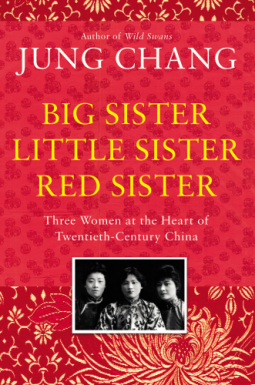
Big Sister, Little Sister, Red Sister by Jung Chang

Jung Chang’s Wild Swans is one of the best non-fiction books I’ve ever read, so when I saw her new biography, Big Sister, Little Sister, Red Sister, available on NetGalley, I knew I wanted to read it. As the title suggests, this is the story of three sisters – the Soong Sisters – who were at the heart of twentieth century Chinese politics. Like Wild Swans, it gave me some fascinating insights into a country whose history I know very little about, but unlike Wild Swans, the author has no personal connection with the women she is writing about and I thought that made it a much less immersive and powerful read.

Despite their important roles in Chinese history, I’m ashamed to say that I had never heard of the three Soong Sisters before reading this book. In case anyone else hasn’t heard of them either, here’s a quick introduction:

‘Big Sister’ Ei-ling, born in Shanghai in 1888, was the eldest daughter of Charlie Soong and Ni Kwei-tseng. Through her marriage to the banker H.H. Kung – who later became Minister of Finance in the Nationalist government – Ei-ling was one of China’s richest women.

‘Little Sister’ May-ling was the youngest of the three. As the wife of Chiang Kai-shek, who was chairman of the Nationalist party (the Kuomintang) and later President of the Republic of China, May-ling was China’s First Lady. With her American education and excellent command of the English language, she provided a link between Chinese and Western cultures.

In the middle was Ching-ling, or ‘Red Sister’. In 1915, she married the much older Sun Yat-sen, the revolutionary leader who helped to overthrow the Qing Dynasty. After Sun’s death, Ching-ling’s continued involvement in left wing politics and her support for the Communist Party often put her in direct opposition to Big and Little Sister.

The book takes us through the lives of all three of these women from birth to death, comparing the different paths they choose to follow and describing their achievements and their influence on Chinese politics and society. Rather than devoting a separate section of the book to each sister, Chang jumps from one to the other and back again, moving forward chronologically over a period of more than a hundred years. As this is the first time I’ve read about the Soong sisters I’ve no idea how they are usually portrayed, but it seemed to me that Chang’s account was quite fair and balanced, showing sympathy for all three women but an awareness of their faults and weaknesses as well.

I found Ei-ling the least interesting to read about. With her wealth and position, there’s a sense that she is very detached from the realities of life, although she does come across as a generous and dutiful sister who tries to help her younger siblings in any way she can. May-ling is more appealing; although she is depicted as ambitious and sometimes extravagant, she also seems warm and compassionate, with a genuine interest in carrying out humanitarian work. But it was Ching-ling who intrigued me the most, with her unwavering dedication to the communist cause that sets her apart from her sisters and creates divisions in the family that never really heal. Was she, as one observer says, ‘most responsive and likeable, quiet and poised but misses nothing’ or was she, in the words of another, ‘basically a cold, hard, ruthless woman who knows what she wants and how to get it’?

Although the three Soong sisters all found themselves in positions of influence and power, these positions initially came about because of the men they chose to marry and that, for me, was one of the problems with this book. Almost as much time was spent describing the lives and careers of Sun Yat-sen, Chiang Kai-shek and H.H. Kung as was spent on May-ling, Ei-ling and Ching-ling, who were supposed to be the subjects of the book. Overall, it felt more like a general political history of twentieth century China than a biography of three specific people. I found it a much more challenging read than Wild Swans, which was as gripping as fiction, and it has taken me more than a month to finish it as there was just so much information to take in and digest. I can’t pretend that I am now an expert on Chinese politics, but I do feel that I learned a lot from this book and although it was a struggle at times, I’m glad I persevered and finished it!

Thanks to Jonathan Cape for providing a copy of this book for review via NetGalley.

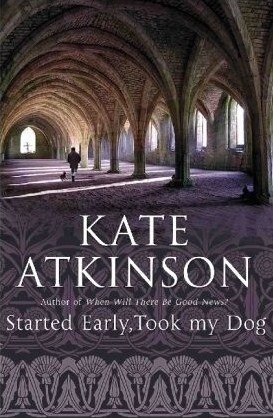
Started Early, Took My Dog by Kate Atkinson

This is the fourth book in Kate Atkinson’s Jackson Brodie series. For some reason, after reading the first three in quick succession in 2015, I never moved on to this one and it was only with the publication of the fifth book, Big Sky, earlier this year that I remembered I still needed to read it. Fortunately, the Jackson Brodie novels all stand alone very well so I found that it didn’t matter at all that I had left such a long gap between books three and four.

The plot of Started Early, Took My Dog is actually quite difficult to describe, but I’ll do my best. A good place to start is probably with Tracy Waterhouse, a retired police superintendent now working as head of security at the Merrion Shopping Centre in Leeds. Tracy is lonely and bored – she has no family, no friends and no social life; she gets up in the morning, goes to work, then comes home to spend every evening alone eating chocolate in front of the television. Then, one day, as she patrols the Merrion Centre, she sees a little girl being mistreated by Kelly Cross, a prostitute and drug addict whom Tracy recognises from her police days. She makes the decision to intervene and suddenly life becomes much more eventful!

While Tracy is trying to help an abused child, in a parallel storyline the novel’s other main protagonist, private investigator Jackson Brodie, is carrying out a good deed of his own. With a series of failed relationships behind him, Jackson is almost as lonely as Tracy, and when he witnesses a dog being kicked by its owner, he steps in and rescues it. The dog then becomes his inseparable companion as he embarks on his latest case – trying to trace the biological parents of Hope McMaster, a woman who was adopted as a child and grew up in New Zealand. This proves to be more difficult than he expected, because as soon as he starts asking questions it becomes obvious that those who do know the truth about Hope’s parentage will do anything to cover it up.

Jackson’s story quickly begins to intertwine with Tracy’s when he discovers that the murder of a woman in 1975 – a murder scene at which Tracy, then a young police officer, had been present – may have had something to do with the mystery of Hope’s origins. The novel moves backwards and forwards between the 1970s and 2010, showing how the events of the past have had an impact on the events of the present. Some of Tracy’s actions and choices following her encounter with the little girl in the Merrion Centre, for example, seem implausible at first but make more sense once you gain a deeper understanding of her background and her earlier experiences.

As with the other Jackson Brodie books, I found that the crime element of this one took second place to the characters. I thought Tracy was a great character and I loved her relationship with little Courtney, and, similarly, I enjoyed watching Jackson bonding with his new canine companion. The other character who stood out for me was Tilly, an elderly actress who is in the early stages of dementia; the way Kate Atkinson portrays Tilly’s fear and confusion over what is happening felt, to me, very convincing and very moving.

While the characters I’ve mentioned above were excellent, however, there were too many others whom I struggled to distinguish from each other; in particular, the other police officers involved in the 1975 storyline all seemed to blend into one which made that part of the book difficult to follow. There were also some subplots that didn’t seem to go anywhere and some important questions that remained unanswered at the end. Compared with the first three books in the series, I thought this one was disappointing. I’m sure I will still read Big Sky, but there are also a few other Kate Atkinson books I haven’t read yet: Transcription, Emotionally Weird and Not the End of the World. Have you read any of those and is there one you would particularly recommend?

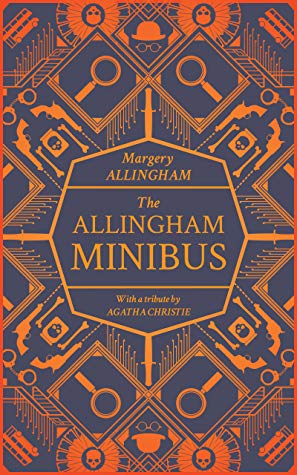
The Allingham Minibus by Margery Allingham

I have read and enjoyed several of the Margery Allingham short story collections which have been reissued by Agora Books recently; The Allingham Minibus is the latest and my favourite so far.

This collection was first published posthumously in 1973 and has also appeared under the title Mr Campion’s Lucky Day. However, that title would be quite misleading as there are eighteen stories in the book and only three of them actually feature Allingham’s famous detective, Albert Campion. Of these, I have already read the Christmas-themed The Man in the Sack (which was included in Campion at Christmas), but the other two were new to me and I particularly enjoyed The Unseen Door, a locked room mystery with a simple but clever solution.

The rest of the stories in the book cover a range of genres, not just the crime fiction with which Allingham is usually associated. Many of them are ghost stories or have a supernatural element of some sort and all of these were excellent; they were the perfect kind of supernatural stories for me – unsettling and unusual, without being too creepy. I won’t talk about all of them here, but three that stood out for me were Bird Thou Never Wert, about a woman who buys a haunted bird cage, She Heard It On the Radio, in which a lonely old lady develops an obsession with listening to the radio, and He Was Asking After You, where a man who betrays his best friend finds himself unable to escape his friend’s vengeance.

One of my favourite stories in the collection was The Pioneers, the story of a married couple who both meet someone else and decide to get divorced. On their last evening together, while they prepare to go their separate ways forever, some friends come to visit, with unexpected results. I loved this one! Actually, the only story in this book that I didn’t like was A Quarter of a Million, a crime thriller which should really be described as a novella rather than a short story as it was more than twice as long as most of the others. The length, and the fact that it seemed less tightly plotted than the rest, made it feel out of place in this collection.

With the exception of that one novella, then, I really enjoyed The Allingham Minibus – and the introduction by Agatha Christie was a nice little bonus.

Thanks to Agora Books for providing a copy of this book for review via NetGalley.

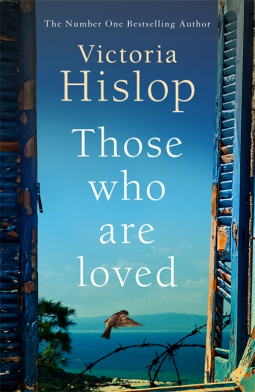
Those Who Are Loved by Victoria Hislop

This was one of several books on my 20 Books of Summer list this year that I didn’t have time to read before the September deadline, but if I’d know how much I was going to love it I would have made it a priority. It turned out to be one of the best books I’ve read this year and probably the most moving.

The novel opens in Greece in 2016 and introduces us to an elderly woman called Themis, whose family have gathered in her Athens apartment to celebrate her birthday. Aware of how little the younger generations know about their country’s history, she decides to share her life story with her two favourite grandchildren, Nikos and Popi. It seems as though almost every book I pick up recently is set in multiple time periods and, to be honest, I’m getting a bit bored with that format, but in this case the framing story only forms the beginning and end of the book – the bulk of the novel is set in the past, which makes it easier to become fully immersed in the story Themis is telling.

And what a fascinating story it is, beginning in the 1930s and taking us through the Axis occupation of Greece during the Second World War, the rise of communism and the Civil War that followed, the political crisis that led to a military junta taking control of the country and then the abolition of the monarchy and establishment of a more democratic society, bringing us right up to the present day. As I probably knew even less about 20th century Greek history than Nikos and Popi at the start of the novel, I found that I was learning a lot from the book, as well as being gripped by the personal stories of Themis and her family.

After their father leaves for America and their mother suffers a nervous breakdown, Themis and her three siblings are raised by their beloved grandmother. As they each grow up to hold different political opinions, a heated discussion takes place every evening when the family sit down around their large mahogany dining table. Themis and her brother Panos want to free Greece from German occupation and later, as their views move further to the left, they both decide to join the Communist army. Meanwhile, her eldest brother Thanasis and sister Margarita are much more right wing, believing that Nazi Germany is Greece’s friend and that the Communists are the dangerous ones.

One of the things I liked about the novel is that, although we naturally find ourselves siding with Themis as the main protagonist, the whole subject of political division and difference is treated with balance and sensitivity. We see that Thanasis and Margarita, despite standing for everything Themis dislikes, do still have some good qualities, while Panos and Themis find themselves doing some questionable things in the name of their own beliefs. The message I took away from the book is that violence, destruction and killing can never be justified, no matter how much someone may try to tell themselves they’re doing it for the right reasons.

I was struck by this quote which I think feels very relevant to today’s world as well as to 1940s Athens:

People seemed to be losing their humanity. The schism that existed between left and right had been allowed to widen, the polarisation to deepen, and now the city was paying the consequences.

Those Who Are Loved is a powerful, emotional story. So far the only other Victoria Hislop book I’ve read is The Sunrise, which I enjoyed, but found quite uneven. This one is a much stronger book, in my opinion, and held my interest from beginning to end. I do have a copy of The Thread, which will be the next one I read and also set in 20th century Greece.

Thanks to Headline Review for providing a copy of this book for review via NetGalley.

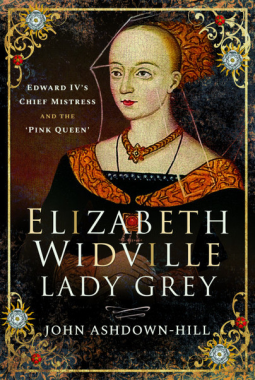
Elizabeth Widville, Lady Grey by John Ashdown-Hill

As this is Nonfiction November, I have been working through a few of the non-fiction books on my TBR this month. This one, by the late historian John Ashdown-Hill, is a biography of Elizabeth Woodville, who became queen consort of England when she married Edward IV in 1464. Ashdown-Hill, who died in 2018, spent many years studying and writing about the Wars of the Roses and was a member of the Richard III Society, playing a part in the discovery and identification of Richard’s remains in 2012. This is the first of his books that I’ve read so I hoped I would be in good hands with an author who seems to have been an expert on his chosen subject.

As soon as I started to read, the depth of Ashdown-Hill’s research and knowledge was obvious. He begins with a detailed discussion of the origins of the Woodville name and why he believes ‘Widville’ is a more accurate spelling, before going on to spend several chapters looking at Elizabeth’s ancestry and genealogy charts. This level of detail continues throughout the book as we are taken through the rest of Elizabeth’s life, including her first marriage to Sir John Grey, her widowhood and meeting with Edward IV, the births of her many children and, after Edward’s death, how she fared under the reigns of Richard III and Henry VII. He frequently quotes long passages from primary sources (and doesn’t make it easy for us by translating them into modern English). However, his main source seems to be himself – he constantly references his own earlier works, which is not particularly useful when you haven’t read them!

Another thing that quickly became obvious to me was that this was not going to be a balanced, unbiased account of Elizabeth’s life. In his introduction, Ashdown-Hill questions whether Elizabeth could really be considered Edward IV’s wife and queen as Edward had allegedly been pre-contracted to another woman, Eleanor Talbot, before marrying Elizabeth (hence the book’s subtitle which refers to Elizabeth as ‘Edward IV’s chief mistress’). I already knew about the pre-contract, but Ashdown-Hill also puts forward a theory I haven’t come across before, which is that Elizabeth was responsible for Eleanor’s death. And this is not the only murder he attributes to Elizabeth; he also suggests that she was behind the deaths of the Earl of Desmond and of George, Duke of Clarence, and that she poisoned Clarence’s wife and young son. There is no real evidence for any of this and I found it disappointing that the author makes no attempt to be fair and objective, letting his own personal dislike of Elizabeth come to the forefront.

As this is my favourite period of history to read about, I found it interesting to read Ashdown-Hill’s thoughts on Elizabeth, even if I didn’t necessarily always agree with them – and, as I’ve said, the amount of detail he goes into is very impressive. He can even draw on his own studies into the mitochondrial DNA sequences of Elizabeth’s descendants. If you’re new to the period, though, I would recommend looking for a good general book on the Wars of the Roses first. As for other non-fiction specifically on Elizabeth herself, I remember enjoying David Baldwin’s essay in The Women of the Cousins’ War, but haven’t read any other full-length biographies. If you know of any good ones, I’d love to hear about them.

Thanks to Pen & Sword for providing a copy of this book for review via NetGalley.

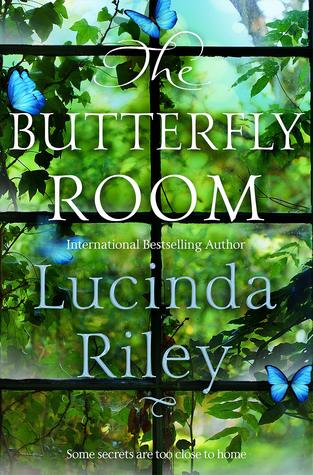
The Butterfly Room by Lucinda Riley

It’s 2006 and Posy Montague has made the difficult decision to put her Suffolk home, Admiral House, up for sale. She doesn’t want to – it has belonged to her family for generations and holds lots of memories – but as she is approaching the age of seventy she has had to accept that the house is too big and too expensive to maintain. There is a chance that it could still be kept in the family, as her eldest son Sam is interested in acquiring the house for his new property development company, but Posy is not too hopeful as she knows that all of Sam’s previous business ventures have ended in failure. Then a face from her past reappears – Freddie – and gives Posy something else to think about. Why did Freddie break off their relationship without explanation so many years ago? Is it too late for them to try again?

To find the answers, we have to go back in time to the 1940s, when Posy is a child growing up at Admiral House. She shares a close bond with her father, a butterfly collector who instils in her a lifelong love of nature, but when he goes away to fly a Spitfire in the war, Posy’s idyllic childhood is destroyed. Exploring the gardens one day, she enters her father’s private ‘butterfly’ room in the Folly, where she makes the upsetting discovery that he has not been setting his specimens free as she believed, but preserving them behind glass. But does Admiral House hide an even darker secret – and if so, what is it?

Like most of Lucinda Riley’s novels, The Butterfly Room moves between two time periods, so that the story unfolding in the past sheds light on the story taking place in the present. Usually I would prefer the one set in the past, but in this case I felt that it existed mainly to provide some background for the characters rather than being an interesting historical storyline in its own right unlike, for example, the wartime espionage thread in The Light Behind the Window.

Surprisingly for me, then, it was the modern day narrative that I found myself drawn into more fully. I was particularly interested in the story of Amy, trapped in an unhappy and abusive marriage to Posy’s son Sam, and not sure how to get herself and her children out of it. Meanwhile, Tammy, the girlfriend of Posy’s other son, Nick, is also having doubts about her relationship, but for a different reason: she’s convinced that Nick is hiding something from her. It’s obvious to the reader what his secret is (or at least, it was obvious to this reader) and that was my main problem with this book – that too much of the plot was predictable. However, the revelation of Freddie’s secret came as a surprise to me, which I was pleased about; I’d had a few guesses but didn’t get it completely right!

This is not a favourite Lucinda Riley novel – apart from the points I’ve mentioned above, I thought the book was too long for the story that was being told – but in general it kept me entertained and was a change from her Seven Sisters books. I have the next book in that series, The Sun Sister, waiting to be read soon.