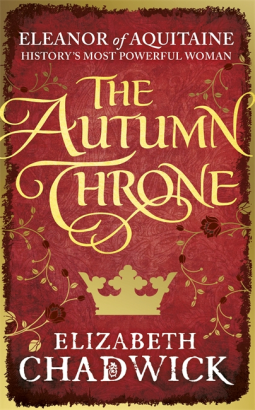
The Autumn Throne by Elizabeth Chadwick

This is the third part of Elizabeth Chadwick’s trilogy telling the story of Eleanor of Aquitaine in fictional form. I love Chadwick’s portrayal of Eleanor (or Alienor, as her name is spelled throughout the trilogy) and having enjoyed both The Summer Queen and The Winter Crown, I was hoping that The Autumn Throne would be just as good. As the title suggests, she is entering the ‘autumn’ of her life in this final novel but remains close to the throne in one way or another.

As well as being Duchess of Aquitaine in her own right, Alienor was also Queen of France through her first marriage to Louis VII and then Queen of England as the wife of Henry II. Following Henry’s death, she would also be mother to two more kings of England: Richard I (the Lionheart) and John. The Autumn Throne, though, begins while Henry is still very much alive and has had Alienor imprisoned at Sarum in Wiltshire as punishment for supporting their sons in a rebellion against him. It’s 1176 and Alienor will remain in captivity for another thirteen years.

I was surprised to find that during the long years of her imprisonment, Alienor actually spends quite a lot of time visiting various castles and palaces, being brought out of confinement whenever it suits Henry to have her present at court celebrations and rituals. She also manages to have some contact with her sons and daughters and with her good friend, Isabel de Warenne, who is married to Henry’s half-brother Hamelin. This means that Alienor is not as cut off from the world as you might imagine and that, as the years go by, she (and through her, the reader) is kept informed of her children’s marriages, Henry’s plans for his kingdom, and important events taking place in Europe and beyond.

Alienor’s feelings towards Henry are portrayed in a way that feels plausible and realistic. There are times when she hates him for what he has done to her and the way he is treating their sons, but also times when she feels sorrow for the husband she once loved and regret that things have turned out this way. Still, it’s hard not to be relieved for Alienor’s sake when Henry finally dies and she is set free at last. After this, Alienor’s relationships with her two surviving sons, Richard and John, come to the forefront of the novel. I have to say, as far as kings of England go, Richard I has never been one of my favourites, partly due to the fact that he spent very little time actually in England. Alienor, though, makes no secret of the fact that he is the son she loves most. She is shown here to have at least some influence over his decision-making and to be trusted with playing a role in the running of the country while Richard is away taking part in the Third Crusade.

The most interesting character in the novel, apart from Alienor herself, is probably John. I have read several fictional portrayals of John, some which cast him as a villain and others which give a more balanced view – this one falls into the second category. He begins the book as an ambitious, calculating boy who does as he pleases without thinking of the consequences; he is much the same as he grows into a man, but his relationships with Alienor and his illegitimate son Richard show he is more complex than that and has enough good qualities to make people care about him.

I have had a lot of sympathy for Alienor throughout this series, but more than ever in this final book as she suffers the loss of one adult son or daughter after another. Of the eight children Alienor has with Henry, only two are still alive by the time of her death. Alienor herself lives into her eighties and it’s sad that she doesn’t have much time to relax in her old age. She is in her seventies when John sends her on the long journey to Castile to select one of his nieces as a bride for the King of France’s heir – and just two or three years before her death, she is being besieged in her castle of Mirebeau by one of her own grandsons!

With this novel covering the last thirty years of Alienor’s life, ending with her death at Fontevraud in April 1204, it does feel very long and drawn out at times. I kept wondering whether there were things that could have been left out to make it a bit shorter, though it’s hard to say which scenes could be omitted without disturbing the course of Alienor’s story. I did enjoy this book just as much as the first two in the trilogy, but I’m glad it’s been a while since I read the last one – I think if I’d read the three books one after the other it would have been too much for me!

In Elizabeth Chadwick’s next book, Templar Silks, she is returning to the story of William Marshal, hero of The Greatest Knight. William made a few appearances in The Autumn Throne where his story overlapped with Alienor’s and I’m looking forward to meeting him again. Templar Silks will be published in 2018, but I also have some of Chadwick’s earlier novels still unread on my TBR.

Thanks to the publisher for providing a copy of this book for review via NetGalley.

Classics Club List #2 – and another Classics Spin!

I mentioned last week that I had finished my current Classics Club list and would probably be posting a second one…and here it is! I have decided to list 50 books this time rather than 100 as that will give me more flexibility and more time to read other books as well. We have five years to complete our lists, so as I’m starting from today that means my finish date will be 14th November 2022 – how far away that seems! I’ve included a mixture of books that I’m hoping will be fun to read, books that sound much more challenging and books that I know very little about but are by authors I’ve wanted to try for a while.

~

1. The Black Sheep by Honoré de Balzac
2. The Long Ships by Frans G Bengtsson
3. The White Guard by Mikhail Bulgakov
4. Death Comes for the Archbishop by Willa Cather
5. Jezebel’s Daughter by Wilkie Collins
6. Dombey and Son by Charles Dickens
7. Nicholas Nickleby by Charles Dickens
8. The Brothers Karamazov by Fyodor Dostoevsky
9. La Reine Margot by Alexandre Dumas
10. Chicot the Jester by Alexandre Dumas
11. Castle Dor by Daphne du Maurier
12. Don’t Look Now and Other Stories by Daphne du Maurier
13. Daniel Deronda by George Eliot
14. Moonfleet by John Meade Falkner
15. The Brontes Went to Woolworths by Rachel Ferguson
16. The Fifth Queen by Ford Madox Ford
17. A Passage to India by E.M. Forster
18. Black Narcissus by Rumer Godden
19. Claudius the God by Robert Graves
20. Desperate Remedies by Thomas Hardy
21. Two on a Tower by Thomas Hardy
22. In a Dark Wood Wandering by Hella S Haasse
23. The Crowded Street by Winifred Holtby
24. Goodbye Mr Chips by James Hilton
25. The Galliard by Margaret Irwin
26. The Europeans by Henry James
27. How Green Was My Valley by Richard Llewellyn
28. The Betrothed by Alessandro Manzoni
29. Of Human Bondage by W Somerset Maugham
30. The Corn King and the Spring Queen by Naomi Mitchison
31. That Lady by Kate O’Brien
32. The World is Not Enough by Zoe Oldenbourg
33. I Will Repay by Baroness Emmuska Orczy
34. The Scottish Chiefs by Jane Porter
35. Jane and Prudence by Barbara Pym
36. The Cloister and the Hearth by Charles Reade
37. Fire from Heaven by Mary Renault
38. Bardelys the Magnificent by Rafael Sabatini
39. Sandokan: The Tigers of Mompracem by Emilio Salgari
40. The Pirate by Sir Walter Scott
41. The Turquoise by Anya Seton
42. The Grapes of Wrath by John Steinbeck
43. The Black Arrow by Robert Louis Stevenson
44. A Game of Hide and Seek by Elizabeth Taylor
45. High Rising by Angela Thirkell
46. The Prime Minister by Anthony Trollope
47. The Duke’s Children by Anthony Trollope
48. The Fountain Overflows by Rebecca West
49. The Chrysalids by John Wyndham
50. Germinal by Emile Zola

What do you think? Have you read any of these?

~

I am just in time to take part in the latest Classics Club Spin! The idea of the spin is to choose twenty unread books from your Classics Club list and number them from 1-20. On Friday 17th November, the Classics Club will choose a number and that is the book you need to read before the end of the year.

As I haven’t read any of the books on my new list yet, I’m just going to use the first twenty books above as my Spin list. If I get #10 I will probably read #9 instead as they are part of a series, but otherwise I don’t mind which number comes up. Now I just need to wait until Friday to find out what I’ll be reading!

Historical Musings #32: Exploring South America

While I was reading The Bedlam Stacks by Natasha Pulley a few weeks ago, it occurred to me that I have read very few books set in South America, historical or otherwise. The Bedlam Stacks involves a mission to 1860s Peru in search of quinine and is the only book about Peru I can remember reading. And it’s not just Peru, because Ecuador, Venezuela, Chile, Argentina, Bolivia and all the other countries that make up South America have also featured rarely or not at all in my reading.

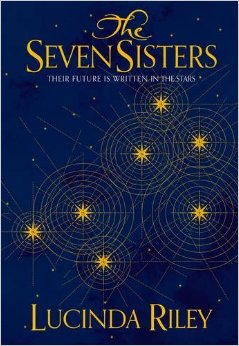
A quick search of the historical fiction reviews on my blog brings up only one result: The Seven Sisters by Lucinda Riley, which tells the story of a young woman who lived in Rio de Janeiro during the 1920s and played a part in the creation of the statue of Christ the Redeemer. Expanding the search to include reviews of any genre, I also found Little Black Lies, a crime novel by Sharon Bolton set in the Falkland Islands, and Three Singles to Adventure, Gerald Durrell’s account of an animal-collecting expedition to Guyana. And that’s all. I can’t think of many examples from my pre-blogging days either, so clearly there’s a big gap in my reading that needs to be filled!

Do you have any good books to recommend that are set in South America? For the purposes of this post I would particularly like to hear about historical fiction or non-fiction – anything that will help me to understand the histories of these countries – but contemporary suggestions are welcome too.

~

Added to my historical fiction shelves since last month’s post:

* The Queen’s Mary by Sarah Gristwood
* Shadows and Strongholds by Elizabeth Chadwick
* The Marsh King’s Daughter by Elizabeth Chadwick
* Voice of the Falconer by David Blixt
* The Beacon at Alexandria by Gillian Bradshaw
* Lincoln in the Bardo by George Saunders
* Seven Stones to Stand or Fall by Diana Gabaldon
* The Tower is Full of Ghosts Today by Alison Weir

Have you added any new historical fiction to your TBR recently?

The Crow Garden by Alison Littlewood

This is the first book I’ve read by Alison Littlewood, although I do remember hearing about The Hidden People a year or two ago and thinking it sounded interesting. I was attracted to The Crow Garden by its striking cover, but it sounded appealing too, with its Victorian setting and comparisons to Wilkie Collins and Susan Hill, so I thought I would give it a try.

Our narrator, Nathaniel Kerner, is a newly qualified ‘mad-doctor’ on his way to Yorkshire to take up his first position at Crakethorne Manor, an asylum for those ‘troubled in mind’. The tone of the novel is set immediately, with descriptions of dark skies, desolate heaths and remote villages on the journey north and Nathaniel’s first sight of his new place of work, a bleak grey stone building with iron bars on the windows. The asylum is run by Doctor Chettle, a man whose preferred methods of treatment – cold baths, electric shocks and phrenology – are very different from Nathaniel’s. Nathaniel will have the opportunity to try out some of his own ideas when he is assigned his first patient, the beautiful Victoria Adelina Harleston.

Mrs Harleston has been brought to Crakethorne by her husband following an incident on a London omnibus. Accusing her of hysteria, he demands that Nathaniel and Chettle stop at nothing to find a cure for his wife. Believing that the best way to get to the bottom of a patient’s problems is by talking and listening, Nathaniel gradually begins to uncover Mrs Harleston’s story. Far from making things clearer, however, the situation only becomes more confusing. Is Mrs Harleston really insane or is there more to her hysteria than meets the eye? Nathaniel knows he is becoming too deeply involved in the life of his patient but he has vowed to help her and now there’s no going back.

This is the sort of story and setting I usually enjoy, but I think there’s a limit to how many novels about Victorian asylums you can read and I am now close to reaching that limit! I was pleased when, in the middle of the book, the action moved away from Crakethorne for a while and into the streets of London. Here Nathaniel is swept up in the world of mesmerists, spiritualists and séances and although these are also common elements in Victorian historical fiction, I found that the book became much more interesting from this point onwards. Nathaniel’s narration also starts to become increasingly less reliable (although I won’t tell you why as I want to leave you to discover some of the novel’s surprises for yourself) and it is difficult to tell exactly what is real and what isn’t, which gives the rest of the novel a disturbingly hypnotic and unsettling feel.

I appreciated the effort Alison Littlewood makes to tell Nathaniel’s story in language appropriate to the 19th century. It’s something that is always important to me in historical fiction, but even more so in books of this type in which the atmosphere and the setting play such a big part. A few poorly chosen words and phrases can so easily pull you out of the time period, but thankfully Littlewood gets it just about right.

The Crow Garden was an interesting read but, as I’ve said, I think I’ve read too many books with similar settings and themes to really get anything new out of this one. The Asylum by John Harwood, Affinity by Sarah Waters, The Girl Who Couldn’t Read by John Harding and, of course, Wilkie Collins’ classic The Woman in White all came to mind while I was reading, and I would recommend all of those ahead of this book. It didn’t help that I disliked the character of Mrs Harleston so didn’t have the sympathy for her that I would usually have with a woman at her husband’s mercy and committed to an asylum against her will.

Despite not really loving this book, though, I did find it entertaining – and with its atmosphere, Gothic undertones and subtle touches of the supernatural, it’s an ideal autumn or winter read. If anyone else has read it, I would be interested to know what you thought.

Thanks to Quercus Books for providing a copy of this book for review via NetGalley.

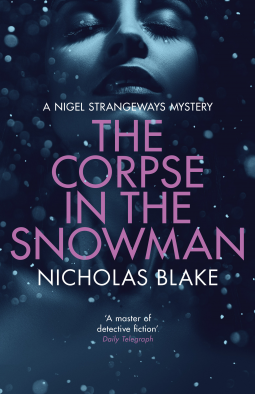
The Corpse in the Snowman by Nicholas Blake

Nicholas Blake was a pseudonym of the Poet Laureate Cecil Day-Lewis under which he wrote a series of mystery novels featuring the private investigator Nigel Strangeways. It seems there are sixteen in the series, published between 1935 and 1966, which is good news for me as The Corpse in the Snowman is my first and I enjoyed it so much I will certainly be reading more of them!

This book is set in winter, as you will have guessed from the title – and yes, there is a snowman and yes, there’s a dead body hidden inside it. We know this from the very first chapter, but what we don’t know is whose body it is and how it has come to be in such a strange and macabre hiding place. To find out what is going on, we have to go back several weeks to the moment earlier in the winter when Nigel and Georgia Strangeways arrive at Easterham Manor in Essex, home of the Restorick family. They have been invited by Clarissa Cavendish, an elderly cousin of Georgia’s who lives on the estate and who has become convinced that there is something badly wrong at the Manor.

Clarissa’s fears are proved correct when, the day after the Strangeways’ arrival, the beautiful Elizabeth Restorick is found dead in her bedroom. It looks like a suicide, but Nigel is sure it is murder – and with a large party of guests gathered at Easterham for the festive season, there are plenty of suspects to choose from.

All the elements of a classic mystery novel are here – a country house cut off by snow; a locked room murder; an amateur detective working alongside the local police; family secrets, clues and red herrings – but a lot of attention is also given to themes such as drugs and drug addiction (with some interesting insights into the attitudes of the time). Published in 1941, the war is in the background but doesn’t really have any influence on the story; it’s set in those early days of the war when not much seemed to be happening and apart from a reference to blackout curtains and Nigel’s complaint at having to travel to Essex in wartime on an old woman’s whim, it is barely mentioned at all.

Although Nigel Strangeways is very ordinary as far as literary detectives go (there’s nothing to make him stand out amongst the Poirots, Campions and Wimseys of the genre), I did like him and will be happy to spend more time in his company. I was intrigued by mentions of his wife Georgia’s past career as an explorer; she doesn’t have a very big part to play in the novel, but I enjoyed what we do see of her. As for the other characters, there are a good variety of them within the Restorick household, ranging from an author who is in love with Elizabeth to a doctor whose speciality is ‘nervous disorders’ in women. I particularly loved Clarissa Cavendish, who is obsessed with the Georgian period and speaks of it as ‘in my day’ as if she had actually been alive at the time.

I am so pleased to have discovered Nicholas Blake and I’m sure I’ll be trying another of his books soon!

Note: This book has also been published as The Case of the Abominable Snowman.

Thanks to Ipso Books for providing a copy of this book for review via NetGalley.
The Classics Club: Looking back

I joined the Classics Club in March 2012 with the aim of reading sixty classics in five years. Over time, my list changed and grew, I removed books I no longer felt like reading, added other books and ended up with a list of one hundred. A few weeks ago I finished the last of those hundred classics (a re-read of my favourite Dumas novel, The Count of Monte Cristo) – seven months past my deadline, which would have been March of this year, but I really enjoyed working through my list, which I think is all that matters! Taking part in the Classics Club has definitely been a rewarding experience: I have participated in monthly memes, had fun with Classics Spins, joined in with the Women’s Classic Literature Event and, most importantly, discovered lots of new books, authors, blogs and bloggers.

You can see my complete Classics Club list here, with links to my reviews, but here are some of my highlights from the last five years (and seven months):

* Finishing Anthony Trollope’s Chronicles of Barsetshire and starting his other series, the Pallisers.

* Discovering that Louisa May Alcott wrote sensation novels.

* Tackling some very long books: Don Quixote, Kristin Lavransdatter, War and Peace and Clarissa!

* Enjoying Alexandre Dumas’ complete series of D’Artagnan novels.

* Revisiting Jane Eyre, Wuthering Heights, Emma and Rebecca.

* Moving out of my comfort zone and reading some plays.

* Being pleasantly surprised by John Steinbeck, John Wyndham and Somerset Maugham, three authors I hadn’t expected to like.

* Deciding that A Tale of Two Cities is my favourite Dickens novel.

* Loving all four Rafael Sabatini books on my list!

A few of you have asked whether I will be putting another Classics Club list together. I think the answer is probably yes, although I haven’t decided what form my second list will take, how many books will be on it or which books and authors will be included. I’ll let you know if and when the list is ready!

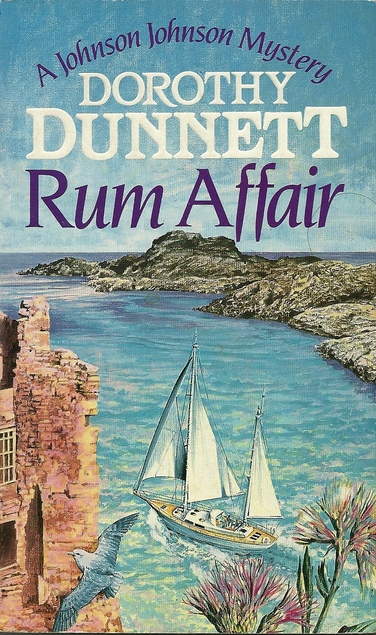
Rum Affair by Dorothy Dunnett – #1968Club

I am, after all, the only really photogenic coloratura soprano alive. My only problem, just about then, was in staying alive.

It’s been a while since I read my first of Dorothy Dunnett’s Johnson Johnson mysteries and this week’s 1968 Club (hosted by Simon and Karen) seemed the perfect opportunity to read another one. Rum Affair – originally titled Dolly and the Singing Bird and then The Photogenic Soprano – was the first in the series to be published (in 1968 obviously), although Tropical Issue, the other one I’ve read, was the first chronologically.

Dunnett is better known for her historical novels, some of which have recently been reissued, but the seven books in her mystery series have contemporary settings. They are each narrated by a different young woman and all feature the portrait painter Johnson Johnson and his yacht Dolly.

Rum Affair opens with Tina Rossi, a Polish-Italian opera singer, arriving in Scotland where she is due to give two performances at the Edinburgh Festival. During a break in her schedule, she has arranged to meet her lover, Kenneth Holmes, at his friend’s Rose Street flat. However, there’s no sign of Kenneth – just a card with the three handwritten words, “Darling, I’m sorry”. Searching for clues to explain his absence, Tina opens a wardrobe door to reveal the body of a man, a stranger, who has been shot in the chest. When the police unexpectedly arrive, making enquiries about a robbery in the neighbourhood, she quickly makes the decision to conceal what has happened – to try to save her own reputation, she tells us, and Kenneth’s.

Instinct is a marvellous thing, I dare say; but I prefer to use my good sense. You, perhaps, with a strange man lying dead at your feet would have welcomed the police with an exhibition of nervous relief. I, on the other hand, kept my head.

On the same night, Tina’s path crosses for the first time with that of Johnson, who is staying nearby. Tina is immediately intrigued by Johnson, a mysterious man who wears bifocals and introduces himself as “thirty-eight. Painter. London. On holiday.” When Johnson invites her to join him on a yacht race to the Isle of Rum, she is quick to accept. Rum is where Kenneth is currently based, working on a highly sensitive project for his employers, although she doesn’t admit this to Johnson. However, it seems that Johnson has a reason of his own for wanting Tina to sail with him on board Dolly – and it’s not just so that he can paint her portrait!

I won’t go into any more detail regarding the plot because I wouldn’t like to inadvertently give too much away and spoil the mystery – and I don’t want to say much more about Tina Rossi either as I’m finding that part of the fun of reading the Johnson novels is in getting to know the woman who is narrating the story. What I will say is that Tina is very different from Rita Geddes of Tropical Issue and that their narrative voices reflect their different personalities and backgrounds (while I liked Rita immediately, I never connected with Tina at all, but I suppose you can’t like every character in every book). As for Johnson himself, even though I have now read two books in this series, he is still very much an enigma to me. Of course, we only see him through the eyes of the narrators so we only know what they choose to tell us and are reliant on their observations and interpretations of his character, which may not always be correct or true.

I also found the setting interesting; the race in which Johnson and Tina are participating takes them around the west coast of Scotland, visiting several islands of the Inner Hebrides, of which Rum is one.

In the summer night, the Inner Hebrides lay all about us, black on the indigo sea. Above us, the uninterrupted sky stretched, a light, dense ultramarine, its ghostly clouds and small, sharp white stars suspended over the bright winking lights, near and far, of a constellation of lighthouses, and the grey, dimly voyaging waves here below.

I particularly enjoyed the scenes set at Fingal’s Cave on the island of Staffa!

Although I don’t think these books come close to the brilliance of Dunnett’s Lymond or Niccolò series, or King Hereafter, they are still quite enjoyable in a different way. I am looking forward to reading the rest and meeting the other five narrators.