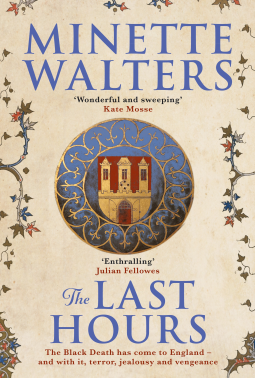
 Yes, this is the same Minette Walters who is best known for her crime novels which include The Ice House and The Dark Room. I’ve never read any of those (at least I don’t think so – I did used to read a lot more crime than I do now so it’s possible I may have read one of her books and forgotten about it) but when I saw that her new book, The Last Hours, marked a change of direction from crime to historical fiction I was immediately interested!
The Last Hours is set in 1348 on the estate of Develish in Dorsetshire. Those of you who know your 14th century history will know that the Black Death, which had been sweeping its way across Europe, reached England in 1348 – and this forms the heart of Walters’ novel. Sir Richard of Develish falls victim to the plague early in the book, leaving his wife, Lady Anne, responsible for the demesne, the household and the serfs who work the land. Lady Anne gathers everyone inside the boundaries of the moated manor, believing that cutting off contact with the outside world will be the best way to avoid the pestilence.
With so many people forced to live together in a confined space, it is inevitable that problems will arise, old rivalries will resurface and tempers will be lost. The cause of most of the trouble at Develish is Sir Richard’s daughter, Lady Eleanor, a cruel and selfish fourteen-year-old who resents having to live with the serfs. In particular, her hatred is directed at Thaddeus Thurkell, a serf who has just been promoted to the position of Lady Anne’s steward, a move which Eleanor sees as evidence of her mother’s favouritism and unnatural affection for Thaddeus. When supplies at the manor begin to run low, it is Thaddeus who volunteers to venture out into the countryside to find food – but what is the real reason for his departure?
The Last Hours was an interesting read for me as I’ve always found the Black Death a fascinating topic (sorry if that sounds morbid). Walters explores so many different aspects of the disease: the beliefs and superstitions surrounding it; the physical effects it has on the body; the theories people had as to what was causing it; and the limited methods of preventing its spread. However, I knew as soon as I started reading that at some point our protagonists would make the connection with rats and fleas and recognise the importance of hygiene and cleanliness – and I was right. It would have been so much more convincing from a historical point of view if they had continued to think the plague was a punishment from God or that it was caused by breathing bad air.
I did like both Lady Anne and Thaddeus, even if they don’t always feel like believable 14th century people, and they (along with a young maid, Isabella) were certainly the characters I had most sympathy for. Lady Eleanor is the most unpleasant, unlikeable character I’ve come across for some time. She is horrible from her first appearance and remains horrible throughout the entire book – although we do eventually learn a little bit more about her and what possibly made her the way she is, so maybe we’ll see a different side of her in the sequel.
And yes, there is going to be a sequel. I had no idea this was the first in a series until I reached the words ‘to be continued’, so be aware that if you do choose to read this book it doesn’t have a proper conclusion and we are left with lots of loose ends. At the moment I’m not sure whether I will be looking for the second book; I found this one quite slow and unevenly paced – I enjoyed the chapters set in and around Develish, but struggled to stay interested in the adventures of Thaddeus and his companions as they wandered the countryside looking for supplies. I will probably be tempted, though, as I do have lots of questions that haven’t been answered!
Thanks to Atlantic Books for providing a copy of this book for review via NetGalley




 She Reads Novels