 A few years ago I read John Wyndham’s The Midwich Cuckoos and loved it, which was a nice surprise as I very rarely choose to read science fiction. It has taken me a while to get round to reading another book by Wyndham, but now that I’ve finally read The Day of the Triffids I’m pleased to report that I found this another enjoyable, if unsettling, read.
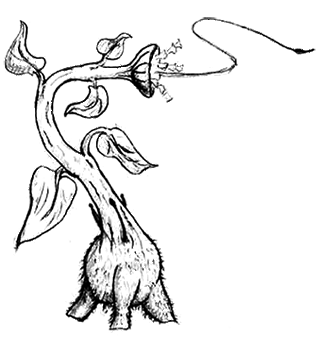
The story is set in a world very similar to our own, but for one small but very significant difference: the presence of a species of plant known as the triffid:
There must have been plenty of them about, growing up quietly and inoffensively, with nobody taking any particular notice of them – at least, it seemed so, for if the biological or botanical experts were excited over them, no news of their interest percolated to the general public. And so the one in our garden continued its growth peacefully, as did thousands like it in neglected spots all over the world.
It was some little time later that the first one picked up its roots and walked.
Apart from the ability to walk, another characteristic of the triffid is its long stinging arm with which it lashes out with unnerving accuracy at anyone who gets too close. At the beginning of the novel, our narrator, Bill Masen, is in a London hospital with a bandage over his eyes, having been stung in the face by one of these vicious plants. Because of this, Bill misses out on seeing a spectacular display of meteors which light up the sky with green flashes all over the world.
The next day, when he tentatively removes his bandages, Bill is relieved to find that no damage has been done to his eyes – but on venturing out of his hospital ward, which is strangely quiet that morning, he makes a shocking discovery. It seems that everyone who watched the meteor shower in the sky last night has suddenly and mysteriously gone blind, meaning that Bill is one of the few people left in the world who is able to see.
When I read The Midwich Cuckoos, one of the reasons I liked it so much was that the focus was on a small community trying to deal with the consequences of one strange occurrence and the ‘science fiction’ elements were quite subtle. With giant killer plants, flashing lights in the sky and sudden worldwide blindness, those elements are a lot stronger in The Day of the Triffids, but there’s still the same sense of the ordinary blending with the extraordinary.
It’s never entirely clear what caused the blindness – or the introduction of the triffid to the planet – but there are hints of biological and chemical warfare (it’s worth remembering that the book was published in 1951, in the early years of the Cold War). But maybe the causes are not really important; what is important is the reaction of the characters to the post-apocalyptic world in which they find themselves. And I found the way most people reacted quite depressing – fighting, rioting, looting shops and stealing food. The most memorable section of the novel, for me, was the part immediately following the onset of the blindness, where Bill leaves the hospital to find that the world – or London at least – has descended into chaos:
We had turned a corner to see the street seventy yards ahead of us filled with people. They were coming toward us at a stumbling run, with their arms outstretched before them. A mingled crying and screaming came from them. Even as we came into sight of them a woman at the front tripped and fell; others tumbled over her, and she disappeared beneath a kicking, struggling heap. Beyond the mob we had a glimpse of the cause of it all: three dark-leaved stems swaying beyond the panic-stricken heads.
Personally, I think the idea of seven-foot tall plants uprooting themselves and walking around the streets is terrifying enough without all the other things that happen in the novel! The triffids play a surprisingly small part in the novel, though; much more time is spent on the implications of the blindness, the opportunity for shaping a new society and the varying opinions of what that society should be like. The role of the triffids in the story, I think, is to show how precarious our position is in the world and how just one small change (such as the loss of our eyesight) can result in the conditions being right for another species to gain superiority.
Although I preferred The Midwich Cuckoos, The Day of the Triffids really is a fascinating novel. Now I need to decide which John Wyndham book to read next.


 In 1922, Count Alexander Ilyich Rostov is brought before a Bolshevik tribunal and found guilty of the crime of being an ‘unrepentant aristocrat’. Once a recipient of the Order of Saint Andrew, member of the Jockey Club and Master of the Hunt, the Count is now considered a Former Person and is sentenced to live out the rest of his days under house arrest in his current place of residence, Moscow’s Metropol Hotel. Forced to leave his luxury suite and move his possessions to a tiny room in the attic, the Count refuses to let his spirit be broken and decides to make the best of his situation, continuing with his daily routines as far as he is able without leaving the building.
 A Country Road, A Tree by Jo Baker
 She Reads Novels