The Echo of Twilight by Judith Kinghorn

the-echo-of-twilight It’s 1914 and Pearl Gibson, a young woman in her twenties, is about to take up a new position as lady’s maid. Her new employer, Ottoline Campbell, has estates in Northumberland and Scotland, which means Pearl will have to leave London and move north. She’s prepared to do this, however, because it’s not as if she has much to leave behind – her relationship with her boyfriend, Stanley, already seems to be fizzling out, and she has no other friends or family. Her mother killed herself just after Pearl’s birth and Pearl was raised by a great-aunt who is also now dead.

Spending the summer at Delnasay, the Campbells’ house in the Scottish Highlands, Pearl gradually settles into her new job and her new life. Although the other servants view her as proud and superior at first, she slowly wins them over, and at the same time she starts to form a close friendship with Ottoline. It seems that both Pearl and Ottoline are hiding secrets and as the bond between them strengthens, they begin to confide in each other more and more.

Meanwhile, the trouble which has been brewing in Europe throughout the year has escalated into war and the family return to England, hoping they will be safe at Birling Hall, their other estate in Warkworth, Northumberland. Ottoline’s two sons, Billy and Hugo, both enlist and are soon on their way to France, while Pearl also has someone to pray for: Ralph Stedman, an artist with whom she embarked on a new romance during her time in Scotland and who has also gone to war. All of this takes place just in the first half of the novel; there are plenty of other surprises and revelations to follow as Pearl and Ottoline learn more about each other – and as the war progresses, changing the lives of all of our characters forever.

Pearl, the novel’s narrator, is an interesting and complex character. I was intrigued by her habit of pretending to be other people, introducing herself to strangers as Tess Durbeyfield, Mrs Gaskell and even Ottoline Campbell herself…anybody but Pearl Gibson. I was happy, though, that by the end of the novel we’d had a chance to get to know the real Pearl. Ottoline was also a fascinating character, but I felt that she remained more of an enigma.

The Echo of Twilight is Judith Kinghorn’s fourth novel. I loved her first, The Last Summer, was slightly less impressed by the second, The Memory of Lost Senses, and haven’t yet read her third, The Snow Globe. This one sounded appealing to me as it is set during the same time period as The Last Summer – and although the stories are quite different, the two books do share some similar themes. The impact of war, not just on those who are fighting in it, but also on the people left behind, is an important part of both novels. We see how, with so many young men lost from the British workforce, women had to take on what would previously have been considered ‘jobs for men’, and how, once the war was over, the social structure had changed so much that the running of large estates like Delnasay and Birling tended not to be sustainable.

The Echo of Twilight is an easy read – the sort where the pages seem to fly by effortlessly – and a beautifully written one. Although I wasn’t entirely convinced by the romance at the heart of the novel and didn’t sense a lot of chemistry there, there were enough other aspects that I did like to make up for that. It’s not just a romance; it’s also a lovely, moving story about a young woman trying to find her place in the world.

Thanks to the publisher Canelo for providing a review copy via NetGalley.

Lost Horizon by James Hilton

lost-horizon I’m very happy with the way my reading is going so far this year. I’ve read some great books already and this is another one. Published in 1933, Lost Horizon is the novel which introduced into popular culture the idea of Shangri-La as a sort of earthly paradise. It’s a fascinating story and very absorbing – I started it on a Saturday and was finished by Sunday; at just over 200 pages it’s a quick read but also the sort of book that leaves the reader with a lot to think about after the final page is turned.
We begin with a prologue in which the narrator is having dinner with a novelist friend, Rutherford. The two find themselves discussing a mutual acquaintance, Hugh Conway, who had disappeared under unusual circumstances only to be discovered by Rutherford several months later in a hospital in China. Conway has been suffering from amnesia but as his memories start to return, he tells Rutherford a long and remarkable story.

During a revolution in Baskul, Conway, who was the British consul at the time, was evacuated by plane along with three other people. The plane was supposedly heading for Peshawar, but it never arrived and its four passengers were believed to be dead. What Conway tells Rutherfurd, however, is that the plane was hijacked and flown in a different direction, stopping once to refuel and finally crashing to the ground in a mountain valley somewhere in Tibet. The pilot was killed but the passengers survived. Seeking shelter at the nearby lamasery (a monastery for lamas) known as Shangri-La, the group asked for help to continue their journey to Peshawar, but as the days and weeks went by and no help arrived, Conway began to wonder whether their presence at the lamasery was really an accident – and whether they would ever be able to leave.

Shangri-La is a mysterious place; beautiful, but slightly eerie too, I thought. How was such a beautiful building constructed in such a remote location? Who installed the modern western plumbing and who brought the grand piano, the harpsichord and the books for the library, considering that the only way to reach the lamasery (unless you happen to make a crash-landing there) is on foot through the dangerous mountain passes? What is the secret of the lamas, who look so much more youthful than they really are? And where is Shangri-La, exactly? All Conway can deduce is that they have flown “far beyond the western range of the Himalayas towards the less known heights of the Kuen-Lun” and into the shadow of the mountain Karakal, or ‘Blue Moon’.

I found it interesting that Conway’s three companions have such different reactions to their enforced imprisonment in Shangri-La. Mallinson, Conway’s young vice-consul, reacts with anger and frustration, and with every day that passes he becomes more and more desperate to escape; the American businessman, Barnard, is hiding secrets of his own and is content to enjoy the hospitality of the lamasery while looking for money-making opportunities in the valley; and Miss Brinklow, the British missionary, wonders if this is a challenge sent by God and if she has been brought here to carry out His work. The characters (apart from Conway) are thinly drawn, but they serve their purpose in the story – and it could be said that Shangri-La is actually the most important character in the novel anyway.

Conway himself is in no hurry to go anywhere; he is intrigued by the lifestyle of the lamas and the atmosphere of serenity and peace. With his curious, contemplative nature, the philosophy behind the lamasery appeals to him and he becomes captivated by this mystical place where time seems almost to stand still and the pressures of everyday life can be left behind. It is obvious from the framing story set up in the prologue that Conway does, for one reason or another, leave Shangri-La, but it is not at all clear how or why that will happen and this kept me in suspense and kept me turning the pages.

Lost Horizon was another read from my Classics Club list. I am coming to the end of my list now and will soon be putting another one together; I’ll have to think about including one or two more books by James Hilton – probably Random Harvest or Goodbye, Mr Chips. Has anyone read them?

First of the Tudors by Joanna Hickson

first-of-the-tudors Yes, I’ve been reading yet another Wars of the Roses novel! One of the things I’m enjoying about reading so many books set in the same time period is seeing the variety of ways in which different authors choose to approach the same subject as they search for a new angle and some fresh insights. In First of the Tudors, Joanna Hickson takes us right back to the early days of the conflict and the beginnings, more or less, of the Tudor dynasty to tell the story of Jasper Tudor, uncle of the future Henry VII.

As the sons of Welshman Owen Tudor and Henry V’s widow, Catherine of Valois, Jasper and Edmund Tudor are half-brothers to Henry VI, who is King of England as the novel opens in 1451.  Being closely related to royalty but with no real claim to the throne for themselves, Edmund and Jasper are welcomed to court by Henry who rewards them with lands and titles, making Edmund Earl of Richmond and Jasper Earl of Pembroke. Edmund also wins the hand in marriage of Margaret Beaufort, which is seen as a great accomplishment as Margaret, despite being little more than a child, has royal blood and is one of England’s richest heiresses.

When Edmund dies at Carmarthen Castle in 1456, possibly of bubonic plague, he leaves Margaret pregnant with his child. The baby, when it is born, is named Henry and is taken into Jasper’s care (before later being placed in the custody of the Yorkist William Herbert). As the years go by and Henry grows into a man, Jasper is occupied with looking after his estates, trying to keep the peace in Wales and supporting his brother the king as unrest grows and the country heads towards civil war. Based closely on historical fact, we see all of this through Jasper’s eyes, as he narrates his own story in his own words.

But there’s also a fictional story, built around the idea that Jasper had a cousin, Sian (or Jane) Hywel, who became his mistress. There is no historical basis for this, but it is known that Jasper did have illegitimate children, so I have no problem with Joanna Hickson inventing the character of Jane, especially as she makes clear in her author’s note which parts of the novel were factual and which weren’t. However, I felt that too much time was devoted to Jane – she narrates around half of the book – and I would have preferred to concentrate more on Jasper and the other historical figures. This is just my personal opinion, though, and I’m sure other readers will like the domestic scenes and the love story more than I did.

I’ve always found Jasper Tudor intriguing, maybe partly because he tends to be overshadowed in historical fiction by other, more well-known characters. I had been looking forward to seeing him take centre stage for once, but I didn’t really find his portrayal in this novel entirely convincing. I can’t quite explain why, other than to say that his narrative voice was almost identical to Jane’s and that I could never fully believe in him as a 15th century man. I did like the portrayal of Margaret Beaufort, however, which made her seem slightly more endearing than in other fictional portrayals I’ve read! I also enjoyed the focus on Wales, the descriptions of the Welsh castles and the Welsh people who played a part in this fascinating period of history – one secondary character whom I found particularly interesting was the poet Lewys Glyn Cothi.

First of the Tudors ends abruptly, leaving the feeling that there is much more of this story still to come, and the author’s note confirmed what I had already expected: there will be a sequel and Henry Tudor will take more of a central role in that one. If you’ve never read Joanna Hickson before you may also be interested in The Agincourt Bride and The Tudor Bride, which tell the story of Catherine of Valois, or Red Rose, White Rose, the Wars of the Roses from Cicely Neville’s perspective.

Thanks to the publisher HarperCollins for providing a review copy via NetGalley.

The Bear and the Nightingale by Katherine Arden

the-bear-and-the-nightingale I was drawn to this book first by the cover – and then by the mention of Russian fairy tales and folklore. It seemed a little bit different from the usual books I read and I hoped it would prove to be an enchanting, magical read, perfect for the winter months.

The story is set in the 14th century in Lesnaya Zemlya, a village in northern Rus’.  The village is home to Pyotr Vladimirovich who, since losing his beloved wife in childbirth several years earlier, has lived alone with his five children and their elderly nurse, Dunya. The youngest child, Vasilisa (or Vasya, as she is known), is becoming wild and rebellious and it is partly because of the need to provide a mother figure for her that Pyotr decides to marry again. Unfortunately, though, his new wife – Anna – turns out to be a wicked stepmother who dislikes and distrusts Vasya and believes she can see demons hiding all over the house.

Vasya, who has inherited special abilities from her mother, can also see Anna’s ‘demons’, but she knows that they are not evil spirits – they are household guardians watching over the people of Lesnaya Zemlya. When Father Konstantin arrives in the village, believing he is on a mission from God to stamp out the old traditions and beliefs, the powers of the household spirits begin to fade. Harvests start to fail, winters seem colder and harder than ever before and the evil forces that lurk in the forest grow stronger. Can Vasya find a way to protect her family and restore happiness and prosperity to the village?

The Bear and the Nightingale is a story steeped in Russian myth, legend and fairy tale. Although I loved fairy tales as a child, I seem to have missed out on most of the Russian ones, but that wasn’t a problem at all – and I was surprised to discover how much I was actually familiar with. I particularly enjoyed being reminded of the story of Frost which Dunya is telling the children as the novel opens:

“But what did he look like?” Olga demanded.

Dunya shrugged. “As to that, no two tellers agree. Some say he is naught but a cold, crackling breeze whispering among the firs. Others say he is an old man in a sledge, with bright eyes and cold hands. Others say he is like a warrior in his prime, but robed all in white, with weapons of ice. No one knows.”

Frost, or Morozko to give him his Russian name, is an important presence throughout the whole novel, although he only appears to the characters on a few occasions and we are made to wait until near the end of the book before his true significance becomes clear. Other aspects of the story are slow to unfold too – such as the role of the Bear and Nightingale of the title – which is why I’m not going to say any more about the plot or the characters, even though I would love to! I would prefer to leave some of the novel’s secrets and surprises for you to discover for yourself.

What I will mention is the setting, which I loved. Most of the action takes place in and around Vasya’s village, with lots of vivid descriptions of the harsh living conditions and the bleak, relentless winter weather, but there are also a few sections set in Moscow at the court of the Grand Prince Ivan II. I have very little knowledge of 14th century Russia (or Rus’, as the region was known at that time) so I wasn’t sure how much of this was based on fact, but as this is historical fantasy I tried not to worry too much about that.  I was more interested in the portrayal of the conflict between the old ways and the new, the changing beliefs of the people and the loss of old traditions.

The Bear and the Nightingale is apparently the first in a trilogy – I hadn’t been aware of this when I first started to read, but on reaching the end of the book I was happy to discover that there will be another two and that the next one will take us away from the forests of Rus’ and into medieval Moscow. I hope we won’t have to wait too long for it as I’m looking forward to it already!

Thanks to the publisher Del Rey for providing a copy of this book via NetGalley for review.

My Commonplace Book: January 2017

Looking back at January’s reading – in words and pictures.

My Commonplace Book

commonplace book
Definition:
noun
a notebook in which quotations, poems, remarks, etc, that catch the owner’s attention are entered

Collins English Dictionary

~

cardinal-richelieu

Cardinal Richelieu

But there’s no harm in learning about history from a novelist, especially those details that historians find unworthy to relate, assuming they even know them.

The Red Sphinx by Alexandre Dumas (1865)

~

Mark had prided himself on his library. It was a mixed collection of books. Books which he had inherited both from his father and from his patron; books which he had bought because he was interested in them or, if not in them, in the authors to whom he wished to lend his patronage; books which he had ordered in beautifully bound editions, partly because they looked well on his shelves, lending a noble colour to his rooms, partly because no man of culture should ever be without them; old editions, new editions, expensive books, cheap books, a library in which everybody, whatever his taste, could be sure of finding something to suit him.

The Red House Mystery by A.A. Milne (1922)

~

Without thought, I laughed when laughter was required, or I was gentle or fiery or amiable or seductive or roguish or voluptuous or childlike, as the man wished me.  But which of these different women was truly Jane Shore?  A diamond has many facets, I told myself, and all are beautiful: I was a diamond, save that I was not hard and had no cutting-edges.

The Merry Mistress by Philip Lindsay (1952)

~

bannik

Bannik – the bathhouse spirit

“A prophecy then, sea-maiden.”

“Why do you call me that?” she whispered.

The bannik drifted up to the bench beside her. His beard was the curling steam. “Because you have your great-grandfather’s eyes. Now hear me. You will ride to where earth meets sky. You will be born three times: once of illusions, once of flesh, and once of spirit. You will pluck snowdrops at midwinter, weep for a nightingale, and die by your own choosing.”

The Bear and the Nightingale by Katherine Arden (2017)

~

One man can no more see into the mind of another than he can see inside a stone…

His Bloody Project by Graeme Macrae Burnet (2015)

~

The gardens at Wolf Hall proved a delight, a tangled land of enchantment full of overblown roses and secret paths.  Beneath the trees of the orchard I could see a harassed looking goose girl trying to round up her flock.  She was flapping as much as they.  Over in the stable yard, I could hear the chink of harness and the murmur of voices.  The air was full of scent and heat, and I wandered at will, lost in the pleasure of it.

The Phantom Tree by Nicola Cornick (2016)

~

musical-notes

“Do people see him? Does he haunt the tower?”

“Poor Goldsworthy?” Mr Ratcliffe shook his head. “Not as far as I know. No, it’s his music that people hear. Or they say they do. Fragments of melody, just a few notes.” He waved his pipe in the direction of the cathedral. “It’s as if the anthem was broken into many pieces in the fall. And all the notes it contained were thrown up into the air. They are still there. Looking for each other. Trying to come together again.”

Fireside Gothic by Andrew Taylor (2016)

~

Then, while he watched and pondered, a strange transformation took place.  The light turned to bluish over the whole mountain, with the lower slopes darkening to violet.  Something deeper than his usual aloofness rose in him – not quite excitement, still less fear, but a sharp intensity of expectation.  He said: “You’re quite right, Barnard, this affair grows more and more remarkable.”

Lost Horizon by James Hilton (1933)

~

She had scraps for a dog, milk for a cat, bread for a child, a wage for an old woman; she had a roof and a fire and a door to shut or open. She was beginning to be beloved, and she was already essential.

The Flowering Thorn by Margery Sharp (1933)

~

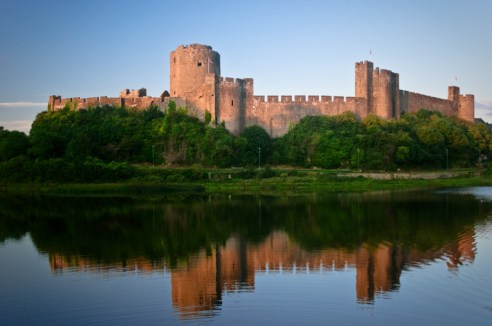
pembroke-castle

Pembroke Castle

During our journey some of the churches and abbeys we rode past had amazed me, but I had never laid eyes on anything to compare with the huge and fearsome edifice that was Pembroke Castle.

Viewed across an expanse of rippling water, it crouched like some gigantic monster on a steep rocky promontory, its mighty lime-washed towers and battlements appearing to grow out of the pale rock beneath, as if it was rooted in the earth itself.  It looked like a man-made white mountain, indestructible, impregnable.

First of the Tudors by Joanna Hickson (2016)

~

It would be reasonable to suppose that a routine time or an eventless time would seem interminable. It should be so, but it is not. It is the dull eventless times that have no duration whatever. A time splashed with interest, wounded with tragedy, crevassed with joy – that’s the time that seems long in the memory. And this is right when you think about it. Eventlessness has no posts to drape duration on. From nothing to nothing is no time at all.

East of Eden by John Steinbeck (1952)

~

Edmund coughed and filled his wife’s glass, then his own. “Aren’t you pleased, Bessie?”

“It’s not that I’m not pleased. I’m sure it’s a great compliment
to you that you should be asked to investigate such an important
case.”

“But, my love?” He pulled at his cravat.

“Well, it’s just that it’s such a very awful case. I can’t help but
think that simply by being involved with it, your name will be
tainted.”

The Unseeing by Anna Mazzola (2016)

~

Favourite books this month: The Red Sphinx, His Bloody Project, The Red House Mystery, Lost Horizon and East of Eden

January has been a great month for me where reading is concerned!  I would usually just pick out one or two books as favourites, but this month I had trouble narrowing it down to five.  I hope February will be even better.

The Red House Mystery by A.A. Milne

the-red-house-mysteryI don’t think I would have ever read The Red House Mystery if it hadn’t been for seeing other bloggers reading and reviewing it. I had always thought of A.A. Milne solely as the author of the Winnie the Pooh stories and it had never occurred to me to wonder what else he had written. It turns out that The Red House Mystery, originally published in 1922, was his first and only detective novel – which is a shame, because it’s excellent.
The novel opens on a beautiful summer’s day with Mark Ablett entertaining guests from London at his home, the Red House. Earlier that morning, Mark had announced to his friends that his brother, Robert, was on his way home from Australia, having been absent for fifteen years. The guests are surprised to hear this, as Mark had never mentioned a brother before, and unfortunately – or perhaps fortunately, given the descriptions of Robert’s character – they don’t get a chance to meet him, because almost as soon as Robert arrives at the Red House he is shot dead.

Antony Gillingham, a latecomer to the party at the Red House, is one of the first on the scene, along with Mr Cayley, the Abletts’ cousin. Seeing Robert’s dead body on the office floor and no sign of Mark, who appears to have run away, it seems quite obvious what has happened…but Antony is not so sure. Joining forces with his friend and fellow house guest, Bill Beverley, he begins to search for clues in an attempt to solve the mystery.

I loved this book; being such an early example of a detective novel, it contains many of the elements of a classic ‘locked room mystery’ which would still have felt fresh and new in the 1920s: a country house, secret passages, ghostly figures, midnight adventures, red herrings etc. I also think Milne is very fair to the reader, providing enough hints for us to at least guess at the solution, while not making it too easy to work out.

Antony and Bill make a great detecting team, falling perfectly into the roles of Sherlock Holmes and Dr Watson (they even refer to themselves as Holmes and Watson several times throughout the novel). They are both very likeable characters and I would have been happy to read a whole series of Gillingham/Beverley mysteries.

Most of all, though, I loved the writing style, which is light and lively, with plenty of humour and witty dialogue. Here, for example, is a conversation between two of the Red House servants:

“I was never the one to pretend to be what I wasn’t. If I’m fifty-five, I’m fifty-five – that’s what I say.”

“Fifty-eight, isn’t it, auntie?”

“I was just giving that as an example,” said Mrs. Stevens with great dignity.

And here we learn what Antony’s father thinks of his son:

Old Gillingham returned to his paper. Antony was a younger son, and, on the whole, not so interesting to his father as the cadets of certain other families; Champion Birket’s, for instance. But, then, Champion Birket was the best Hereford bull he had ever bred.

The Red House Mystery was great fun to read.  Having enjoyed it so much, I’m disappointed that there aren’t more mysteries to read by A.A. Milne, but if you think I might like any of his other books I would love to hear your recommendations.

Fireside Gothic by Andrew Taylor

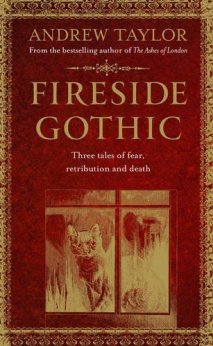
fireside-gothic Having read and enjoyed some of Andrew Taylor’s historical crime novels, I was immediately intrigued when I heard about Fireside Gothic, a hardback collection of three novellas which had originally been published separately in ebook form as ‘Kindle Singles’.  The stories are all quite different but, as Taylor says in his author’s note, they do share some common themes.

Broken Voices, the first of the three, has the feel of a classic Christmas ghost story. Set in an English cathedral city just before the First World War, it follows the adventures of two schoolboys whose circumstances mean they have to stay at school in the care of a retired teacher over the Christmas holidays. After listening to the teacher’s tales of mysterious happenings in the nearby cathedral, one of the boys begins to hear ghostly music and persuades his friend to sneak into the cathedral with him late one night to investigate.

Broken Voices gets the collection off to a good start.  Although I would describe it as an eerie story rather than a scary one, with its haunting atmosphere, winter setting and vivid descriptions of the deserted cathedral, this is the most obviously ‘gothic’ of the stories in the book.

The second story, The Leper House, is my favourite. Set in the modern day this time, our narrator is driving home from his sister’s funeral when his car breaks down on a lonely country road near the Suffolk coast. Setting off through the rain and wind in search of help, he manages to find shelter for the night and during his stay he has a brief but unforgettable encounter with a woman who lives in a neighbouring cottage. In the morning, he discovers that both the woman and the cottage have disappeared – and becomes obsessed with finding an explanation for his strange experience.

I can’t say too much, but the story then goes in a direction which was completely unexpected and which I loved. It raises a lot of fascinating questions and some of them are still unanswered at the end. There are some ideas here which I would have liked to have seen developed further; this story has all the ingredients of a full-length novel and I was sorry it had to come to an end so soon!

The collection finishes with The Scratch, another contemporary story. Unlike the first two, this one is narrated by a woman. Her name is Clare and she lives in the Forest of Dean with her husband, Gerald, and their pet cat. At the beginning of the story, their orphaned nephew, Jack, comes to stay with them on his return from fighting in Afghanistan. Jack’s time in the army has left him with a fear of cats, a dislike of enclosed spaces and a scratch on his arm which won’t seem to heal.

This is an interesting story, but the focus is mainly on the complicated relationships between Clare, Gerald and Jack, so the supernatural elements are much more subtle than in the other novellas. This is my least favourite of the three, although there are some clever little twists at the end which took me by surprise!

Fireside Gothic is an entertaining and unusual collection. The title and cover had led me to expect something slightly different – something spookier and, well, more gothic – but I did still enjoy these three novellas, particularly the middle one.  While it’s still winter, this would be an ideal time to get yourself a copy of this book and spend a cold, dark evening reading it by the fire.

Thanks to HarperCollins for providing a review copy of Fireside Gothic.