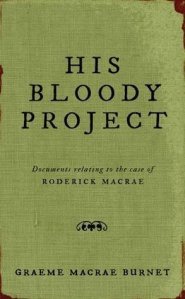
 This novel by Scottish author Graeme Macrae Burnet attracted a lot of attention after being shortlisted for the Man Booker Prize last year. Of all the books on the list, I remember thinking that this sounded like the one I would be most likely to enjoy, so I had a lovely surprise when I received a nice hardback copy from my sister for Christmas.
His Bloody Project is fiction but presented so convincingly as non-fiction that there were times when I wondered if I’d misunderstood and I was actually reading a true story after all! Subtitled Documents relating to the case of Roderick Macrae, the case in question is that of a triple murder committed in August 1869 in Culduie, a remote village in the Scottish Highlands. In his preface, the author explains that he came across the documents contained in this book while researching his own family history at the Highland Archive Centre in Inverness.
Following a collection of statements given by the residents of Culduie, we proceed to the longest section of the book: Roderick Macrae’s memoir which he was instructed to write by his advocate, Andrew Sinclair, during his imprisonment at Inverness Castle awaiting his trial. Roderick, only seventeen at the time of his arrest, never tries to deny that he killed his neighbour, Lachlan Mackenzie, and two other members of the Mackenzie family – we know this right from the beginning of the book – but what we don’t know is what caused him to do such a thing. Roderick’s memoir provides some insights, giving some background information on what life was like in Culduie and describing the events leading up to the murders.
Next, we have the opportunity to read the medical reports on each of the three murder victims – and this is the first real indication we get that maybe Roderick has not been entirely honest with us. A study by a doctor who visited Roderick in prison follows, raising and answering questions about the prisoner’s state of mind, and finally we arrive at the trial itself. As judge, jury and spectators try to understand the motive behind the crime, witnesses are called who give statements both to confirm Roderick’s own account and to contradict it. A verdict is finally reached, but whether it is the right one or not is up to each individual reader to decide.
While I was reading Roderick’s own story, I had a lot of sympathy for him and I was so angry with Lachlan Mackenzie (or Lachlan Broad, as he is usually known) that I could understand why Roderick felt driven to take revenge. However, when I read the rest of the documents, particularly the report of the court proceedings, I began to wonder how much Roderick had omitted from his memoir and whether Lachlan Broad’s actions were really as provocative as they had at first seemed.
Another interesting aspect of the novel is the portrayal of life in a tiny Scottish community in the middle of the 19th century. Roderick Macrae’s mother dies in childbirth just before the events described in the novel, leaving Roderick and his siblings alone with their father, a crofter trying to earn his living from the land. Culduie (a settlement of only nine houses) and the surrounding villages are the property of the Laird, who rules through his factor and a network of local constables. Lachlan Broad is elected the constable for Culduie and this is what brings him into conflict with the Macraes.
The writing style and the language used throughout the novel feels appropriate for the time period and increases the sense of authenticity; as I’ve said, at times I could almost have believed I was reading genuine historical documents. Dialect is used sparingly and a glossary is provided if you need to look up any unfamiliar Scots words (there were a few that were new to me, but these were mainly the names of farming implements such as croman and cas chrom). Maybe Roderick’s narrative voice isn’t entirely convincing given his age, but we are told that he is an exceptionally bright, intelligent boy – and the author does address this issue in the preface too.
I loved His Bloody Project; although it’s not a traditional crime novel and there’s never any mystery surrounding the identity of the murderer, it’s the sort of book that leaves you with more questions at the end than you had at the beginning. I think a re-read might be necessary at some point!
 I have always found the concept of time-travel fascinating – and equally fascinating are the number of ways in which various authors choose to approach the subject when writing time-travel fiction. The Phantom Tree is one of many dual time period time-slip novels I have read over the last few years, but I found it refreshingly different in that it deals not with the usual idea of a modern day character going back in time but a woman from the past coming forward to the present time.
 Well, it may be only January but I think I already know one book which will be appearing on my books of the year list this December! Having read and enjoyed all of Alexandre Dumas’ d’Artagnan novels over the last few years (beginning with a re-read of

 Night’s Dark Secrets (first published in 1936 as The Golden Violet, The Story of a Lady Novelist) was the first of the two books that I read. The novel opens with the marriage of Angel Cowley, an author of romance novels, to Thomas Thicknesse, the owner of a sugar plantation in Jamaica. Angel has been busy preparing her latest novel, The Golden Violet, for serialisation in a magazine, but this has to be postponed when Thomas insists that the newly married couple leave England and return to his plantation, Venables Penn.
 Having said all of that, I did still find the story itself compelling and kept reading to the end. And I was happy to go on to try a second Shearing novel, Forget-Me-Not. This novel, published in 1932, also appeared under the title The Strange Case of Lucile Clery, and Bowen claimed it was based on true events which led to the downfall of Louis Philippe I, King of the French, in the revolution of 1848.
 This is only the second book I’ve read by E.M. Forster – the first one being
  Published in 1973, Strangers in Company reminds me of Mary Stewart’s romantic suspense novels, or maybe M.M. Kaye’s Death In… series. It is set in Greece and follows the story of Marian Frenche, who is looking for a new job after finding herself at a loose end when her children move away to live with her ex-husband. Marian finds work with an agency who arrange for her to accompany a troubled young woman called Stella Marten on a coach tour of the major Greek archaeological sites. She is given very little information about Stella and her background, apart from a warning that she should be left on her own as little as possible, but after only a few hours in Stella’s company, Marian finds her to be rude, angry and irritable. It’s going to be a difficult trip!

 She Reads Novels