 My first introduction to Margery Sharp’s work came this time last year when I read The Nutmeg Tree for the Margery Sharp Day hosted by Jane at Beyond Eden Rock. I enjoyed it and went on to read Cluny Brown a few months later. Now Jane is hosting another celebration for Margery’s birthday (which is today – 25th January) and this seemed the perfect opportunity to read another of her books. There were plenty to choose from – it’s much easier to find Margery Sharp books now than it was a year ago, thanks to Open Road Media reissuing them in digital form – and I settled on her 1933 novel The Flowering Thorn, one which sounded particularly appealing to me.
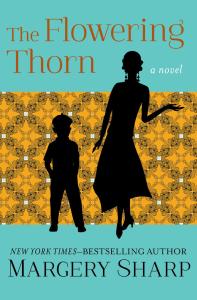 The Flowering Thorn introduces us to Lesley Frewen, a twenty-eight-year-old socialite living in London. Lesley’s days and nights are a whirl of bridge parties, lunch engagements, shopping trips, hair appointments and visits to matinees and art exhibitions. Despite all of this, there’s still something missing from her life: love. Having discovered that the one man she really wants appears to be the one man she can’t have, Lesley is still in low spirits when she joins her aunt for afternoon tea the next day. This could explain why, when her aunt introduces her to Patrick, the orphaned child of a servant who has recently died, Lesley finds herself volunteering to adopt the boy.
Lesley has no experience of young children and can’t imagine what possessed her to make such an offer, but she knows that now the decision has been made, there’s no turning back. Children aren’t allowed in her luxury flat, however, so the first thing to do is to look for a new home for herself and Patrick – but finding somewhere in London which is both affordable and suitable for a four-year-old boy proves to be more difficult than she’d expected. Eventually, a solution presents itself: she and Patrick will go and live in a cottage in the Buckinghamshire countryside. It will be cheaper, her friends will still be able to visit – and besides, it will only be for a few years, until Patrick is old enough to go away to school…
I have enjoyed all three of the Margery Sharp novels I have read so far, but I think this might be my favourite. I wasn’t sure about the book at first; I found Lesley’s lifestyle quite tedious to read about and Lesley herself (as she was at the beginning of the book) shallow and irresponsible. A few chapters in, though, when Lesley takes Patrick to live in the country, I immediately warmed to both the character and the novel. It was similar to the experience I had with Julia in The Nutmeg Tree. As the story progressed, I watched Lesley slowly adapt to life in the country and found that as she formed new friendships, rearranged her priorities and adjusted her outlook on the world, she became a much nicer person, an opinion shared by her elderly uncle when he meets her again after an absence of several years.
I was surprised by the lack of romance in the novel. Although Lesley does have one or two love interests, things tend to be one-sided and it’s not until the very end of the book that there’s a hint of an actual romance for her. I found this quite refreshing as it meant the focus was on other things, such as Lesley’s growth as a person and the development of her relationship with Patrick – and this was a surprise too as there’s nothing sentimental or affectionate in this relationship; Lesley doesn’t even seem to particularly like Patrick, and yet it’s obvious that she does understand and care about him in her own way.
The Flowering Thorn is a lovely story and was a good choice for this year’s Margery Sharp Day!
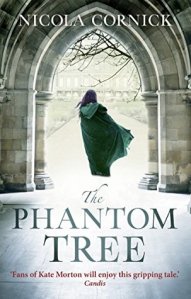 I have always found the concept of time-travel fascinating – and equally fascinating are the number of ways in which various authors choose to approach the subject when writing time-travel fiction. The Phantom Tree is one of many dual time period time-slip novels I have read over the last few years, but I found it refreshingly different in that it deals not with the usual idea of a modern day character going back in time but a woman from the past coming forward to the present time.
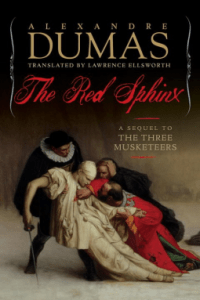 Well, it may be only January but I think I already know one book which will be appearing on my books of the year list this December! Having read and enjoyed all of Alexandre Dumas’ d’Artagnan novels over the last few years (beginning with a re-read of

 Night’s Dark Secrets (first published in 1936 as The Golden Violet, The Story of a Lady Novelist) was the first of the two books that I read. The novel opens with the marriage of Angel Cowley, an author of romance novels, to Thomas Thicknesse, the owner of a sugar plantation in Jamaica. Angel has been busy preparing her latest novel, The Golden Violet, for serialisation in a magazine, but this has to be postponed when Thomas insists that the newly married couple leave England and return to his plantation, Venables Penn.
 Having said all of that, I did still find the story itself compelling and kept reading to the end. And I was happy to go on to try a second Shearing novel, Forget-Me-Not. This novel, published in 1932, also appeared under the title The Strange Case of Lucile Clery, and Bowen claimed it was based on true events which led to the downfall of Louis Philippe I, King of the French, in the revolution of 1848.
 This is only the second book I’ve read by E.M. Forster – the first one being
  She Reads Novels