Historical Musings #17: The historical mystery

Historical Musings I’ve been so badly organised recently that I had no idea what this month’s Historical Musings post would be about until yesterday, when I sat down to start reading Sovereign, the third book in CJ Sansom’s Shardlake mystery series, set in Tudor England. I enjoy reading historical mysteries for the same reasons that I enjoy reading historical fiction in general (escaping into the past, learning through fiction etc) but also because I like to see mysteries being solved through traditional methods – questioning witnesses, making observations, searching for clues – without the use of modern technology.

Sovereign I loved the first two Shardlake novels, yet it has taken me more than a year to get round to picking up this third one; the problem with historical mysteries is that they all seem to be part of a long series! I can’t think of many standalones that I’ve read; The Name of the Rose by Umberto Eco is one, The Unburied by Charles Palliser is another, and then there are some of Andrew Taylor’s books (The Anatomy of Ghosts and The American Boy) – but historical mystery series are in abundance! Although I seem to be very good at starting them, I’m not so good at remembering to continue with them.

Here are a few that I have in progress at the moment:

Crocodile on the Sandbank Shardlake series by CJ Sansom (Tudor) – read the first two books and currently reading the third
Sebastian St Cyr series by CS Harris (Regency) – read the first book
Amelia Peabody series by Elizabeth Peters (19th/20th century, Egypt) – read the first two books
Mary Russell series by Laurie R King (early 20th century) – read the first two books
Justin de Quincy series by Sharon Penman (medieval) – read the first book
Charles Horton series by Lloyd Shepherd (19th century) – read the first two books
Adelia Aguilar series by Ariana Franklin (medieval) – read the first book
Thomas Hawkins series by Antonia Hodgson (18th century) – read the first two books and starting the third soon

As you can see, I’ve got a lot of reading to do!

This month, then, I’d like to hear your thoughts on historical mysteries. Do you enjoy reading them? Which are your favourites?

The People in the Photo by Hélène Gestern

The People in the Photo August is Women in Translation Month and although I hadn’t made any formal plans to take part, I found myself reading a translated novel by a woman this month anyway – one I’d been interested in reading for a while. Hélène Gestern’s The People in the Photo was originally published in French in 2011; this Gallic Books edition is an English translation by Emily Boyce and Ros Schwartz.

Hélène Hivert lives in Paris, where she works as an archivist. She has never known her mother, who died when Hélène was very young, and for some reason her father and stepmother have never wanted to talk about her. When Hélène finds a photograph of Nathalie, her mother, taken at a tennis tournament in Interlaken in 1971, she’s intrigued. There are two men in the photograph whom she can’t identify, so she places a newpaper advertisement asking if anyone can provide more details.

Stéphane Crusten, a Swiss biologist living in England, responds. One of the men in the photo is his father, Pierre, who is now dead, and he recognises the other as a close friend of his father’s. What Stéphane doesn’t know is why Hélène’s mother is in the picture with them. Corresponding at first through letters and emails and later by telephone and in person, the two begin to piece together the fragments of information they have in an attempt to discover the connection between their parents. Gradually, as they delve into their family histories and more old photographs come to light, the true story of Nathalie and Pierre is revealed.

The People in the Photo is a beautiful, moving novel. The story is told in epistolary form, through the letters and emails Hélène and Stéphane send to each other, and it was nice to watch two people being drawn together in this way, forming a bond in writing before they had even had the chance to meet. The photos they discover are not included in the book, but they are described in such careful detail that I could picture them quite clearly in my mind, and I liked that aspect of the novel too.

However, this was not a perfect book; it did have a few flaws which stopped me from loving it as much as I’d hoped to. First, I thought it was very predictable – maybe not for Hélène and Stéphane, who were genuinely shocked by each revelation, but definitely predictable for the reader. This in itself wouldn’t have been a big problem, but I also found the plot very contrived and too reliant on coincidences, on photographs which turned up just when another clue was needed and on circumstances which conveniently prevented secrets from being revealed until after the next letter was received.

In the end, though, none of this mattered too much. It’s still a lovely, emotional story and once I started reading it I didn’t want to stop until I reached the final page and had learned all the secrets of the people in the photo.

The Wicked Boy by Kate Summerscale

The Wicked Boy It’s July 1895 and Robert and Nattie Coombes could be any two young boys enjoying the hot summer weather. They go to see a cricket match, they play in the park, they take a trip to the seaside and they go fishing. Their father, a ship’s steward, is at sea and the boys tell anyone who asks that their mother is visiting her sister in Liverpool and that a family friend, John Fox, is staying with them while she’s away. However, there is more to the situation than meets the eye and it’s not long before the neighbours grow concerned. Why did Emily Coombes not mention to anyone that she was going away – and what is that horrible smell drifting down from the bedroom upstairs?

When the police are eventually called to the house at 35 Cave Road, they make a shocking discovery: it seems that Emily Coombes has been there all the time, her dead body decomposing in the summer heat. Her eldest son, Robert, immediately confesses to stabbing his mother to death ten days earlier. In the trial which follows, the court attempts to make sense of this terrible crime. Robert is only thirteen years old (one year older than his brother, Nattie); what would make a boy of this age commit such a cruel and cold-blooded act?

This may sound like the plot of a crime novel, but it’s not – it’s actually a true story and the events I’ve been describing above really did take place in London’s East End in 1895. In The Wicked Boy, Kate Summerscale gives an account of the murder, the inquest and the trial, exploring some of the factors which may have led to Robert’s actions before going on to look at what happened to him after he was found guilty.

This is the third book I’ve read (or attempted to read) by Summerscale. I loved The Suspicions of Mr Whicher, which was also based on a true crime, but I found Mrs Robinson’s Disgrace, about a Victorian divorce scandal, difficult to get into and I abandoned it after a few chapters. I’m pleased to report that I liked The Wicked Boy much more than Mrs Robinson, though not as much as Mr Whicher, which had a stronger mystery element. There’s really no mystery at all about the Robert Coombes case; we know almost from the beginning what the crime is and who is responsible for it. Of course, this doesn’t mean there are no more questions to be asked. The official verdict was that Robert was “guilty but insane” and no clear motive was ever identified, but Summerscale does devote a large portion of the book to discussing Robert’s childhood and family background in an attempt to understand what could drive a thirteen-year-old boy to kill his mother.

Where the murder and the trial themselves are concerned, Summerscale sticks to the facts and doesn’t resort to too much speculation or personal opinion. However, she also spends a lot of time looking at what life was like in general for working-class Londoners towards the end of the Victorian era. Robert and Nattie Coombes would have been among the first generations to be educated at the new Board Schools which were established after the Elementary Education Act of 1870, but there were many people who believed that making education available to everyone was a bad idea. It meant that more children were able to read and therefore had access to ‘penny dreadfuls’, cheap adventure novels aimed at boys which were thought to be a bad influence on impressionable minds. Robert Coombes had a collection of these sensational stories, something that was seized upon in the same way that people sometimes blame violent video games for encouraging modern day teenagers to commit crimes.

I found all of this fascinating to read about, but was slightly less interested in the second half of the book which covers Robert’s time at Broadmoor, the asylum where he was sent after his trial, and what happened after he was released. I understand why the author wanted to follow Robert’s story through to its conclusion, but I just didn’t have enough interest in him as a person to want to read such a long account of his later life. Apart from this, I did enjoy reading The Wicked Boy and am glad I gave Kate Summerscale another chance after my disappointment with Mrs Robinson’s Disgrace.

I received a copy of this book via NetGalley for review.

Succession by Livi Michael

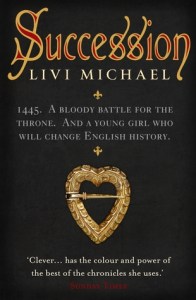
Succession With my interest in the Wars of the Roses, I remember hearing about this book, the first in a trilogy, when it was published a couple of years ago, but for one reason or another I never got round to reading it. Two years later, the third and final novel has just been published, and Penguin have kindly sent me the whole trilogy for review. I’ve now read the first book, Succession, and am sure I’ll be reading the other two very soon.

I know not everyone is familiar with the background to the Wars of the Roses, so I should start by explaining that they were a series of wars fought in the second half of the 15th century between two rival branches of the royal House of Plantagenet. With King Henry VI of England (a descendant of Edward III through the Lancastrian line) suffering from an unspecified mental illness, there were many who considered him unfit to rule, leaving the way open for another claimant to the throne – Richard, Duke of York, another of Edward III’s descendants. From 1455-1487 a number of battles were fought between supporters of Lancaster and supporters of York; Succession covers only the early part of this period.

There are interesting, colourful characters on both sides of this conflict, but if I had to choose, I would say that I’m a Yorkist. This novel, however, is written mainly from the Lancastrian perspective, concentrating on two young women who share the same name – Margaret. The first is Margaret of Anjou, wife of Henry VI, and the second is Margaret Beaufort, mother of the future Henry VII. We do meet plenty of other characters (so many that you may need to make use of the character list and family tree at the beginning of the book to keep track of them all) but the stories of these two women are always the main focus of the novel.

We first meet Margaret Beaufort as a little girl who has become a ward of the Duke of Suffolk following the death of her own father, the 1st Duke of Somerset. A childhood marriage to Suffolk’s son, John de la Pole, is annulled when Henry VI chooses to marry the twelve-year-old Margaret to his half-brother, Edmund Tudor. Within a year, Edmund is dead of the plague, leaving his young widow pregnant with his child and at the mercy of his brother, Jasper (who is portrayed here in a surprisingly negative light).

Margaret of Anjou also has a difficult life, trying to hold the country together during the king’s long spells of illness so that she can keep the throne secure for their baby son, Edward. Neither of the Margarets are very likeable characters, but it would be difficult not to sympathise with the situations in which they find themselves. Some of Margaret of Anjou’s attempts to communicate with her unresponsive husband are very moving, while Margaret Beaufort’s story is sometimes quite disturbing – for example, the trauma suffered by a small thirteen-year-old giving birth is described in detail.

This is a period of history with which I’ve become very familiar over the last few years and, as this novel follows the historical sequence of events very closely, I always knew, more or less, what was going to happen next. There’s nothing very new in terms of plot, but the approach Livi Michael takes to telling the story is quite different from anything I’ve read before. She writes in several styles throughout the novel – sometimes a chapter is written in the first person, sometimes in the third – and from the perspectives of many different characters (a red or a white rose at the start of each chapter gives a useful indication of whether the character’s allegiance is to York or to Lancaster), but the most striking thing about Succession is the use of extracts from contemporary chronicles such as the Crowland Chronicle or John Benet’s Chronicle.

Each chapter starts or finishes with at least one paragraph taken from a chronicle of the time and it’s important to read all of these because they are used to advance the story and to relate events which our characters may not have personally witnessed. The Battle of Blore Heath, for example, is told entirely in the form of chronicles with no original prose at all. I liked the feeling of authenticity that this provided; however, it could also be distracting at times and, together with the very short length of the chapters (many are only one or two pages long), it made me feel that I was constantly being pulled out of the story. There is one much longer chapter in the middle of the book entitled Margaret Beaufort Travels to Wales and this was my favourite part of the novel, as we were finally given an opportunity to spend a decent amount of time getting to know one character with no interruptions.

Although the style and structure of Succession weren’t always a complete success with me, I did still enjoy the creative approach to a story I love and I will certainly be picking up the second book, Rebellion, soon.

The Poisoners by Marjorie Bowen

The Poisoners I have read several novels by Marjorie Bowen this year and this is one of my favourites so far. First published in 1936, The Poisoners originally appeared under one of her other pseudonyms, George Preedy, and now that I’ve read it I can see why she chose to use a different name for this one. Although this book, like the others I’ve read, is set in the past, it is more of a mystery/thriller which should appeal to readers of vintage crime as well as to fans of historical fiction.

The story takes place in 17th century Paris during the reign of the Sun King, Louis XIV, and revolves around a famous murder scandal known as L’affaire des poisons (Affair of the poisons). Our hero is Charles Desgrez, newly arrived in Paris with his wife, Solange, to take up a position as Lieutenant of Police and keen to make a name for himself. At the beginning of the novel, the couple are attending a party for Solange’s birthday, when one of the guests – the Widow Bosse, a supplier of perfumes – drunkenly boasts of becoming rich by helping wives to become widows. “I’ve only got three more poisonings to do and I shall be a very wealthy woman,” she says.

To satisfy his curiosity, Desgrez asks Solange to visit the Widow in disguise, posing as a wife unhappy with her husband – and he is shocked by what he learns. Reporting his findings to the Chief of Police, M. de la Reynie, the two begin to investigate and gradually discover that the network of poisoners operating in Paris is much larger and more sophisticated than they could ever have imagined. To complicate things further, some of the people involved are closely connected to the Sun King himself – so Desgrez and de la Reynie must find a way to bring the criminals to justice while avoiding the publicity the King would prefer to avoid.

The Affair of the Poisons is a dark and fascinating episode in Parisian history. I’ve read about it before, in The Oracle Glass by Judith Merkle Riley, and it was good to revisit the same subject from a different angle. As far as I can tell, Bowen’s novel sticks to the basic historical facts of The Affair, with the addition of a few fictional characters and plot developments. The result is an atmospheric and suspenseful crime novel featuring fortune tellers and spies, counterfeiters and apothecaries, an empty house which hides sinister secrets, mysterious letters marked with the sign of a pink carnation, and a society thought to be involved in black magic.

The plot is excellent – fast-paced and exciting – but there’s not a lot to say about the characters in The Poisoners. Many of them are based on real historical figures, such as the king’s mistress, Madame de Montespan, and the notorious poisoner, La Voisin. Although they are all interesting to read about, none of them are developed in any great depth. I enjoyed reading about the work of the police officers in the novel (I hadn’t realised the French police were so well organised in the 17th century, which is something Bowen talks about in her author’s note) and I did like Charles and Solange Desgrez, but they are not the sort of characters who stay in your thoughts after finishing the book. This is a novel you would read for the plot rather than the characters, and maybe this is one of the differences between the books which were originally published under the Marjorie Bowen and George Preedy names.

If you’ve read anything by Marjorie Bowen (or any of Margaret Gabrielle Vere Campbell’s other pseudonyms) I’d love to hear what you thought!

The Revelations of Carey Ravine by Debra Daley

The Revelations of Carey Ravine There was always a good chance that I was going to love The Revelations of Carey Ravine. A book which has been compared with “Sarah Waters, Amitav Ghosh’s The Sea of Poppies, and Jamaica Inn” sounded perfect for me…and it was. Set in 1770s London, this is a dark tale of deception and betrayal in which nothing is as it seems. Our guide through all of this is Carey Ravine, an intelligent and spirited woman with an interesting past.

On the surface, Carey and her husband, Oliver Nash, appear to be the perfect couple: rich, good-looking, charming and leading a life of glamour and luxury. In reality, their lavish lifestyle is funded by Carey’s dwindling savings – and as their finances become stretched to the limits, cracks in their marriage begin to appear. When Carey finds a dossier in Nash’s desk describing the death by poisoning of a young man during a medical experiment in India, she confronts her husband and asks for an explanation. It’s obvious, though, that Nash doesn’t want to talk about it, so Carey is left to investigate on her own…

Towards the end of the novel, revelation follows upon revelation as the mystery surrounding the poisoning starts to unfold…but Carey also makes some important discoveries about herself and the sort of person she really wants to be. The novel is narrated by Carey herself, which means the reader can only know as much as Carey does – and it quickly becomes obvious that there are some big gaps in our heroine’s knowledge. The fate of her father, the horticulturalist Daniel Ravine, for example, is unknown to Carey. The last she heard of him was when he wrote to her from India ten years earlier to tell her of her mother’s death in Calcutta. Having had no further news, Carey has given up hope of ever seeing or hearing from him again. Eventually, though, the truth about Daniel Ravine begins to emerge, and as we learn more about Carey’s family and her past, some light is shed on her present circumstances.

Carey is a wonderful character – she’s strong and resourceful but she’s still convincing as a woman of her time and her actions never fall outside of the realms of plausibility. Through her eyes we see what it was like to be female in the 18th century, facing a range of challenges, some of which were unique to the time period and others which we can still identify with today. Carey’s relationship with Nash is particularly interesting; she’s in love with her husband and wants to please him, but not at the expense of losing her own identity. Although her freedom is restricted as a married woman, she still does what she can to support herself independently and finds work translating scientific texts.

The setting for this novel is one that I always enjoy – Georgian England – and Debra Daley does a wonderful job of bringing the time period to life with descriptions of flamboyant clothing of silk, velvet and lace, popular dances (the cotillion, for example), and entertainment (masquerade balls and card games such as faro). But it’s the lesser-known details of Georgian life and culture that I like reading about the most; I love the idea that pineapples were seen as such a status symbol in the 1770s that it was possible to hire one to use as a table decoration for your dinner party!

Too many good novels are let down by a poor ending which leaves the reader wondering what was the point of it all. Carey Ravine, though, feels like a complete novel with a beginning, a middle and a satisfying ending. I was also happy, on reaching the end of the book, with the level of character development throughout the story – Carey changes and grows as a person as the novel progresses and by the time we come to the final page she is a rather different woman than she was at the beginning.

This is the second novel by New Zealand author Debra Daley; her first, Turning the Stones, was published in 2014. I will certainly be going back to read that one, as well as looking forward to any future books from Daley.

Prince of Foxes by Samuel Shellabarger

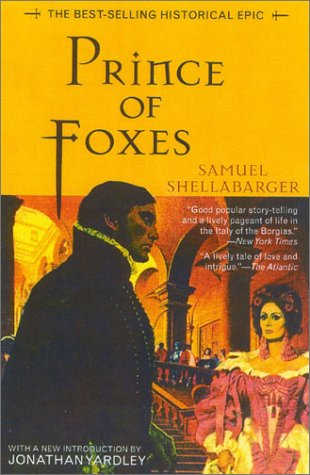
Prince of Foxes This was the book chosen for me in the Classics Club Spin a few months ago; I’m a day late posting this review (the deadline was yesterday) but I did actually finish the book in time. It has taken me a while to decide what to say about this wonderful novel and I probably still haven’t done it justice! I had at least three reasons for adding Prince of Foxes to my Classics Club list in the first place: it’s a classic historical fiction/adventure novel published in 1947 and set in Renaissance Italy, a period I love; it sounded very similar to the work of Rafael Sabatini, an author I love; and it came highly recommended by The Idle Woman, whose blog I love. It seemed inevitable, then, that I would love the book itself – and fortunately I did.

In 1500, when Prince of Foxes begins, Italy is divided into a collection of city-states which are constantly at war, leaving them vulnerable to foreign invasion. Our hero, Andrea Orsini, dreams of seeing the country united under one ruler and has entered the service of the ruthless and powerful Cesare Borgia, son of Pope Alexander VI. We first meet Andrea in Venice, preparing to undertake a mission for the Borgias. He has been given the task of travelling to Ferrara to try to negotiate a marriage between Alfonso d’Este, son of Duke Ercole, and Lucrezia Borgia, Cesare’s sister. When the d’Estes hear about this, however, they decide to have Andrea killed in Venice before he can reach Ferrara – but the murder attempt is foiled and the hired assassin, Mario Belli, ends up switching sides and joining Andrea on his journey.

If he is successful, the Borgias have promised to reward Andrea with the strategically placed hill town of Città del Monte, and the town’s ruling lady, the beautiful Camilla degli Baglione, as his wife. The problem is, Camilla’s husband, the elderly Lord Varano, is still alive and must be disposed of before Andrea will be able to claim his reward. As Andrea gets to know both Varano and Camilla, he finds that he’s not at all sure he’ll be able to betray them into the hands of Cesare when the time comes. Torn between his loyalty to the Borgias (and the personal ambition which goes with it) and his increasing love and respect for Camilla and her husband, Andrea is faced with making a decision which could affect not only his own future but the future of Italy.

As well as navigating his way through this delicate political situation, Andrea and Belli have a number of adventures involving battles, duels, clever disguises, last-minute escapes, sieges, miracles and all sorts of trickery and deception. I was right in thinking that this book would be similar to Sabatini; in particular, I kept being reminded of Bellarion (a previous Classics Spin read) which is also set in Renaissance Italy and includes many of the same elements. But while I remember feeling irritated by the perfection of the main character in Bellarion, I did like Andrea Orsini. He’s another hero who is good at everything, but with just enough flaws and ambiguities to make him interesting. Mario Belli was my favourite, though – and I can’t say too much about him without spoiling the story!

I also loved Camilla, an intelligent and courageous woman with a sense of humour, although other female characters such as Lucrezia and Angela Borgia felt less well developed. Moving away from the novel’s central characters, there’s also a fascinating supporting cast consisting of assorted dukes, lords and ambassadors, soldiers (including the Chevalier de Bayard) and saints (Lucia of Narni). The language used throughout the novel always feel appropriate to the time period and the dialogue is subtle and witty.

Not being an expert on the Renaissance (although I always enjoy reading about it and am gradually building up my knowledge) I found that I was learning a lot from Prince of Foxes as well as being entertained by it. It really is a great book and if anyone else has read it – or seen the 1949 film version with Tyrone Power and Orson Welles – I’d love to know what you thought.