Remember These? Books beginning with F and G

Before I started blogging I used to keep a list of the books I read in an A-Z notebook – the title, the author and a rating out of 5, but no other information. I did this from the mid-1990s to around the year 2000, but sadly kept no records after that until October 2009 when I started my blog.

I still have the notebook and a few years ago I began writing a series of blog posts highlighting some of the books listed under each letter, but only got as far as E before getting distracted and forgetting to do the rest. I did enjoy working on those posts, so I have decided to continue and try to get all the way to Z this time – and yes, I do have a book listed under Z!

So, without further ado, here is a selection of the books that appeared on the ‘F’ and ‘G’ pages of my notebook. I originally gave the books ratings out of 5 and the additional symbol * means that I particularly loved the book while X means I didn’t finish it. Although I’ve included my original ratings here, these do not necessarily reflect what I would feel about the books if I read them again today!

Books beginning with F and G:
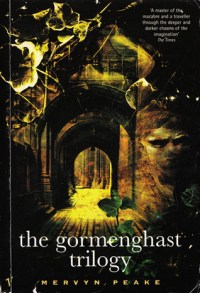
Gormenghast The Gormenghast Trilogy by Mervyn Peake 5/5*
I remember buying this book after watching the BBC adaptation in 2000. My edition includes all three novels in the trilogy – I didn’t like the third one, Titus Alone, but loved the first two, Titus Groan and Gormenghast.

The Far Pavilions by M.M. Kaye 5/5*
This wonderful novel set in India is one of my favourite historical fiction novels. I loved it the first time I read it and when I re-read it in 2010 I was pleased to find that it was still as good as I remembered.

Gone with the Wind by Margaret Mitchell 5/5*
I have read Gone with the Wind several times and don’t know if this particular entry refers to my first read or a later re-read. It’s another favourite, though, so it would get 5/5 from me every time.
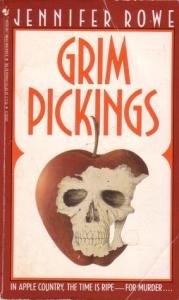
Grim Pickings Grim Pickings by Jennifer Rowe 5/5
This was a great Agatha Christie-style mystery novel set in Australia and revolving around a murder that takes place in an old woman’s orchard where her family have gathered to pick apples. I think it was part of a series, but I never read any of the others.

The Ghost of Thomas Kempe by Penelope Lively 3/5
This is one of Penelope Lively’s children’s books. I can remember what the front cover of my copy looked like (and I think I still have it somewhere) but the story has faded from my mind. I would like to read it again as I think I might appreciate it more now than I did the first time.
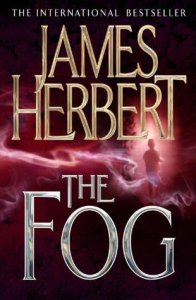
The Fog The Fog by James Herbert 3/5
I very rarely read horror novels these days but I used to read a lot of them. I enjoyed this one, about a mysterious fog that spreads across Britain, altering the minds of everyone who comes into contact with it.

Freezing by Penelope Evans 3/5
I have no memories at all of reading this book. According to Goodreads, it’s a crime novel about a photographer who works in a mortuary and tries to find the identity of a drowning victim who is brought into the morgue one day. It sounds a bit gruesome but I must have enjoyed it enough to give it a 3/5 rating.

First Impression by Margot Dalton 3/5
I can’t remember this one either. It’s another crime novel, this time about a detective trying to solve a missing child case.
Fog Heart The Ghost Road by Pat Barker 2/5
If you’d asked me whether I’d read anything by Pat Barker I would have said no, but obviously I did read this one. I think I’ll have to read it again as I can’t remember anything about it and I suspect it deserves more than 2/5! It’s the third in the Regeneration trilogy and I don’t have any record of reading the previous two, so maybe that was the problem.

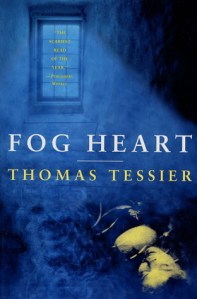
Fog Heart by Thomas Tessier 2/5
The story of two couples who are drawn together when they attend a séance and meet a young medium called Oona. I do vaguely remember reading this book, but I wasn’t very impressed by it.

The Ghosts of Candleford by Mike Jeffries 2/5
Neither the title nor the author sound familiar to me but Amazon tells me that this is a ‘classic tale of the supernatural’. Seeing how many books I’ve read and then completely forgotten about has confirmed for me (if I needed to have it confirmed) that starting a book blog was an excellent idea!

Have you read any of these books? Can you shed any light on the more obscure ones?

I’ll be back soon with another selection, but if you missed my earlier Remember These? posts you can see them here.
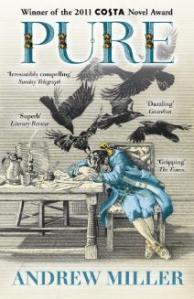
Pure by Andrew Miller

Pure This is another book that I’ve read for my Reading the Walter Scott Prize project and another interesting read – though a very dark one.

The story is set in France in 1785, just a few years before the French Revolution. Jean-Baptiste Baratte, a young engineer from Normandy, has arrived in Paris commissioned with an important but gruesome task – the destruction of the cemetery of Les Innocents. As the oldest and largest cemetery in the city, Les Innocents has now become overcrowded, smelly and unsanitary. To prevent it becoming even more of a health hazard than it already is, Jean-Baptiste has been given the job of destroying the cemetery and its church, emptying the graves and arranging for reburial elsewhere.

The novel is based on historical fact – Les Innocents really did need to be removed in the 18th century in order to purify the surrounding area and a market place was later built on the site of the old cemetery. However, Jean-Baptiste Baratte is fictional and in Pure Andrew Miller imagines what it may have felt like to be the person responsible for carrying out such an unpleasant and controversial task. Everyone has an opinion on the destruction of the cemetery and as Jean-Baptiste continues his work, he learns just how deeply people feel about it.

During his time in Paris, Jean-Baptiste lodges with the Monnards, whose daughter Ziguette is not at all pleased with the removal of the cemetery she has been able to see from her window all her life. On his first inspection of the church, he meets the organist Armand de Saint-Méard, who will lose his job when the building is demolished. In another building on the site live the sexton and his young granddaughter, Jeanne, both of whom have devoted their lives to Les Innocents. And then there are the men – ex-miners from the mines of Valenciennes – summoned to Paris by Jean-Baptiste to help with the excavations of the graves. All of these people are affected in some way by what is happening and Jean-Baptiste receives both support and opposition.

I enjoyed the first half of this book which deals with Jean-Baptiste’s first days in Paris, getting to know the people in and around the cemetery, and deciding how to proceed with the job he has been given. I loved the portrayal of a young man experiencing life in a big city, so desperate to fit in that he lets his new friends persuade him to exchange his smart brown suit for a pistachio green silk one. France is heading towards Revolution and although this never becomes a big part of the plot, the hints are there in the references towards progress, a group of rebellious young men who call themselves the ‘party of the future’, grafitti daubed on walls, the contrast between the working class and the aristocracy – and a doctor called Guillotin who arrives at the cemetery to study the skeletons.

I’m not sure what went wrong with the second half of the book, but I started to lose interest at the point when the miners arrived in Paris and work on the cemetery began. I had found it interesting to read about the preparations, the inspections that had to be made and what the work would involve, but the descriptions of the actual excavations started to feel repetitive. I was also hoping for more character development, but apart from Jean-Baptiste himself the other characters have very little depth. Two of them commit acts of violence towards the end of the book, yet I didn’t feel that their motivations were fully explored and the consequences of both actions seemed to be resolved too quickly.

Pure is a fascinating novel, especially if you’re interested in historical fiction set in pre-Revolutionary France. I really liked Andrew Miller’s style of writing, but my lack of emotional engagement with the characters and the other problems I’ve mentioned above left me feeling slightly disappointed at the end.

The King’s Curse by Philippa Gregory

The Kings Curse This is the sixth and final volume in Philippa Gregory’s Cousins’ War series which explores the Wars of the Roses from a female perspective. The books can be read in any order, although I would recommend reading them in the order of publication. Previous novels in the series have introduced us to Elizabeth Woodville, Margaret Beaufort, Jacquetta of Luxembourg, Anne Neville and Elizabeth of York; this one, The King’s Curse, tells the story of Margaret Pole, another woman with an important part to play in the history of the period.

Margaret is the daughter of George, Duke of Clarence, brother of the last two Plantagenet kings, Edward IV and Richard III. With a new dynasty – the Tudors – now on the throne of England, Margaret’s Plantagenet blood means that she and her family are seen as a threat. At the point when the novel opens, her brother has already been executed on the order of Henry VII and Margaret herself has been married off to a minor knight, Richard Pole – a man she respects but does not love.

When the King and his wife, Margaret’s cousin Elizabeth of York, send their son and heir, Prince Arthur, into Margaret’s care at Ludlow Castle, she becomes a friend and confidante of the Prince’s Spanish bride, Katherine of Aragon. Arthur dies following a sudden illness and Katherine is left a widow – but not for long, as his younger brother, the newly crowned Henry VIII, decides to marry the Princess himself.

Margaret is by Katherine’s side as she tries and fails to give Henry a male heir, losing one baby after another. But when Henry finally tires of Katherine and turns his attention to Anne Boleyn, Margaret discovers that her loyalty to the Queen has cast suspicion on the Plantagenets once again. Can Margaret convince the King that she and her family can be trusted, while still continuing to offer friendship to Katherine and her only surviving child, Princess Mary?

After the disappointment of the previous novel, The White Princess, I was pleased to find that I enjoyed this one much more. I thought the writing was better, the story was more interesting and Margaret was a much stronger character than Elizabeth of York. I got the impression that Gregory herself had enjoyed writing this novel, perhaps more than some of the others in the series.

I’ve read the story of Henry VIII, his marriage to Katherine of Aragon and subsequent divorce many times before, but it was interesting to see familiar events retold from a different point of view. Margaret is perfectly placed to know what is going on, being a cousin to the King’s mother, friend to Katherine and governess to Princess Mary. Through Margaret’s eyes we watch Henry’s transformation into a cruel tyrant unable to tolerate anyone disagreeing with him, we see how the people of England respond to Thomas Cromwell’s dissolution of the monasteries, we witness the public reaction to Anne Boleyn, and we learn how Mary feels about being cast aside and disinherited.

As well as being an observer of the royal court, however, Margaret has her own problems to deal with away from court as she works to keep herself and her children safe. Two of her sons – Lord Montague and Arthur – have positions at court and another, Reginald, is sent to Padua to study and is given the job of researching the theological argument behind the King’s divorce. It’s difficult for Margaret and her children to regain the power and influence they believe is due to them as Plantagenets without making themselves appear a direct threat to the Tudor throne. But unlike her cousin Elizabeth in The White Princess, Margaret is portrayed here as a very capable woman with strength, dignity and spirit. I did sometimes find her annoying, though, especially every time she showed such blatant favouritism to her youngest son, Geoffrey, who did nothing to deserve it as far as I could tell.

I still had a few problems with the book – one of them being Gregory’s insistence on referring to every character by his or her full name, title and relationship to the narrator almost every time they appear in the text. Would a mother having a private conversation with her son really address him as “Son Montague”? Is this really necessary when Montague (Henry Pole) is one of the main characters in the story? We’re not likely to forget that he is Margaret’s son, after all. I also thought the book felt much longer than it really needed to be; some of the scenes started to feel quite repetitive.

I haven’t mentioned the ‘curse’ of the title yet, but I can tell you that it refers to the curse Elizabeth of York and her mother, Elizabeth Woodville, supposedly placed on the Tudor line in the previous novel. The subject of the curse is raised every time a child or heir to the throne dies, but I was pleased to see that it never becomes a major part of the plot. In her author’s note at the end of the book, Gregory offers a scientific alternative to the curse, which I found interesting.

On the whole, then, I found this to be one of the better Cousins’ War novels. It was also the perfect way to end the series, tying in with her previous series of Tudor novels. Now I’m wondering which period of history Philippa Gregory will turn to next.

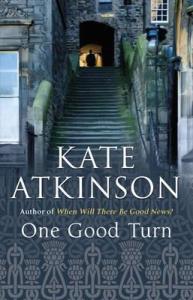
One Good Turn by Kate Atkinson

One Good Turn After reading Case Histories, the first of Kate Atkinson’s Jackson Brodie novels just before New Year, I was desperate to continue with the series. Luckily, I saw a copy of the second book, One Good Turn (subtitled A Jolly Murder Mystery), on the shelf on my next visit to the library so I didn’t have too long to wait!

Following the events of Case Histories, Jackson Brodie has given up his private investigating, taken his inheritance and is leading a quiet life in the French countryside. At the beginning of One Good Turn, he is visiting Scotland for the Edinburgh Fringe Festival where his girlfriend, Julia, is acting in a new play. On Tuesday, as he waits to enter a comedy venue, Jackson witnesses a road rage incident in which one man attacks another with a baseball bat. Jackson doesn’t want to get involved but it seems that he may have no choice.

Another bystander is crime writer Martin Canning, who intervenes by throwing his laptop at the assailant – and then begins to wish he hadn’t when he is asked to accompany the victim to hospital and stay with him overnight. They say that one good turn deserves another, but Martin’s good turn leads to a chain of bizarre incidents that could almost have come straight out of the pages of one of his own Nina Riley crime novels.

Over the next four days, a complex plot unfolds involving a fraudulent businessman, a mysterious cleaning company, a knife-wielding Russian girl, two teenage shoplifters, an unwelcome guest and an aggressive dog. Jackson can’t help being drawn into the investigations, but as the mystery deepens he finds that he has become both a victim and a suspect.

I had enjoyed Case Histories but I thought this one was even better. It was good to meet Jackson again and to see how his relationship with Julia has developed, but I also think it’s good that Jackson is only one of a large cast of eccentric, colourful characters, each of whom becomes caught up in the whirlwind of events. Atkinson puts so much detail and so much humour into her characterisation that each one feels like a real person – we can laugh at them and with them, but we can understand them and have sympathy for them as well.

In this book, we get to know Gloria Hatter, the bored and disillusioned wife of an unscrupulous businessman in trouble for fraud; police detective Louise Monroe, who is trying to investigate the case while struggling to cope with the behaviour of her teenage son; and my favourite, Martin the crime novelist, a shy, reclusive man still haunted by memories of a disastrous trip to Russia several years earlier. Martin’s Nina Riley mysteries sounded so much fun I kept wishing they really existed!

The one criticism I had of Case Histories – the fact that it dealt with three separate storylines that never really came together – was not a problem with this book, as it’s more of a conventional crime novel in that respect. Characters and events that seemed unrelated at the beginning do eventually begin to overlap and things start to fall into place (comparisons are made throughout the novel to a set of Russian dolls, with one fitting inside the other). I loved the ending too; there was a surprise on the final page that left me questioning everything I’d read about one of the characters!

Now I’m looking forward to reading the third book in the series, When Will There Be Good News?

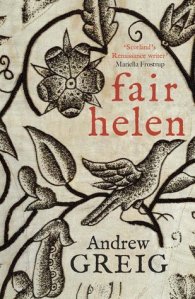
Fair Helen by Andrew Greig

Fair Helen Last year I started a little project of my own – which I don’t think I ever actually blogged about – to work through the titles shortlisted for the Walter Scott Prize for Historical Fiction since it began in 2010. So far I’ve discovered some great books including An Officer and a Spy, Harvest and The Garden of Evening Mists. This book, Fair Helen, is another one that I’ve enjoyed and might never have thought about reading otherwise.

Fair Helen, by Scottish author Andrew Greig, is a beautifully written novel based on the Border ballad, Fair Helen of Kirkconnel Lea which begins:

“O that I were where Helen lies!
Night and day on me she cries;
O that I were where Helen lies,
On fair Kirkconnel Lea.”

The ballad goes on to tell of two rivals for Helen’s love, a shot being fired and Helen falling dead into her lover’s arms. In Fair Helen, Andrew Greig offers one possible interpretation of this ballad, retelling some of its events and expanding on it to include other aspects of Scottish history and Border folklore.

In the late 16th century, when the novel is set, ‘Jamie Saxt’ (King James VI) is on the throne of Scotland, while England’s Queen Elizabeth is approaching old age with no heir of her own. Soon the two thrones will be united under James, bringing some sort of peace and order to the Border region. In the meantime, though, the Borders remain a wild and dangerous place where clans of reivers on both sides of the English-Scottish border fight and feud, steal cattle and conduct raids.

Adam Fleming, whose stepfather is ‘heidsman’ (leader) of the Flemings, has fallen in love with the beautiful Helen Irvine of Annandale. Unfortunately, Helen has already been betrothed to another man, Robert Bell, because the Irvines are keen to form an alliance with the Bell family. Adam has no intention of ending his romance with Helen and summons an old friend from his student days, Harry Langton, to help arrange their secret trysts.

Harry is the narrator of Fair Helen, looking back on the events of the past from several decades into the future, and he is the ideal person to tell the story, being Adam’s best friend and Helen’s cousin. But Harry is also working for another, more powerful patron – someone who has plans of his own for the Borders and will have no sympathy for two young lovers who get in the way of his plans.

I was surprised by how much Andrew Greig managed to pack into the story. I was expecting a tragic romance (according to the cover, the ballad is sometimes described as the Scottish Romeo and Juliet) but it was so much more than that. In fact, the story of Adam and Helen is only one part of the story, no more or less important than the Border politics, the complex feuds and alliances between the clans, and the plotting and scheming going on behind the scenes. There’s a lot happening in this book, yet the pace never feels too rushed.

I always enjoy reading about the Border Reivers, as I live quite close to the Borders (on the English side), but so far I’ve found very few novels that deal with the subject. As I read Fair Helen I kept thinking of Dorothy Dunnett’s The Disorderly Knights – some of the same Borders families appear in both books, such as the Scotts of Buccleuch, and in both there is a dramatic Hot Trod (a lawful pursuit of a raiding party). I wish more authors would choose to write historical fiction based on this fascinating time and place in history – or maybe there are lots of books already and I just haven’t discovered them yet. I do have some non-fiction books on my list for future reading!

I’ve already mentioned how beautiful Andrew Greig’s writing is but I think it deserves to be mentioned again as it really is lovely and poetic, filled with feeling and emotion. The language used is suitable for the 16th century, with no inappropriately modern phrases finding their way into the dialogue to spoil things (one of my pet hates with historical fiction). Harry’s narration is written in the Scots dialect, which also adds to the authenticity. Definitions of unfamiliar words are not given directly in the text – you can usually work them out from the context of the sentence or if not, you can look them up in the glossary at the end of the book. Unless, of course, you’re Scottish in which case it shouldn’t be a problem at all!

Andrew Greig has written six other novels as well as some non-fiction and poetry. If you’ve read any of his other books, please let me know which you would recommend.

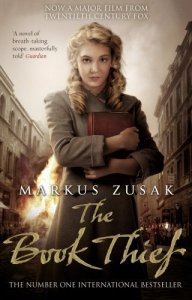
The Book Thief by Markus Zusak

The Book Thief I know what you’re thinking: how could I possibly have not read The Book Thief until now? My answer is that I really don’t know. My excuse is that I wasn’t paying much attention to new releases at the time when the book was published in 2005 so I missed all the hype surrounding it. Since then I have just never felt like reading it; there has always been another book calling to me more loudly. Now that I’ve finally read it, of course, the next question is: was it worth waiting for? And my answer to that is, sadly, no. Not only am I one of the last people in the world to have read The Book Thief, it seems that I’m also one of the only people not to have loved it.

The novel is narrated by Death, who is experiencing one of the busiest times of his career – World War II. Death is everywhere during the war, but he has chosen to focus on the story of a nine-year-old German girl called Liesel Meminger. Liesel’s parents are communists and as the novel begins in 1939, Liesel and her brother, Werner, are being sent to live with a foster family in the small town of Molching. Werner dies during the journey and this is when Death has his first encounter with Liesel – and when he first witnesses her stealing a discarded book, which happens to be called The Grave-Diggers Handbook.

Liesel can’t read but she is fascinated by books and words and this is what sustains her as she faces the challenges of settling into a new home. Her kind-hearted foster father, Hans Hubermann, teaches her to read and with the help of her new friend, Rudy Steiner, Liesel soon begins to add to her small library, becoming the ‘book thief’ of the title. Despite the atrocities going on in the world around her, Liesel’s life on Himmel Street, Molching, is relatively peaceful until the arrival of Max Vandenburg, a Jew in need of help – and a basement to hide in.

I said that I didn’t love the book, but this doesn’t mean I didn’t like it at all, because I did. My problem was the writing style – or I should say, styles, as there are so many all incorporated into one book. There are some very short sentences, some partial sentences, nouns used as verbs, dictionary definitions dropped into the text, and parts of the story told in the form of illustrations and cartoons. Sometimes Death interrupts his narration to talk directly to the reader, to make an observation or to hint at something that will happen later in the book.

It’s certainly creative and unique – I’ve never read anything quite like it – and I can see that a lot of readers will absolutely love it, but I am just not a fan of writing that feels experimental or gimmicky. I don’t even like it when a book is written in the present tense! I find that when a novel is written in an unusual way I end up being distracted by the writing instead of being drawn into the story and the lives of the characters. While I was reading The Book Thief I felt that I was never quite there on Himmel Street with Liesel and Rudy and the others; I could never forget that I was reading a book.

I did like the idea of the story being narrated by Death. I’m aware that this is not a very original concept and that there are other books that also use Death as a narrator (some of Terry Pratchett’s, for example) but I haven’t personally read any so it was something different as far as I was concerned! There were other things that I liked – the development of Liesel’s relationship with her foster parents; the stories Max writes while he’s hiding in the basement; watching Liesel discover the joys of reading – and by the time I started to approach the final chapters of the book, I found that Zusak had made me care about the characters and their fates. There’s no doubt that this is a very moving book and I was close to tears once or twice near the end.

Despite being a little bit disappointed by this book, I completely understand why it is so popular and why so many people love it. I know I’m in a tiny minority, so please, if you haven’t read it yet don’t let me put you off – try it for yourself and see what you think!

2015 Historical Fiction Reading Challenge

2015 HF Reading Challenge Button_FINAL I’ve been avoiding the temptation to sign up for any reading challenges for 2015 as I want to keep things simple and free of stress. However, I’ve been awaiting the announcement of this year’s Historical Fiction Reading Challenge as it’s one challenge that I always like to participate in and don’t find stressful at all!

This challenge has previously been hosted by Historical Tapestry but there’s a new host this year – Amy at Passages to the Past. Amy is very active in the historical fiction community and I’m sure she’ll be a great host.

The challenge runs from January 1st to December 31st 2015 and there are six different levels to choose from:

20th century Reader – 2 books
Victorian Reader – 5 books
Renaissance Reader – 10 books
Medieval – 15 books
Ancient History – 25 books
Prehistoric – 50+ books

Any type of historical fiction is accepted including sub-genres such as Historical Romance, Historical Mystery, Historical Fantasy and Young Adult.

As such a large proportion of my reading is historical fiction anyway, I know I will read more than 25 books so although I might not reach 50 I’m going to aim for the Prehistoric level.

I’ll be keeping track of my progress on my Challenges page.

If you’re interested in joining the challenge too, please see the challenge sign-up post at Passages to the Past!