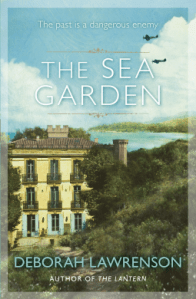
The Sea Garden by Deborah Lawrenson

The Sea Garden I remember hearing a lot about Deborah Lawrenson’s The Lantern a few years ago but never found time to read it, so I was pleased to have the opportunity to read her latest book, The Sea Garden. This book consists of not just one story, but three, each taking up approximately one third of the book and introducing us to three very different women. The stories are loosely connected but each has a different setting and a different feel.

The first of the three stories (you could probably call them novellas) is also titled The Sea Garden. It’s 2013 and Ellie Brooke, a landscape garden designer, is visiting Porquerolles, a small island off the coast of France where she has agreed to restore a memorial garden for a client, Laurent de Fayols. However, she is unprepared for both the hostile welcome she receives from Laurent’s elderly mother and for the supernatural experiences that happen to her while on the island. Ellie’s story then comes to an abrupt end and another begins…

The Lavender Field takes us back to Nazi-occupied France in 1944 and a small community of people working for the French Resistance. Marthe Lincel, a young blind woman, is an apprentice at the Distillerie Musset in Provence. Her work involves creating fragrances and perfumed soaps, but as the war progresses she turns her skills to helping Allied soldiers. There are the beginnings of a dramatic and romantic wartime story here, but again we come to the end too soon…

The third and final story is A Shadow Life, the story of Iris Nightingale, who is working for British Intelligence in 1943, gathering information and recruiting spies to be sent into occupied France. Iris grows close to one of the agents, Xavier Descours, but his work is secretive and dangerous and this is not a good time to be falling in love. As the book draws near to its conclusion, we finally begin to see some connections between Ellie, Marthe and Iris and the men in their lives.

This is a beautifully written book, set in a time period I love to read about (World War II). There are some lovely descriptions of Provence with its lavender fields and also of the island of Porquerolles, a place I previously knew nothing about. The Porquerolles story has some ghostly/supernatural elements and I was impressed with the way the author creates such an eerie atmosphere in what should be a peaceful, idyllic setting. I also enjoyed learning about the work Iris carries out for the SOE (Special Operations Executive); it was fascinating to see the level of secrecy that was required when going undercover in France!

My problem with this book was the structure. Keeping the three stories separate just didn’t work for me as well as a more traditional multiple time period novel would have done. While there were definitely some links between the three, most of these didn’t become obvious until very near the end of the book. When things did start to come together the result was fascinating, but it happened too late and I’m sure I would have been happier if the three stories had been woven together from the beginning to form one cohesive novel.

Marthe’s section in particular felt very disconnected from the other two – yes, there was some character overlap, but I’m not convinced that such a large chunk of the book needed to be devoted to Marthe’s story. The third story – the one with Iris and the secret agents – was the one I found most compelling, possibly because it’s the only one that felt like a complete story and brought in elements from the other two. At the end, though, there were still some questions left unanswered and if I had enjoyed the book more, I would have taken the time to go back and search the earlier sections to see if there were any clues I had missed.

I received a copy of The Sea Garden for review via NetGalley

Another Classics Club Spin!

The Classics Club

It’s time for another Classics Club Spin and after enjoying my last few spin books I’m quite excited about this one.

If you need a reminder, here are the rules:

* List any twenty books you have left to read from your Classics Club list.
* Number them from 1 to 20.
* Next Monday the Classics Club will announce a number.
* This is the book you need to read by 5th January.

And this is my list:

1. David Copperfield by Charles Dickens
2. The Woodlanders by Thomas Hardy
3. A Country Doctor’s Notebook by Mikhail Bulgakov
4. Crime and Punishment by Fyodor Dostoevsky
5. The Vicomte de Bragelonne by Alexandre Dumas
6. The Glass-Blowers by Daphne du Maurier
7. The Sea-Hawk by Rafael Sabatini
8. Prince of Foxes by Samuel Shellabarger
9. The Return of the Native by Thomas Hardy
10. I, Claudius by Robert Graves
11. Excellent Women by Barbara Pym
12. Mary Anne by Daphne du Maurier
13. Bellarion by Rafael Sabatini
14. The Heart of Midlothian by Walter Scott
15. Lorna Doone by R.D. Blackmore
16. The Day of the Triffids by John Wyndham
17. Vanity Fair by William Makepeace Thackeray
18. The Leopard by Giuseppe Tomasi di Lampedusa
19. Around the World in Eighty Days by Jules Verne
20. Oliver Twist by Charles Dickens

I’m happier with this list than I’ve been with any of the other lists I’ve put together for the spin because I’m genuinely looking forward to reading all of those twenty books. I’m not in the right mood at the moment to try to force myself to read something I don’t really feel like reading.

Usually I stick to one book per author for my spin lists but this time I’ve included some of my favourite authors more than once.

Have you read any of these books? Which one would you be hoping for?

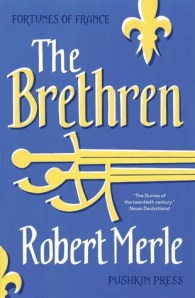
The Brethren by Robert Merle

The Brethren How could I resist a book that has been compared to both Alexandre Dumas and Dorothy Dunnett’s Lymond Chronicles? The Brethren is the first in Robert Merle’s thirteen-volume series, Fortunes of France, and sounded exactly like the sort of book I usually love! I was surprised to find that, despite being hugely successful in France when it was originally published between 1977 and 2003, the series is only now being made available in an English translation for the first time by Pushkin Press.

This first instalment introduces us to the de Siorac family and is set in the 16th century during the French Wars of Religion, a period of conflict between the Catholics and the Huguenots (Protestants). Our narrator is Pierre, the young son of Jean de Siorac, a former soldier who retires to the castle of Mespech in the Périgord region of France and establishes a small Huguenot community there with the help of his friend, Jean de Sauveterre. The two Jeans are such close friends that they formally adopt each other as brothers, becoming the ‘brethren’ of the title, but while they are united in their religious beliefs, they have very different personalities!

The adventures that follow are remembered by an older Pierre, looking back on his life. He tells us of the time the château of Mespech was attacked by a band of gypsies and of an attempt to rescue the family’s former maid from a plague-stricken town, as well as the more mundane tasks of haymaking and harvesting. We also get to know the other members of the household, from Pierre’s Catholic mother (whose refusal to convert is a source of discord within the family) and his wet-nurse’s mischievous daughter, Little Helix, to the superstitious cook, La Maligou, and the three veteran soldiers who have been with the two Jeans since their earliest military campaigns. Most of all, though, we follow the religious struggles taking place between Catholic and Huguenot, both within the walls of Mespech and throughout the whole of France.

I found The Brethren an enjoyable book, although it was not exactly what I had expected. It lacked the humour and flair of Dumas’ novels and the characters didn’t come to life the way Dunnett’s do, but I did still find plenty of things to love. The portrait of 16th century France is vivid and fascinating and I learned a lot about the religious wars, which I’ve never read about in so much detail before.

After finishing the book I was interested to discover that Robert Merle had written the originals using a form of 16th century French. The English edition, you may be relieved to hear, is not written in anything resembling 16th century English, but it does not really seem like an entirely modern translation either. This wasn’t a problem for me, as I do like books to have an old-fashioned feel, especially when I’m reading historical fiction. However, the writing does become quite dry in places and there’s not as much action as I would have hoped for, with a lot of time spent on discussions of religious treaties and detailed descriptions of battle strategies.

As Pierre is a young child throughout most of this novel and still only fifteen, I think, at the end, many of the things he tells us about are things he has not actually witnessed or taken part in personally. Instead, he gives us second-hand accounts of his father’s adventures, often drawing on Jean de Siorac’s journal, the Book of Reason. This has the effect of creating a distance between Pierre and the reader so that I found his narration slightly detached at times. But although Pierre didn’t pull me into the story as quickly as I would have liked, I did eventually become completely absorbed in the lives of the de Siorac family. I’m already looking forward to the second book and I hope Pushkin Press will continue to publish the rest of the series.

I received a copy of this book from the publisher for review.

The White Princess by Philippa Gregory

The White Princess - Philippa Gregory The White Princess is the fifth book in Philippa Gregory’s Cousins’ War series. The Cousins’ War is another name for the Wars of the Roses, a series of 15th century conflicts between the House of York and the House of Lancaster, two rival branches of the English royal family. This novel is set at the end of the period, just after Henry Tudor has defeated Richard III at the Battle of Bosworth and has been crowned Henry VII. Our narrator is Henry’s wife, Elizabeth of York, a niece of Richard III and daughter of another former king, Edward IV. The novel takes us through the early years of Elizabeth’s marriage to Henry (an alliance which was supposed to unite the houses of York and Lancaster), the births of their children and the plots and conspiracies that troubled Henry’s reign.

The Wars of the Roses is a period filled with mysteries and controversies and every author or historian seems to have their own set of opinions and theories. The most intriguing of these mysteries is of course the question of what happened to Elizabeth of York’s two younger brothers who disappeared from the Tower of London never to be seen again. Were they murdered and if so who by? Or did one of them manage to escape? Henry VII was unable to prove that the two princes were dead, so the possibility that they could have survived gave rise to a series of Yorkist rebellions. In The White Princess we focus on one of these uprisings, centred around a pretender known as Perkin Warbeck who claims to be the younger of the princes, Richard, Duke of York. Is he really who he says he is and if so, must Elizabeth choose between her husband and her brother?

While I’m not a particularly big fan of Philippa Gregory’s writing and I think there are much better historical fiction authors out there (and much better Wars of the Roses novels – The Sunne in Splendour by Sharon Penman is my top recommendation) I have quite enjoyed following this series and learning more about the women of the period. This one, though, was disappointing and the weakest of the series, in my opinion. It felt repetitive and unnecessarily long and I just didn’t find Elizabeth a very engaging narrator.

The story is based around two theories that you may or may not find plausible. The first is the idea that Elizabeth was in love with Richard III, her uncle, and that they were romantically involved. As far as I know, there is no historical evidence for this but Gregory is not the only author to have suggested it and I suppose it did add an extra layer to her portrayal of Elizabeth and Henry’s marriage. Then there’s the Perkin Warbeck story, which dominates the second half of the novel. I have read about Perkin Warbeck before and am familiar with the arguments for and against him being the lost prince; the theory Gregory describes here seems very unlikely to me, but this is fiction after all!

Something I think Philippa Gregory is very good at is making a complex period of history easy to understand. Even with no previous knowledge you would probably be able to follow what is happening in this novel without too many problems. Sometimes, though, I think she goes too far in her attempts to clarify things for the reader. For example, when Elizabeth is talking to her sister Cecily about their half brother she refers to him as “Thomas Grey, Mother’s boy” which just sounds silly, doesn’t it?

My biggest problem with this book, though, was the portrayal of the main characters. Elizabeth had such an interesting life and yet she comes across in The White Princess as boring. She doesn’t have the strength, intelligence and spirit of the other women who have been featured in the series – Elizabeth Woodville (The White Queen), Margaret Beaufort (The Red Queen), Jacquetta Woodville (The Lady of the Rivers) and even Anne Neville (The Kingmaker’s Daughter). The portrayal of Henry VII is very negative, which makes it difficult later in the book when we are expected to accept that Elizabeth is starting to love him. I don’t see how anyone could have loved the cruel, petty, vindictive Henry described in this book – especially after something he and his mother do to Elizabeth at the beginning of the novel, which I won’t go into here!

I think maybe I should have skipped this book and gone straight to the latest one, The King’s Curse, which sounds more intriguing and seems to be getting better reviews than this one. It’s about Margaret Pole, Elizabeth’s cousin, an historical figure I know nothing about. I’m looking forward to reading it eventually despite my problems with this one.

For more Wars of the Roses recommendations see My Journey Through Time: The Wars of the Roses and for more on Elizabeth of York and Henry VII see The Tudors – Part I.

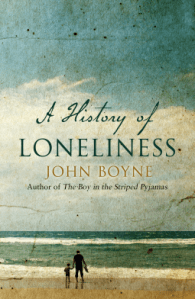
A History of Loneliness by John Boyne

A History of Loneliness The first John Boyne book I read was This House is Haunted, a Victorian-style ghost story. The second was Crippen, a fictional account of the life of the murderer Dr Hawley Harvey Crippen. His latest novel, A History of Loneliness, deals with a subject no less dark and disturbing: the child abuse scandal within the Catholic Church in Ireland.

If you have heard about this scandal on the news or read about it in the newspapers, you have probably asked yourself the following questions. How did these paedophiles get away without being caught for so long? Their friends and colleagues must have known what was going on, so why didn’t they say anything? And why did the victims not come forward earlier? John Boyne attempts to answer these questions and more through the story of Odran Yates, a Catholic priest from Dublin who is ordained in the 1970s and lives through some of the darkest days in the church’s recent history.

Having lost his father and little brother under tragic circumstances during a family beach holiday, the young Odran doesn’t argue when his mother tells him he has a vocation for the priesthood and must dedicate his life to God. After seven years of training, Odran begins working at Terenure College where he finds that teaching English and tidying books in the school library suits him better than carrying out the duties of a traditional parish priest. Hiding away in his library for thirty years, Odran is able to ignore what is happening elsewhere in the church…but is he really as oblivious as he claims to be?

A History of Loneliness is a very insightful and thought-provoking novel and my favourite John Boyne book so far. This is obviously never going to be an easy or comfortable subject to write a book about, but he handles it with sensitivity and understanding. By telling the story from Odran’s perspective this means the focus is not just on the issue of child abuse itself, but also on the dangers of burying our heads in the sand and choosing not to confront things that we find difficult or unpleasant.

There are several different ways in which Odran’s character could be interpreted. I saw him as a weak, naïve but basically well-meaning person who made some terrible mistakes and serious errors of judgment. It’s difficult for anyone to know how they would react under similar circumstances, but I’m sure we would all like to think that we would do what is right and not just take the easy way out. Odran doesn’t always do the right thing and he does sometimes take the easy option, but does that make him as guilty as the people who have actually committed the crimes? It’s left to the reader to decide how much blame should be attributed to Odran and those like him and whether there can ever be any excuse for turning a blind eye and doing nothing.

The novel has an interesting structure as the chapters don’t follow each other chronologically (a chapter set in 2006 is followed by one set in 1964 and then 1980). This was confusing at times but very effective because it meant we were filling in one piece of the story at a time, like a jigsaw puzzle. John Boyne is a wonderful storyteller and as well as exploring the serious, sensitive issues I’ve already described, he also creates an absorbing personal story for Odran and his family which unfolds slowly as we jump back and forth in time.

With the story spanning more than five decades, we are shown how public perception of the Catholic Church has changed over the years. In the 1970s and 1980s, Odran is treated with respect and admiration everywhere he goes; people trust him and look to him for help and advice, never questioning his integrity. By the time we reach the present day, attitudes are completely different. A man spits in Odran’s face just because the clothes he is wearing identify him as a priest, while an attempt to help a lost child in a department store ends in disaster. It’s sad because, of course, not everyone within the church was involved in these sexual scandals and yet they have all suffered through the actions (or non-actions) of others.

A History of Loneliness could easily have been a very depressing book, but thankfully Boyne does add some humour to the story – even if he does seem to rely on Irish stereotypes and clichés at times (if you’ve ever watched the comedy Father Ted you’ll know the sort of humour I mean). If I haven’t already made it clear, I loved this book and am so glad I still have so many of John Boyne’s earlier novels left to explore!

I received a copy of this book for review via NetGalley.

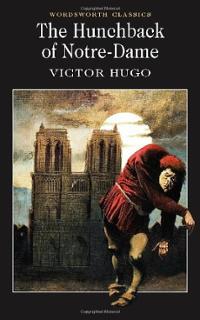
The Hunchback of Notre-Dame by Victor Hugo

The Hunchback of Notre-Dame Or Notre-Dame de Paris, to give it its original French title and one which is much more appropriate. Quasimodo, the hunchback, has a surprisingly small role in the book while the cathedral of Notre-Dame itself is at the heart of the story, with most of the action taking place within its walls, on top of its towers or in the streets and squares below.

Set in 15th century Paris, the novel follows the stories of three tragic and lonely people. First there’s the beautiful gypsy dancer, La Esmeralda, who captivates everyone she meets with her looks, her dancing and her magic tricks. Alone in the world with only her goat, Djali, for company, she dreams of one day being reunited with her parents. Then there’s Claude Frollo, the Archdeacon, once a good and compassionate man who rescued Quasimodo as a child and raised him as his son. He becomes obsessed with Esmeralda after seeing her dancing in the Place de Grève and descends into a life dominated by lust and envy, turning away from the church and towards black magic. Finally, of course, there’s Quasimodo himself, the bell-ringer of Notre-Dame. Outwardly deformed and ugly, his kind heart and his love for Esmeralda lead him into conflict with his adoptive father, Frollo.

I read Hugo’s Les Miserables almost exactly five years ago and I really don’t know why it has taken me so long to read another of his books. I loved Les Miserables and I loved this one too, though not quite as much; this is a shorter and slightly easier read, but I didn’t find the story as powerful or emotional. It was a good choice for the R.I.P. challenge, though – the atmosphere is very dark and there are plenty of Gothic elements.

At least having had some previous experience of Hugo meant that I knew what to expect from his writing! You need to be prepared for some long diversions and chapter after chapter that has almost nothing to do with the plot or the main characters. Hugo devotes a lot of this novel to discussing Gothic architecture, the structure of the cathedral, the geographical layout of Paris and other topics which may or may not be of interest to the reader. I’m happy to admit that I didn’t read every single word of these sections (in fact, I skipped most of the chapter entitled A Bird’s-Eye View of Paris) and I don’t feel that I missed anything as a result.

The version of the book that I read is not actually the one pictured above (I just wanted a book cover to illustrate my post). I downloaded the free version from Project Gutenberg for my Kindle, which is Isabel F. Hapgood’s 1888 translation. I was very happy with it, but I’m used to reading older books and older translations; depending on your taste you might prefer a more modern translation. And just as a side note, does anyone else love books with imaginative chapter titles? There are some great ones here, including The Inconveniences of Following a Pretty Woman through the Streets in an Evening, The Effect which Seven Oaths in the Open Air Can Produce and The Danger of Confiding One’s Secret to a Goat. Much more intriguing than just numbering them 1, 2, 3!

As I’ve now read Hugo’s two most popular books, can anyone tell me if there are any others that I should read? I like the sound of Ninety-Three and The Man Who Laughs, but are they worth reading?

Burial Rites by Hannah Kent

Burial Rites Based on a true story, Burial Rites is a fictional account of the final weeks in the life of Agnes Magnúsdóttir, the last woman to be executed in Iceland.

It’s 1829 and Agnes – along with two other people – has been found guilty of murdering her lover, Natan Ketilsson. Due to the lack of prisons in the north of Iceland, Agnes has been sent to the farm of District Officer Jón Jónsson where she will await the day of her beheading. Understandably, Jón’s wife and daughters are nervous and angry about having a convicted murderer coming to stay with them, but as they have no choice in the matter they must find a way to deal with their fear and distrust.

Agnes is visited at the farm by Assistant Reverend Thorvárdur Jónsson (known as Tóti), the young priest she has chosen to act as her confidant and spiritual adviser. At first Tóti is surprised to have been given this task and isn’t sure how he can help Agnes, but he soon discovers that all she needs is someone to talk to about her past and about the events leading up to the night of the murder. As Tóti and the Jónsson family listen, the story of Agnes Magnúsdóttir begins to unfold.

It seemed that everyone was reading Burial Rites a while ago, especially when it was shortlisted for the Women’s Prize for Fiction earlier in the year. Despite the good reviews, it was not a book that sounded very appealing to me and I wasn’t planning to read it, but when I noticed it in the library I thought I would give it a try. Now that I’ve read it, I can understand why it has been so successful – it’s beautifully written, the setting is stunning and the atmosphere is haunting – and I did enjoy it, though maybe not as much as other people have.

I loved the Icelandic setting. This is not a story that would have worked had it been set in any other time or place. Nineteenth century Iceland, its landscape, its weather and its small rural communities are as important to the novel as the characters and the plot. The author does a great job of portraying both the isolation of farms and crofts such as Jón Jónsson’s at Kornsá or Natan’s at Illugastadir and the claustrophobia of daily life (entire families lived and slept in one room, known as the badstofa). The book includes extras such as a map and pronunciation guide for readers who, like me, know very little about Iceland.

While Agnes tells part of her story herself in first person, other sections of the novel are told from other perspectives and these are important in helping us to understand the perceptions people have of Agnes. It’s not surprising that Jón’s wife, Margrét, and daughters, Steina and Lauga, react with fear and suspicion at first, but as they learn more about Agnes they begin to adjust the way they think about her. Tóti’s feelings also change over the course of the novel, and so does the reader’s: at the beginning of the book we know nothing about Agnes and have no idea whether she is really guilty or not; by the end, we are left with a sense of sadness and injustice, especially on learning that the other woman accused of the murder (who happens to be younger and prettier) is given the opportunity to appeal while Agnes isn’t.

Of course, the account the fictional Agnes gives of her life and the circumstances of Natan’s murder is not necessarily what happened in real life and we don’t know whether Iceland’s last execution really was a miscarriage of justice or not. Burial Rites is a combination of fact and fiction, the result of both careful research and the author’s imagination. I thought it was interesting that in her author’s note, Hannah Kent says that she doesn’t think of Agnes Magnúsdóttir as a feminist heroine or even a heroine at all; just a ‘human who does not want to die, and no more’. But whatever else Agnes was, she was a character I cared about and I’m pleased to have had the chance to read her story.