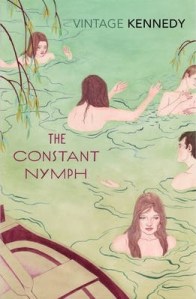
The Constant Nymph by Margaret Kennedy

The Constant Nymph This week Jane of Fleur in her World has been hosting a Margaret Kennedy Reading Week. Margaret Kennedy is a new author for me so I could have chosen to read any of her books (they all sound intriguing in different ways), but I decided to go with The Constant Nymph, as I’d received a copy from NetGalley a while ago. The Constant Nymph was published in 1924 and is probably Margaret Kennedy’s best-known book.

At the beginning of the novel, Lewis Dodd, a talented young composer is on his way to the Tyrol to visit his friend and fellow musician, Albert Sanger, who lives in a chalet in the Alps with his large family. Sanger has seven children – with three different mothers – and they are known collectively as ‘Sanger’s circus’. Lewis has been a frequent visitor to the chalet for years and the children consider him almost part of the family, but for fourteen-year-old Teresa (Tessa) he’s something more than that: he is the man she has loved for as long as she can remember. Lewis loves Tessa too, but as he is more than twice her age, they don’t tell each other how they feel.

When Albert Sanger dies unexpectedly, Sanger’s circus is broken up; the two eldest children, Caryl and Kate, decide to start new lives elsewhere, while Sanger’s current mistress, Linda, moves out of the family home with her young daughter, Susan. Tessa’s sixteen-year-old sister, the wild and free-spirited Antonia, marries her lover Jacob Birnbaum, so that only Tessa and her two younger siblings, Paulina and Sebastian, remain. Their relatives in England come to the rescue, with the children’s cousin, Florence Churchill, setting off for the Alps to see what she can do to help.

Florence is a well-educated, beautiful and refined young woman of twenty-eight and is shocked by the Sangers’ unconventional, bohemian lifestyle. She immediately makes plans to bring Tessa, Paulina and Sebastian to England and send them to school. Before she leaves Austria, however, she finds herself falling in love with Lewis Dodd who is still at the chalet. Despite his feelings for Tessa, Lewis is also drawn to Florence and the two are soon married.

It may seem that I’ve given away a lot of the plot here, but all of this actually takes place in the first half of the book. The remainder of the novel describes the marriage between Lewis and Florence, which as you might expect, is not a very successful one as Lewis really wants to be with Tessa – who is still in love with him. The viewpoint shifts from character to character so that we can understand the emotions and motives of all three (I never managed to warm to Lewis at all, but loved Tessa and had some sympathy for Florence). As the story starts to move towards the final chapters it’s obvious that things aren’t going to end happily for all of them – and maybe not for any of them. The ending, when it does come, is unexpected and not very satisfying. I felt that the characters deserved a better conclusion to their story.

I was also a bit disappointed that so many of Tessa’s other family members and friends disappeared in the middle of the book; Kennedy had gone to so much trouble to introduce us to Caryl and Kate, Linda and Susan, the Russian Trigorin and others, it seemed a shame not to develop any of their stories any further (though I’m aware that there’s a sequel, The Fool of the Family, where we might meet some of them again).

I did enjoy The Constant Nymph, though! The book hasn’t aged very well in some respects (the portrayal of Antonia’s Jewish husband, for example) but then, I read a lot of older books and can accept that sometimes they do feel dated. I loved the setting, the characterisation and the elegant, engaging writing style and am looking forward to reading more of Margaret Kennedy’s books. Thanks to Jane for hosting the reading week and introducing me to an author I might never have thought about trying!


A Glimpse into 1960s Paris – a guest post by Rachel Hore

It’s not often that I have the chance to introduce a guest post here at She Reads Novels, but today I’m pleased to welcome author Rachel Hore to the blog to tell us about researching 1960s Paris for her new novel A Week in Paris which has been published in the UK this week.

Rachel Hore

Rachel Hore

A GLIMPSE INTO 60s PARIS by Rachel Hore

My new novel, A Week in Paris, opens in 1961, when Fay Knox, a young English violinist, visits the city with her orchestra and learns secrets of her family’s wartime past. What was Paris like at that time and how did I go about researching it?

Reading histories of the period gave me the context. Paris, though glamorous, elegant and romantic, a cradle of new ideas in philosophy and high art, was still socially conservative, France as a whole even more so. In 1958, after a period of unstable government and succeeding crises over the war of independence in Algeria, General de Gaulle was recalled as President and a period of strong rule ensued. It wasn’t until the students’ riots and sit-ins of May 1968 that the young and dispossessed really challenged the aging, authoritarian head of government, and change was finally, if painfully slowly, set in motion.

Boutique off Rue de Rivoli

Boutique off Rue de Rivoli (2014)

In other ways, too, the liberal sixties came late to Paris. A glance at the popular music hits of 1961 reveals months of No.1s for traditional French crooners Edith Piaf and Charles Aznavour, with a young Johnny Hallyday making an appearance with ‘Kili Watch’ and, bizarrely for January, Richard Anthony singing ‘Itsy Bitsy Petit Bikini’. This picture had not changed much by early 1964 when the Beatles played a series of concerts at the Olympia music hall. An interviewer had to ask, ‘What is Beatlemania?’ and there were no girls screaming and fainting. Jazz is still big in this period. On her arrival in the city, Fay spots a poster about the trumpeter Miles Davis playing the Olympia.

Paris Match March 1961

Paris Match March 1961

Guidebooks for 1961 were immensely helpful for my research. The Dolphin Guide to Paris, written for American tourists, was full of black and white photographs of the period; a student jazz band jamming on the quays of the Left Bank of the Seine and haute couture models wearing the latest boxy coats – like Fay’s. My copy of Paris Match magazine featuring film-maker Jean-Luc Godard’s elegantly sexy wife Anna Karina made its way into my narrative, as did the Gateway Guide’s advice to fashion-hunters on a budget to visit Worth, Dior and Schiaparelli’s ’ cheaper ‘boutiques’ or to satisfy themselves with the big department stores, Printemps and Galeries La Fayette.

A Bout de Souffle

Poster of A Bout de Souffle

Much has been written about French film of the time. Fay’s fellow musician Sandra is excited when her French boyfriend holds out the possibility of meeting Alain Delon, the heart-breaker star of 1960’s Purple Noon. In the same year came A Bout de Souffle (Breathless) by Jean-Luc Godard, which with its bold visual style and innovative use of jump cuts was hailed as an important example of French Nouvelle Vague (New Wave). Other practitioners included Francois Truffaut (The 400 Blows) and Alain Resnais (Hiroshima, Mon Amour), both released in 1959. Movies, of course, can be a gift to the novelist conducting research as long as one weighs up their veracity.

A rest from sightseeing

A rest from sightseeing

Research can only take the fiction-writer so far. The trick for me was to recognize when to leave it all behind and to enter instead the world of 1961 Paris I’ve imagined – the world Fay sees and in which she lives and loves. When I could hear her voice I knew that it was time to put the books away.

Text and photos ©Rachel Hore 2014 unless stated otherwise.

Hand of Fire by Judith Starkston

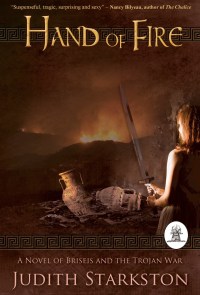
perf6.000x9.000.indd In this wonderful combination of historical fiction and Greek mythology, Judith Starkston reimagines events from the Iliad, telling the story of the Trojan War through the eyes of Briseis, a woman who plays an important role in Homer’s epic despite being only briefly mentioned. In Hand of Fire, Briseis is finally given the attention she deserves.

At the beginning of the novel, Briseis is a young priestess of the healing goddess Kamrusepa, but is sadly unable to prevent her own mother from dying. There is more sadness to follow for Briseis when she is married off to Mynes, a prince of Lyrnessos, and finds him to be a violent and abusive man. Sustained by the compassion of her elderly nurse, Eurome, and by visions of the handsome, half-immortal Greek warrior, Achilles, the turning point comes when the city of Lyrnessos falls to the Greek army and Briseis is taken captive. How can she reconcile her love for Achilles with her new position as slave?

Hand of Fire surprised me; I really didn’t expect to enjoy it quite as much as I did. I love reading historical fiction but tend not to choose books set in the ancient world. I often find that I have trouble identifying with the characters – I sometimes feel that even the non-mythological ones seem more like mythological beings than real people. That was not a problem here: this is a very human story with characters I could love and care about. Briseis herself is a great protagonist and I liked her from the beginning. She has great strength and resilience, all the more impressive when you consider everything she has to endure – the loss of her mother, marriage to a man who treats her badly, personal tragedy in the face of war, life as a captive slave, and her tumultuous relationship with Achilles.

Achilles is more difficult to understand. His personality is complex and conflicted; in battle he is a fierce, mighty warrior gripped by an unstoppable rage, but when he is alone with Briseis we see the gentler, more sensitive side of his nature. Of the secondary characters, there are two in particular that I found very well developed and memorable. One is Eurome, Briseis’ elderly maid, a caring, warm-hearted person and a devoted friend Briseis can trust and rely upon. The other is Patroklos, the beloved companion of Achilles, the only person apart from Briseis who is able to quell his rage.

This is a novel that has been thoroughly researched, which is evident from Judith Starkston’s author’s note in which she describes her reasons for writing this story, the things she discovered during the writing process and the decisions she needed to make. She does an excellent job of drawing on her knowledge of the period to create a convincing picture of what life may have been like for a woman who lived during the Bronze Age. The history of medicine is something I’ve always found very interesting, so I enjoyed the parts of the book that describe Briseis’ work as a healer (which consists mainly of using herbs and magical rituals as unlike her brother, Iatros, she is unable to study to be a physician).

Even for a reader like myself who only has a limited knowledge of Ancient Greece and hasn’t actually read the Iliad, I found this novel very accessible and easy to follow. I appreciated the fact that the author takes the time to flesh out the background to the story and doesn’t just assume that every reader will be familiar with the time period and the mythology. I was also pleased to find that there’s not too much emphasis on the battle scenes! This is Briseis’ story and the focus is on her personal life and on her relationships with Achilles, Mynes and the others. I really enjoyed spending time in her world and will be looking out for more novels from Judith Starkston in the future.

Hand of Fire tour graphic I read Hand of Fire as part of a Fireship Press Virtual Book Tour. You can find the tour schedule here.

The Remains of the Day by Kazuo Ishiguro

The Remains of the Day The Remains of the Day tells the story of Stevens, an elderly butler who worked for many years in the service of Lord Darlington of Darlington Hall. After his master’s death, Stevens has continued to serve the house’s new American owner, Mr Farraday. Given a week’s holiday – and the use of Mr Farraday’s car – Stevens decides to take a drive through the English countryside to visit Miss Kenton, Darlington Hall’s former housekeeper. During the journey, he reminisces about the past, about his relationship with Miss Kenton, and about what makes a butler ‘great’.

I loved this book; it’s definitely one of my favourites of the year. It’s a gentle, slow-paced novel but completely compelling and, despite the lack of drama, I found it difficult to put down. I’m aware that my description above probably doesn’t make the story sound very interesting but I can promise you that it really is! Stevens’ trip through the South West of England (which takes place in 1956) and his memories of the past (the 1920s and 1930s) give the author a chance to explore lots of different topics from the daily duties of a butler and the running of an English country house to the political situation in Europe between the two world wars. Most of all, though, this is a story about loss and regret, misplaced loyalties and missed opportunities.

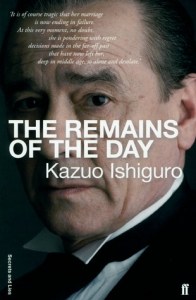
One of the things I found most impressive about this book was the authenticity of Stevens’ narrative voice. Ishiguro gets it completely right; the language is formal, emotionally restrained and perfectly suited to what we learn of Stevens’ personality. I could almost have believed that I really was reading the memoirs of an elderly British butler! The edition that I read (a library book) was from Faber and Faber’s ‘Secrets and Lies’ series of modern classics, which immediately made me wonder what secrets Stevens was keeping from us and what lies were being told. However, it’s not as simple as that. Unlike some unreliable narrators, Stevens is not intentionally trying to mislead the reader; he is actually lying to himself. He knows, for example, that Lord Darlington’s views are not always entirely right, but he wouldn’t dream of questioning them and manages to convince himself that there’s nothing to worry about.

Stevens spends a lot of time thinking about the qualities that make a great butler and he decides that the most important of these qualities is ‘dignity’. Sadly, Stevens has devoted so much of his life to maintaining his dignity that he has missed out on things like love and friendship and has denied himself the right to form opinions of his own. He never allows himself to experience pleasure or enjoyment and never displays any emotion, even when faced with personal tragedy. His story is such a sad one, though not without any humour – the book is quite funny in places, especially when Stevens describes his unsuccessful attempts at ‘bantering’. The ending is perfect too; the book’s final chapter is poignant and moving but does leave both the reader and Stevens with some hope and optimism.

The only other book I’ve read by Kazuo Ishiguro is Never Let Me Go, which I enjoyed but didn’t love as much as this one, although it’s difficult to compare the two as they’re so completely different. Now I’m wondering which of his books I should read next.

The Haunting of Hill House by Shirley Jackson

HillHouseReadalong I’ve included this book on my R.I.P. list every year since I read We Have Always Lived in the Castle in 2011, but this is the first year I’ve actually found time to read it, thanks to a readalong hosted by the Estella Society. They have posted some discussion questions for us today, which I didn’t see until I had already written my post…though I think I’ve said everything here that I want to say anyway. I’ll look forward to reading what everyone else thought of it!

The Haunting of Hill House is a 1959 novel by Shirley Jackson. Dr John Montague, an anthropologist and psychic investigator, is renting Hill House for the summer in the hope of studying the supernatural phenomena and ghostly manifestations that he believes take place there. After assembling a list of people who have had previous paranormal experiences he invites them to stay in the house with him as his assistants, but there are only two who accept the invitation: Eleanor Vance, a shy, lonely woman of thirty-two, and the confident, outgoing Theodora. Accompanied by Luke Sanderson, whose aunt is the owner of Hill House, Dr Montague and his guests arrive at the house one by one and wait for something to happen.

Things do soon begin to happen but I can’t tell you too much about those happenings because as with all books of this type it’s best if you know as little as possible before you start. All I will say is that the story is told from Eleanor’s perspective…and Eleanor is not always entirely reliable. The supernatural element of the novel is quite subtle and you can never be completely sure what is going on. Because we spend so much time inside the head of a character who is unstable and insecure it’s difficult to tell exactly what is real and what isn’t.

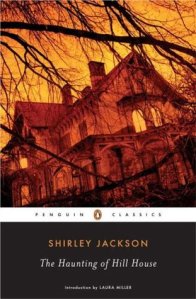
The Haunting of Hill House I didn’t find this book as frightening as I’d expected, but that could just be because I deliberately avoided reading it late at night (I’m a coward when it comes to books like this). There are certainly some very creepy moments, though – without having to resort to graphic horror, Jackson is still able to unsettle the reader and convey the feeling that something isn’t quite right. I loved the descriptions of Hill House – it has all the characteristics you would expect a haunted house to have, including a tragic history – but there are very few physical manifestations of ghostly activity. The creepiness of the story comes mainly from the fact that we don’t know how much of the ‘haunting’ is caused by Hill House itself and how much is the product of Eleanor’s disturbed mind.

I had been looking forward to reading The Haunting of Hill House because of its status as a classic American haunted house story and because I loved the other Shirley Jackson book I read. I really wanted to love this one too, but I have to be honest and say that I didn’t. It was good, but not as good as We Have Always Lived in the Castle. However, if you’re new to Shirley Jackson, I would recommend either of these two books as a perfect read for this time of year.

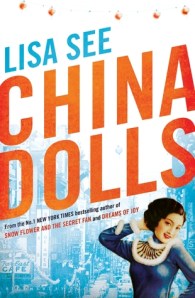
China Dolls by Lisa See

China Dolls Lisa See is a Chinese-American author whose books deal with various aspects of Chinese history and culture. I had mixed feelings about the first one I read, Snow Flower and the Secret Fan, but I loved Shanghai Girls and its sequel Dreams of Joy, so I was looking forward to reading her new novel, China Dolls.

Beginning in 1938, China Dolls is a fictional account of three young women who meet at an audition for dancers at San Francisco’s Forbidden City nightclub.

First there’s Grace Lee, who grew up in a small town in Ohio – a town so small that, apart from her parents, Grace has never met another Chinese person and has never even tasted Chinese food. She has come to San Francisco to escape from her abusive father and is hoping to build a career for herself in show business.

Then there’s Helen Fong, whose family is one of the richest and most respected in Chinatown. Her strict parents disapprove of her decision to work in a nightclub…until Helen points out that she will be earning much more than in her current job at the Chinese Telephone Exchange. Helen appears to have led a sheltered life, but is hiding some secrets which she is reluctant to reveal even to her friends.

Finally, there’s Ruby Tom from Hawaii. Ruby, who is the most outgoing and flamboyant of the three, also has a big secret: although she has allowed everyone to think she is Chinese, she is actually Japanese. If the authorities learn the truth, Ruby could be in trouble, especially when anti-Japanese sentiment increases following the bombing of Pearl Harbor.

Three girls with very different personalities and from very different backgrounds! Despite having little in common, they are drawn together that day at the audition and become friends, helping and supporting each other as they try to fulfil their ambitions. As the months and years go by, though, the girls find that their friendship is tested by a series of lies and betrayals, disagreements and withheld secrets.

China Dolls was compelling enough to keep me interested right to the end but I found it quite disappointing after Shanghai Girls and Dreams of Joy. The main reason for my disappointment was something which should have been the strong point of the book: the friendship between Grace, Helen and Ruby. It just wasn’t convincing at all! The three of them didn’t even seem to like each other and were certainly not ‘like the Three Musketeers’, as they claimed. They said and did some terrible things to each other and I couldn’t understand why they didn’t just go their separate ways in life.

The structure of the novel, with the three girls taking turns to narrate chapters, was also a problem for me. I got the impression that the story Lisa See really wanted to write was Grace’s – she is the easiest character to like and identify with, and she seemed to get a few more chapters than the others too – so I think I would rather have had the entire book written from Grace’s perspective. Having said that, Ruby’s story had the potential to be the most interesting, particularly after Pearl Harbor, and she was also the only one whose narrative voice felt significantly different (filled with some of the lively slang of the period); the other two were interchangeable and sometimes it was easy to forget who was narrating.

Grace, as I’ve mentioned, was my favourite of the three girls but she didn’t have much competition as I really disliked both Helen and Ruby – particularly Helen, whom I never really felt I understood or could have any sympathy for, despite some of the ordeals she had been through. Of the novel’s other characters, only one or two play a significant part in the story, and the rest are just secondary – though I was interested to discover, after finishing the book, that some of the characters I’d assumed were fictional were actually people who really existed.

The historical backdrop of the story is excellent; everything feels thoroughly researched and we are given lot of great insights into the entertainment world of the 1930s and 1940s, in particular what it was like to work in a Chinese nightclub and the challenges facing the Chinese performers. The book deals with lots of serious issues – from racism and prejudice to domestic violence and wartime atrocities – but because the main characters were so shallow, I felt that these issues weren’t explored in as much depth as they could have been.

So, not a favourite Lisa See novel, but still worth reading for its depiction of Chinese American life in the first half of the twentieth century.

Named of the Dragon by Susanna Kearsley

Named of the Dragon I love Susanna Kearsley’s books. I always know what to expect from them: a beautiful setting, some romance, some history, a touch of mystery and an element of the supernatural. Named of the Dragon, one of her earlier novels from 1998, is no exception.

Our narrator is Lyn Ravenshaw, a literary agent from London, who has been suffering from nightmares since being widowed and losing her baby son several years earlier. When one of her clients, Bridget Cooper, a children’s author, invites her to her boyfriend’s home in Wales for the Christmas holidays, Lyn accepts. She’s intrigued by the thought of meeting Bridget’s boyfriend, the author James Swift, and hopes she’ll be able to convince him to sign for her agency.

In Wales, Lyn and Bridget look forward to celebrating a traditional Christmas with James and his brother, Christopher, but Lyn’s holiday is disrupted by vivid and disturbing dreams in which a mysterious woman dressed in blue begs her to take care of her son. The Swifts’ neighbour, Elen, another young widow with a baby boy, is also having nightmares and Lyn soon becomes aware of a connection between herself, Elen and the woman in blue. With the help of the reclusive Welsh playwright, Gareth Gwyn Morgan, Lyn delves into local myths and legends in an attempt to make sense of what is happening.

Although I wasn’t really ready for a Christmas novel just yet (it’s only September!) I did love the Welsh setting. James and Christopher live in a farmhouse in Angle, Pembrokeshire and Kearsley describes the house and the surrounding area beautifully. I also enjoyed the descriptions of Pembroke Castle, where Lyn spends an interesting afternoon. I find that being able to see pictures of where a book is set really adds something to the reading experience and photographs of the locations mentioned in the book can be found on Susanna Kearsley’s website.

I really liked Lyn – Kearsley is very good at creating narrators who are easy to like and identify with, without seeming too good to be true – and there’s an interesting assortment of supporting characters too. Even Gareth’s dog, Chance, has a personality of his own. Bridget was a bit overwhelming at first – she’s the sort of person I would find annoying in real life and find annoying in fiction too – but I did warm to her after a while. I loved the hero of the novel, though I won’t tell you who he is (but if you know your poetry and your Arthurian legends, the fact that Lyn’s full name is Lynette might give you a clue). I just wished his romance with Lyn hadn’t been quite so subtle and that we could have seen them together more often.

There were lots of poems, myths, legends and historical facts worked into the novel, with literary quotes and references introducing each chapter. I was pleased to see that the story of Merlin and King Vortigern was included, having just read The Crystal Cave by Mary Stewart! It’s always fun to come across connections in your reading like that, isn’t it? The paranormal aspect of the story, though, didn’t seem to have any real purpose and didn’t resolve itself very satisfactorily. For that reason, this is not a favourite Kearsley novel and doesn’t really compare with her later ones such as The Firebird or The Rose Garden.

I have another of Kearsley’s books, Season of Storms, waiting to be read and am looking forward to it!