The Devil in the Marshalsea by Antonia Hodgson

The Devil in the Marshalsea This is a murder mystery with a difference, being set almost entirely within the confines of an eighteenth century debtors’ prison. Our narrator, Tom Hawkins, is a young man who has rebelled against his clergyman father’s plans for his future and is enjoying himself in London, spending all his money on drinking and gambling. After a big win at the card tables one night, Tom is attacked on his way home and his winnings are stolen, leaving him unable to pay his debts. Taken to the notorious Marshalsea Prison, he is horrified to discover that the last occupant of his cell, Captain Roberts, was murdered. The killer has never been caught, but Tom’s new roommate, the charismatic and mysterious Samuel Fleet, is the man most people believe to be the murderer.

The Marshalea is privately run for profit, so it’s not surprising that the prison governors want the killer identified as quickly as possible to avoid any further scandal. Told that his only chance of being released depends on whether or not he can solve the mystery of Roberts’ death, Tom agrees to investigate. Unsure who can be trusted and beginning to wonder whether such things as truth and justice even exist in a place as corrupt as the Marshalsea, Tom eventually uncovers a web of betrayal and deception on a scale he could never have imagined.

Other authors have written about the Marshalsea, most famously Charles Dickens in Little Dorrit, but Dickens’ Marshalsea was a newer building on a site further down the road; set in 1727, Antonia Hodgson’s novel refers to the original prison. Not knowing anything at all about the Marshalsea, this was quite an eye-opening book for me. I was aware that prisoners were often able to offer bribes in return for better living conditions and privileges, but I hadn’t realised there was such a great disparity between the fate of those who could afford to pay and those who couldn’t.

The prison was divided into two sections. The prisoners who had some money to spend or who had influential friends, lived on the Master’s Side, which was almost like a complete town in itself, with coffee houses, bars, restaurants and even a barber. They had the freedom to move around and in some cases were even given permission to go out into London during the day. For the poor people on the Common Side, things were much worse. Crammed into tiny cells and suffering from starvation, disease and overcrowding, they died at a rate of up to twelve a day. Tom Hawkins, whose best friend happens to work for Sir Philip Meadows, Knight Marshal of the Marshalsea, is lucky enough to find himself on the Master’s Side but with the knowledge that if his luck should run out, he could find himself thrown into the Common Side to meet his death with the others.

This is not a book for the faint-hearted as there are some horrible descriptions of sickness, torture and brutality, not to mention the dirty, squalid conditions the unfortunate inmates of the Common Side were forced to endure. Knowing that this was an experience many people really did have to go through makes it even more horrific. Despite this, I found The Devil in the Marshalsea very entertaining and fun to read. The book is filled with larger than life characters and I was surprised to find, when I read the notes at the end of the book, that many of these people really existed and were mentioned in the diary of John Grano, a debtor who spent a year in the prison from 1728-1729.

As a mystery novel, The Devil in the Marshalsea kept me guessing right until the end. I did not work out who the murderer was and even after the truth was revealed there were still more plot twists and revelations to come. As a work of historical fiction it’s equally impressive; I loved the portrayal of eighteenth century London both inside and outside the Marshalsea. I was so pleased to find that there’s going to be a sequel to this book and I’m already looking forward to meeting Tom Hawkins again!

I received a copy of this book from the publisher for review
The Classics Club Spin #7

The Classics Club

It’s time for another Classics Club Spin. I was hoping there would be one this month! As always, here are the rules:

* List any twenty books you have left to read from your Classics Club list.
* Number them from 1 to 20.
* Next Monday (August 11th) the Classics Club will announce a number.
* This is the book you need to read during August and September.

And this is my list:

1. Shirley by Charlotte Brontë
2. The Return of the Native by Thomas Hardy
3. Excellent Women by Barbara Pym
4. A Country Doctor’s Notebook by Mikhail Bulgakov
5. The Vicomte de Bragelonne by Alexandre Dumas
6. The Age of Innocence by Edith Wharton
7. The Hunchback of Notre Dame by Victor Hugo
8. The Cloister and the Hearth by Charles Reade
9. Vanity Fair by William Makepeace Thackeray
10. Germinal by Emile Zola
11. David Copperfield by Charles Dickens
12. The Heir of Redclyffe by Charlotte M. Yonge
13. The Mill on the Floss by George Eliot
14. The Heart of Midlothian by Sir Walter Scott
15. The Glass-Blowers by Daphne du Maurier
16. The Leopard by Giuseppe Tomasi di Lampedusa
17. The Idiot by Fyodor Dostoevsky
18. East of Eden by John Steinbeck
19. Lorna Doone by R.D. Blackmore
20. Around the World in Eighty Days by Jules Verne

I’m not dividing these into categories as I had enough trouble just deciding on my twenty books, but I’ve tried to include a mixture of books that I’m looking forward to reading and books that I feel more hesitant about.

Now I have to wait until next Monday to see what I’ll be reading. Which numbers do you think I should be hoping for?

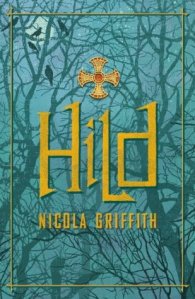
Hild by Nicola Griffith

Hild “That night she dreamt Fursey was talking to Hereswith. It’s what women do: weave the web, pull the strings, herd into the corner. It’s their only power. Then she was inside Hereswith, and Fursey was talking to her. Unless they’re seers. Your mother has built you a place where you can speak your word openly.

Hild is one of the most beautifully written books I’ve read for a long time. Set in 7th century Britain – an island divided by warring kings, where the old pagan religions are under threat from the advance of Christianity – it’s the story of the girl who would later become St Hilda of Whitby.

Hild is the daughter of Hereric of Deira and his wife, Breguswith. She is only three years old when her father is poisoned while in exile in the lands of the Brittonic king, Ceredig, and she, her mother and sister join the court of Hereric’s brother, King Edwin of Northumbria. As the two girls grow older, Hild’s sister Hereswith becomes Edwin’s ‘peaceweaver’ – a female relative who can be married off to secure alliances with other rulers – but Hild’s wyrd (fate) will be something very different.

Ever since Hild was born, her mother, Breguswith, has talked of a dream she’d had during her pregnancy…a dream in which Hild was said to be “the light of the world”. In this novel – the first of a planned trilogy – we see how Hild becomes Edwin’s seer, foretelling his future and giving him the advice he needs to protect and expand his kingdom. Many of Hild’s predictions are based on her observations of the behaviour of animals or changes in the weather and on her shrewd understanding of human ambitions and motivations, but as her reputation as a prophet grows, so does her value to the king.

Reading Hild, for me, was like entering a different world. From the very beginning I was confronted with strange place names – Caer Loid, Elmet, Deira – and unfamiliar words – gesith, wealh, seax, haegtes. Yet I was not reading a book set in a fantasy land, but in my own country. At first I felt lost (and very aware of how ignorant I am of this whole period of history) but eventually I began to slowly make sense of Hild’s world and become absorbed in her story. Nicola Griffith’s writing is beautiful and lyrical; the Anglo-Saxon people lived an almost semi-nomadic lifestyle and there are some gorgeous, poetic descriptions of nature and scenery as Hild, with the rest of Edwin’s court, moves from one part of the kingdom to another.

Hild is not an easy read that you can breeze through with your mind on something else; it does require some effort from the reader, but I definitely think it’s worth making that effort. The only thing that prevented me from truly loving this book is the fact that I found Hild herself difficult to fully engage with on an emotional level until almost the end. Apart from that, I thought Hild was a hugely impressive novel; it reminded me in many ways of Dorothy Dunnett’s King Hereafter, which is high praise from me! I’m looking forward to reading the next part of Hild’s story whenever the second book in the trilogy becomes available.

As a side note, I read an ebook version of Hild but the problem with this was that I couldn’t easily keep turning back to the map, family tree and glossary – and believe me, this is the type of book where you really need to be able to do that! I was delighted, then, to discover that on Nicola Griffith’s blog she provides all of these extras for readers of the ebook to download and use for reference. Very useful, even though by the time I made this discovery I was halfway through the book and had already worked a lot of things out for myself anyway!

Thanks to the publisher for providing a copy of Hild via NetGalley

Shadow of Night by Deborah Harkness

Shadow of Night This is the second book in the All Souls Trilogy by Deborah Harkness. I read the first, A Discovery of Witches, earlier this year and the third, The Book of Life, has just been published, which is what made me decide to pick up the middle book last week.

Shadow of Night follows witch Diana Bishop and vampire Matthew Clairmont as they travel back in time to the year 1590 with two goals in mind. The first is to hunt down Ashmole 782, an elusive manuscript which they hope will provide important information on the origins of their species – witches, vampires and daemons (known collectively as ‘creatures’). The second is to find another witch who can help Diana to understand and control her magical powers. Another benefit of leaving the present day behind is that Matthew and Diana will be able to escape the clutches of the other witches, vampires and daemons who have also been trying to get their hands on Ashmole 782.

Arriving in Elizabethan England, Diana discovers that Matthew is one of a group of writers, artists and scientists known as the School of Night, whose other members include Sir Walter Raleigh and Christopher (Kit) Marlowe. Reunited with his old friends again, Matthew also resumes one of his other occupations – spying for Elizabeth I. Meanwhile, Diana’s mission to find a witch willing to train her in the use of magic proves more difficult than expected in a time when public fear and suspicion of witches is increasing. Discovering that life in the past is no less complicated than it was in the present, Diana’s and Matthew’s adventures take them first into the heart of Elizabethan London, then to Matthew’s family estate at Sept-Tours in France and to the court of Rudolf II in Prague.

This book should have been perfect for me as I usually enjoy both historical fiction and time travel, but I think I actually preferred A Discovery of Witches. There were some parts of this book that I loved, but for such a long novel (nearly 600 pages) I found the pace very slow and uneven. It seemed that most of the book’s major developments all took place in the final 50-100 pages.

There are a lot of characters to keep track of in Shadow of Night and the character list at the back of the book was very useful. Diana and Matthew meet a huge number of real historical figures as they travel between London, Sept-Tours and Prague, but while some of these were very intriguing, such as the Rabbi Judah Loew who created the Golem of Prague, many of them had little or no relevance to the story. I couldn’t help thinking that they had been included just for the sake of it; I would rather have had fewer characters so that we could spend more time getting to know each one. I also really disliked the portrayal of Kit Marlowe in the book. I’m sure the real Marlowe would have been a fascinating character to write about in his own right; making him a daemon (a very spiteful, petulant daemon) added nothing to the story.

Matthew began to stretch my belief to its limits. Not only does he belong to the School of Night, he is also a member of at least one other secret organisation and an order of chivalry, a spy for Elizabeth I and a close personal friend of numerous famous historical figures from all over Europe. You may think that as I’m happy to accept that he’s a vampire I should be able to accept the rest of it too, but it all felt too convenient and just not believable in the context of the story. I do like Diana, partly because as she’s the narrator the reader naturally feels closer to her, but I would still like to see her take the lead more often when it comes to decision-making.

The time travel aspect of the book didn’t quite make sense to me either – it seemed that as Matthew was returning to an earlier period in his own life, he simply replaced his previous self for a while, but I’m not sure what was supposed to have happened to the 16th century Matthew in the meantime or what would happen when he came back. Time travel is always confusing, though, so I tried not to think about it too much! I did like the way each section of the book ended with a chapter set in the present day, showing how Matthew and Diana’s actions in the past affect the future. This also gave us a chance to briefly catch up with characters from the previous book such as Diana’s aunts, Sarah and Emily, and Matthew’s mother, Ysabeau.

Although I didn’t find this book as enjoyable as A Discovery of Witches, I think it maybe suffered from being the middle book in a trilogy. I will still be reading The Book of Life and hoping I don’t have any of the problems I had with this one!

Thanks to Headline for providing a copy of this book for review.

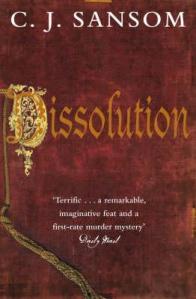
Dissolution by C J Sansom

Dissolution Reading C J Sansom’s alternate history novel Dominion a few months ago reminded me that I still hadn’t read any of his Shardlake books, despite meaning to for years. I noticed last week that my library had the whole series available as ebooks, so it seemed as good a time as any to get started with the first one, Dissolution.

Dissolution is set in the winter of 1537, just after the death of Henry VIII’s third wife, Jane Seymour. Having broken away from the Catholic church and declared himself Supreme Head of the Church of England, the King, with the help of Thomas Cromwell, has begun the process of dissolution of the country’s monasteries. After the closure of some of the smaller religious houses in the north led to rebellion, Cromwell is now taking a different approach and is sending commissioners to the larger monasteries to offer pensions to the monks in the hope that they will voluntarily surrender – or if not, to search for signs of fraud, corruption or other legal reasons to close them down.

At the monastery of Scarnsea, on the coast of Sussex, disaster strikes when one of Cromwell’s commissioners, Robin Singleton, is found brutally murdered in the monastery kitchen. Cromwell sends another of his men, the lawyer Matthew Shardlake, to investigate the mystery of Singleton’s death and discover what has been happening at the monastery. Accompanied by his assistant Mark Poer, Shardlake sets out for Scarnsea but what he learns when he arrives there convinces him that the commissioner had been about to make an important discovery before he was killed.

As a murder mystery, there’s everything here that you would expect: the detective and his sidekick, the isolated house (monastery in this case) cut off from the rest of the world, the small group of suspects each with their own secrets and motives, and the usual string of clues and red herrings. But what made this book stand out for me among other historical mysteries was the fascinating setting and detailed portrayal of monastic life. There are some obvious similarities with Umberto Eco’s The Name of the Rose, although this is an easier read – and set in a completely different time period, of course.

I have read other novels that focus on the dissolution of the monasteries (books such as The Crown by Nancy Bilyeau, for example) but usually from the point of view of the monks and nuns whose way of life has been destroyed. This book is narrated by Shardlake himself and it’s interesting to see dissolution from his perspective, as a dedicated reformer. Shardlake gradually becomes disillusioned with Henry and Cromwell, but for a long time he tries to justify what they are doing and it is only towards the end of the book that he allows himself to have doubts. Something I haven’t mentioned yet is that Shardlake is a hunchback and has spent his life trying to overcome prejudice and rejection. The fact that he has had to deal with a disability in a time much more unenlightened than our own adds another dimension to his personality.

Having taken so long to get round to reading this book, I’m pleased that I did enjoy it! I correctly named the murderer quite early in the story, but while I would like to pretend that I had cleverly managed to solve the mystery I have to admit it was really just a guess. This didn’t spoil the rest of the story at all, though – I had to wait until almost the end of the book to find out if I was right and even after Singleton’s killer was eventually revealed, there were still one or two other developments that took me by surprise! I will definitely be continuing the series with the second book, Dark Fire – but probably not immediately.

The Italian Girl by Lucinda Riley

The Italian Girl Rosanna Menici is only eleven years old when she first meets Roberto Rossini, the son of her parents’ best friends. Roberto is an opera singer at La Scala in Milan, a career which to Rosanna seems impossibly glamorous and out of reach. At a family party, Roberto hears her voice and recommends that she have singing lessons, but Rosanna tries not to get her hopes up. Her parents run a restaurant in the Piedigrotta district of Naples and although it is a successful business, they are not rich people and singing lessons are expensive. But when Rosanna’s brother, Luca, comes to the rescue and helps to pay for the lessons, it seems that her dream of becoming an opera star and marrying Roberto could eventually become a reality.

The Italian Girl is a lovely, romantic story spanning three decades and taking us from the streets of Naples and churches of Milan to a peaceful English village and some of the world’s greatest opera houses. It’s not a new novel – it was originally published as Aria in 1996 under the name Lucinda Edmonds – but has been revised and updated so that you wouldn’t guess it had been written so much earlier than the more recent Lucinda Riley books.

One way in which this book is different to the other novels by Lucinda Riley that I’ve read (The Girl on the Cliff, The Light Behind the Window and The Midnight Rose) is that the others have dual narratives, jumping between past and present, but this one, apart from a few letters written by an older Rosanna, follows one linear timeline. I like both types of book, but I do prefer to stay in one time period so I was happy with that aspect of The Italian Girl. Although this book isn’t really what you could call ‘historical’, being set in the fairly recent past, I think I would still have liked more period detail as the 1960s chapters didn’t feel any different from the 1970s or 1980s. On the other hand, this is a story driven more by the characters and their relationships rather than by the setting.

I initially found the young Rosanna a very endearing character. Things did seem to fall into place for her too easily, but I didn’t mind because I liked her and wanted her to succeed. Later in the book, though, I began to find her frustrating. I disagreed with a lot of her decisions, but I was hopeful that she would do the right thing in the end. As for Roberto, I had thought at first that he was going to be the sort of romantic hero I could fall in love with along with Rosanna…suffice it to say that this certainly didn’t happen, but I won’t spoil the story by explaining why not!

While the relationship between Rosanna and Roberto forms the main plot, there’s also a secondary romance between Luca and Rosanna’s friend, Abi. I liked both of these characters and found their story as interesting to follow as Rosanna’s and Roberto’s. I also enjoyed learning about the lifestyle of a professional opera singer and the amount of hard work and training it takes to reach the top. I’m not an opera fan and probably never will be, but this book made me want to listen to some of the arias Rosanna sings in the story.

The Italian Girl is a long book – almost 600 pages, which makes it quite a thick paperback – but after a slow start I was swept away by the story and it didn’t feel as long as it looked. It was the perfect book to read sitting outside in the summer sunshine we’ve had here this week!

I received a copy of The Italian Girl for review.

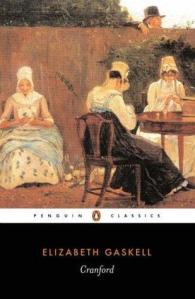
Cranford by Elizabeth Gaskell

Cranford “In the first place, Cranford is in possession of the Amazons; all the holders of houses above a certain rent are women. If a married couple come to settle in the town, somehow the gentleman disappears; he is either fairly frightened to death by being the only man in the Cranford evening parties, or he is accounted for by being with his regiment, his ship, or closely engaged in business all the week in the great neighbouring commercial town of Drumble, distant only twenty miles on a railroad. In short, whatever does become of the gentlemen, they are not at Cranford.”

Cranford is the fourth Elizabeth Gaskell book I’ve read, following North and South, The Moorland Cottage and Sylvia’s Lovers. I had been hesitant to read this one, despite it being highly recommended by other bloggers, because I wasn’t sure it sounded like the sort of book I would enjoy. A few weeks ago, though, Hesperus Press sent me a review copy of Gaskell’s novella, Mr Harrison’s Confessions, which is described as a prequel to Cranford, so I thought it would make sense to actually read Cranford first.

Originally serialised in Charles Dickens’ journal Household Words in 1851, Cranford is set in a small English town populated mainly by women, most of whom have either never married or are widows. Our narrator is a young woman called Mary Smith who lives in nearby Drumble but who spends a lot of time staying with her friends in Cranford. Through Mary we meet the ladies of Cranford, listen to their gossip, join them at their tea parties, and watch as they go about their everyday lives. The book has a very episodic feel and feels almost like a collection of short stories, particularly throughout the first half of the book. Later in the novel, we focus more on one storyline – the collapse of the Town and County Bank and its impact on the people of Cranford – as well as returning to some of the earlier storylines and developing them further.

At first it seems that the narrator doesn’t have an active role in the novel and that her main purpose is to act as an observer, reporting on the daily lives and routines of her Cranford friends. Unless I missed something we don’t even learn that her name is Mary Smith until the fourteenth chapter, yet she is obviously an integral part of Cranford society, a loyal friend to several of the ladies and regularly invited to their parties and gatherings. Towards the end of the book we finally get to know a little bit more about Mary and she does eventually play an important part in resolving some of the novel’s storylines.

If the novel has a main character, though, it is not Mary but her friend, Miss Matty Jenkyns. Matty’s story is quite sad: her brother Peter left for India years ago and has never been heard from again, and now that her parents and older sister are dead, Matty is the only member of her family left in Cranford. She’d also been romantically linked with a Mr Holbrook decades earlier but their relationship ended as Matty’s sister, Deborah, disapproved. As the narrator observes: “She had probably met with so little sympathy in her early love, that she had shut it up close in her heart; and it was only by a sort of watching…that I saw how faithful her poor heart had been in its sorrow and its silence.” Despite her troubles, Matty remains a loving, kind-hearted person, liked and respected by everyone in the town and also by the reader – this reader at least!

The story of Matty and Mr Holbrook is an indication that although many of the Cranford women are happy with the absence of men in their lives, not all of them are single by choice. I also thought it was interesting that it’s mainly the more genteel ladies who are unmarried, while their servants do have ‘followers’, as they call them. Matty’s early heartbreak makes her more sympathetic to her twenty-two-year-old maid, Martha, and she allows her to have a follower and consider marrying him, whereas some of the other women would never have agreed to such a thing.

Cranford is also a very witty book filled with lots of funny little anecdotes about the women of Cranford. I won’t go into too many details here, but I particularly enjoyed the stories of Miss Betty Barker’s cow who fell into a lime-pit, Miss Matty’s habit of rolling a ball under her bed to check that there’s nobody hiding under it, and the time Mrs Forrester’s cat swallowed her favourite piece of lace. But while there’s a lot of humour in Cranford, there’s also a good balance between funny scenes and moments of sadness and even tragedy.

It seems I was wrong about Cranford not being my sort of book, because I did enjoy it much more than I thought I would. If I’d known it was such a short book (only about 200 pages) I’m sure I would have read it before now. When I reached the end I was sorry to have to leave the world of Cranford behind, but at least I can still look forward to reading Mr Harrison’s Confessions!