Tropical Issue by Dorothy Dunnett

Tropical Issue Having read all of Dorothy Dunnett’s six-volume Lymond Chronicles, eight-volume House of Niccolò series and her standalone novel, King Hereafter, I suppose it was only a matter of time before I picked up one of her Johnson Johnson mystery novels. I wasn’t entirely sure that I was starting with the right book, as Tropical Issue (originally titled Dolly and the Bird of Paradise – Dolly being the name of Johnson’s yacht and the ‘bird’ being the female narrator of the story) was actually the sixth to be published. I had discovered, though, that it is also the first chronologically, so it seemed like a good place to start.

Our narrator is Rita Geddes, a Scottish make-up artist with a punk hairstyle (the book was published in 1983 and I should point out here that unlike the rest of Dunnett’s books, these were contemporary novels rather than historical ones). Rita’s latest client is the journalist and celebrity Natalie Sheridan and at the beginning of the novel Rita is in London preparing Natalie for a photo shoot with the photographer, Ferdy Braithwaite. Ferdy has borrowed his friend Johnson Johnson’s studio flat to use for the session and in this way, Rita meets Johnson for the first time. Not that she learns much about Johnson during this first meeting, other than that he is recuperating after being seriously injured in a plane crash – and that he is a portrait painter, has black hair and wears bifocal glasses.

Joining Natalie for another job on the island of Madeira, Rita learns that the life of her friend and fellow make-up artist Kim-Jim Curtis could be in danger. And when Johnson and his yacht, Dolly, also arrive in Madeira, a mystery unfolds which is complex, surprising and takes the reader through a range of exotic locations from the banana plantations of Barbados to the volcanic craters of St Lucia. As with all good mystery novels, you’ll need to pay attention as things which may seem irrelevant at first turn out to be important later in the book.

I liked the character of Rita from the beginning. She has a very distinctive narrative voice, with her strong personality coming across in every sentence – how can you not love a character who thinks, when disturbed by an intruder in the night, “I rather wished I was wearing something handier than a quilt, but if all else failed, I could smother the guy if I caught him”? As for Johnson, it was difficult not to want to make comparisons with Dunnett’s other heroes, Lymond, Nicholas and Thorfinn, but really, while they do all share some characteristics, there are also some big differences between them. However, I do think there were a lot of similarities in the way Dunnett introduces his character to us – viewing him only through the eyes of other people (in this case Rita), with his true thoughts and motives often being obscured and misinterpreted.

While I love all of Dorothy Dunnett’s other books, I can’t really say that I loved this one – but I did enjoy it. It took me a while to really get into the story, but after a few chapters I was won over by a wild and wonderful sledge race to rival the ostrich ride in Niccolò Rising. It made a nice change, in a way, to be able to read a Dunnett novel without becoming too emotionally involved in the lives of the characters! I don’t feel the same compulsion to immediately read the rest of the series as I did with Lymond and Niccolo, but it’s good to know that there are still another six books to look forward to.


Love and Treasure by Ayelet Waldman

Love and Treasure In Love and Treasure, Ayelet Waldman traces the fate of a single item – a necklace with a peacock pendant – and uses it to tell the story of Hungary’s Jewish communities before and after the Holocaust. Spanning a period of one hundred years, the novel is divided into three separate stories, but there are links between all three and the peacock pendant plays an important role in each one.

The novel begins in 2013 with a conversation between Jack Wiseman and his granddaughter, Natalie, when he admits to her that the necklace she wore on her wedding day thinking it was her grandmother’s did not actually belong to her grandmother at all. The real owner, he says, is unknown, but he would like Natalie to find her and give the pendant back.

We then move back in time to Salzburg in 1945 where Jack is serving in the US army. He is given the responsibility for guarding the Hungarian Gold Train, a train containing the confiscated personal belongings of thousands of Hungarian Jews (paintings, watches, furs, cameras and other objects) but while he does his best to protect its contents he is forced to watch as his fellow army officers ‘borrow’ one item after another. When Jack’s days in charge of the train come to an end, he himself steals one of its treasures – the peacock pendant – because it reminds him of Ilona, a Jewish girl from the Hungarian town of Nagyvárad whom he has grown close to during his time in Salzburg.

Returning to 2013, Natalie is beginning her search for the original owner of the pendant – a search which will take her to Budapest where she joins forces with Amitai Shasho, an Israeli art dealer on a special mission of his own. This takes us into the final section of the book, set in 1913 Budapest and telling the story of a psychoanalyst and one of his patients, a young Hungarian suffragette whose strong views lead to her father wanting her treated for insanity.

Of the three main sections of the novel I think my favourite was the first one, the story of Jack and Ilona. Ilona is a survivor of the concentration camps and through her character, Waldman explores the lives of the Displaced Persons who lost their homes and their families during the war. I thought she did an excellent job of showing what it may have felt like to be a Jew displaced in Europe after the war had ended. I cared about Jack and Ilona in a way that I never really came to care about Natalie and Amitai, so I was sorry to leave them behind when I reached the end of the first section and moved on to the second.

I also enjoyed the final part of the book: narrated by the psychoanalyst, Dr Zobel, this is the only section to be written in the first person rather than the third, and I thought his narrative voice was very strong and distinctive – just what I would expect from a man of his profession in 1913.

I found Love and Treasure a very interesting read because it introduced me to subjects I knew little or nothing about. The Hungarian Gold Train, for example, really existed, yet it’s something I had never read about before and I thought it was fascinating. While the book didn’t really affect me emotionally as much as I would have expected from a novel about the Holocaust, the fact that it was so intriguing from an historical perspective made up for it.

Love and Treasure tour banner

I read this book as part of the Love and Treasure Historical Fiction Virtual Book Tour. For more reviews, interviews and guest posts please see the tour schedule.

The Mayor of Casterbridge by Thomas Hardy

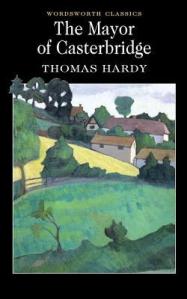
The Mayor of Casterbridge - Thomas Hardy This book was chosen for me in the recent Classics Club Spin. My strategy with spin books is to pick it up and start reading as soon as possible after the number is announced – that way I don’t put it off until the last minute and end up not wanting to read it. This worked well with my last two spin books, A Tale of Two Cities and Can You Forgive Her? and it worked again with this one – once I started reading The Mayor of Casterbridge I didn’t want to put it down, though that wasn’t entirely surprising as I’ve loved everything else I’ve read by Thomas Hardy and fully expected to love this one too.

The Mayor of Casterbridge is the story of Michael Henchard, whom we first meet as a young man, out of work and walking from town to town in search of employment as a hay-trusser. On arriving in a small village near the town of Casterbridge and discovering that a country fair is taking place, Michael proceeds to get drunk and sells his wife, Susan, and baby daughter Elizabeth-Jane to a sailor for five guineas. In the morning he regrets what he has done, but Susan, Elizabeth-Jane and their new owner have already disappeared without trace. After swearing not to touch another drop of alcohol for twenty-one years – the length of time he has been alive – Henchard begins to rebuild his life.

Almost twenty years later, we rejoin Susan and her daughter as they return to Casterbridge. The sailor, Mr Newson, has been lost at sea and having only recently learned that her second ‘marriage’ was not legally binding, Susan is hoping that she and Elizabeth-Jane can find and be reconciled with Michael Henchard. Things have changed in the intervening years and Henchard has transformed himself into the sober and respectable Mayor of Casterbridge. How will he react to having his wife and daughter back in his life? With the arrival of two more newcomers – Lucetta, a pretty young woman from Jersey, and Donald Farfrae, a Scottish traveller – Henchard’s fortunes begin to change yet again and in typical Thomas Hardy fashion a series of mistakes and misunderstandings follow, sometimes with tragic consequences.

I loved this book as much as I expected to and enjoyed being back in Hardy’s Wessex (now that I’ve read quite a few of his books it’s fun to be able to notice the occasional references to characters and places from previous novels). There are some lovely descriptions of Casterbridge with its Roman ruins, and the beautiful countryside surrounding it. However, this is a less pastoral book than most of the others I’ve read – the action takes place in and around the market town of Casterbridge itself, which gives this book a slightly different feel to the more rural, farm-based ones such as Far From the Madding Crowd.

The plot is a great one, with lots of twists and turns and plenty of drama; I was never bored once. There are lots of scenes and images that I’m sure will stay with me from this novel – the ‘furmity tent’ at the fair, the goldfinch in its cage, the noise of the ‘skimmington ride’ – but the main focus of the story is on Michael Henchard and his rise and downfall. There is no doubt that what Henchard does in the first chapter of this book is cruel and shocking, but he’s not just a two-dimensional villain; he is much more complex than that and his character is not written completely without any sympathy. It’s up to the reader to decide whether they can find any forgiveness for him or whether they think he deserves everything he gets. Personally, although I thought the way he behaved was terrible at times, I still found his story very sad, particularly as so much of his misery was self-inflicted and a result of his own flaws and impulsive decisions. And of course, as with many of Hardy’s novels, there is a sense of impending tragedy that hangs over everything and you know from the beginning that there is unlikely to be a happy ending.

I’m now looking forward to reading the other Thomas Hardy novels on my Classics Club list. I think The Return of the Native will probably be the next one I read.

Beatrice and Benedick by Marina Fiorato

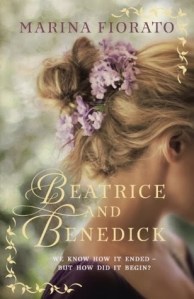
Beatrice and Benedick “I had rather hear my dog bark at a crow than a man swear he loves me.” These words are spoken by Beatrice near the beginning of Shakespeare’s Much Ado About Nothing, when she is reunited with Benedick, a man whom it is hinted she had been romantically involved with in the past. Shakespeare never gives us any details of Beatrice and Benedick’s history together and in this new novel, Marina Fiorato imagines how they may have met, what could have led to their separation and what brought them together again.

As the novel begins in the summer of 1588, Beatrice, the daughter of Prince Escalus of Verona, is visiting Messina in Sicily, staying at the home of her uncle Leonato, the Governor of Messina. Sicily is under Spanish rule and Leonato is preparing to welcome a party of Spaniards to the island, including the Prince of Aragon, Don Pedro, who is accompanied by his two young Italian friends, Claudio and Benedick. Claudio instantly falls in love with Leonato’s beautiful daughter, Hero, while Beatrice and Benedick are also attracted to each other – but are unable to admit it, preferring to trade insults instead. Just as they begin to acknowledge their love for each other, the two are torn apart with Beatrice heading home to Verona and Benedick joining Don Pedro and Claudio at sea as the Spanish Armada sets out to invade England. Eventually they will all meet again in Messina, setting the scene for the events of Much Ado About Nothing

Well, this book was a surprise! I had expected a light, gentle romantic comedy, but what I got was an entertaining and often quite dark historical adventure novel filled with duels, pageants and puppet shows, sea voyages, mutinies and treasure troves. Like a play, the novel is divided into Acts and Scenes, each Scene narrated by either Beatrice or Benedick. The voices of the two narrators were very similar and I thought more effort could have been made to make them more distinctive, but otherwise I liked the way the novel was structured. I wondered whether Fiorato would be able to pull off the wars of words between Beatrice and Benedick, but I think she did this very well – although Benedick doesn’t seem as quick-witted as Beatrice and usually comes off worst in their encounters.

I know there are some readers who are not interested in prequels, sequels or rewritings of any kind (and actually, I usually am one of those readers) but I enjoyed this one and thought it was very cleverly done, with Shakespeare’s characters and storylines woven perfectly into the history of the period. There are also some elements and characters from other plays, most notably Othello and Romeo and Juliet. Fiorato even manages to incorporate Shakespeare himself into the novel – if you’re not already aware of the theories connecting Shakespeare with Sicily I’ll leave you to find out for yourself!

You don’t really need to be familiar with Much Ado About Nothing as this book does work as a straightforward historical fiction novel, but you will get more out of it if you do read (or watch) the play either before you start or after you finish. As for the historical aspects of the novel, it was interesting to learn about Spanish-ruled Sicily and the fate of the Moors who lived there. I also loved all the beautiful descriptions of both Messina and Verona.

Having enjoyed Beatrice and Benedick so much more than I’d expected to, are there any other Shakespeare-inspired novels you would recommend?

New book arrivals

I’ve acquired some new books recently and thought I would share them here with you:

New books May 2014

The first three books were bought last week on a trip to my favourite book shop, Barter Books:

The Heaven Tree by Edith Pargeter – I’ve wanted to read this for years and was so pleased to find a copy. It’s the first in a trilogy and set during the reign of King John.

The Last Light of the Sun by Guy Gavriel Kay – I’m looking forward to reading this as I enjoyed the other two Guy Gavriel Kay books I’ve read.

Bellarion by Rafael Sabatini – I don’t know anything about this book but I love Sabatini so of course I had to pick this one up!

The next book is a review copy received from Random House:

The Second Duchess by Elizabeth Loupas – The story of Barbara of Austria and her marriage to the Duke of Ferrara. I can’t wait to read this.

I won the final two books in Goodreads giveaways.

The Shining by Stephen King – I’ve read this before, as a teenager, and thought it might be fun to read it again. I didn’t really expect to win it!

The Walls of Byzantium by James Heneage – The first of a new series, The Mistra Chronicles, set in the final decades of the Byzantine Empire.

Have you read any of these books? What did you think of them?

The Temporary Gentleman by Sebastian Barry

The Temporary Gentleman

“It seemed there was more cruelty than joy stored up in the human story, and kindness and comfort only rationed, and the ration book for both indeed not issued to everyone.”

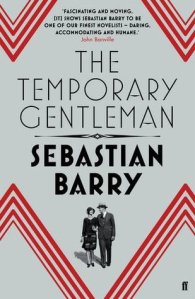
The Temporary Gentleman is the third Sebastian Barry book I’ve read and I was looking forward to it, having loved both The Secret Scripture and On Canaan’s Side. Based on those two novels I knew I could expect a tragic, heartbreaking story and some beautiful, haunting writing – and that’s exactly what I got. Whenever I read a book by Sebastian Barry I am impressed by how much care he gives to each and every sentence, always searching for the perfect word or phrase to use. He can make the most ordinary, mundane things sound poetic and magical.

This is the third, I think, of Barry’s novels to focus on members of the McNulty family. The first, which I haven’t read yet, is The Whereabouts of Eneas McNulty and the second is The Secret Scripture, which tells the story of Roseanne, Tom McNulty’s wife. This new book, The Temporary Gentleman, is narrated by Jack McNulty, the brother of Tom and Eneas. They are all standalone novels and I don’t think they need to be read in any particular order, but I do like the fact that they are all loosely connected.

As an Irishman whose commission in the British Army during the Second World War is not permanent, Jack McNulty is the ‘temporary gentleman’ of the title. In 1957, sitting in his lodgings in Accra, Ghana where he lives alone with only his houseboy, Tom Quaye, for company, Jack begins to write his memoirs. He remembers his early days in Ireland and his first meetings with his future wife, Mai Kirwan. He reflects on the reasons why their relationship became strained and their marriage began to disintegrate. And he thinks of the mistakes he has made and the terrible impact of alcohol on both his own life and the lives of his family. Occasionally we return to the present where we learn a little bit about the political situation in 1950s Ghana, but the majority of the novel is devoted to Jack and Mai’s troubled marriage.

This is such a sad story, made even sadder by the fact that Jack does truly love Mai and although he can see that he is ruining his life and hers, he can’t stop himself from doing it. He knows he has made bad decisions and that he is to blame for the tragic outcome of those decisions – and yet he seems incapable of trying to put things right. Jack is not the most pleasant of people but even while I felt frustrated and angry with him, it was still possible to feel a bit of sympathy for him at times. I was also intrigued by Mai’s character, particularly because we only see her through Jack’s eyes and never have a chance to hear her point of view. It would have been interesting to have been able to read the same story from Mai’s perspective – I would love to know how she really felt about Jack and his actions.

As usual with a Sebastian Barry novel, I found that I was constantly marking lines and passages that I loved and as usual, if I started to quote them here I would have to quote almost the whole book. But despite the gorgeous writing I didn’t like this book quite as much as The Secret Scripture or On Canaan’s Side, maybe because Jack causes so many of his problems through his own behaviour and I didn’t feel as desperately sorry for him as I did for Roseanne McNulty or Lilly Dunne. I also felt that the Ghana sections of the novel added very little to the story. Still, this book was worth reading for the beauty of the writing alone. While I’m waiting for Sebastian Barry’s next novel I would like to go back and read his other books on the McNulty and Dunne families that I haven’t read yet.

I received a copy of this book from NetGalley for review.

Insurrection by Robyn Young

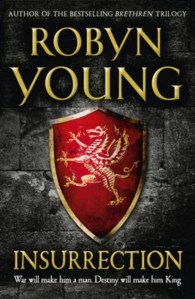
Insurrection - Robyn Young Insurrection is the first in a trilogy telling the story of Robert the Bruce, who was King of Scotland in the 14th century. The second book, Renegade is available now and the third, Kingdom, will be out this summer. In this first novel, beginning in 1286, we meet Robert as a young boy in a Scotland torn apart by the sudden and unexpected death of King Alexander III. The King has died without a male heir, leaving the succession to the throne undecided. The Bruces believe they have a strong claim, but they face competition from their enemies, John Balliol and the Comyns.

In England, meanwhile, King Edward I is forming his own plans for Scotland. Beginning a search for four ancient relics that will enable Merlin’s Last Prophecy to be fulfilled, Edward enlists the help of a group of young noblemen known as the Knights of the Dragon. When Robert, sent to England to restore his family’s reputation, is approached by the Knights, he must decide exactly where his loyalties and ambitions lie.

Insurrection is exactly the sort of historical fiction I love. As someone who reads a lot of historical novels I often find that they either focus too much on romance and court intrigue or are too action-packed with one long battle scene after another. I had neither problem with this book; I found it to be a fascinating, atmospheric tale of kings and knights, witches and soldiers, treachery, murder and war. The descriptive writing is wonderful and the battles (yes, there are a few) are well written and easy to follow. I admit that my heart sank when I discovered this was yet another book with an ‘ancient prophecy’ storyline, but I needn’t have worried because it is only one small part of the plot and I thought it actually felt quite plausible as it’s true that Edward I really did have a fascination with Arthurian legend.

Robert the Bruce is a name I’ve always been intrigued by without really knowing much about him. I have a memory from years ago of going out with my parents one Sunday afternoon on what my dad always called ‘an aimless drive’ and ending up in Dumfries and Galloway in Scotland where we noticed a sign pointing to ‘Robert the Bruce’s Cave’ – the cave where Robert supposedly went into hiding from Edward I in 1306 and was famously inspired by a spider weaving its web. Not one of the most exciting places I’ve ever visited (there wasn’t even a spider in sight when we went to look inside the cave), but it has stayed in my mind all these years later!

Because I knew so little about Robert and this period of history, I felt that I was really learning a lot from Insurrection. Everything felt accurate and thoroughly researched and although I had to concentrate to keep track of the complex politics and relationships between the characters, I was never bored. At the end of the book there’s a character list, glossary of medieval terms and a chart showing the order of succession to the Scottish throne, all of which I found useful.

Of course, this is a work of fiction rather than non-fiction so there are times when the author doesn’t stick exactly to the known facts. For example, the deaths of Alexander III and his granddaughter Margaret, Maid of Norway may have had more innocent causes than those described in the book. The Knights of the Dragon is also a fictional order, although the men who belong to it really existed. Robyn Young explains some of her choices in her author’s note so that we can see where she has used her imagination to fill in some gaps and provide motivations for the actions of her characters.

I know this book will not suit all tastes in historical fiction (some readers might dislike the inclusion of prophecies and witchcraft or will be disappointed by the lack of significant female characters and the fact that Robert himself is not always easy to like) but I absolutely loved it. I’m looking forward to reading Renegade and Kingdom and also exploring Robyn Young’s earlier trilogy on the Knights Templar.