It’s the first Saturday of the month which means it’s time for another Six Degrees of Separation, hosted by Kate of Books are my Favourite and Best. The idea is that Kate chooses a book to use as a starting point and then we have to link it to six other books of our choice to form a chain. A book doesn’t have to be connected to all of the others on the list – only to the one next to it in the chain.
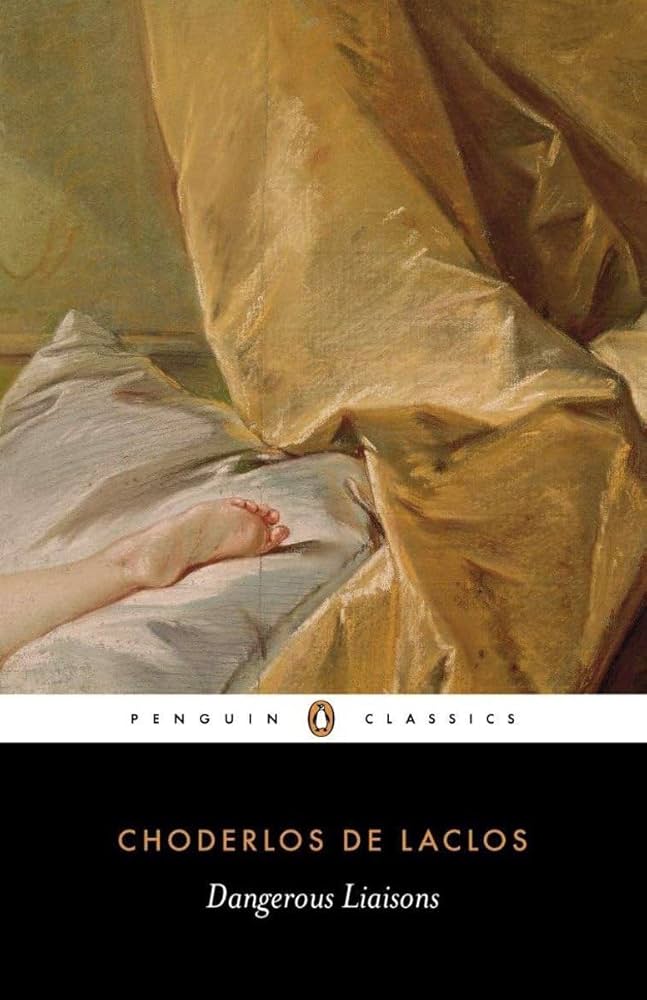
This month we’re starting with Dangerous Liaisons by Pierre Choderlos de Laclos.
Published in 1782, just years before the French Revolution, Les Liaisons Dangereuses is a disturbing and ultimately damning portrayal of a decadent society. At its centre are two aristocrats, former lovers, who embark on a sophisticated game of seduction and manipulation to bring amusement to their jaded existences. While the Marquise de Merteuil challenges the Vicomte de Valmont to seduce an innocent convent girl, the Vicomte is also occupied with the conquest of a virtuous married woman. But as their intrigues become more duplicitous and they find their human pawns responding in ways they could not have predicted, the consequences prove to be more serious, and deadly, than Merteuil and Valmont could have guessed.

Dangerous Liaisons has been adapted for film several times, sometimes transposing the setting to different periods and countries. The most famous version was the 1988 one, which received seven Oscar nominations including one for Glenn Close for Best Actress. She also appeared in an adaptation of Agatha Christie’s Crooked House (1) in 2017.
In the foreword, Christie states that “practically everybody has liked Crooked House, so I am justified in my own belief that it is one of my best”. Similarly, Thomas Hardy named his novel The Woodlanders (2) as a personal favourite, saying “I like it as a story best of all”. It’s one of my favourite Hardy novels as well – definitely in my top three!
Trees grow in woodlands, so the next book I’m linking to is The Dance Tree by Kiran Millwood Hargrave (3). This fascinating novel is set in Strasbourg in 1518 during a plague of dancing – something which may sound strange, but did actually happen!


Another novel I’ve read with a dancing theme is Russian Winter by Daphne Kalotay (4) in which a retired ballerina looks back on her career with the Bolshoi Ballet in the 1940s and 50s.
A simple link to another book with ‘winter’ in the title: The Winter Garden by Nicola Cornick (5), which tells the story of the family of Robert Catesby, one of the conspirators involved in the failed Gunpowder Plot of 1605. I found it interesting to read about Catesby as the name usually associated with the Gunpowder Plot is Guy Fawkes.
Lizzie Fawkes is the main character in Birdcage Walk by Helen Dunmore (6). Although the novel is set in England, the lives of the characters are affected by events in France as the French Revolution gathers pace. With our starting book, Dangerous Liaisons, being set just before the Revolution, I think this brings the chain full circle!
~
And that’s my chain for February! My links this month have included: Glenn Close adaptations, authors’ personal favourites, woods and trees, dancing, the word ‘winter’ and the name Fawkes.
In March we’ll be starting with Prophet Song by Paul Lynch.






 She Reads Novels