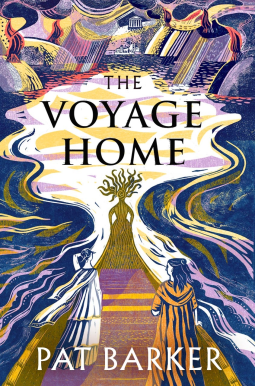
My Commonplace Book: October 2024

A selection of quotes and pictures to represent October’s reading:

commonplace book
noun
a book into which notable extracts from other works are copied for personal use.

~

‘Yet beautiful words are the surest way past science to the real truth of life, just as beautiful paintings are,’ Blake said, watching as I began to pick up the hothouse lilies one by one, trim their stems and put them in the silver vase.

The Bells of Westminster by Leonora Nattrass (2024)

~

I shook off my moment of melancholy and determined not to think of loss. Life held sadness for us all, but there was joy too, and being of an optimistic nature, I would always choose enjoyment over sorrow.

The Lost Queen by Carol McGrath (2024)

~

Minotaur in the Labyrinth (engraving from the Medici Collection, Palazzo Strozzi, Florence)

“The evaluation of any work of fiction is to a large extent based on one’s personal preferences. I suggest we all frankly share our opinions, and from there we can discuss fully each other’s views and arrive at a joint conclusion.”

The Labyrinth House Murders by Yukito Ayatsuji (1988)

~

She wore successive states of mind like layers of petticoats picked up and put on at random, so that it was a matter of chance which one was innermost and which would show when she hitched her skirt.

God is an Englishman by RF Delderfield (1970)

~

That evening, in a whirlwind of spite, I turned out our office drawers for more paper to light the fire. Leadership Training Event, Delegation Welcome Pack, Change Management and Synergy Workshops. Was this all we’d done with our lives? It was like mining through layers of igneous rock. If I dug deep enough, perhaps I would get to the core, to the heart of the matter?

The Significance of Swans by Rhiannon Lewis (2024)

~

The Rio dei Vetrai, Murano (photo by Wittylama)

It was like that for some: coming out of quarantine was almost harder than being in it, When locked in, there were few decisions to make: all you could do was to wait and keep yourself alive in the meantime. Once out, suddenly there was freedom, and with it, choices.

The Glassmaker by Tracy Chevalier (2024)

~

Hadn’t she been trying to find him? Trying to find the love and closeness that had been missing between them? True, the way she had chosen to look for it was a twisted, dishonest way; childish, and childishly cruel. She would never look that way again. But there were other ways…honest, adult ways…shining, sunlit ways, strewn with bright canvases, with sawdust and splashes of paint…with laughter and gay discussion far into the night…

Don’t Go to Sleep in the Dark by Celia Fremlin (1970)

~

Politicians don’t have time to look at the world they’re living in. They see the country they’re living in and they see it as one vast electoral platform. That’s quite enough to put on their plates for the time being. They do things which they honestly believe will make things better and then they’re surprised when they don’t make things better because they’re not the things that people want to have.

Passenger to Frankfurt by Agatha Christie (1970)

~

Favourite books read in October:

God is an Englishman and Don’t Go to Sleep in the Dark

Authors read for the first time in October:

None this month

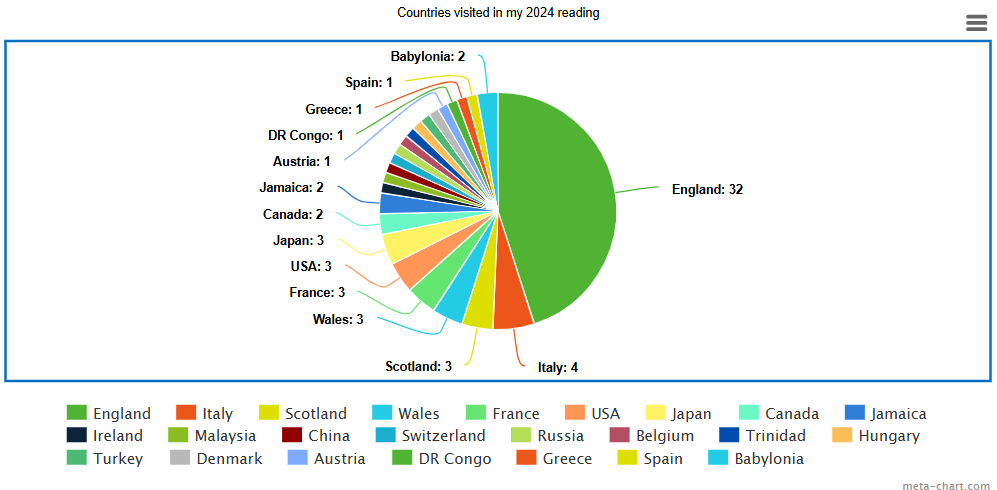
Places visited in my October reading:

England, Wales, Germany, Italy, Japan, The Holy Land

~

Reading notes: Apart from the Christie, which was a big disappointment, I enjoyed everything else I read this month. I was pleased to be able to take part in 1970 Club and to read a few more books for this year’s RIP challenge (I managed six in total during September and October). Also this month I celebrated my 15th blog birthday!

November is the busiest month in the book blogging calendar. Nonfiction November is already underway, as is Witch Week, which focuses on Joan Aiken’s work this year. There’s also Novellas in November, SciFi Month, German Literature Month, Margaret Atwood Reading Month and Norway in November – I hope I haven’t missed anything! Will I be able to take part in all of these? I doubt it, but I do have books lined up for at least some of them.

How was your October reading? What do you have planned for November?

The Labyrinth House Murders by Yukito Ayatsuji

Translated by Ho-Ling Wong

This is a good example of why it’s often worth giving an author a second chance. I was disappointed with Ayatsuji’s The Decagon House Murders, finding the characters very wooden and the plot a poor imitation of And Then There Were None, so I had decided to stick with Japanese crime authors more to my taste, such as Seishi Yokomizo. Then I read lots of glowing reviews of The Mill House Murders, the second in Ayatsuji’s series to be released in a new English translation, so when I saw the third one, The Labyrinth House Murders, on NetGalley I decided to give him another try.

The Labyrinth House, we are told, is the work of the same architect who designed the Decagon House and the Mill House. As its name suggests, the house contains a labyrinth of passageways with the rooms arranged around the edges, so that to get from one room to another it’s necessary to enter the maze. The design is inspired by the Minotaur myth and all of the rooms are named after characters associated with the myth. This very unusual house is the home of the mystery writer Miyagaki Yōtarō.

Miyagaki is in poor health but, as the novel opens, he is preparing for his sixtieth birthday and has invited a group of friends and colleagues to celebrate with him at the Labyrinth House. These include four younger crime authors whom Miyagaki has mentored, a literary critic, his editor Utayama and his wife – and a friend, Shimada Kiyoshi, who is the series detective. As the guests assemble at the house, they are greeted by Miyagaki’s secretary, who gives them the shocking news that their host has committed suicide, leaving them a recorded message to listen to. The recording instructs them not to leave the house or call the police for five days and in the meantime the four authors must each use the time to write a detective story. The four stories will be judged by the other guests and the winner will inherit part of Miyagaki’s fortune.

This book was much more fun than The Decagon House Murders. Although the plot is obviously very contrived, that didn’t bother me and I found it easy enough to just suspend disbelief and accept the premise. Once the story writing competition begins, murders start to take place (in very imaginative ways) and I was completely gripped until the end. My only real criticism is that one of the clues to the solution is something that only a man would think was plausible; Ayatsuji should maybe have discussed it with a woman first before basing a key plot point around it. Sorry to be vague!

I loved the setting of the Labyrinth House and the way so many aspects of the Minotaur myth are worked into the plot. A map of the house is included to help the reader appreciate the layout of the rooms and the labyrinth (and this is where I wished I had a physical copy of the book instead of the ebook). The house has an eerie, unsettling atmosphere and I worried for the characters every time one of them went wandering off on their own! Being originally published in 1988, there are also lots of little details that set the book in that period: the way everyone smokes indoors; the word processors the authors use with floppy disks to save their work; the landline telephones that can so easily (in crime novels, anyway) become cut off from the outside world.

The characters have a bit more depth than the ones in The Decagon House, although I’m finding that characterisation doesn’t seem to be a strong point in any of the older Japanese crime novels I’ve read. Most of the book is written from Utayama’s perspective, although Shimada is the one who does the detective work – and, thankfully, explains some of his deductions to Utayama as he goes along so that the reader can follow what’s happening. And did I manage to solve the mystery? Well, no, I didn’t, but Ayatsuji conceals an important piece of information from us until the end of the book, so I don’t really consider this a fair play mystery anyway. There are also multiple plot twists and a story-within-a-story structure, just to make things even more difficult!

I’m pleased to see that the next book in the series, The Clock House Murders, is being published by Pushkin next year and also pleased that they’re sticking with Ho-Ling Wong as translator, as he’s done such a great job with this one. Meanwhile, I’ll go back and read The Mill House Murders, in the hope that for some reason it was only The Decagon House I didn’t connect with.

Thanks to Pushkin Vertigo for providing a copy of this book for review via NetGalley.

This is my sixth and final book for this year’s RIP XIX challenge.

Nonfiction November: Week 1 – My year in nonfiction

November is always a very busy time in the book blogging calendar and one of the many reading events taking place is Nonfiction November – which actually begins today, while we’re still in October, because of the way the dates fall this year.

Nonfiction has never formed a big part of my reading, but I find that taking part in this event helps me to focus on the few nonfiction books I’ve read and the many I would like to read, so it’s still worth trying to join in, I think! Each week throughout November, one of the challenge hosts (there are five) will post a different topic for us to discuss. I doubt I’ll have time to post every week, but the first topic is an easy one:

Week 1 – Your Year in Nonfiction: Celebrate your year of nonfiction. What books have you read? What were your favorites? Have you had a favorite topic? Is there a topic you want to read about more? What are you hoping to get out of participating in Nonfiction November?
(Hosted by Heather of Based on a True Story)

I’ve read even less nonfiction than usual this year, which is disappointing, although in my defence I’ve also been reading Rebecca West’s very long travelogue, Black Lamb and Grey Falcon, throughout the year in addition to the books listed below:

The Black Count by Tom Reiss – A biography of General Thomas-Alexandre Dumas, father of the French author Alexandre Dumas.

The Angel Makers by Patti McCracken – A book about a group of female serial killers in a Hungarian village who murdered over a hundred men between 1914 and 1929.

Eighteen: A History of Britain in 18 Young Lives by Alice Loxton – A fascinating look at eighteen historical figures, with a focus on how their first eighteen years shaped the rest of their lives.

Most of the nonfiction I tend to read is biography, history or true crime, so I haven’t been very adventurous this year! I enjoyed all of these books, though, particularly Eighteen and The Angel Makers.

This November I’m planning to read another true crime book, The Peepshow by Kate Summerscale.

Do you like to read nonfiction? Will you be joining in with Nonfiction November this year?

The Bells of Westminster by Leonora Nattrass

I’ve enjoyed all three books in Leonora Nattrass’ Laurence Jago series (Black Drop, Blue Water and Scarlet Town) and was hoping for a fourth, but it seems she’s moved on to other things, at least temporarily. Like the Jago books, The Bells of Westminster is set in the 18th century but is a completely separate story with a new set of characters to get to know.

It’s 1774 and King George III has just given his permission for the Society of Antiquaries to open the tomb of Edward I, who rests in Westminster Abbey. The Society wants to discover whether Edward’s body was embalmed, according to his wishes, and whether he was buried with any valuable artifacts. However, the opening of the tomb sets in motion a series of bizarre events: first, a ghostly figure is seen wearing the dead king’s crown, then one of the Antiquaries is found dead and Edward’s body is stolen. Mr Bell, the Dean of Westminster, is given the job of investigating, but his daughter Susan knows he’s not capable of solving the mystery and it will be up to her to solve it for him.

The novel is narrated by Susan Bell who, at twenty-three, is already considered a spinster. Her father would like her to marry her cousin Lindley, an aspiring scientist who is staying with them at the Deanery, but Susan isn’t sure what she thinks of him – and anyway, she’s quite happy with the company of her talking parrot, Cuthbert. Susan’s narration takes the form of diary entries, through which we see the mystery unfold as well as gaining some insights into life within the confines of Westminster Abbey.

I’ll be honest and say that at first I didn’t think I was going to enjoy this book. I had trouble connecting with Susan’s narrative style, peppered with notes and asides, which seemed to be trying very hard to be clever and witty. It also took a long time for the story to really get started, but once the murder happened about a quarter of the way into the book, I became drawn in. Susan’s narration also grew on me after a while and I found I liked her much more than I thought I would at the beginning.

Nattrass explains in her author’s note which parts of the book are based on fact and which are invented. The opening of Edward I’s tomb in 1774 really happened, for example – although the body wasn’t stolen and a ghost didn’t really appear! The characters are also a mixture of real people and fictional ones (Susan Bell is one of the latter). One thing that’s completely real, of course, is the setting: with the whole book being set within Westminster Abbey and its grounds, there are lots of detailed descriptions of the chapels, arches and galleries as well as the various tombs and shrines.

The eighteenth century was also a time of major scientific developments and Nattrass is able to explore some of these through Lindley’s interest in science. In particular, we see how a knowledge of science can work along with – and sometimes in conflict with – superstitions, religion or fear of the supernatural. This is a fascinating novel, then, and although I would still have preferred another Laurence Jago book, I did enjoy this one once I got past the slow, uncertain start!

Thanks to Viper for providing a copy of this book for review via NetGalley.

Book 47/50 for the Historical Fiction Reading Challenge 2024

The Glassmaker by Tracy Chevalier

Having enjoyed some of Tracy Chevalier’s previous books I was particularly looking forward to this one because of the setting. It takes place on Murano, an island in the Venetian Lagoon which for centuries has been associated with glass making. It begins in the 15th century but doesn’t remain in that time period because, Chevalier tells us, time works differently there – more on that later!

1486 is when we first meet Orsola Rosso, the eldest daughter of a Murano glassmaking family. Working with glass is considered a man’s job, but Orsola feels that glassmaking is in her blood and longs to have the same opportunities as her brothers. When her father is killed in an accident in the workshop and the family begin to struggle both financially and creatively, Orsola comes up with a plan to earn some extra money by making glass beads. Despite bead making being looked down on by men as not ‘real’ glassmaking, it’s difficult, intricate work and takes Orsola a lot of time and effort to master, but eventually she learns the necessary skills and is helping to keep the family business afloat.

In 1574, the Rosso family experience more hardships when plague makes its way across the water from Venice to Murano – but this is where time begins to move strangely. Although many decades have gone by, the characters have barely aged at all and the story just continues within this new setting as if nothing unusual has happened. We jump forward in time several more times throughout the book until we are brought right up to date with the Covid pandemic – and still Orsola and the other central characters remain unaware that they should have been dead for hundreds of years! I don’t think I’ve read another novel that handles time in this exact way; Virginia Woolf’s Orlando has a similar concept, but it only involves one or two characters rather than the entire cast, and she plays with gender as well as age. John Boyne’s The Thief of Time also has a protagonist who doesn’t age, but he is at least aware that something odd is going on. What Chevalier does here is different and I think readers will either dislike it or just accept and enjoy it.

The device Chevalier uses to tell the story has two advantages. The first is that it allows her to give an overview of the history of Venice and Murano from the 1400s to the modern day and explore the ways in which things have changed over the centuries (plagues, two world wars, increasing tourism, competition affecting Venice’s position as a centre of trade). The second is that she can focus on developing one set of characters – including Orsola and her brothers and sisters, her lover Antonio, the German merchant Klingenberg and the African gondolier Domenego – instead of introducing new generations. Still, I think I would have been just as happy if the book had been set entirely in one of the earlier time periods, as they were the ones that interested me most.

A lot of Chevalier’s novels tend to deal with specific crafts or vocations: embroidery and bell ringing in A Single Thread; fossil collecting in Remarkable Creatures; or growing apple trees in At the Edge of the Orchard. Obviously in this book it’s the making of glass and beads and we learn a lot about the skills required, the methods used and the personal touches each individual glassmaker brings to their work. I’m fortunate enough to have visited both Venice and Murano and seen a glass blowing demonstration so I could easily picture some of the things and places Chevalier describes, but even if you haven’t she does an excellent job of bringing them to life. This is a fascinating book and I did enjoy it, even if I wasn’t completely convinced by the time travel element!

Thanks to The Borough Press for providing a copy of this book for review via NetGalley.

Book 46/50 for the Historical Fiction Reading Challenge 2024

God is an Englishman by RF Delderfield – #1970Club

My final book for this week’s 1970 Club hosted by Simon and Karen is one I was almost certain I would love – and I did! I’ve read several of RF Delderfield’s other books and particularly enjoyed his A Horseman Riding By trilogy, set in rural England during the first half of the 20th century. God is an Englishman, published in 1970, is the first in another trilogy, known as the Swann Saga, which promises to be equally enjoyable.

The novel begins with soldier Adam Swann fighting in India during the Sepoy Mutiny of 1857. In the chaos of the battlefield, Adam stumbles upon a valuable ruby necklace in a broken casket. With no way of finding its rightful owner and reluctant to hand it over to the East India Company, he decides to use it to start a new life for himself. Disillusioned by his experiences with the Mutiny and previously the Crimean War, Adam has been considering resigning from the army anyway and the money from the sale of the necklace will enable him to launch a new business venture.

On his return to England, Adam contemplates investing in railways but a better plan soon begins to emerge. What about the areas of the country that can’t be reached by train? He rides out into the countryside to investigate the possibility of a horse-drawn delivery service and after passing through Seddon Moss, a mill town near Manchester, he has his first encounter with the mill owner’s daughter, Henrietta Rawlinson, who is running away to avoid marriage to a man she doesn’t love. The rest of the novel follows the formation and expansion of Adam’s new business, Swann-on-Wheels, and his relationship with Henrietta as they marry and start a home and family.

At almost 700 pages in the edition I read, this book was quite a commitment, especially as I needed to finish it in time to review this week and should probably have started it earlier. However, once I became absorbed in the story, the pages went by a lot more quickly than I’d expected and I was sorry to reach the end.

While the Horseman Riding By books were set in the countryside with a focus on farming and rural life, this one is set in the very different world of trade, business and industry. It’s fascinating to see how Adam starts with nothing except some jewels and some good ideas and slowly builds up Swann-on-Wheels into a successful haulage company with depots all over the country. Adam gives each region a name (the Border Triangle, the Mountain Square, the Western Wedge…) and each one presents its own unique set of challenges and opportunities depending on the terrain, the existing infrastructure and the industries already operating in that area. He also puts a manager in charge of each area and although some of them are not much more than names on the page, others are brought to life and have adventures of their own.

The broad geographical setting and large number of characters allows Delderfield to address many specific topics and social issues relevant to life in Victorian Britain. Through Henrietta’s father, the miller Sam Rawlinson, we see first the dissatisfaction of the mill workers with their pay and working conditions and later the impact of the reduction in the supply of raw cotton due to the American Civil War. The fate of homeless children and the dangers facing young boys used as chimney sweeps are also explored – and if all of this makes you think of Charles Dickens, there’s a cameo appearance from the man himself as he and several of the Swann family become involved in the Staplehurst rail accident of 1865.

At the heart of the novel, though, is the relationship between Adam and Henrietta and how it develops as both characters grow and change and make discoveries about themselves and each other. Henrietta, being a lot younger than Adam, is immature, innocent and frivolous at the start of the novel and there’s a sense that although Adam loves her he doesn’t fully understand or respect her. It’s only after the introduction of another woman, Edith Wadsworth, into both their lives, that Henrietta begins to take control of her future and Adam comes to see her as more of an equal. Ironically, Edith, the daughter of one of Swann-on-Wheels’ area managers, is in love with Adam herself, but I won’t tell you what happens there or whether she acts on her feelings!

I think some readers will probably enjoy this book more for the Swann family storylines and others for the insights into the building of a business empire. I found both interesting and felt that Delderfield got the balance between the two just about right. I will be continuing with the second book, Theirs Was the Kingdom!

Book 45/50 for the Historical Fiction Reading Challenge 2024

Passenger to Frankfurt by Agatha Christie – #1970Club

My second book for this week’s 1970 Club (hosted by Karen and Simon) also counts towards the Read Christie challenge where, for the final three months of the year, we are focusing on Agatha Christie books from the 1960s and 70s. I was a bit dubious about reading Passenger to Frankfurt as it seems to be widely considered one of her worst novels, but I want to read all of her books eventually anyway, so this seemed as good a time as any.

The novel begins with Sir Stafford Nye being delayed at Frankfurt Airport on his way home to England from a diplomatic mission in Malaya. When he is approached by a young woman who tells him that her life is in danger, Sir Stafford finds himself agreeing to lend her his passport and cloak so she can safely board the next flight to London in disguise. This is to be the first of several encounters Sir Stafford has with this woman; after he returns to London himself, having claimed to have been the victim of a theft, he places an advertisement in the newspaper in the hope of tracking her down, and their paths soon cross again.

None of this may seem particularly plausible, but at least it’s fun. Once Sir Stafford begins to learn more about his new acquaintance and her mission, however, things start to go downhill. He is pulled into a web of espionage and intrigue, which should be exciting but unfortunately isn’t, partly because there’s not much action – instead there are lots of long passages in which various people hold meetings and conferences to discuss the rise in youth movements and rebellions around the world. There are discussions of fascism, neo-Nazis, student protests, anarchy, drugs and weapons; Christie was eighty years old when this book was published and it seems that her view of the future was a very bleak one, in particular regarding the role young people would play.

This could still have been interesting, but Christie doesn’t manage to balance her political commentary with any kind of coherent plot, so all those conversations about youth unrest do become very repetitive and tedious, especially as the various conspiracy theories that arise are too outlandish to take seriously. There’s also a large number of characters, many of whom are introduced and then disappear again a few pages later. Apart from Sir Stafford and his mysterious female friend, the only one who really stands out is Sir Stafford’s Aunt Matilda, one of those no-nonsense old ladies Christie writes so well. Intriguingly, Matilda has an assistant, Amy Leatheran, who I assume is the same character who appeared in Murder in Mesopotamia, although no reference is made to her earlier adventures!

I often enjoy Christie’s thrillers and spy novels (They Came to Baghdad and The Man in the Brown Suit are favourites), but this one was a big disappointment and certainly the weakest of all the Christie novels I’ve read so far. I don’t regret reading it for 1970 Club, though, because, as I’ve said, I was going to read it at some point anyway. Definitely one for completists, in my opinion, and not the place to start if you’re new to Christie’s work.