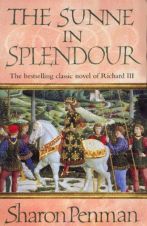
The Sunne in Splendour by Sharon Penman

“And what of those who didn’t know him? What happens, too, when all who knew him are dead, when people know only what they’ve been told?”

When I read The White Queen by Philippa Gregory earlier in the year, I became intrigued by Richard III, the Wars of the Roses and the mystery of the Princes in the Tower. The Sunne in Splendour was recommended to me as the best fictional account of Richard III, so I immediately bought a copy – and it has taken me until now to pick it up and read it. I think one of the things that was putting me off was the sheer size of the book; it’s one of those books that is physically difficult to hold because it’s so thick and heavy. But as soon as I started reading I knew I was going to love this book. Not only did it turn out to be the best historical fiction book I’ve read for a long time, it was also one of the best books of any type that I’ve read this year.

The Sunne in Splendour tells the complete life story of Richard III from childhood to death. Penman portrays Richard as a sympathetic figure who has been unfairly treated by history. Sadly, he is often thought of today as the villain of Shakespeare’s Richard III: the evil hunchback who murdered his nephews. It’s worth remembering though, that Shakespeare lived in Tudor England – and it was Henry Tudor who defeated Richard, the last of the Plantagenet kings.

The Wars of the Roses is the term used to describe a series of battles and rebellions that took place between two branches of the English royal family, the House of York and the House of Lancaster, during the late fifteenth century. I already had some basic knowledge of the period before I started reading this book, but even if you don’t I think Penman makes it easy enough to understand. Sometimes a story can suffer from the author’s attempts to include every little bit of interesting information they’ve uncovered in their research, but that’s not actually a problem here. Yes, there’s an enormous amount of detail, but everything feels necessary and helps to build up a vivid picture of Richard’s world.

The author really brought the characters to life and made them feel like real people who I could understand and care about rather than just names on the pages of a school history book. The number of characters with similar names could have caused confusion but I thought Penman handled the problem very well making them easy to identify by using nicknames (Ned, Dickon, Bess etc) or titles (Warwick, Clarence, Montagu) and Edward of Lancaster is given the French version of his name, Edouard, to distinguish him from Edward of York.

The story is told from multiple viewpoints, with surprisingly little of the story being from Richard’s perspective. Much of what we learn about Richard we learn through the eyes of his family, friends and enemies. A lot of time is devoted to the romance between Richard and Anne Neville, but what really fascinated me was the complex relationship between the York brothers, Richard, Edward and George.

As you might expect, there are a number of battle scenes – something that I don’t usually enjoy, but these were so well written that I was able to follow exactly what was happening and could even form mental pictures of the battlefields and the positions of the two opposing armies. The Battle of Barnet kept me up late on a work night and the Battle of Tewkesbury was even more compelling. I loved the way we got to see the human side of the battles, the emotions of the people on the battlefield, rather than just descriptions of the military tactics. While Richard and Edward are clearly supposed to be our ‘heroes’, it’s a testament to Penman’s writing that I could also cry at the deaths of their ‘enemies’.

Being almost 900 pages long, it took me a long time to read this book, but that was mainly because it was so emotionally intense in places that I couldn’t read too much at once. And also, I was dreading reaching the end. The problem with a book like this is that you know what’s ultimately going to happen (at least you do if you have some background knowledge of the period or have read about it before) so I knew what the eventual fate of the characters was going to be.

This is one of the best books I’ve read this year and I can’t believe I’ve never read anything by Sharon Penman before now. At least I know I’ll have hours of reading pleasure ahead of me as I work through the rest of her novels!
My Persephone Secret Santa Revealed!

Today is the day when Persephone Secret Santa participants reveal the identity of their Santa and the gift they received! Persephone Books have been a wonderful new discovery for me in 2010. I’ve read four so far and loved them all, so I couldn’t resist signing up for this year’s Secret Santa.

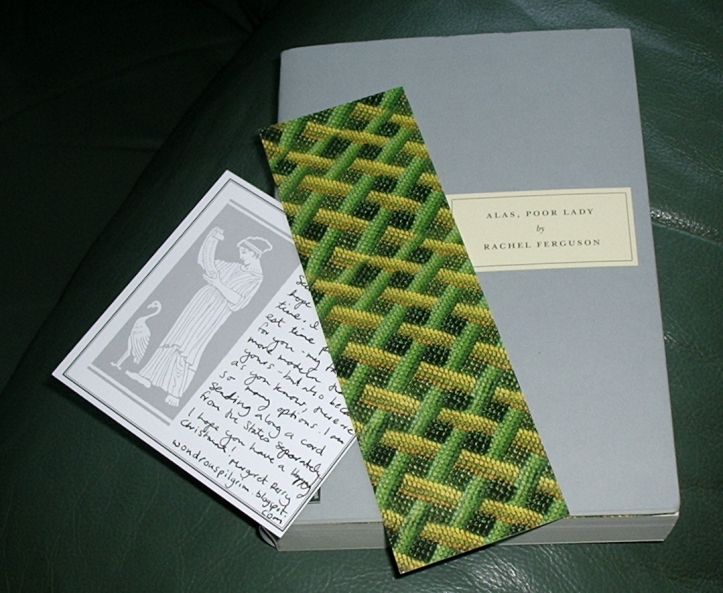
My Santa was Margaret of Ten Thousand Places. I was delighted to find that the book she sent me was Alas, Poor Lady by Rachel Ferguson. Margaret included a message with the book and mentioned that it had been a difficult decision – well, Margaret, I would have been happy with any of the Persephones I haven’t already read, but I think you’ve chosen one that will be perfect for me! I can’t wait to start reading it.

Thank you to Margaret for being my Santa and thanks also to Claire at Paperback Reader for hosting this! I’m looking forward to visiting everyone else’s blogs to find out what they received. For a list of all the Persephone Secret Santa participants see this post at Claire’s blog.

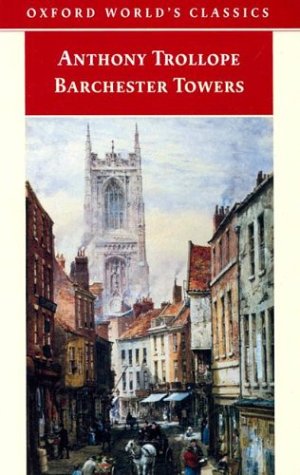
Barchester Towers by Anthony Trollope

Back in April I read my first Anthony Trollope book, The Warden, and enjoyed it so much I immediately bought a copy of Barchester Towers, the second Chronicle of Barsetshire, with the intention of going on to read the whole series. As it turned out though, other books seemed more tempting and poor Barchester Towers was pushed further and further down my tbr pile until The Classics Circuit’s Anthony Trollope Tour reminded me that it really deserved to be read as soon as possible!

Barchester Towers is set five years after the conclusion of The Warden. At the beginning of the story, the Bishop of Barchester dies, leaving a vacancy to be filled. It is expected that the Bishop’s son, Archdeacon Grantly, will take his place, but a change of government ruins his chances and newcomer Dr Proudie is appointed instead. When the new Bishop and his wife, the formidable Mrs Proudie, arrive in Barchester accompanied by their chaplain Mr Slope, Grantly becomes determined to prevent them from gaining too much power and changing the Barchester way of life.

This might not sound like a very exciting plot, and I have to admit it isn’t. Barchester Towers is a character-driven novel, and fortunately, the characterisation is excellent. Trollope’s characters are multi-faceted, complex and real; the villains are not completely evil and the heroes have their flaws. Archdeacon Grantly, for example, was portrayed quite negatively in the previous novel, but we see things more from his perspective in this book and I found that I was rooting for him against the Proudies and Slope.

Almost all of the characters are well-rounded and interesting. There’s the Signora Madeline Vesey Neroni, left crippled by her abusive Italian husband, who manages to get every man in Barchester to fall in love with her. There’s Miss Thorne, the local squire’s sister who lives in the past, dreaming of the days of knights and chivalry. And I was pleased to meet some old friends from The Warden, including my favourite characters, Mr Harding and his daughter Eleanor.

I’m not sure who I would recommend Trollope to. As far as comparisons to other Victorian authors go, I would say his style is a lot closer to George Eliot than Charles Dickens, for example. He tells his stories at a gentle, leisurely pace with some subtle humour, witty observations, and clever insights into human nature. He has a habit of talking directly to the reader and never lets us forget that we’re reading a novel, but rather than being annoying or disruptive, this style gives his writing the warm, conversational feel that I love. If you prefer stories with a lot of suspense and tension, though, you’ll be disappointed because Trollope keeps telling us in advance what is and is not going to happen, which has the effect of building an intimate and trusting relationship between the author and the reader. But even though it may seem quite obvious what the outcome of the book is going to be, the fun is in seeing how the outcome is reached.

Much as I love Trollope though, I can see that he won’t appeal to everyone – the gentle pace that I mentioned, in addition to the long descriptions and character introductions, might make the book too slow for some readers (it did take me almost 100 pages before I really got absorbed in the story). Some of his comments on gender, race and religion could also be considered offensive, although as a male Victorian author his views were probably consistent with the time period and society in which he lived. If you have read and enjoyed other Victorian writers, I would highly recommend giving Trollope a try to see what you think.

Although this one was a better book, I think I would still suggest that newcomers to this series start with The Warden. The shorter length means it’s less of a commitment if you find you don’t like Trollope’s writing style. It’s also the first in the series and although I’m sure Barchester Towers would work as a stand-alone novel, The Warden does introduce us to several of the characters and their backgrounds.

Based on the two books I’ve read so far, Trollope is quickly becoming one of my favourite Victorian authors. I definitely don’t want to let seven months go by again before I pick up another of his books! I’m already looking forward to the third Barsetshire novel, Doctor Thorne.

Anthony Trollope has been visiting my blog today as part of the Classics Circuit Anthony Trollope Tour. See this post for a list of other stops on the tour.

Remember These? Books beginning with ‘B’

Remember These? is a series of posts looking at some of the books I recorded in my old reading diary. The diary spanned my teenage years to my early twenties, so most of the books mentioned below will have been read during the 1990s and although I’ve included my original ratings, these do not necessarily reflect what I would feel about the books if I read them again today!

I gave the books ratings out of 5. The symbol * means I loved the book. X means I didn’t finish it.

Books beginning with ‘B’

Here are a selection of the books that appeared on the ‘B’ page of my notebook.

Black Beauty by Anna Sewell (5/5*)
This was one of my childhood favourites, but is a classic that can be enjoyed by adults too. If you’ve never read it, it’s told through the eyes of a horse called Black Beauty and highlights the way horses can suffer through the cruel treatment of their owners. Needless to say, this is yet another children’s book that makes me cry! The edition I have is a hardback with beautiful colour illustrations – sorry about the poor quality photo, but I couldn’t find the cover of this particular edition online anywhere.

Bloodstream by Tess Gerritsen (5/5)
It’s funny because I’ve read a few reviews of Tess Gerritsen books recently and didn’t take much notice of them, thinking that they didn’t sound like my type of books. In fact, I would have sworn that I had never even read one. Well, obviously I was wrong. I have read one and apparently I loved it!

Born of the Sun by Gillian Cross (5/5)
Gillian Cross is a British author best known for her children’s series, The Demon Headmaster. She also wrote this book, which I couldn’t remember at all until I read the synopsis: “For years, Paula and her father have dreamed and talked about trying to find the lost city of Atahualpa. And now, without warning, Paula is taken out of school and finds her dream come true…But as they descend towards the jungle, Paula senses that all is not quite as it should be. Why is her father so moody and impatient? And why does he insist that the expedition is being shadowed by sinister enemies?”

Borderliners by Peter Hoeg (4/5)
Peter Hoeg is best known for the thriller Miss Smilla’s Feeling for Snow. After reading Miss Smilla, I remember looking for more of Hoeg’s books and came across this one in the library. Although I appear to have enjoyed this book at the time, I can’t remember much about it now except that it was about a group of students at a private school in Denmark who discover that they’re being used as part of a social experiment.

The Ballad of Frankie Silver by Sharyn McCrumb (4/5)
Sharyn McCrumb wrote several novels that deal with Appalachian history and folklore. I remember reading this one, The Hangman’s Beautiful Daughter and She Walks These Hills, and I enjoyed all of them. The Ballad of Frankie Silver takes as its starting point two murders separated by more than a century and looks at the ways in which the justice system has changed over the years.

Bloody Roses by Natasha Cooper (3/5)
This was one of a series of murder mystery books featuring the detective Willow King who leads a double life as both a civil servant and a romantic novelist. It seems that I used to read a lot of crime fiction and murder mysteries, which is interesting because they’re not genres that I read very much at all anymore.

The BFG by Roald Dahl (3/5)
I think I probably read all of Roald Dahl’s children’s books, most of them more than once. This one was never one of my favourites though and although I can remember some of the characters (Sophie, the ‘Big Friendly Giant’, the other evil giants) I can’t really remember the plot.

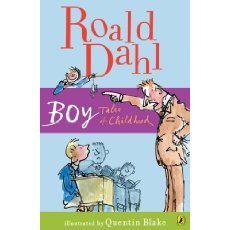
Boy by Roald Dahl (3/5)
This is an autobiographical work by Roald Dahl, in which he shares stories about his childhood years. It’s written in the same lively, humourous style as his fiction.

Bright Island by Mabel L Robinson (X)
I’m intrigued by this one because I don’t remember it at all, not even the title. I didn’t like it enough to even finish it and yet it apparently won a Newbery Honor in 1938. Can anyone remind me what it was about?

Do you remember reading any of the books mentioned above?

Coming soon… Remember These? Books Beginning with ‘C’.

The Epic of Gilgamesh

When I signed up for the Really Old Classics Challenge I had no idea what to read, as I’m completely new to ‘really old classics’. I finally picked The Epic of Gilgamesh, which proved to be the perfect choice because I loved it!

The Epic of Gilgamesh is one of the earliest known pieces of literature in the world. It was written on a set of clay tablets from ancient Mesopotamia which were discovered by the archaeologist Hormuzd Rassam in the 19th century and are thought to date from around 2000 BC. It’s fascinating to think that something written so long ago has survived and is still being read today.

The epic tells the story of Gilgamesh, a powerful Sumerian king who is feared by his subjects. The gods respond to the pleas of the people by sending a wild man called Enkidu to be Gilgamesh’s equal. The first half of the epic shows how Gilgamesh and Enkidu form a close friendship and have some great adventures together, including a journey into a cedar forest to slay the monster Humbaba. Later, when Enkidu dies, the devastated Gilgamesh sets out in search of the secrets of immortality.

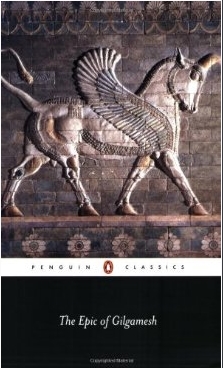
There have been several different translations of The Epic of Gilgamesh but the one I read was the Penguin Classics version translated by Andrew George. I’m not sure how this would compare to the other translations that are available (this is in verse form and I know that some of the others are in prose, for example); I might try reading a different one at some point in the future to find out.

The story is very repetitive with some verses being repeated two or three times in quick succession, with only a few words being changed each time. I actually really liked this structure, as it produced an almost hypnotic effect, as well as helping to emphasise the points that were being made. I was surprised at how easy it was to read and understand, despite some missing words and disjointed sentences (the Epic of Gilgamesh does not exist in its entirety – the various translators have had to piece it together from the surviving fragments of text). Some parts of the story feel very familiar, such as when Gilgamesh, during his quest for immortality, meets Utnapishtim who tells him about a great flood. This is obviously very similar to the biblical story of Noah.

There are lots of references to Sumerian gods and place names, which I am not familiar with at all, but the book has a lot of helpful extras including a glossary, character list and map. There’s also an introduction which helps to explain the historical context of the epic and describes how the tablets were discovered.

The Epic of Gilgamesh is relatively short in comparison to many other ‘really old classics’, but despite its shortness, it gives us a lot to think about. One thing we can learn from the epic is that although the world has changed in many ways over the last four thousand years, there are some things that are still the same: for example, friendship, love, grief at losing a loved one, fear of death, and every other human emotion you can think of.

Recommended

Reading the Victorians in 2011

Around this time last year, I signed up for a lot of challenges for 2010. After a few months though, I discovered that challenges don’t really work for me. I prefer to just read whatever I feel like reading without being under any pressure – so I’ve been trying not to be tempted by any of the 2011 challenges. However, I couldn’t resist the Victorian Literature Challenge as I was planning to read a lot of Victorian classics next year anyway.

* The challenge is hosted by Bethany at Words, Words, Words and runs from 1 Jan 2011 to 31 Dec 2011.

* There are four levels to choose from:
Sense and Sensibility: 1-4 books.
Great Expectations: 5-9 books.
Hard Times: 10-14 books.
Desperate Remedies: 15+ books

I’m signing up for the Hard Times level, but hopefully will read enough for the Desperate Remedies level. I prefer not to make lists because I have trouble sticking to them, but here are some of the authors and books I’d like to read in 2011.

Charles Dickens
I’ve only read two of Dickens’ books so far: A Christmas Carol and Bleak House. I have a copy of Our Mutual Friend on my shelf so I might read that one next, but I’d also like to read Great Expectations. Hopefully I’ll have time for them both next year.

Thomas Hardy
The only two Thomas Hardy books I’ve read so far are Tess of the d’Urbervilles and A Pair of Blue Eyes, both of which I read this year and loved. I would welcome any suggestions as to which one I should read next. I’d like to read them all eventually!

Charlotte Bronte
I love the Brontes – all three of them. I’ve read Emily’s Wuthering Heights and both of Anne’s books, The Tenant of Wildfell Hall and Agnes Grey, but only Jane Eyre by Charlotte. I’ll definitely read Villette in 2011 (I was hoping to get to it this year, but I’m not going to have time now) and would like to read Shirley and The Professor too.

Mary Elizabeth Braddon
Aurora Floyd is definitely on my list for 2011 as I’ve really enjoyed both Lady Audley’s Secret and The Doctor’s Wife

Anthony Trollope
I enjoyed The Warden, and Barchester Towers was even better (I’ll be posting my review of that one soon) so I can’t wait to read more Trollope. I just need to decide whether to continue with the remaining four books in the Barsetshire series or to try one of his other books.

George Eliot
I read Middlemarch this summer and loved it, so I want to read another George Eliot book in 2011. Not Silas Marner though, because I read that at school and although I can’t remember much about it, I know I didn’t like it.

Oscar Wilde
I’m not sure about including Oscar Wilde on my list. I read The Picture of Dorian Gray a few years ago and The Canterville Ghost in October, and most of his other works are plays. I don’t usually read plays and the few that I have read I haven’t really enjoyed, but I’d be prepared to give one of his a try, probably The Importance of Being Earnest.

Elizabeth Gaskell
I feel guilty about not having read any of Elizabeth Gaskell’s books yet, despite reading so many glowing reviews of her work. I did read one of her short stories and liked her writing style, so I’m looking forward to reading some of her novels next year.

What do you think? Any Victorian classics I definitely need to read in 2011? Will you be reading some Victorian literature next year too?

Northanger Abbey by Jane Austen

I feel embarrassed admitting that I still haven’t read all of Jane Austen’s books, knowing how popular she is both with book bloggers and the world in general. The reason for that is because although I enjoyed Pride and Prejudice I was less impressed with Mansfield Park and Emma. I didn’t dislike them but I didn’t love them, so I haven’t been in any hurry to read the rest of her books.

Northanger Abbey is the story of Catherine Morland, a seventeen-year-old girl who is obsessed with reading gothic novels. On a visit to Bath with some friends of the Morland family, Mr and Mrs Allen, Catherine gets to know Henry Tilney and his sister Eleanor. The Tilneys invite Catherine to stay at their family home and she is thrilled to discover they live in an abbey! But when on her first night at Northanger Abbey, in the middle of a thunderstorm, she finds a mysterious cabinet in her bedroom, Catherine’s imagination starts to run away with her…

This seems to be a book of two distinct halves. The first half, set in Bath, follows Catherine as she begins to fall in love with Henry Tilney and tries to escape the unwelcome attentions of her brother’s obnoxious friend, John Thorpe. She also meets John’s shallow, self-absorbed sister Isabella, who quickly becomes her ‘best friend’. In the second half, after Catherine accompanies the Tilneys to Northanger Abbey, the book becomes a parody of the gothic novel for a while before everything starts to tie together at the end. I’ve read a lot of gothic novels (including Catherine’s favourite Ann Radcliffe book, The Mysteries of Udolpho) and I think this probably helped me understand the humour, although all you really need is a basic knowledge of what a gothic novel involves (crumbling castles, dark passageways, sinister secrets, a gloomy atmosphere, melodrama etc). I imagine a lot of people are inspired to pick up a gothic novel for the first time after reading this book, rather than the other way round though!

Northanger Abbey could also be described as a coming of age novel. At the start of the book Catherine is very naïve and innocent, with romantic notions and an over-active imagination. As the story continues she begins to discover that there are some big differences between the world she lives in and the world of Ann Radcliffe’s novels. She also learns to be a better judge of character and to understand other people’s motives. Catherine is not a particularly strong character but she’s amusing and likeable, and so is Henry Tilney.

I found this a lot easier to read than the other Austen books I’ve read. The writing feels very bright and lively. This is the first Jane Austen book that I’ve really found funny and been able to understand why her wit and irony are so highly regarded. I know a lot of people don’t like it when an author ‘intrudes’ into the story and speaks directly to the reader, but it’s not actually something that bothers me at all. Austen does quite a lot of it in this book, particularly in chapter 5 when she defends novel-reading:

There seems almost a general wish of decrying the capacity and undervaluing the labour of the novelist, and of slighting the performances which have only genius, wit, and taste to recommend them. “I am no novel-reader — I seldom look into novels — Do not imagine that I often read novels — It is really very well for a novel.” Such is the common cant. “And what are you reading, Miss — ?” “Oh! It is only a novel!” replies the young lady, while she lays down her book with affected indifference, or momentary shame. “It is only Cecilia, or Camilla, or Belinda”; or, in short, only some work in which the greatest powers of the mind are displayed, in which the most thorough knowledge of human nature, the happiest delineation of its varieties, the liveliest effusions of wit and humour, are conveyed to the world in the best-chosen language.

I think I can see why this is considered one of Austen’s less popular books, because although it was a fun, entertaining and relatively quick and easy read, it did somehow feel less satisfying than the other books of hers that I’ve read. The ending seemed slightly rushed and some of the characters not as well developed as they could have been. But those are only minor criticisms because overall I loved this book. I still have two more Jane Austen books left to read and as I enjoyed this one so much, I’m now looking forward to reading the other two!