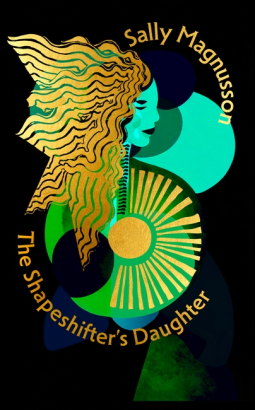
 I’ve read a lot of Greek mythology retellings but only one or two Norse ones, so I was curious about Sally Magnusson’s most recent novel, The Shapeshifter’s Daughter, described as a reimagining of the story of Hel of the Underworld. I’ve read all of Magnusson’s previous books and mostly enjoyed them; I hoped this would be another good one!
Hel is one of the three children of the Norse god Loki (the shapeshifter of the title) and Angrboda, a frost giant. She grows up in Utgard – a world on the peripheries of Asgard, home of the gods, and Mitgard, land of the humans – where she lives happily with her brother and sister, a wolf and a serpent, until Odin sends his gods to hunt them down and bring them to him. Hel finds herself sent by Odin to rule over the icy realm of Niflheim, where she welcomes the souls of the dead into the underworld – until one day she is drawn back to the surface by the memory of one of the dead she has guided.
Meanwhile, in the modern day, we meet Helen Firth, a woman in her fifties who has been diagnosed with terminal cancer. Helen has led a lonely, troubled life since the death of her father when she was a teenager. Believing that nobody cares about her, she decides to return to Orkney, her childhood home, so she can die on her own terms. However, she hadn’t expected to be reacquainted with an old friend, Thorfinn Coffin, who reminds her that maybe she’s not completely alone in the world after all.
Not only do our two main characters have similar names, their stories also mirror each other in several other ways and eventually begin to intersect. I couldn’t help thinking, though, that Helen’s story on its own would have been enough to form a compelling novel. Her life has clearly been a sad and isolated one, so I found her relationship with Thorfinn very moving, as well as bittersweet coming when she knows she only has a short time left to live. Magnusson writes quite sensitively on the topics of loneliness, bereavement and healing and I was completely drawn into Helen’s sections of the novel.
The Norse myth parts of the book were much harder for me to connect with. Hel, Loki and the others didn’t seem ‘real’ and I felt that I just watching their story unfold from a distance. I had similar feelings about A.S. Byatt’s Ragnarok (based on the same myths) and I remember in her author’s note Byatt said that characters in myths don’t have personalities the way characters in novels do – they only have attributes. Maybe that’s what Magnusson was trying to show here as well, but if so it didn’t really work for me and I would have been happy just to read a whole book about Helen and Thorfinn!
I’ll be interested to see what Sally Magnusson writes next, as her books so far have covered such a range of different subjects – although always with a Scottish or Nordic connection. And if you can recommend any good Norse myth retellings, I’d love to hear about them!


Good to see that we’re moving beyond the Greek myths at last – but that vein has (mostly) been played out by now I think! Interesting the point about attributes rather than personalities – although the *Greek* gods definitely seemed to have MORE than enough personality to go around! I’ll look out for this one. Thanks.
I do find Greek myths interesting, but yes, we need more books on other cultures’ myths as well!
not characters but attributes is a good way of looking at it; I’ve only read one Sally Magnusson but enjoyed it so I should really get on with reading more!
Yes, I thought Byatt’s explanation of characters from myths having attributes made a lot of sense. I think all of Sally Magnusson’s books are worth reading, although this particular book isn’t one of my favourites.
I’ve enjoyed Sally Magnusson’s books, but I don’t think I fancy this one!
I’ve read all four and thought this was the weakest.
Sounds interesting…though it’s disappointing that she didn’t make Hel and Loki and the others come alive like she did with Helen and Thorfinn. I prefer books with characters I can root for and truly like.
I could definitely root for Helen and Thorfinn, but the mythological characters never felt real at all.
That’s funny. I thought I had read at least two books by Magnussen, but apparently I only read The Sealwoman’s Gift.
That happens to me sometimes too. I suppose it’s easy to get confused when you read a lot of books! I’ve liked all of Sally Magnusson’s books but haven’t really loved any of them – I thought The Sealwoman’s Gift was probably the best.
I agree that the Helen sections of the novel were by far the strongest! It will take me a long time to forget her and Thorfinn. And yes, I’ve often thought that myth and folktale retellings stumble because of that exact point that Byatt makes – myth and folktale don’t function like novels and don’t inhabit character in the same way. I’ll never tire of recommending Kate Bernheimer’s wonderful essay ‘Fairy Tale is Form’ on this subject, which I believe you can read online for free.
It seems we had similar feelings about this book. Thanks for recommending the essay! I’ve found it and will read it as soon as I have time.
Oh it’s such a shame to hear that the Norse mythology is the weak spot within this novel as thats the element that most intrigues me. Im glad you found Helen’s story successful though and it certainly sounds like an emotional read surrounding her. As to Norse mythology I’ve heard good things about A Witch’s Heart but still need to read it myself. Its one I’m determined to pick up this year though.
The Norse mythology element sounded most interesting to me too, but the mythological characters felt disappointingly flat and unconvincing. I did love the Helen and Thorfinn storyline, though, so that saved the book for me. I hope you like The Witch’s Heart!
I was convinced I’d read one of Sally Magnusson’s books (The Ninth Child) but when I checked on Goodreads it turns out I haven’t but I do own a copy of Music in the Dark which I also haven’t yet read. Not sure I’d be adding this one to my shelves.
I find mythology retellings only work for me if I have some understanding of the original, otherwise I can’t appreciate what the author has added to it. The same can occur with retelling of classics that I haven’t read. On the other hand, I can also become annoyed by retellings where fundamental elements of the original are changed! Basically, there’s no pleasing me sometimes…
Music in the Dark is very different from this book and I think you would probably enjoy that one more as it’s straight historical fiction without the mythology. That’s a good point about needing some understanding of the original myth as well – I’m much more familiar with Greek myth than Norse, which could be another reason I struggled with this one.
Helen, I really love Norse mythology and I have also read a couple of A.S. Byatt’s novels, with my favourite being the YA Runemarks, but most of them were good but not quite great. Will keeping looking and hoping for some for us both! 👀
I’ve read very few books about Norse mythology, but it does seem a fascinating subject and a nice change from all the books on Greek mythology! I hope we can both find some good ones soon.