Review: Basil by Wilkie Collins

In 19th century literature, a man can approach a girl’s father, ask for permission to marry her and be given that permission, all without the girl having any say in the matter whatsoever. Sometimes the potential husband has only actually spoken to the girl once or twice; sometimes not at all – and they certainly haven’t had time to get to know each other properly. Basil by Wilkie Collins is a good example of why these arrangements were often doomed to failure and caused unhappiness both for the husband and the wife.

Our narrator, the Basil of the title, is the son of a rich gentleman who is proud of his family’s ancient background and despises anyone of a lower social standing. When Basil meets Margaret Sherwin on a London omnibus he falls in love at first sight and becomes determined to marry her. Unfortunately Margaret is the daughter of a linen-draper, the class of person Basil’s father disapproves of most of all, so he decides not to tell his family about her just yet.

Mr Sherwin agrees to Basil marrying Margaret – but he insists that the wedding must take place immediately and that Basil must then keep the marriage secret for a whole year, not even seeing his wife unless Mr or Mrs Sherwin are present. This unusual suggestion should have told Basil that something suspicious was going on but he’s so blinded by love that he doesn’t care – until it’s too late…

Basil was one of Collins’ earliest novels and it shows, as it’s just not as good as his more famous books such as The Woman in White. The story took such a long time to really get started, with Basil introducing us to the members of his family, giving us every tiny detail of their appearance, personality and background. The second half of the book was much more enjoyable, filled with action, suspense and all the elements of a typical sensation novel including death, betrayal and adultery (Victorian readers apparently found the adultery scenes particularly shocking). There are lots of thunderstorms, people fainting and swooning, fights in the street, and everything you would expect from a Victorian melodrama.

All of Collins’ books are filled with strong, memorable characters and this was no exception. There’s Basil’s lively, carefree brother Ralph, his gentle, kind hearted sister Clara, the poor, frail Mrs Sherwin and the sinister Mr Mannion. However, I thought the overall writing style of this book was slightly different to what I’ve been used to in his later books – although I can’t put my finger on exactly what the difference was. This is not a must-read book but if you like the sensation novel genre, you’ll probably enjoy this one.

After the Sunday Papers #2: New Books vs Old Books

Sunday again already – and it’s a long weekend so I’m not back to work until Tuesday!

While I was trying to think of a topic for this week’s After the Sunday Papers post, it occurred to me that it’s been a while since I reviewed a newly published book. Recently I’ve been reading a lot of classics and books from the early 20th century. I don’t know if anyone has a problem with blogs that review older books, though I’m guessing that if you’re following my blog you probably don’t mind!

We all have different reading tastes – some of us like to read the latest books as soon as they are published; others prefer Victorian classics or World War II era books; many of us just read whatever we’re in the mood for or whatever happens to be on our shelves. But have you ever thought about when most of the books you read were published?

If you had asked me that question yesterday, I would have said that I don’t read enough new books. It’s not deliberate – I do read other people’s reviews of the latest releases and make a note of the titles, fully intending to read them, but when it comes to actually buying books or borrowing them from the library, I find myself choosing books that sound interesting regardless of publication date and regardless of whether everyone else has already read them years ago.

However, today I took the publication dates of the 35 books I’ve reviewed so far on this blog, put the figures into a pie chart maker…and this is what it came up with:

As you can see, I’ve obviously read more books from the last decade than I thought! What about you? Do you read mostly new books, older books or a mixture?

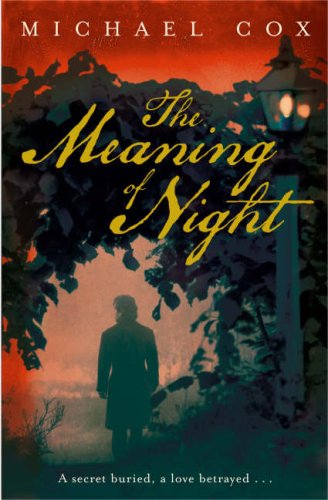
Review: The Meaning of Night by Michael Cox

I was intending to read this book when it was first published four years ago, but for some reason I didn’t and forgot all about it until I noticed it in the library recently.  I’m glad I finally got round to it, even if I’m late as usual!

The plot will be a familiar one to anyone who has read a lot of Victorian fiction – it’s a story of love, betrayal and deceit, revolving around a lost inheritance and a childhood rivalry. A vast country estate, a beautiful, mysterious heroine, and the dark, foggy streets of 19th century London combine to make this a clever imitation of the Victorian sensation novel.

In a similar way to The Unburied which I reviewed earlier this month, the book is presented as a genuine 19th century manuscript, complete with an ‘Editor’s Preface’ and numerous footnotes. The use of footnotes, which seemed to appear on almost every page, reminded me of Susanna Clarke’s Jonathan Strange & Mr Norrell. However, whereas in Jonathan Strange the footnotes really added something to the story, providing us with fascinating anecdotes about the history of magic, in The Meaning of Night they served very little purpose – other than to give the book a scholarly feel. Overall though, this was one of the best written of all the novels of this type that I’ve read so far and I was impressed by the author’s use of language and writing style to make this feel like an authentic 19th century novel.

The narrator, Edward Glyver, is really quite a horrible person. In the first chapter – in fact, in the first sentence (so this is not a spoiler) – he confesses to murder:

“After killing the red-haired man, I took myself off to Quinn’s for an oyster supper.”

He also cheats on the woman who loves him, develops an obsession with his enemy, Phoebus Rainsford Daunt – and becomes increasingly dependent on opium, making him an unreliable narrator at times. Is he a character deserving of our sympathy, then? Definitely not – and yet, I was rooting for him throughout the story, wanting him to right the wrongs that had been done to him, which is a testament to Michael Cox’s writing skills.

The only thing that really disappointed me about this book was the ending. I can’t say too much about it without spoiling the story for you, but the ending left me feeling dissatisfied – I had been hoping for a few more plot twists.

This book won’t be to everyone’s taste – if you simply don’t like intricately plotted Victorian or Victorian-style novels you’ll want to avoid this one. However, fans of Charles Dickens or Wilkie Collins will probably enjoy this book, as they were clearly two of Michael Cox’s influences (many of the characters have Dickensian names such as Phoebus Daunt, Fordyce Jukes and Josiah Pluckrose). It should also appeal to readers of Sarah Waters, Charles Palliser or other writers of neo-Victorian fiction. In particular, I found it very similar to Palliser’s The Quincunx, though slightly less complex and intellectually demanding.

Recommended

Genre: Historical Fiction/Pages: 608/Publisher: John Murray/Year: 2006/Source: Library book

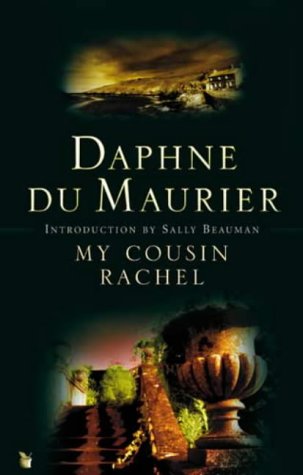
Review: My Cousin Rachel by Daphne du Maurier


This is the second Daphne du Maurier book I have read this month.  I hope eventually I’ll have time to read all of them because so far none of her books have disappointed me.

Like I’ll Never Be Young Again, which I read at the beginning of May, My Cousin Rachel is written in the first person from a male perspective. Also as in I’ll Never Be Young Again, the male narrator is a naïve, immature man who I found it difficult to sympathise with. His name is Philip Ashley, a twenty-four year old Englishman who has been raised by an older cousin, having lost both his parents at an early age. Philip and his cousin Ambrose have a very close relationship and Philip is left confused and jealous when Ambrose suddenly marries a woman he meets in Italy. This woman happens to be another cousin of theirs – their cousin Rachel.

Early in the novel, Ambrose dies and Rachel returns alone to the Ashley estate in England. At first, Philip is convinced his cousin Rachel was responsible for Ambrose’s death, but after meeting her he’s not so sure…

My Cousin Rachel is often compared with Daphne du Maurier’s most famous book, Rebecca, and although the two books are very different in many ways, I can see the reasons for the comparisons. The books share some common elements, including the estate in Cornwall (based on du Maurier’s own home, Menabilly) and the mysterious, secretive woman, but the biggest resemblance is in the atmosphere the writing conveys. Daphne du Maurier is one of the most atmospheric writers I know of. Whether she’s writing about the streets of Florence or the coast of Cornwall she always manages to convey a mood perfectly suited to the location and draws you completely into the world she has created. My Cousin Rachel has a strong feeling of foreboding, where from the beginning you know something bad is going to happen and you’re just waiting to see what it is.

Throughout the book, my opinion of Rachel was constantly changing. It was hard to form an accurate idea of what Rachel was like, as we only really saw her through Philip’s eyes and he was not a reliable narrator. Another thing that added to the vagueness and uncertainty of the story was that we were never told exactly when it was taking place. It was obvious that the book was set in the 19th century, but which decade? And what was the name of the Ashley estate? Unless I missed it, we weren’t told that either. It seems to be quite typical of Daphne du Maurier to withhold information from us in this way – after all, in Rebecca we aren’t even told the narrator’s name!

There are a lot of loose ends and questions left unanswered at the end of the book, which is something that often bothers me, but in this case I didn’t mind. I liked the way there were aspects of the story that could be interpreted in several different ways. I expect it would have been a good book to read with a group, as the ambiguity would lead to some interesting discussions and theories.

Recommended

Pages: 304/Publisher: Virago Press (Virago Modern Classics 491)/Year: 2008 (originally published 1951)/Source: Library book

After the Sunday Papers #1

As I mentioned a few weeks ago, moving my blog from blogger to wordpress meant that I lost my Sunday Salon membership. I suppose I could have continued to do unofficial Sunday Salon posts, but I thought I might as well come up with something different – and I decided to stay with the quote from which I took my blog title (“She had read novels while other people perused the Sunday papers”).  So, welcome to my first After the Sunday Papers post, in which I’ll look at some interesting news and links from the previous week and update you on my current reading plans.

Inspired by Iris’s post on readalongs yesterday, I’m considering taking part in Nymeth’s Middlemarch readalong. I haven’t had much luck with reading Middlemarch in the past – I attempted to read it a few years ago and gave up halfway through. I had a second attempt the following year and this time couldn’t even get past the first couple of chapters! I can’t understand why I’ve been finding it so difficult to read. The length isn’t a problem – I’ve read and enjoyed plenty of books of the same length or longer (my all-time favourite book is The Count of Monte Cristo and they don’t come much longer than that!) The fact that it was written in the 19th century is also not a problem – as most of you will know, I love Victorian classics.  I don’t think I even have a problem with George Eliot herself – I’ve read Silas Marner and although I can’t remember much about it, I know I enjoyed it (and Middlemarch is considered to be better). So what is the problem? I don’t know, and that’s why I would like to try again.

Are there any books that you have repeatedly tried to read with no success?

  • One book that I am finding a success (at least so far) is the one I’m currently reading, Daphne du Maurier’s My Cousin Rachel. I had my love for Daphne du Maurier reawakened when I read I’ll Never Be Young Again earlier this month, so couldn’t resist borrowing two more of her books from the library – this one and The Scapegoat, neither of which I had read before.
  • Some good news for any of you who are parents: a new study by Nevada University has found that having even 20 books in the home can have an impact on your child’s education – and having more than 500 books can lead to a child staying in education for an average of three years longer than in households with less access to literature.
  • Finally, if any Charles Dickens fans are reading this, here’s an article from the Daily Mail about his relationship with Ellen Ternan, the actress for whom he separated from his wife, Catherine.  I found it interesting as this period of Dickens’ life, including the Staplehurst Rail Disaster, was covered in Drood, which I read in March. Apparently the BBC are making a new film about Dickens and Ellen, though there’s no news on when it will be shown.

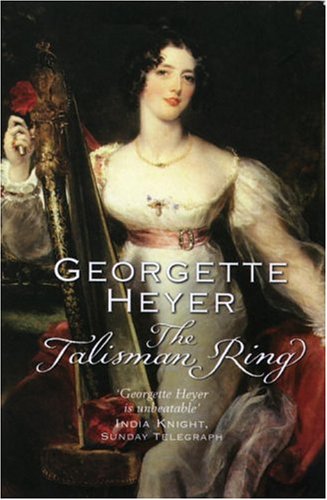
Review: The Talisman Ring by Georgette Heyer

Before I started blogging I had never considered reading Georgette Heyer, but after seeing how popular she is with so many other bloggers I knew I would have to give her a try. I’m glad I did – and I’m glad I chose to begin with The Talisman Ring because I really enjoyed it.  I could describe this book in one word: fun!

Lord Lavenham’s dying wish is that his great-nephew Sir Tristram Shield will marry his granddaughter Eustacie de Vauban.  However, Tristram is a sensible, practical man in his thirties while Eustacie is a romantic, passionate girl of eighteen – and neither particularly wants to marry the other.  Eustacie would prefer to marry her other cousin, Ludovic, but there’s just one problem: Ludovic is a fugitive, wanted for murder.  With the help of Sarah Thane, Tristram and Eustacie begin a search for the talisman ring that will prove Ludovic’s innocence.  This is all part of a thrilling adventure involving smugglers, excisemen, the Bow Street Runners and a Headless Horseman!

I enjoyed the witty dialogue and the way all the characters interacted with each other, particularly the relationships between Tristram and Sarah, and Eustacie and Ludovic.  Even the minor characters were well drawn and fun to read about. One of my favourites was Sir Hugh Thane, Sarah’s brother, who appeared completely oblivious to what was going on around him and was more interested in the contents of the Red Lion’s cellar.

I thought Eustacie was very over the top and as a result, not very realistic, but I can appreciate that Heyer had intended her to be an amusing, entertaining character. I preferred the book’s other heroine, Sarah Thane, who was more down to earth and composed – though like Eustacie, she longs to have some excitement in her life…

“I thought it too good to be true,” said Miss Thane. “If there is one thing above all others I have wanted all my life to do it is to search for a secret panel! I suppose,” she added hopefully, “it would be too much to expect to find an underground passage leading from the secret panel?”

The Talisman Ring has a bit of everything: mystery, adventure, history, romance and comedy. In general I prefer my historical fiction to be more serious, but I still enjoyed this book and am looking forward to reading more of Heyer’s work. I have a couple of her other books waiting to be read, so it will be interesting to see what I think of them.

Recommended

Genre: Historical Fiction/Pages: 320/Publisher: Arrow/Year: 2005 (originally published 1936)/Source: Library book

Review: Tess of the D’Urbervilles by Thomas Hardy

Tess Durbeyfield’s life changes forever when her father learns that he is descended from the noble D’Urbervilles. After discovering that he has some wealthy D’Urberville relatives living nearby, Tess is sent to visit them in an attempt to improve the family’s fortunes. While there she is taken advantage of by Alec D’Urberville and returns to her parents pregnant. A few years later when she falls in love with Angel Clare, the parson’s son, she is forced to decide whether to trust Angel with the truth about her past…

It seems that people either love or hate Tess of the D’Urbervilles. Among those who hate it the main reasons for disliking it appear to be that the book was too dark and depressing, or that Tess was too passive and weak. Although I can understand these complaints, I personally fall into the group of readers who loved the book. I don’t have a problem with a story being tragic, melodramatic or depressing as long as it’s well-written. And Hardy’s writing is beautiful. With other books I am often tempted to skim through pages of descriptions of trees, fields, sunrises etc, but Hardy’s portrayal of nature and the English countryside is so poetic I wanted to read every word. Be prepared, though – you will learn more than you ever wanted to know about milking cows, threshing wheat and slicing turnips!

It’s true that Tess doesn’t stand up for herself enough – there were plenty of times when I wanted to scream at her – but I mostly felt sorry for her. She was young (sixteen I think at the start of the book), innocent, naive, and didn’t have the best family life, with a father who was often drunk.  It seemed that everything that could go wrong for her did go wrong. More than poor Tess, it was Alec d’Urberville and Angel Clare who both really infuriated me – and I actually thought Angel was worse than Alec in some respects.

The injustice of a society with different sets of rules for men and women, Christianity vs pagan symbolism, the Industrial Revolution, and the class system of Victorian England are some of the interesting topics this book covers. The only thing I didn’t like about the book was the ending – the final chapters just didn’t seem to fit with the rest of the novel.

So, if you haven’t read this book yet give it a try – you might hate it…but you might just love it like I did.

Highly Recommended

Genre: Classics/Pages: 464/Published:BBC Books (Random House)/Year: 2008 (originally published 1891)/Source: Library book