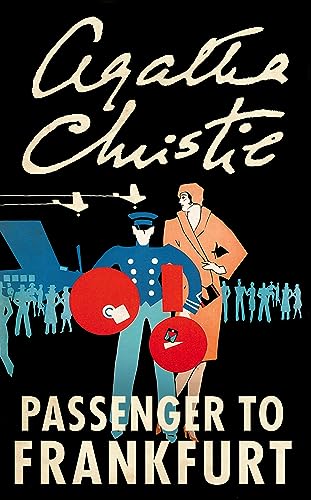
 My second book for this week’s 1970 Club (hosted by Karen and Simon) also counts towards the Read Christie challenge where, for the final three months of the year, we are focusing on Agatha Christie books from the 1960s and 70s. I was a bit dubious about reading Passenger to Frankfurt as it seems to be widely considered one of her worst novels, but I want to read all of her books eventually anyway, so this seemed as good a time as any.
The novel begins with Sir Stafford Nye being delayed at Frankfurt Airport on his way home to England from a diplomatic mission in Malaya. When he is approached by a young woman who tells him that her life is in danger, Sir Stafford finds himself agreeing to lend her his passport and cloak so she can safely board the next flight to London in disguise. This is to be the first of several encounters Sir Stafford has with this woman; after he returns to London himself, having claimed to have been the victim of a theft, he places an advertisement in the newspaper in the hope of tracking her down, and their paths soon cross again.
None of this may seem particularly plausible, but at least it’s fun. Once Sir Stafford begins to learn more about his new acquaintance and her mission, however, things start to go downhill. He is pulled into a web of espionage and intrigue, which should be exciting but unfortunately isn’t, partly because there’s not much action – instead there are lots of long passages in which various people hold meetings and conferences to discuss the rise in youth movements and rebellions around the world. There are discussions of fascism, neo-Nazis, student protests, anarchy, drugs and weapons; Christie was eighty years old when this book was published and it seems that her view of the future was a very bleak one, in particular regarding the role young people would play.
This could still have been interesting, but Christie doesn’t manage to balance her political commentary with any kind of coherent plot, so all those conversations about youth unrest do become very repetitive and tedious, especially as the various conspiracy theories that arise are too outlandish to take seriously. There’s also a large number of characters, many of whom are introduced and then disappear again a few pages later. Apart from Sir Stafford and his mysterious female friend, the only one who really stands out is Sir Stafford’s Aunt Matilda, one of those no-nonsense old ladies Christie writes so well. Intriguingly, Matilda has an assistant, Amy Leatheran, who I assume is the same character who appeared in Murder in Mesopotamia, although no reference is made to her earlier adventures!
 I often enjoy Christie’s thrillers and spy novels (They Came to Baghdad and The Man in the Brown Suit are favourites), but this one was a big disappointment and certainly the weakest of all the Christie novels I’ve read so far. I don’t regret reading it for 1970 Club, though, because, as I’ve said, I was going to read it at some point anyway. Definitely one for completists, in my opinion, and not the place to start if you’re new to Christie’s work.












 She Reads Novels