The Official Agatha Christie Puzzle Book

This is a book I received last Christmas (a present from my sister) and now that I’ve completed all of the puzzles in it, and with Christmas almost here again, I thought I would post a short review. It would make a great gift for any friends or family members who are Agatha Christie fans.

The book is divided into sections, with each one themed around a different Christie novel. For example, Chapter 5 is based on The ABC Murders, so many of the puzzles involve the alphabet or the letters A, B and C, while Chapter 9, Murder on the Orient Express, has puzzles about trains and snow. A few of them do require a knowledge of the original novel, but the majority could be solved even if you’d never read Christie before.

The puzzles in the book are nicely varied and range from crosswords and wordsearches to anagrams, logic puzzles and many more. I found some of them very easy to solve, but others were much more challenging. There are solutions included at the back of the book if you get stuck!

Each chapter ends with a letter written by Charles, a new librarian at Greenway, Christie’s old holiday home which is now a museum owned by the National Trust. The letters are addressed to his Aunt Mary and relate to the disappearance of the former librarian, Mrs Ashmore, who has gone missing, leaving behind a bundle of puzzles for Charles to solve. This framing story helps to tie the whole book together, as the mystery of Mrs Ashmore’s disappearance can only be solved once you’ve completed all of the other puzzles in the book.

If you already own this book, or if it doesn’t appeal, maybe you would prefer The Offical Poirot Puzzle Book, which has just been released in time for Christmas. There’s also The Official Agatha Christie After School Detectives Club aimed at children aged 8 and up, so something for all the family!

The Twelve Days of Christmas by Susan Stokes-Chapman

I’ve previously only read one short story by Susan Stokes-Chapman (in the anthology The Winter Spirits) and I was interested in reading more of her work. This seemed like the perfect time of year to read her new book, The Twelve Days of Christmas!

The book is loosely based on the Christmas carol of the same name, with each chapter inspired by one of the gifts traditionally mentioned in the song – for example, Chapter 1 features pear trees and a character called Miss Partridge (“a partridge in a pear tree”) and Chapter 6 revolves around a game involving hidden goose eggs (“six geese a-laying”). In some cases this is done quite subtly, but in others it’s more heavy-handed; I can appreciate that it’s probably not easy to work all of these references into a novel without it beginning to feel unnatural!

Each chapter feels almost like a separate story (a few of them probably would work as standalones), but they are also linked together through shared characters and a shared setting. That setting is the little English village of Merrywake during the Regency period, with the Napoleonic Wars playing out in the background. Beginning on Christmas Day and ending on Twelfth Night, we join Viscount Pepin of Wakely Hall and his family, friends and servants as they celebrate the festive season. There’s a lovely Christmassy atmosphere as we watch the characters decorate the house, kiss under the mistletoe, open gifts, write and solve riddles, and prepare for the grand Twelfth Night Ball. But although it may all sound idyllic, not everyone at Wakely Hall is having a happy Christmas…

Stokes-Chapman explains in her author’s note that this book is her tribute to Jane Austen and Georgette Heyer and you can definitely see the influence of both. The Viscount and Viscountess Pepin (the name also has links to the song The Twelve Days of Christmas) with their five daughters immediately made me think of Austen’s Pride and Prejudice – the chapter based on “five gold rings” deals with the five girls and their hopes of marriage. The servants, though, are given just as much attention as the upper classes: there are stories about Loveday Lucas, the new kitchen maid, who can’t seem to do anything right; Will Moss the under-gardener, who appears to have fallen in love with someone completely unsuitable; and Mrs Wilson, the cold, strict housekeeper who is shocked to find that her staff consider her heartless.

I loved the world Stokes-Chapman created at Wakely Hall, but it was also nice to get some insights into the lives of the other residents of Merrywake, such as the village toymaker whose son, a drummer in the British army, has failed to come home from France. The toymaker’s story was one of the highlights of the book for me and together with the chapter that follows, about another army musician (a piper, as you may have guessed), it shows that the impact of the Napoleonic Wars is being felt all over the country, in even the smallest of communities.

The Twelve Days of Christmas is a lovely book and despite it obviously being very contrived in places, I found it completely absorbing. I particularly liked the way so many different characters from such varied backgrounds are all given their chance to shine, while each chapter also cleverly builds on the one before. I was sorry to say goodbye to the people of Merrywake and would love a sequel so we could catch up with them again in the summer!

Thanks to Random House UK, Vintage/Harvill for providing a copy of this book for review via NetGalley.

White Corridor by Christopher Fowler

This is the fifth book in a series I started over a decade ago. My slow progress doesn’t mean I’m not enjoying the books, because I am, but I do feel ashamed that when I reviewed the fourth book, Ten-Second Staircase, I claimed that I would “be continuing soon with book number five, White Corridor” – and that was in 2016!

Anyway, the series follows the investigations of Arthur Bryant and John May, a pair of octogenarian detectives who work for London’s Peculiar Crimes Unit. Some of the books have contemporary settings while others deal with cases from earlier in the careers of Bryant and May. White Corridor is one that’s set in the present day (around 2007, when the book was published). At the beginning of the novel, Raymond Land, the Unit Chief, has decided to close the unit for a week in February due to a lack of work and because the team had worked throughout the Christmas holiday period. Bryant has chosen to spend his time off attending a spiritualist convention in Dartmoor and May finds himself agreeing to accompany him.

As the two elderly detectives set off by car on their journey, heavy snow begins to fall and they quickly become stranded in a blizzard along with lots of other drivers. Meanwhile, back at the PCU, pathologist Oswald Finch has been found dead in his own locked mortuary. Four other PCU members have keys to the door, so all four become suspects, but the investigation is made difficult by the fact that the unit is temporarily closed and their two best detectives are miles away, trapped in a snowstorm. Bryant and May must try to solve the mystery by phone, but first, they have another killer to catch – one who is hiding somewhere within the snowy ’white corridor’ of abandoned cars.

This second killer is on the trail of a woman and her young son in another car, having pursued them all the way from France. Now he’s finally caught up with them and thanks to the snow they’re not going to be able to escape. Throughout the book, the perspective switches between the mother and child, desperately trying to evade their pursuer, Bryant and May, trying to solve both crimes while avoiding freezing to death, and the PCU staff back in London. With Bryant and May not around, Detective Sergeant Janice Longbright takes charge of things and it was good to see her coming to the forefront of the story and developing as a character.

Compared to the first four books in the series, this one has quite a different feel, with Bryant and May taken out of their usual environment and the rest of the unit left on their own. Some things never change, however, such as Arthur’s arcane knowledge and useful friendships with the most unexpected people, in this case a white witch, and of course, the PCU being threatened with closure yet again! This time they are facing a royal visit, so needless to say, their pathologist being murdered is not exactly the best way to prepare.

This isn’t one of my favourite books in the series, as I think I prefer to see Arthur and John on home ground and working with the rest of the team, but it was still quite entertaining. I’m looking forward to reading the next book, The Victoria Vanishes, and will try not to leave it so long this time!

My Commonplace Book: November 2025

A selection of quotes and pictures to represent November’s reading:

commonplace book
noun
a book into which notable extracts from other works are copied for personal use.

~

Over centuries, literature has served as a refuge for the weary, a space where individuals could confront their fears, process trauma, or simply escape into a world kinder than their own.

100 Books to Live By by Joseph Piercy (2025)

~

‘Yes, ’tis a powerful thing, fear. But never forget that loneliness gives you strength. You can spend your life observing others, on the outside looking in. You end up learning a lot about human nature that way.’

The Last Love Song by Lucinda Riley (2025)

~

The classic Cluedo board layout

‘God, Elva, I could kick myself. It’s the first rule of detective fiction – never delay questioning a suspect, because they’re bound to be bumped off before you get to them.’

The Christmas Clue by Nicola Upson (2025)

~

Stupidity is the same as evil if you judge by the results.

Surfacing by Margaret Atwood (1972)

~

‘I do,’ I say. ‘Art is generally about love, one way or another, don’t you think? Every book. Every song. Every film. All of us trying to live with it. Or get over it. Or wonder why we’ve never had it. Not necessarily love in a sexual sense. Love between parents and children. Love for a place.’

Air by John Boyne (2025)

~

Lotus blossoms had to rise from the depths of murky waters in order to bloom. They were survivors. And so was she.

Ghosts of Grayhaven by Amy Newbold and Lark Wright (2025)

~

Illustration of “Twelve Lords a Leaping”, from Mirth Without Mischief

But, as is often the case, some people do not take the advice solicited so passionately from their loved ones, yet find themselves considering the same advice if offered to them by another party…

The Twelve Days of Christmas by Susan Stokes-Chapman (2025)

~

Fear can resemble a crackling sound in a frozen ditch.

The Ice Palace by Tarjei Vesaas (1963)

~

“Is it a ruin now? I love ruins. The ancient sadness of them – the knowledge one is treading through history.”

All of Us Murderers by KJ Charles (2025)

~

Some people are so righteous in their minds they can’t accept mistakes in others. They would rather cradle condemnation at their breasts than help someone in trouble. He can’t understand that kind of bitterness at all.

Seascraper by Benjamin Wood (2025)

~

How had she reached such a state, Cheryl wondered, as they made their laborious way down the stairs, when a few kindly meant words of a stranger were all that stopped her sinking to the floor in despair.

The Token by Sharon Bolton (2025)

~

Jason and Medea by John William Waterhouse (1907)

All love is war, if you are one of the weapons.

No Friend to This House by Natalie Haynes (2025)

~

If one man does not make a move, the other must, and by permitting the adversary to make the attack one learns something about him.

The Big Four by Agatha Christie (1927)

~

With all my heart, I envied those to whom the night was nothing. A fleeting mind full of dreams and nothing, nothing more. Rest and refreshment. The quiet lost hours of the night. But for me it was not so.

The Inn Closes for Christmas by Cledwyn Hughes (1947)

~

There is an old German saying: there are always grounds for hope, it just has to be the right hope.

Tales from the Underworld by Hans Fallada (2014)

~

Favourite books read in November:

The Twelve Days of Christmas and Seascraper

Authors read for the first time in November:

Nicola Upson, Joseph Piercy, Benjamin Wood, KJ Charles, Cledwyn Hughes, Amy Newbold and Lark Wright

Places visited in my November reading:

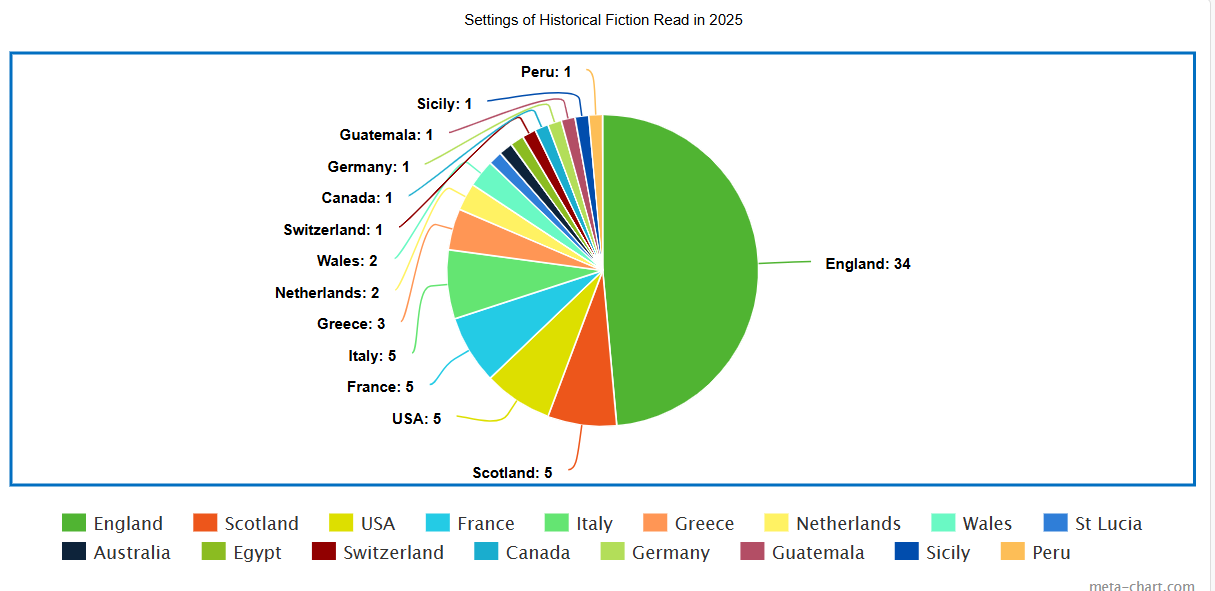
England, Ancient Greece, Norway, US, Canada, Ireland, Germany, Wales, France, Italy

~

Reading notes: I’ve read a lot more this month than I have over the last few months, which is largely due to Novellas in November. I read five novellas, all of which I enjoyed to varying degrees. One of them counted towards Margaret Atwood Reading Month too and I also managed to read books for German Literature Month and Nonfiction November, as well as joining in with all the nonfiction weekly topics. Other than that, I read a few Christmas books and some review copies from my NetGalley shelf.

There are two more events coming up in December – Doorstoppers in December hosted by Laura Tisdall, a chance for us to read some of the bigger books on our shelves after a month devoted to the shorter ones in November, and Dean Street Press December, hosted as ever by Liz. December and the end of the year also means I’ll be posting my annual preview of upcoming historical fiction releases for the year ahead, as well as revealing my books of the year for 2025 – so look out for both of those posts later in the month!

~

What did you read in November? Do you have any plans for your December reading?

The Big Four by Agatha Christie

The November theme for the Read Christie 2025 challenge is spies. I’ve already read the recommended book, Cat Among the Pigeons, and most of the suggested alternatives – I don’t want to read Postern of Fate yet as it’s the final Tommy and Tuppence book and I’m working through that series in order – so I looked for one I hadn’t read that featured international intrigue and espionage. The Big Four seemed suitable but I was a bit wary about reading it as it seems to have a bad reputation. I needn’t have worried, though, because although it’s clearly not one of her better books, I still enjoyed it!

The novel is narrated by Arthur Hastings, which is always a good thing – I love Hastings! – and he plays a big part in the story, having adventures of his own, not just as narrator and sidekick to Poirot. The book begins with a man arriving unexpectedly in Poirot’s doorway, appearing feverish and exhausted. Unable to speak, he writes the number 4 several times on a sheet of paper, and when he recovers he explains that he was referring to an international crime ring consisting of the Chinese mastermind Li Chang Yen, an American, a Frenchwoman and a mysterious fourth person known only as ‘the Destroyer’. Together they form the Big Four, a group trying to cause global unrest so that they can take over the world.

The rest of the book takes the format of a series of loosely connected episodes, as Poirot, with the help of Hastings, tries to identify the other three members of the Big Four. Of course, with their own spies and agents in every corner of the world, the Big Four know that Poirot and Hastings are on their trail and set various traps for them, some of which they fall into and some they don’t. Poirot attempts to set traps of his own, but although he manages to identify the American and the Frenchwoman fairly quickly, Number Four proves much more elusive.

I found The Big Four more entertaining than I expected, considering that Christie herself described it as “a rotten book”. It’s understandable why she would feel that way as the book was published in 1927, during a time when Christie was struggling financially and emotionally and had disappeared from her home for several days. She felt she had to force herself to complete this book and the next one, The Mystery of the Blue Train. This also explains the episodic nature of the book, because it was based on twelve previously published short stories which Christie reworked into a full-length novel rather than trying to come up with a completely original idea while she wasn’t in the right frame of mind to do so.

Despite the book’s origins and its silly, far-fetched plot, I think it’s better than some of her later thrillers, such as Destination Unknown, but I can see why it’s not well regarded and it certainly doesn’t feel like a typical Poirot novel. As I’ve said, though, it has Hastings in it, which is always a bonus, and we also get to meet – sort of – Poirot’s twin brother, Achille! It was a fun, undemanding read for me in this busy month of November, but probably not one I’ll want to revisit.

Nonfiction November: Week 5 – New to my TBR

The host for week 5 of Nonfiction November is Deb of Readerbuzz and here is this week’s topic:

It’s been a month full of amazing nonfiction books! Which ones have made it onto your TBR? Be sure to link back to the original blogger who posted about that book!

Here are some of the books I’ve seen other bloggers mention during Nonfiction November that I would be interested in reading:

Moonlight Express: Around the World by Night Train by Monisha Rajesh
(Frances at Volatile Rune)

An account of the author’s travels by sleeper train.

Monsterland by Nicholas Jubber
(Shelleyrae at Book’d Out)

A book exploring myths and legends about monsters.

The Notebook: A History of Thinking on Paper by Roland Allen
(Heather at Based on a True Story)

A history of the humble notebook.

Islands of Abandonment by Cal Flyn
(Margaret at BooksPlease)

A book exploring some of the world’s most abandoned places.

Raising Hare by Chloe Dalton
(Deb at Readerbuzz)

An account of raising an abandoned baby hare.

Fenwomen by Mary Chamberlain
(Kay at What? Me Read?)

A group of women look back at their lives in a village in the Cambridgeshire Fens.

Essays by George Orwell
(Elle at Elle Thinks)

A collection of Orwell’s essays on a variety of subjects.

The Pattern in the Carpet by Margaret Drabble
(Margaret at BooksPlease)

A history of the jigsaw and Drabble’s own memories of completing jigsaws with her aunt as a child.

Take Courage by Samantha Ellis
(Cathy at What Cathy Read Next)

A look at the life and work of Anne Brontë.

~

Have you read any of these? What have you added to your TBR during Nonfiction November?

The Christmas Clue by Nicola Upson – #NovNov25

I’m sure most of us are familiar with the board game Cluedo (or Clue, if you’re in America), but do you know who invented it? I didn’t, but thanks to Nicola Upson’s new novel, The Christmas Clue, I now know that it was invented in the 1940s by Anthony and Elva Pratt, a married couple from Birmingham. Upson tells the story of the game’s creation while also imagining a fictional murder mystery for the couple to solve.

It’s Christmas 1943 and Anthony and Elva are on their way to the Tudor Close Hotel in Rottingdean on the south coast of England. Although he’s currently working in a weapons factory, Anthony is a pianist and before the war he and Elva regularly provided entertainment for hotels, both of the musical sort and also hosting murder mystery events. They’ve been invited to host one of these at the Tudor Close over the Christmas weekend but, on arriving at the hotel, they quickly discover that the war has made things more challenging than usual – there are no actors available to play the various roles in the game and interact with the guests, so the Pratts are going to have to come up with a new format.

Before the game even begins, however, the couple find themselves with a real mystery to investigate. Stopping at their old friend Miss Silver’s shop in the town to collect a box of cigars for Anthony’s Christmas present, they discover Miss Silver’s body in the storeroom apparently beaten to death. The dead woman’s sister works at the Tudor Close and as Anthony and Elva look for more connections, they start to suspect that the killer could be one of the guests staying at the hotel.

The Christmas Clue is a very short book (novella length at 140 pages), but despite its shortness, Upson manages to create a satisfying murder mystery – I found some of the developments a bit far-fetched, but it was fun to read overall, despite taking a darker turn towards the end. I liked the hotel setting, although Elva and Anthony find it very different from their memories of visiting before the war: shortages of staff, no money for decent Christmas decorations, and a group of Canadian soldiers billeted nearby.

I’ve learned some interesting little facts about the game of Cluedo, both from the book itself and from feeling inspired to look things up while reading. For example, the name Cluedo is a pun on Ludo, another popular board game – which is less well known in America (though Parcheesi is similar) and that’s why the name was simplified to Clue. If Elva and Anthony had their way, it would have been called Murder at Tudor Close and was originally supposed to include additional rooms, weapons and characters. Elva was a talented artist and designed the artwork for the board.

This is the first book I’ve read by Nicola Upson, mainly because most of her other novels are mysteries where the sleuth is the real life author Josephine Tey. I’ve never felt entirely comfortable with the recent trend for using real people as detectives – and of course, Upson is doing the same in this book with Anthony and Elva Pratt. I wondered how the Pratts’ family might feel about it, so I was pleased to read Upson’s acknowledgments at the end where she says she has been in contact with Anthony and Elva’s daughter, Marcia Lewis, who gave her best wishes to the project. I think she can certainly be happy with the way her parents are portrayed in this book – they seem like a really lovely couple!

Thanks to Faber & Faber for providing a copy of this book for review via NetGalley.