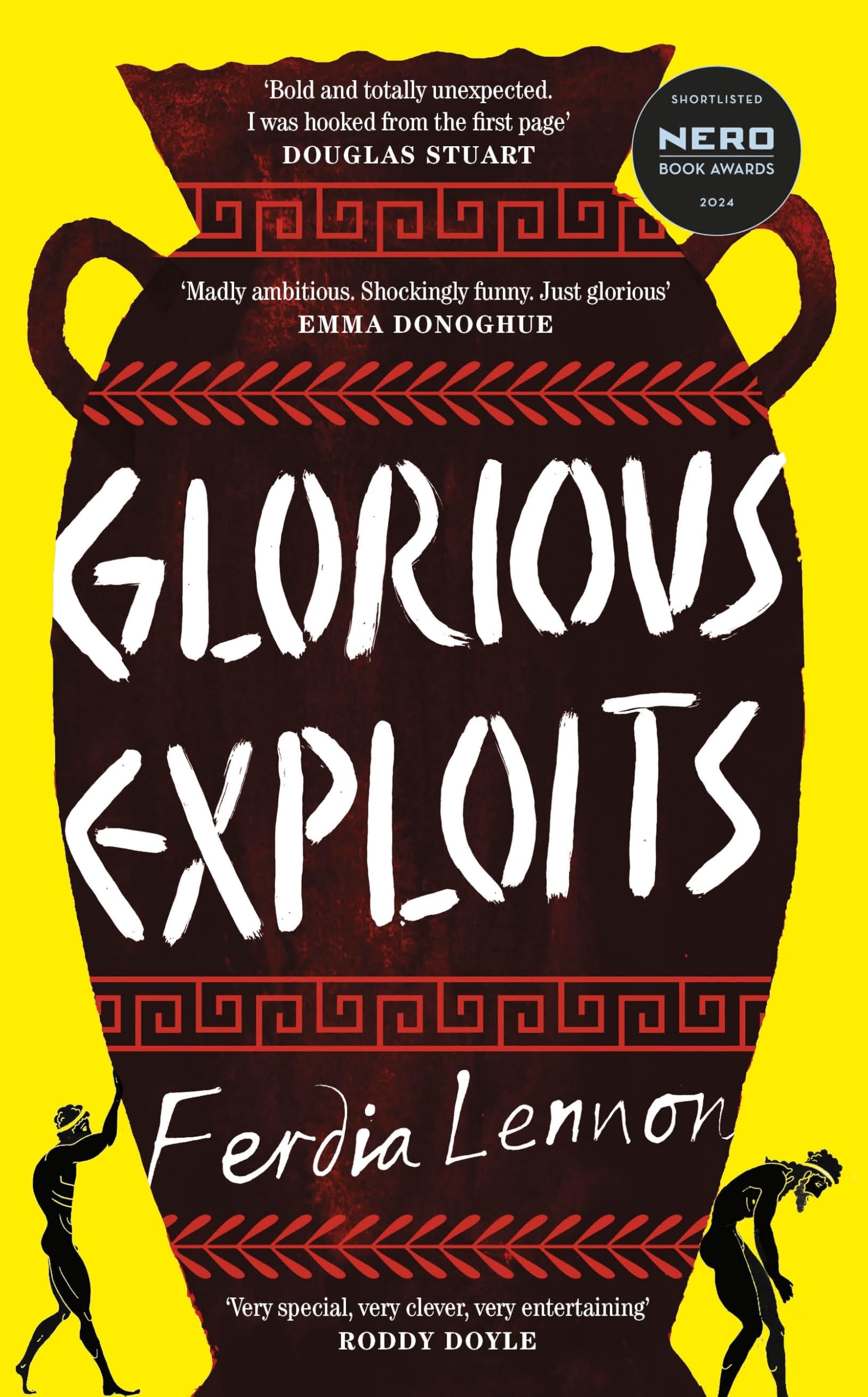
 This is another book that I probably wouldn’t have read if it hadn’t been shortlisted for the Walter Scott Prize this year (I have an ongoing project where I’m attempting to read all of the shortlists for that particular prize). I’m glad I decided to read it, because after a slow start I ended up enjoying it more than I thought I would at first.
Glorious Exploits is set in 412 BC during the Peloponnesian War. An attempt by Athens to invade Sicily has ended in failure and thousands of defeated Athenian soldiers have been imprisoned in a disused quarry in Syracuse where they are slowly starving to death. Gelon and Lampo, two out of work Syracusan potters, occasionally take food to the quarry and in return the prisoners recite lines from plays by the Athenian tragedian Euripides. Gelon loves Greek theatre and when he discovers that some of the prisoners are familiar
with Medea and, even better, Euripides’ newest work, The Trojan Women, he comes up with a plan to stage both plays in the quarry, with the Athenians as actors.
Lampo is our narrator and tells his story using lots of modern Irish vernacular (Lennon is an Irish author) and lots of swearing. He also has a dry sense of humour and I know many people have found the book hilarious, although it didn’t quite work as a comedy for me. Whether or not you’ll like the writing style is entirely down to personal taste, I suppose. I tend to get irritated by historical novels written in very modern, anachronistic language, although as I said when I read Natasha Pulley’s The Hymn to Dionysus earlier this year, it bothers me less when the book is set in the ancient world. I got used to Lampo’s voice after a while and accepted it.
The relationship between Lampo and Gelon forms an important part of the novel. They are very different people but their friendship has endured since childhood. Lampo is illiterate and directionless but always seems cheerful and ready with a joke – until we start to see signs that there’s more to him than meets the eye and we see another side when he falls in love with a slave girl, Lyra. Gelon has a more serious nature and has taught himself to read, developing a love of Greek plays. He’s afraid that the defeat of Athens could mean that the work of great Athenian playwrights like Euripides become lost to history, which is why he comes up with his idea to keep the plays alive. Gelon knows that it’s possible for warring nations to appreciate each other’s art and culture, even if not everyone would agree.
Towards the end, things take a surprisingly dark turn and I found the final part of the book quite moving. It seemed I was more emotionally invested in the story than I thought! I’m not sure if I would rush to read more books by Ferdia Lennon, but I’m glad I stuck with this one despite initially thinking it wouldn’t be for me.


I started that after some great reviews, but couldn’t get onto it at all
Gill
I had trouble getting into it too, but was glad I persevered. I didn’t love it as much as most other people seem to have done, though.
I had the same misgivings as you before picking it up and, like you, read it because was on the WSP shortlist. I really enjoyed it and, yes, the ending was unexpectedly moving.
I love the way the WSP encourages us to read books we might otherwise not have picked up! I’m glad you enjoyed this one.
Yes, or even heard of!
I read this when it was first released and really loved it which surprised me a bit. I will be interested to see what the author writes next.
I didn’t love it as much as you, but I did enjoy it a lot more than I thought I was going to!
I have copy of this which I haven’t got round to yet. It sounds like a lot of fun!
It’s very entertaining!
I also really enjoyed this, though, like you, I didn’t actually find it all that funny – ironic and wry, but not laugh-out-loud. The substitution of Irish labourers’ voices/dialects for those of Greek artisans worked well, I thought.
I often don’t find books funny that are supposed to be! I agree with you on the decision to use Irish voices – I thought it seemed a bit weird at first, but it actually worked.
Glad you enjoyed this one. It’s always nice when a book turns out to be a better read than you were expecting. 😀
Yes, I’m glad I didn’t give up on it!
I loved this book, but my review probably isn’t going to be posted until next year, because it’s going to be one of my Top Ten, and it’s stuck behind five or six others. (I try to only use one every ten reviews.)
Ironically, when I looked at the cover and the subject matter, I thought I was going to hate it. So, there you go.
I didn’t expect to like it either! I’ll look forward to your review next year or whenever you post it.
I’ve read several positive reviews of this since it came out but have yet to push myself to locate a copy to read. What you say about anachronistic language is interesting though – how can we ever capture Sicilian Greek dialect from two millennia ago? Personally I don’t mind how it’s expressed so long as it’s consistent enough for me to go along with the flow without stopping to click my tongue at some badly articulated phrase.
Anachronistic language bothers me much more in historical fiction set in more recent periods. As you say, it would be impossible to accurately capture the speech of Ancient Greeks and make it intelligible to modern readers. The language in this book did feel a bit odd at first but didn’t irritate me as much as I expected!
The Book Club Review podcast #172 talked about this, but the thing that really sold me on it was the excerpt of the audiobook they played, read by the author. Hearing the Irish accent really boosted my appreciation of it.
That’s interesting – I wonder if the audiobook would have worked better for me!
I picked up a copy of this earlier in the year. I wasn’t aware of the use of modern language – and especially modern Irish idiom… I’m wondering how much I might struggle with that?
Interesting how you say that you don’t have as much of a problem when its Ancient Times…. Reading a novel recently about Greeks fighting in Afghanistan under Alexander the Great the tone & language had a real Vietnam War vibe – and I *really* liked it. It just seemed SO appropriate…. Odd, isn’t it?
I’ll be interested to know what you think of it, whenever you get round to reading it! I don’t generally like modern language in historical fiction, but I’m definitely more tolerant of it when the book is set in Ancient times.
Im kind of torn about trying this one. Generally anything with Greek ties intrigues me but ive seen mixed things about this title. I might find the modern tone okay but im not sure. I read a Heracles retelling that had that kind of feel at times and in that case I was okay with it as it kind of fit the vibes for the characters portrayal there. But other cases have bothered me. I guess I’ll have to wait and see how I get on with this one. Im glad you were able to connect in the end.
I thought the modern tone was going to annoy me at first as I definitely prefer historical fiction to feel more ‘historical’, but I got used to it after a while and it didn’t bother me as much as I expected.
I haven’t read this one het because I feel a bit mixed about it but they have it are my library so I’ll probably get to it one day. Glad to hear you enjoyed it!
I hope you like it if you do decide to read it. I didn’t love it, but definitely enjoyed it more than I expected to.
I was drawn to this book because I’m into ancient Greek history, philosophy and art and culture. I loved it; one of my favorites of the year!
I’m more into the medieval and Tudor periods myself, but do still find Greek history interesting. I’m glad you loved this one – it sounds perfect for you!