Fear Stalks the Village by Ethel Lina White

The village was beautiful. It was enfolded in a hollow of the Downs, and wrapped up snugly — first, in a floral shawl of gardens, and then, in a great green shawl of fields. Lilies and lavender grew in abundance. Bees clustered over sweet-scented herbs with the hum of a myriad spinning-wheels.

With its Tudor cottages and cobbled streets, the village depicted in Ethel Lina White’s 1932 novel seems at first sight to be an idyllic place to live. There’s no poverty or unemployment, an endless round of tea parties and tennis games, and once settled there, people find that they never want to leave. Joan Brook is a relative newcomer to the village, having arrived to take up a position as companion to Lady d’Arcy, and she has already fallen under its spell.

When a novelist friend from London comes to visit, she entertains herself and Joan by imagining the secret scandals taking place behind closed doors. Perhaps the village doctor is poisoning his wife, she says, and the saintly Miss Asprey is bullying her companion; the Rector is leading a double life, and Miss Julia Corner, President of the local Temperance Society, is a secret drinker. The visit is a brief one and the friend soon returns to London, but when the inhabitants of the village begin to receive anonymous poison pen letters, it seems that the scenarios she had imagined were not so far from the truth after all.

Fear Stalks the Village is an unusual crime novel; although there are several deaths, it is not a murder mystery and the plot revolves entirely around finding out who is writing the spiteful letters threatening to expose the private lives of the villagers. Other reviews compare it to The Moving Finger by Agatha Christie, but as I haven’t read that one yet it reminded me most of Henrietta Clandon’s Good by Stealth. There’s lots of witty, satirical humour and a large cast of strongly drawn characters, all of whom appear at first to be happy, well-adjusted people…until the letters begin to arrive. The question the novel raises is whether the cracks have always been there beneath the surface or whether they have been created by the letters and the suspicion and anxiety they cause.

The mystery is quite a clever one, with some red herrings to throw us off the track, and I didn’t guess who was sending the letters. However, it took me a while to get into this book as the pace is quite slow and, despite the title, I didn’t feel that there was any real sense of fear or menace. Still, this is the second book I’ve read by Ethel Lina White, the first being The Wheel Spins (the book on which Alfred Hitchcock’s The Lady Vanishes is based) and I think it’s my favourite of the two – probably because with the other book I couldn’t help comparing it unfavourably to the film, which I love! I would be happy to try more of her books so let me know if there are any you would recommend.

The Spendthrift and the Swallow by Ambrose Parry

I loved the first four novels in Ambrose Parry’s Raven and Fisher mystery series and although there doesn’t currently seem to be any news of a fifth, I was pleased to come across this digital short story available free for Kindle. It fits into the series chronologically between the third and fourth books but if you come to it late, as I did, it doesn’t matter at all as it works as a standalone story.

Ambrose Parry is a pseudonym used by the crime author Chris Brookmyre and his wife Dr Marisa Haetzman, a consultant anaesthetist. Marisa’s knowledge is crucial to the series, which is set against the backdrop of the medical world of 19th century Edinburgh. Our two main characters are Dr Will Raven, assistant to the renowned Scottish obstetrician Dr James Simpson, and Sarah Fisher, who also assists at Simpson’s clinic but is struggling to find a way to achieve her own dream of becoming a doctor. Each book in the series features a mystery to be solved, as well as details of Victorian medical procedures and treatments.

The Spendthrift and the Swallow is only 52 pages long, including a preview for Voices of the Dead, and can easily be read in about twenty minutes. The story is set in January 1853 and we follow Will and Sarah as they investigate the death of one of Dr Simpson’s patients, Cora Carlton, the wife of an entrepreneur. The circumstances of Cora’s sudden death could raise questions over the doctor’s medical abilities, so Will and Sarah hope to uncover the truth quickly enough to save his reputation. Meanwhile, Simpson has begun experimenting with the increasingly popular science of mesmerism and places a loud and difficult patient under hypnosis with startling results. I was interested to read in the author’s note at the end of the book that both of these incidents were based on real historical cases.

If you’re new to the Raven and Fisher books, reading this story first wouldn’t be a problem as it doesn’t really spoil anything from the main series and it’s a satisfying mystery in its own right. However, it’s too short for any character development or any background information to help you understand the relationship between Sarah and Will and what has happened to them up to this point. My recommendation is to start with the first full-length novel, The Way of all Flesh. For existing Parry readers, though, this is an entertaining little book and provides an introduction to the mesmerism storyline that will play such a big part in Voices of the Dead.

Book 3/50 for the Historical Fiction Reading Challenge 2024

Classics Club Spin #36: The Result

The result of the latest Classics Club Spin has been revealed today.

The idea of the Spin was to list twenty books from my Classics Club list, number them 1 to 20, and the number announced by the Classics Club represents the book I have to read before 3rd March 2024. The number that has been selected is…

20

And this means the book I need to read is…

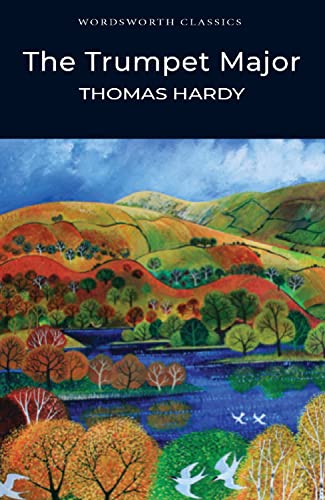
The Trumpet Major by Thomas Hardy

Thomas Hardy’s only historical novel, The Trumpet Major is set in Wessex during the Napoleonic Wars. Hardy skilfully immerses us in the life of the day, making us feel the impact of historical events on the immemorial local way of life – the glamour of the coming of George III and his soldiery, fears of the press-gang and invasion, and the effect of distant but momentous events like the Battle of Trafalgar.

He interweaves a compelling, bitter-sweet romantic love story of the rivalry of two brothers for the hand of the heroine Anne Garland, played out against the loves of a lively gallery of other characters. While there are elements of sadness and even tragedy, The Trumpet-Major shows Hardy’s skills of story-telling, characterisation and description in a novel of vitality, comedy and warmth.

~

This wasn’t one I was particularly hoping for – I would have liked something shorter and lighter – but I always love Hardy, so I’m not unhappy with this result!

Have you read this book? What did you think of it?

The Beholders by Hester Musson

‘Beauty is in the eye of the beholder’ and the cover of this debut novel by Hester Musson is certainly a beautiful thing to behold.

We begin in June 1878 with Clara Gethin on trial at London’s Old Bailey for the murder of her own child, whose body has been pulled from the River Thames. As the wife of a highly respected politician who has provided evidence against her, things look very bleak for Clara, but there’s one person who believes – or at least wants to believe – in her innocence. This is Harriet Watkins, her lady’s maid and the only friend she has in the world.

We then go back several months to Harriet’s arrival in Clara’s household following the death of her previous employer. Her mother wants her to return home to marry her fiancé, but Harriet isn’t at all convinced that William is the man she wants to spend her life with, so instead she accepts a new position as housemaid at Finton Hall, the Gethins’ Hertfordshire estate. When Harriet begins her new job, she quickly senses that something is very wrong at Finton Hall. The housekeeper is hostile and unwelcoming, the footman seems to be hiding secrets, and the master, although largely absent, casts a shadow over the entire household. Harriet makes an effort to befriend her new mistress and is rewarded with promotion to lady’s maid, but she is concerned by Clara’s lack of affection for her baby son and her habit of dismissing servants seemingly on a whim.

The story unfolds through the pages of Harriet’s diary as she gives her account of her early days at Finton Hall and the things she experiences and observes there. The diary entries are long and detailed – sometimes more detailed than they really need to be – but otherwise the format is a good way to convey Harriet’s growing sense of unease as she learns more about what is really going on within the Gethin household. However, I think I’ve read too many similar books recently, because I found it easy to guess what was happening and wasn’t surprised at all when it was revealed. It also seemed to take far too long to reach that point – the first half of the book consists of a lot of very slow build-up and there were times when I struggled to stay engaged.

The pace picks up in the second half as the action finally moves outside the confines of the house and we learn more about the fate of Clara Gethin’s baby. This part of the book felt more original and I was less able to predict what was going to happen; I also liked the romantic storyline which developed towards the end – although it felt slightly rushed, the love interest was not the person I’d expected earlier in the book and I was glad the author hadn’t gone in that direction. Overall, I think my feelings about The Beholders are more positive than negative; I just wish it hadn’t taken so long for the plot to emerge!

Thanks to Fourth Estate for providing a copy of this book for review via NetGalley.

Book 2/50 for the Historical Fiction Reading Challenge 2024

Classics Club Spin #36: My List

It’s time for the first Classics Club Spin of 2024. I wasn’t sure whether to join in this time as I only have eight books left to read from my Classics Club list and I haven’t even finished my book from the last Spin, but in the end I haven’t been able to resist taking part. Ideally, I would like to read all of these eight books within the first half of the year, so this should help motivate me.

If you’re not sure what a Spin is, here’s a reminder:

The rules for Spin #36:

* List any twenty books you have left to read from your Classics Club list.
* Number them from 1 to 20.
* On Sunday 21st January the Classics Club will announce a number.
* This is the book you need to read by 3rd March 2024.

And here’s my list. I’ve had to repeat all of the books at least once as I don’t have twenty left.

1. The Trumpet-Major by Thomas Hardy
2. The White Guard by Mikhail Bulgakov
3. The Silver Branch by Rosemary Sutcliff
4. Moonfleet by John Meade Falkner
5. The Black Lake by Hella S. Haasse
6. The Elusive Pimpernel by Baroness Orczy
7. Fire from Heaven by Mary Renault
8. The End of the Affair by Graham Greene
9. The Trumpet-Major by Thomas Hardy
10. The Silver Branch by Rosemary Sutcliff
11. The Black Lake by Hella S. Haasse
12. The Elusive Pimpernel by Baroness Orczy
13. The End of the Affair by Graham Greene
14. Fire from Heaven by Mary Renault
15. The Elusive Pimpernel by Baroness Orczy
16. The Black Lake by Hella S. Haasse
17. Moonfleet by John Meade Falkner
18. The Silver Branch by Rosemary Sutcliff
19. The White Guard by Mikhail Bulgakov
20. The Trumpet-Major by Thomas Hardy

~

Have you read any of these? Which number do you think I should be hoping for?

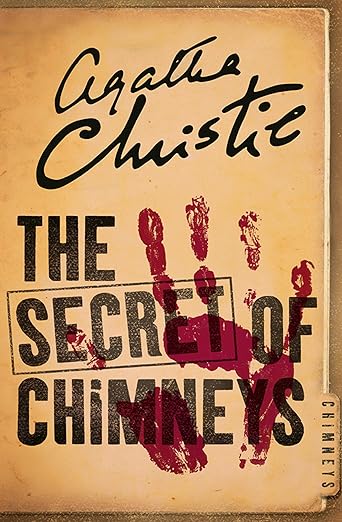
The Secret of Chimneys by Agatha Christie

I’m taking part in Read Christie again this year and the theme for 2024 is Agatha Christie: Through the Decades. Each quarter will focus on a different decade or decades – 20s, 30s, 40s/50s and 60s/70s. For my January read, I have chosen The Secret of Chimneys, which was published in 1925.

The Secret of Chimneys is the first of five novels featuring Superintendent Battle and is more of a thriller than a traditional murder mystery. I usually enjoy the lighter, more adventurous feel of Christie’s thrillers and although this one hasn’t turned out to be a favourite, I did find it very enjoyable. It involves political intrigue in the fictitious Balkan country of Herzoslovakia where attempts are under way to restore the monarchy.

The novel begins in Africa, where Anthony Cade is working as a tour guide when he meets an old friend, James McGrath, in Bulawayo. Anthony agrees to carry out two important tasks for McGrath – firstly, to deliver the manuscript of a memoir written by Count Stylptitch of Herzoslovakia to a London publisher, and secondly, to return a packet of letters to a woman who is being blackmailed. As soon as he arrives in England, however, he discovers that there are other people interested in both the manuscript and the letters, and they will stop at nothing – including murder – to get what they want.

Most of the action takes place at Chimneys, a country estate belonging to Lord Caterham, who invites Anthony to attend a house party at the request of George Lomax, a politician hoping to get his hands on the Stylptitch memoir. With a large and varied group of people gathered at Chimneys – including a beautiful widow, a French governess, a representative from a British oil syndicate and an American collector of rare books – there’s no shortage of suspects when a murder occurs and Superintendent Battle is called in to investigate.

As I’ve said, this is not just a straightforward murder mystery and Christie throws all sorts of things into the plot, from treasure hunts and coded letters to secret societies and international jewel thieves. It’s fun to read, but does need some suspension of disbelief! You also need to be prepared for a lot of racist language, which isn’t unexpected in a Christie novel – or many other 1920s novels – but it seems more excessive in this particular book, maybe because of the large number of characters of other nationalities and races. Other than that, this is an entertaining, fast paced read, written in a light and humorous style that reminded me of PG Wodehouse.

Although Anthony Cade seems to do a lot of the detecting in this book, Battle himself has a larger role than in some of the others in which he appears. He’s certainly no Poirot or Miss Marple, being rather stolid and unimaginative, with what is described as an ‘expressionless face’, but he gets on with his job quietly and unobtrusively and plays a small but important part in the final solving of the mystery. Did I solve it myself? Well, yes and no. I guessed the identity of the jewel thief, King Victor, but there were other revelations that took me by surprise.

This was a good start to a new year of Christie reading! Next month I’m hoping to read The Seven Dials Mystery, another 1920s novel which features some of the same characters.

Historical Musings #84: My Year in Historical Fiction 2023

Welcome to my monthly post on all things historical fiction. For my first Musings post of the year, I am looking back at the historical fiction I read in 2023 and have put together my usual selection of charts and lists! I have kept most of the same categories I’ve used for the previous seven years so that it should be easy to make comparisons and to see if there have been any interesting changes in my reading patterns and choices (here are my posts for 2022, 2021, 2020, 2019, 2018, 2017 and 2016).

Before I begin, just a reminder that I do actually read other genres but for the purposes of this post I haven’t included those books in these stats!

~

Time periods read about in 2023:

No surprises here. Since I started recording these statistics, the 19th and 20th centuries have come out on top nearly every year, apart from in 2020 when the 17th century edged into first place. I tend to read very few books set earlier than the 11th century and that was the case again this time.

~

31% of the historical fiction authors I read in 2023 were new to me.

This is slightly down on the last few years and nowhere near the high point of 54% in 2019! However, I don’t think there’s anything wrong with sticking mainly to favourite authors you know you’re going to enjoy.

Here are three historical novels I read by new-to-me authors in 2023:

Savage Beasts by Rani Selvarajah
These Days by Lucy Caldwell
The Sun Walks Down by Fiona McFarlane

~

I read 0 historical novels in translation in 2023

Although I did read a few books from other genres in translation (including some Japanese crime and a Jostein Gaarder novel), I didn’t read any translated historical fiction. This is something I’m planning to work on in 2024 and have already made a good start with Silence by Shūsaku Endō.

~

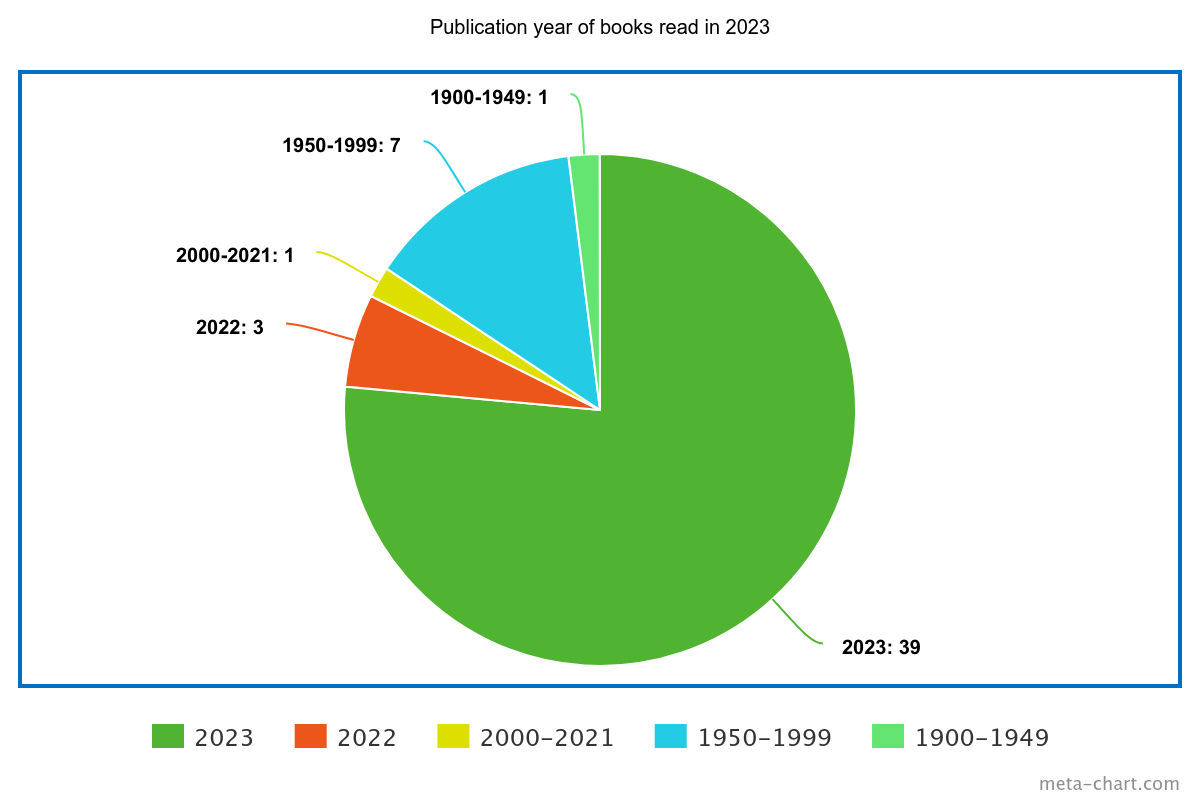
Publication dates of historical fiction read in 2023:

This is always a disappointing statistic for me to look at. Every December when I compile my list of favourite books of the year, it’s older books that dominate – so why am I not reading more older books? I think it’s mainly due to the temptations of all the new books available on NetGalley, so in 2024 I’m determined to pick up more of the books from my own shelves.

The oldest historical fiction novel I read in 2023 was The Spanish Bride by Georgette Heyer (published in 1940).

~

11% of my historical reads in 2023 were historical mysteries.

This is about the same as in previous years. Here are three I enjoyed reading in 2023:

The Murder Wheel by Tom Mead
Voices of the Dead by Ambrose Parry
Death Comes as the End by Agatha Christie

~

I read historical fiction set in 17 different countries in 2023:

As usual, almost half of the historical novels I read were set in England. Although I did read books set in other countries as well, I think I need to be more active in looking for books with different settings, particularly countries I haven’t read about before. Reading more translated fiction should help with that.

In addition to these books, I also read two books set either mainly or partly at sea:
The Ionian Mission by Patrick O’Brian and The Last Lifeboat by Hazel Gaynor.

~

Four historical men I read about in 2023:

Charles Byrne (The Giant, O’Brien by Hilary Mantel)
Hugh O’Flaherty (My Father’s House by Joseph O’Connor)
Henry VIII (Henry VIII: The Heart and the Crown by Alison Weir)
Harry Smith (The Spanish Bride by Georgette Heyer)

Four historical women I read about in 2023:

Empress Maud (The Stolen Crown by Carol McGrath)
Anne Lister (Learned by Heart by Emma Donoghue)
Artemisia Gentileschi (Disobedient by Elizabeth Fremantle)
Princess Nadezhda (The Witch’s Daughter by Imogen Edwards-Jones)

~

What about you? Did you read any good historical fiction last year? Have you read any of the books or authors I’ve mentioned here and have you noticed any patterns or trends in your own reading?