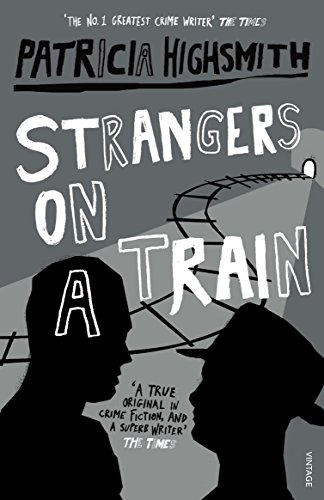
 Patricia Highsmith’s 1950 novel Strangers on a Train begins, as you might expect, with two strangers meeting on a train. One is Guy Haines, an aspiring architect who is on his way home to Metcalf, Texas to see his wife, Miriam, from whom he’s been separated for the last three years. Guy is hoping to secure a divorce from Miriam so that he can start a new life with Anne, the woman he loves. Although Miriam has so far been reluctant to agree to a divorce, she is now pregnant with another man’s child and Guy is optimistic that this will be a chance for both of them to move on.
The other stranger is Charles Bruno, a young man from a wealthy Long Island family. After falling into conversation on the train, Bruno invites Guy to come and eat with him in his private dining compartment. Guy doesn’t particularly like his new companion, but soon finds himself telling Bruno about his troubles with Miriam. In turn, Bruno confesses that he hates his father – and then makes a shocking suggestion. If Bruno were to kill Miriam on Guy’s behalf, there would be nothing to link him to the crime. Guy could then kill Bruno’s father and again there would be no motive and no connection. Two perfect murders! Horrified, Guy refuses to have anything to do with the plan and when the train reaches his destination he leaves Bruno behind, hoping he’ll never see him again. However, when Miriam is later found dead, Guy quickly begins to suspect the truth. Has Bruno gone ahead with the plan – and is he waiting for Guy to uphold his side of the bargain?
This is the first book I’ve read by Patricia Highsmith; I thought it would be a good idea to start with one of her most famous novels and this one proved to be a great choice. It reminded me very much of In a Lonely Place by Dorothy B. Hughes, another classic psychological thriller I read recently. Although I didn’t love this one quite as much, I did still enjoy it very much and found it a real page-turner, despite the fact that Highsmith often slows down the pace to concentrate on exploring the thought processes of Bruno and Guy as they each try to deal with the situation in their own way.
The novel is written from the perspectives of both men and although they are both interesting characters, Highsmith doesn’t make it easy for us to like either of them, particular the spoiled, immature and constantly drunk Bruno. We can have some sympathy for Guy at first, as he tries to resist getting involved in Bruno’s schemes, but he has his resolve gradually worn away as he comes under more and more pressure to carry out the murder and in turn becomes less likeable as the story progresses. The secondary characters are less well drawn – Anne and Miriam never fully come to life and we don’t get to know the other potential murder victim, Bruno’s father, at all, which lessens the emotional impact of the book. From a psychological point of view, however, I found this a fascinating novel.
If you’ve read any other Patricia Highsmith books, please tell me which one you think I should read next!

This is book 11/20 of my 20 Books of Summer 2023
It’s also book 41/50 from my second Classics Club list.






 She Reads Novels