Godwine Kingmaker by Mercedes Rochelle

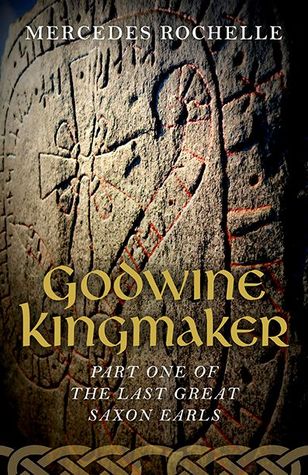
Godwine Kingmaker Earlier this year I read Mercedes Rochelle’s Heir to a Prophecy, a novel set in the 11th century and inspired by Shakespeare’s Macbeth. Her second book, Godwine Kingmaker: Part One of The Last Great Saxon Earls, is also set in Anglo-Saxon England – in the years leading up to the Norman Conquest – and tells the story of Godwine, Earl of Wessex.

Godwine, son of Wulfnoth, is only eighteen when he meets a Danish warrior in the woods and offers his assistance. This chance meeting will change the course of Godwine’s life, because the man he has befriended is Ulf, brother-in-law of Canute, King of Denmark. When Canute takes the throne of England after the death of Edmund Ironside in 1016, Godwine is by his side offering advice and support. During the years that follow he rises to become Earl of Wessex, one of the most powerful men in the kingdom, but Godwine’s good fortune will not last forever…

Godwine Kingmaker provides a fascinating portrayal of one of the last and greatest Saxon Earls. I have come across Godwine once or twice before in other novels set during this time period, but have never read about his life in so much depth. As the father of Harold, the future King of England, his historical significance is obvious, but he was also a very important nobleman in his own right. I thought he was a great character and I enjoyed following his story from his humble beginnings to the height of his power and influence.

One aspect of the story I found particularly interesting – and also quite frustrating – is the relationship between Godwine and Ulf’s sister, Gytha. Gytha very reluctantly becomes Godwine’s wife and for a long time after the marriage she persists in denying her feelings for him, even to herself. Although her behaviour annoyed me at times, I thought it was good that this storyline was not resolved too quickly and continued to have implications for several of the characters later in the book.

Godwine is an ambitious man but he is also a man who cares about his family and throughout the novel we see him working to ensure a safe and secure future for his children, even while his fortunes rise and fall as three more kings follow Canute. Despite Godwine’s best efforts, his eldest son, Swegn, stumbles from one disaster to another, but it is his second son, Harold, who will carry the family’s legacy forward.

Mercedes Rochelle is now working on the sequel to this book, The Sons of Godwine, which will tell the story of Harold Godwineson and his brothers. I’m looking forward to reading it!

Thanks to the author for providing a copy of Godwine Kingmaker for review.

The Chosen Queen by Joanna Courtney

The Chosen Queen In 1066, one of the most famous years in English history, three men were fighting for the throne of England: Harold Godwinson, the powerful Earl of Wessex; Harald Hardrada, the king of Norway; and William, Duke of Normandy. All three men had wives and in this new historical fiction trilogy, Joanna Courtney explores the lives of these three Queens of the Conquest.

The Chosen Queen is the first book to be published in the trilogy and follows the story of Edyth Alfgarsdottir, daughter of Alfgar, Earl of Mercia, and granddaughter of Lady Godiva. When Alfgar falls out of favour with the current King of England, Edward the Confessor, in the year 1055, the family are exiled to Wales. It is here that the fourteen-year-old Edyth meets and falls in love with the man who becomes her first husband – Griffin, King of all Wales. With unrest in the south of Wales, the chance of Viking invasions and the constant threat from the English side of the border, Griffin’s life is dangerous and uncertain – as he says to Edyth, he could be king for another twenty years or for just a few more hours.

When Edyth’s time as Queen of Wales eventually comes to an end, she finds herself back in England where she becomes caught up in the battle for the English crown. The childless King Edward has died, leaving Harold Godwinson as his successor, but neither Harald Hardrada of Norway nor Duke William of Normandy is willing to accept this. The new king needs a strong queen by his side, and Edyth, with her experience of the Welsh court and her family ties to both Mercia and Northumbria, is the ideal choice. The only problem is, Harold already has a wife…Edyth’s beloved friend, Svana.

The Chosen Queen is a fairly light historical novel and some readers may feel that there’s too much focus on Edyth’s romantic relationships, but I still found it quite an emotional and gripping read. It probably helped that I know very little about the Norman Conquest so most of Edyth’s story was new to me. With the story being told from a feminine perspective, I particularly enjoyed the portrayal of Edyth’s relationship with Svana, Harold’s handfast wife who befriends her as a child. Svana’s marriage to Harold took place outside the Catholic Church, which meant there was nothing to prevent Edyth from also marrying him, and the novel explores how both women may have felt about this.

Whenever I read historical fiction, I like to know how much of the book is based on fact and how much has been invented, so an author’s note is always appreciated. At the end of The Chosen Queen there’s not only an author’s note, but also a section giving further details on some of the historical figures, events and terms mentioned in the book (this is in addition to a map and two family trees at the front of the novel). It seems that some artistic licence has been taken (there is no evidence of a friendship between Edyth and Svana for example), but this is understandable when writing about a time period so far into the past; only a limited amount of factual information is available, so some imagination is obviously needed to fill in the gaps.

What I don’t understand was why it was necessary to change so many of the characters’ names. The original names are listed in an appendix together with the modernised forms found in the book and while I can maybe see the sense in referring to Harold’s first wife as Svana rather than Eadyth Swanneck (to avoid confusion with the story’s other Edyth), changing Gunnhild, Siward and Burgheard to Hannah, Ward and Brodie felt unnecessary and pulled me out of the 11th century. I like to feel fully immersed in the time period I’m reading about and that never really happened while I was reading this book. Accuracy is important to me, but it’s not the only thing I look for in a novel – I also look for a good story, and I do think Joanna Courtney has a lot of talent as a storyteller. She made me care about Edyth and she kept me turning the pages until I reached the end.

After finishing this book, I checked Joanna Courtney’s website for details of the other two novels in the trilogy. The second will be about Harald Hardrada’s wife Elizaveta of Kiev and the third will be about Matilda of Flanders, wife of William the Conqueror – two more women I know nothing about!

Thanks to Pan Macmillan for providing a copy of this book for review.

King Hereafter by Dorothy Dunnett

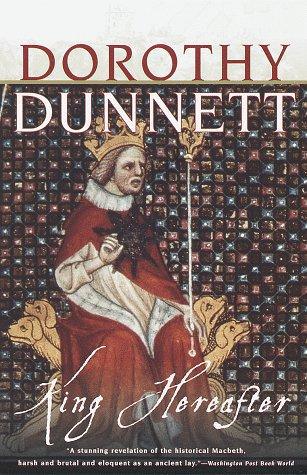
King Hereafter “Then she said, ‘Thorfinn!’ quickly, and moved to him; but had hardly got to his side before he loosed his fingers and thumbs and plunged them down to the mattress like spear-points.
‘No! Macbeth. Macbeth. Macbeth!’ The name reached her like sling-shot.
Groa said, ‘They are the same man. I should know. I married both.’”

I couldn’t wait to read this book having loved Dorothy Dunnett’s Lymond Chronicles and House of Niccolo series so much when I read them last year. King Hereafter, her only standalone historical novel, is set in eleventh-century Orkney and Scotland (known at that time as Alba) and is based around the idea that Macbeth, the historical King of Alba, and Thorfinn, Earl of Orkney, were the same person – Macbeth being Thorfinn’s baptismal name. Whether that might be true or not, the case she puts forward in this book is very convincing and obviously the result of an enormous amount of research. The novel follows Thorfinn throughout his entire life and along the way there are battles, both on land and at sea, fires, storms, births, deaths, political intrigue and even a race across the oars of a longboat. We also meet other historical figures of the time including King Canute and Lady Godiva – but at the heart of the story, for me, is Thorfinn’s love for his wife, Groa.

I loved this book, although the combination of unfamiliar history, complex politics and intricate relationships between the characters meant that it required a huge amount of concentration and a lot of referring to the centre pages of the book which contained three maps of Orkney, Alba and England, and two family trees. I would have been completely lost without these maps and charts; I found myself consulting them constantly – and even then there were some relationships that still weren’t quite clear to me. Added to the fact that my edition of the book had 880 pages (not the same as the one pictured here, by the way), it seemed to take me nearly as long to read this one book as it did to read the entire Lymond Chronicles! That’s not necessarily a bad thing, though, when a book is as good as this one is.

Before I go any further I should point out that King Hereafter is not a retelling of Shakespeare’s Macbeth and there is really very little resemblance between Dunnett’s story and Shakespeare’s, although she does quote from the play in the section headings and there are some references to events that are also in the play, such as ‘Birnam Wood coming to Dunsinane’. Some of the basic plot points are the same – yes, Thorfinn/Macbeth becomes King of Alba after the death of King Duncan, for example, but the circumstances surrounding Duncan’s death are very different from the murder Shakespeare describes. And thankfully, Groa is a far more likeable character than Lady Macbeth. The three witches don’t appear either, though instead we have Groa’s son, Lulach, and his prophecies (I suspect that to really be able to make any sense of most of Lulach’s cryptic comments you need to know how the rest of the story is going to play out and to be familiar with some of the historical sources too).

I loved Thorfinn from his very first appearance. I could see some similarities between Thorfinn and Dunnett’s other heroes, Lymond and Nicholas, but in other ways he is quite different. This is the moment we meet him for the first time as a child, seen through the eyes of his foster father, Thorkel Fostri:

“Not the complaining Earl Brusi. Not the lovely young Rognvald his son. But a scowling juvenile, thin as a half-knotted thong, with a monstrous brow topped by a whisk of black hair over two watering eyes, thick as acorns.
It raised one arm and called. Its voice had not even started to break.

‘Thorfinn,’ said Thorkel, and the word itself was a groan. Here in Norway, here in Nídarós, here on King Olaf’s jetty was the child-Earl of Caithness and Orkney. His foster-son.”

We soon see that Thorfinn’s unattractive exterior hides a shrewd brain, great physical ability, wit, courage and, although we are told that he never laughs, a wry sense of humour too. He is capable of all the plotting, scheming and negotiating that is necessary to keep up with the ever-changing rivalries and alliances between various leaders, while also dealing with the threats from England, Norway and Denmark and trying to do what is best for his people of Orkney, Caithness, Moray and the rest of Alba. As with Lymond and Nicholas we are rarely given the privilege of getting inside Thorfinn’s head; instead we see him mostly from the perspective of the people around him, which can be either insightful or misleading depending on how well these viewpoint characters understand him.

Groa is a great character too and is now one of my favourite female characters in all of Dunnett’s novels. The story of how she and Thorfinn come to love and understand each other is beautifully written and it was wonderful to watch their relationship develop over the course of the novel. Apart from the relationship between Thorfinn and Groa, the other one I found particularly fascinating and complex was the relationship between Thorfinn and his nephew, Rognvald. The encounters between the two of them throughout the first half of the book provided what, for me, were some of the most dramatic and exciting scenes in the book.

Thorfinn does have a lot of ambition, but unlike Shakespeare’s Macbeth, it’s not because he’s looking for personal glory or has been encouraged by his ruthless Lady; his ambition is to improve life in his lands and give his people a strong ruler, uniting the disparate, diverse tribes of Orkney and Alba under a common religion and common laws. On the subject of religion, I did get very confused somewhere in Part 3, where Thorfinn visits Pope Leo in Rome. Actually, a lot of the religious aspects of the story in general confused me and that’s something I would attempt to understand better on a re-read. I tried not to worry too much about the things I couldn’t understand on this first read and instead concentrated on getting to know Thorfinn, Groa and the other characters, and enjoying the beautiful writing. The descriptions of the landscapes of Orkney and Alba are so vivid and evocative. This is one that I particularly loved:

They entered Loch Bracadale with the sunrise, rose-coloured oars laying darkling folds on the rose-tinted pool of the fjord. A dusting of guillemots, asleep on the water, roused and dived with almost no sound, leaving pink and verdigris rings on the surface. A charcoal rock needled with cormorants became suddenly bare, and from the shore came the scalloped cry of an oyster-catcher, joined after a moment by others. Then the longships slid past, and the sounds died away.

Although the Lymond Chronicles are still my favourites, I can definitely see why some people would consider this Dorothy Dunnett’s best book. It’s amazingly detailed and well-researched, as well as being a very powerful and emotional story. The only problem with reading a book like this is that when you know there can only be one outcome to the story and that there’s no chance of a happy ending, it makes the build-up to the conclusion difficult to read. The end of Thorfinn’s story was inevitable but still heartbreakingly sad.

I’m sorry I don’t have any more of Dunnett’s historical novels to look forward to, but I will try her Johnson Johnson mystery series at some point – and like all of Dunnett’s books I’m sure re-reading King Hereafter in the future will also be a rewarding experience!
Shadow on the Crown by Patricia Bracewell

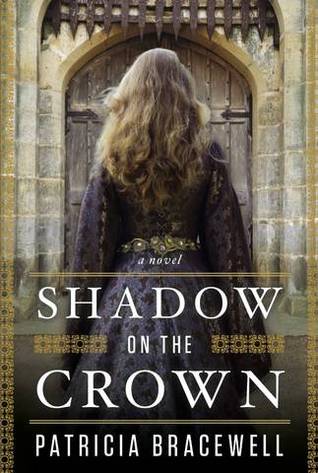
Shadow on the Crown When King Æthelred II of England loses his wife Ælfgifu, he looks across the Narrow Sea to Normandy for his next bride. Duke Richard of Normandy has two unmarried sisters and it’s the younger, fifteen-year-old Emma, who is chosen. In return, Æthelred requests that Richard closes the harbours of Normandy to Swein Forkbeard and his Vikings, the enemies of the Anglo-Saxons.

From the moment Emma arrives in England in the year 1002 and learns that her new husband has not bothered to come and meet her, she knows her marriage is not going to be a happy one. Soon Emma hears of the rumours surrounding Æthelred’s claim to the throne and the older half-brother who died under suspicious circumstances and she begins to understand that she has married a troubled, paranoid man. But dealing with her husband is not the only problem she faces; she also has to cope with the hostility of her stepsons, the æthelings (heirs to the throne) Athelstan, Ecbert and Edmund. Because she has actually been crowned Queen of England, any children of Emma’s will inherit the throne ahead of the æthelings – the children of Æthelred’s previous wife, who was never crowned.

Another person unhappy with Emma’s arrival is Elgiva, daughter of the Northumbrian ealdorman Ælfhelm, who was hoping to become Queen herself. Elgiva soon becomes one of the villains of the novel, consumed with jealousy and plotting Emma’s downfall. The only bright spot in Emma’s life is her relationship with Athelstan, the eldest ætheling, whose feelings for her are changing as he gets to know her better. But with a brutal, violent husband and a woman who will do anything to steal her crown, Emma comes to realise that the only way she will be able to wield any power is to have a child of her own as quickly as possible, a son who will be the future King of England.

I loved Shadow on the Crown. The writing is beautiful and it’s hard to believe it’s Patricia Bracewell’s first novel. It also made a nice change to find an author choosing to write about a period of history that isn’t covered in historical fiction very often. Before reading this book I had only a vague knowledge of this period and I enjoyed learning more about life in the early years of the eleventh century – an era that is fascinating to read about, but definitely not one I would have wanted to live through myself! It’s difficult to comment on the accuracy of a novel when you know so little about the period concerned but the book does include an interesting author’s note explaining which parts of the story are based on fact. Bracewell has used the Anglo-Saxon Chronicle as one of her sources and includes some excerpts throughout the novel, which adds to the feeling of authenticity.

Sometimes historical fiction can work well when it’s written in the first person but this one is written in the third person from several different viewpoints and I think it was the right decision. It allowed us to see events from more than one perspective – from Emma’s, Elgiva’s, Athelstan’s and Æthelred’s – and while I liked Emma from the beginning, being able to get inside the other characters’ heads meant I could understand them better. Æthelred’s feelings of guilt and terror, haunted by the death of his older half-brother, Edward; Athelstan’s inner conflicts, torn between love for Emma and his desire to be king; Elgiva’s envy of Emma and her bitterness at not becoming queen – being given some insights into all of these things helped me to see why these characters behaved the way they did.

Shadow on the Crown is the first in a trilogy of books about Emma of Normandy and I’m already looking forward to the second one. This book only covers the period between 1001 and 1005, so there is still a lot more of Emma’s story to come!

I received a copy of this book from the publisher via Netgalley for review