The Winter Isles by Antonia Senior

One of the many things I love about reading historical fiction is that it gives me an opportunity to learn about lesser-known historical figures – the ones who were never mentioned in my school history lessons and of whom I could otherwise have gone through the rest of my life in complete ignorance. One of these is Somerled, whose story is told in Antonia Senior’s beautifully written The Winter Isles. Set in 12th century Scotland, we follow Somerled as he sets out to prove himself as a warrior and claim the right to call himself Lord of the Isles.

We first meet Somerled as a boy in 1122. The son of a minor chieftain from the Western Isles, he is already becoming aware of his father’s weaknesses as a leader – and in this unpredictable, dangerous world, strong leadership is vital. After his father’s hall is burned during a raid, Somerled gets his chance to step forward and take control and, despite his youth, he finds that is able to command the loyalty and respect of his men. But Somerled is an ambitious young man and if he is to achieve his dreams he must build alliances with lords and rulers of neighbouring islands while conquering others – as well as keeping an eye on the movements of Scotland’s king, David, in nearby Alba.

As you can probably tell from what I’ve said so far, The Winter Isles does include quite a lot of battle scenes and descriptions of raids by land and by sea, but there are other layers to the novel too. It isn’t a book packed with non-stop action; there are quiet, reflective sections in which Antonia Senior’s choice of words paint beautiful pictures of the sea and the Scottish islands, their landscapes and their wildlife. She also explores what Somerled is like as a person and how he grows and changes as his power increases.

Not all of the story is told from Somerled’s perspective. There are also chapters narrated by two women, his childhood friend Eimhear (known as ‘the otter’) and the beautiful Ragnhild, both of whom play important but very different roles in Somerled’s life. Eimhear and Ragnhild have strong and distinctive voices and I thought the decision to let them tell their own stories in their own words was a good one, showing what life was like for women during that period and also offering different views of Somerled’s character.

The Winter Isles is a lovely, poignant, intelligent novel which made me think, at times, of King Hereafter by Dorothy Dunnett. However, the comparison is mainly in the setting; the writing style in The Winter Isles is lighter and dreamier and there’s something about it that prevented me from becoming as absorbed in Somerled’s story as I would have liked. This is an impressive book but not one that I particularly loved. Still, I’m now curious about Antonia Senior’s other novels, Treason’s Daughter and The Tyrant’s Shadow, set during the English Civil War and rule of Oliver Cromwell respectively.

As for Somerled, it seems that his portrayal in The Winter Isles is based on a mixture of history, myth and legend; many of the facts regarding the real man have been lost in the mists of time, but the story Antonia Senior has created for Somerled and his children to fill in the gaps feels convincing and realistic. Now that I’ve been introduced to him, I would like to read more. Has anyone read Nigel Tranter’s Lord of the Isles? Are there any other books you can recommend?
Lionheart by Martha Rofheart

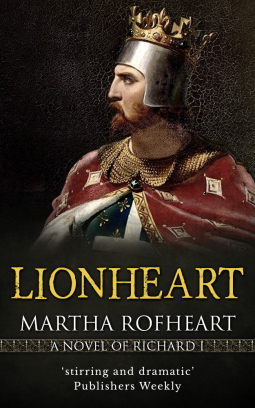
Lionheart Martha Rofheart (1917-1990) was an American author of historical fiction who wrote several novels on subjects as diverse as Cleopatra (The Alexandrian), Henry V (Fortune Made His Sword) and the Greek poet, Sappho (Burning Sappho). Lionheart, her 1981 novel on England’s King Richard I, is the first of her books that I’ve read and although I had one or two problems with it, I did enjoy it and am looking forward to trying her others.

The story of Richard I, known as the Lionheart, is told from the perspectives of not only Richard himself, but five other people who each played a significant role in his life: his mistress, Blondelza; his mercenary captain, Mercadier; his mother, Eleanor of Aquitaine; his wife, Berengaria of Navarre; and his foster-brother and scribe, Alexander. All of these people really existed, apart from Blondelza, who is fictitious, and each of them is given their own section of the book in which to relate their own version of events and to share with us their personal opinion of Richard as a man and as a king.

With six different characters each telling their side of the story, I would have liked their narrative voices to have sounded more distinctive, but they did all seem to blend together, the exceptions being Richard (a child during most of the first section of the novel), and his mother, Eleanor. I have read about Eleanor and Richard recently, in Elizabeth Chadwick’s The Winter Crown, and it was good to read another author’s interpretation of the same characters. The portrayal of Richard here is balanced and well-developed, with each narrator throwing more light on a different aspect of his personality. He is shown to be a complex man, capable of being selfish and inconsiderate, but also courageous, kind-hearted and down to earth.

I’m not sure how I feel about the character of Blondelza, Richard’s mistress. As most of the other characters are real historical figures and the plot of the novel closely follows historical fact, it doesn’t seem quite right for an entirely fictional character to be given such a prominent role in the story. On the other hand, Richard did have an illegitimate son (Philip of Cognac) by an unidentified woman, so there’s plenty of scope there for an author to fill in the gaps, which is just what Martha Rofheart has done. And Blondelza, being a glee-maiden (a female poet or minstrel), is an interesting character to read about, fictional or not!

All of the major events of Richard’s life and reign are covered in the novel, from his childhood and his rebellion (with his brothers) against his father, Henry II, to his meeting with and marriage to Berengaria and, of course, his time on crusade. Obviously the crusades were of huge importance to Richard and it’s understandable that Rofheart goes into a lot of detail in describing them, but I did find that this section of the book (narrated by the monk Alexander) really started to drag, and it didn’t help that it was twice the length of any of the other sections.

Still, this was an enjoyable novel overall and I feel that I learned a lot about not only the life of Richard the Lionheart, but also medieval life in general. I was particularly intrigued by the descriptions of the Courts of Love in Poitiers and the tasks which must be carried out by a knight who wished to prove his love for his lady. Now that I’ve had my first introduction to Martha Rofheart’s writing I’m definitely planning to read her other books, all of which sound interesting.

Thanks to Endeavour Press for providing a review copy via NetGalley.

The Winter Crown by Elizabeth Chadwick

The Winter Crown This will be my last post this week, so I’m going to take this opportunity to wish everyone a Merry Christmas! I’ll be back before New Year to tell you about a Christmas-themed read and to share my list of favourite books of 2015, but first here are my thoughts on another recent read – no connection with Christmas, but at least it does have ‘winter’ in the title.

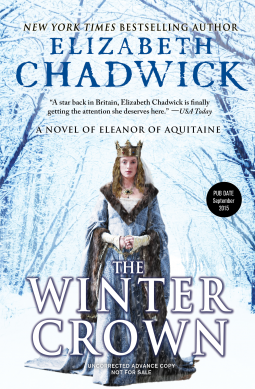
The Winter Crown is the second of Elizabeth Chadwick’s trilogy of novels following the story of Eleanor of Aquitaine. Chadwick uses the alternate spelling Alienor, as she says this is how the name would have been spelled at the time, so I have done the same throughout the rest of this post. The first book in the trilogy, The Summer Queen, covered Alienor’s early years and her marriage to King Louis VII of France. Now, in The Winter Crown, we move on to the next stage in Alienor’s life.

The novel opens in December 1154 when, having had her first marriage annulled, Alienor is crowned Queen of England alongside her second husband, Henry II. As Duchess of Aquitaine in her own right, Alienor has brought Henry wealth, lands and influence – but he has made it clear that he has no plans to allow her to govern her own lands. What Henry wants is a wife who will concentrate on providing and raising children, who will turn a blind eye to his many mistresses and who will keep her opinions to herself. Alienor, though, has other ideas and a marriage that began with so much promise and a certain amount of chemistry, if not love, descends into a series of disappointments and disagreements.

The deterioration of Alienor’s relationship with the king forms a large part of the novel, but so do her relationships with her sons – Henry the ‘Young King’, Geoffrey, Duke of Britanny, and John, the youngest – and her daughters, Matilda, Alie (Alienor) and Joanna. The other son who I haven’t mentioned, of course, is Richard (the future Richard the Lionheart). Alienor makes no secret of the fact that Richard, the heir to her own lands of Aquitaine, is her favourite child, and he is the one whose character is developed most fully in this novel.

For the first half of the novel, Alienor seems to be involved in a constant cycle of pregnancies and births, but that doesn’t mean the story was boring at all. As well as the tensions that are building in Alienor and Henry’s marriage (which get worse when she learns of his new mistress, Rosamund de Clifford), a lot of time is also devoted to Henry’s feud with his chancellor, Thomas Becket. When Henry – against Alienor’s advice – makes Becket Archbishop of Canterbury, he finds that Becket now possesses power which could be used against him instead of for him. The second half of the novel is equally full of conflict, as Henry discovers that his sons are prepared to rise against him in rebellion – and Alienor is forced to take sides.

I have read a few different fictional portrayals of Alienor/Eleanor and I really like the way Elizabeth Chadwick has chosen to portray the character. The Alienor of The Winter Crown is a strong, intelligent woman, keen to play a role in the governance of Aquitaine and England, but restricted due to her gender and the reluctance of her husband to involve her in his decision-making. I was interested to read Chadwick’s author’s note at the end in which she explains why she disagrees with the popular description of Alienor as a powerful medieval woman.

There are plenty of other characters worth mentioning too. Chadwick’s novels often feature a strong female friendship and in this book we meet Isabel de Warenne, wife of William of Blois (son of the late King Stephen of England), who becomes a trusted friend of Alienor’s after being taken into her household. Isabel, and Henry II’s half-brother Hamelin, were two of my favourite characters in the novel: two people who are close to the King and Queen but who don’t always agree with their actions. And readers of Chadwick’s The Greatest Knight will be pleased to know that William Marshal also appears in this novel, as a young man who is brought into Alienor’s service to train her sons in fighting and swordplay. I’m sure we’ll be seeing more of William in the next book.

I am thoroughly enjoying this trilogy so far and am looking forward to reading the final Alienor novel, The Autumn Throne, which should be available next year.

Thanks to Sourcebooks for providing a review copy via NetGalley.

Hammer for Princes by Cecelia Holland

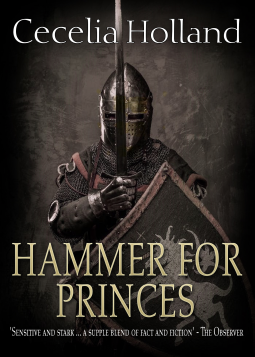
Hammer for Princes Cecelia Holland is an American author of historical fiction; her novels cover a wide range of time periods and settings as diverse as 12th century Iceland, the Mongol invasion of Eastern Europe, medieval France, and the search for Tutankhamun’s tomb. Earlier this year I read City of God, a story of Borgia-ruled Rome, and enjoyed it enough to want to try more of her work.

Hammer for Princes (which I have discovered was originally published in 1971 as The Earl) is set in England during the period known as The Anarchy. Since the death of King Henry I in 1135, the country has been divided between supporters of his nephew, King Stephen, and his daughter, the Empress Matilda. At the point when Hammer for Princes begins, Matilda’s son, Prince Henry, has taken up the battle for the throne and the country is still in a state of civil war. Fulk, Earl of Stafford, has pledged his loyalty to Henry and it is through Fulk’s eyes that the events of the novel unfold.

Fulk is an intelligent, shrewd man with a lot of experience when it comes to warfare and politics. But even as he leads his men in battle, storms castles and fights in tournaments, Fulk’s biggest problems come in the form of his own family. His scheming uncle Thierry has his eye on some of Fulk’s lands, which he believes are rightfully his, and to Fulk’s disappointment it seems that his own son, Rannulf, is ready to take Thierry’s side in the family feud.

This novel is written in the same detached, unadorned style I remember from City of God, which gives Cecelia Holland’s books a distinctive style all of their own. The characters are difficult to like and difficult to understand or connect with on an emotional level, but this just makes them all the more fascinating and complex. I’m not sure that I fully understood the purpose of everything Fulk said and did (I felt very much the same about the actions of Nicholas in City of God) but I do like books in which not everything is clearly explained for the reader and I don’t mind sometimes being left to interpret things for myself.

Hammer for Princes doesn’t have a lot of plot, being more of a series of episodes in Fulk’s life which, when added together, build up a vivid picture of the world of a medieval nobleman. The setting is a little unusual because Fulk is on the move all the time: on horseback, in camp, getting ready to ride into battle or journeying between castles. Holland does not write long, flowery descriptions but she does choose just the right words to set the scene and create atmosphere.

As I read Hammer for Princes I kept thinking of Wolf Hall; they are very different stories, of course, but the portrayal of Fulk reminded me very much of Hilary Mantel’s portrayal of Thomas Cromwell. Both novels are written in the third person, but delve deeply into the minds of their protagonists, both of whom are clever, subtle men with the sort of personal qualities that enable them to find their way through the shifting loyalties and political intrigues of their time.

I enjoyed following Fulk’s story and am looking forward to my next Cecelia Holland novel, whichever that may be.

Thanks to Endeavour Press for providing a review copy via NetGalley.

The Queen’s Man by Sharon Penman

The Queens Man Having read and loved three of Sharon Penman’s historical fiction novels – The Sunne in Splendour, Here Be Dragons and Falls the Shadow – I’ve been interested in trying her series of historical mysteries set in medieval England. I downloaded the first in the series, The Queen’s Man, when it was offered as the Kindle Daily Deal on Amazon a while ago and have been waiting for the right time to read it.

The Queen’s Man introduces us to Justin de Quincy who, as the novel begins in December 1192, has just discovered that he is the illegitimate son of the Bishop of Chester. Furious that his father will not acknowledge their relationship, Justin sets out on a journey to London where he hopes to start a new life. Before he reaches London, however, he witnesses a murder on a snowy road just outside Winchester. As the killers flee the scene, the dying man – a goldsmith called Gervase Fitz Randolph – gives Justin a letter and makes him promise to deliver it to Queen Eleanor in London.

Eleanor of Aquitaine, widow of Henry II, is anxiously awaiting news of her son, King Richard I, who has disappeared while on crusade. As the weeks go by with no word of the missing king, it’s starting to look likely that he is dead and Eleanor’s youngest son, John, Count of Mortain, is getting ready to claim the throne for himself. Justin de Quincy’s arrival at court in possession of a bloodstained letter gives the Queen a clue as to Richard’s fate – but she still wants to know more.

As Justin was the only witness to the murder and the only person able to identify the killers, the Queen commissions him to investigate. Who was responsible for Gervase’s death? Was it a member of the goldsmith’s own family who wanted him dead or could it have been John who paid the murderers to steal the letter before it could reach Eleanor?

I enjoyed The Queen’s Man; it doesn’t compare with Penman’s straight historical novels – it lacks the depth and the emotional impact – but I didn’t mind that as I knew from the beginning that this would be a different type of book. While the plot and characters (with some obvious exceptions) are fictional, the historical background is as accurate and detailed as you would expect from Penman, with lots of interesting snippets of information that bring the 12th century to life: a visit to both a lazar house (hospital for lepers) and a medieval horse fair are incorporated, for example, and there’s a fascinating description of ‘trial by ordeal’ using hot cauldrons.

As a murder mystery, the plot is quite complex with plenty of suspects and some red herrings – although it’s slightly disappointing that some important information is withheld from the reader until near the end, so it would have been difficult to have guessed the solution before it was revealed.

The Queen’s Man has an interesting variety of supporting characters, ranging from innkeeper’s widow, Nell, and the under-sheriff of Winchester, Luke de Marston, to one of Queen Eleanor’s ladies, the beautiful Claudine. My only concern is that I found Justin de Quincy himself very bland. Based on this first novel, I wouldn’t have thought he was a strong enough character to build a whole series around. I could be wrong about him, though, and I’m still interested enough to want to read the next book, Cruel as the Grave, at some point to see how his story continues.

Winter Siege by Ariana Franklin and Samantha Norman

Winter Siege I hope everyone had a good Christmas! I have an appropriately wintry book to tell you about today before I get round to posting my end-of-year list, probably on Tuesday or Wednesday.

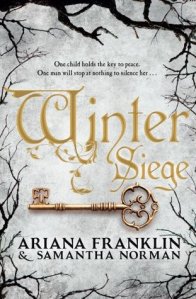
Ariana Franklin (a pen name of Diana Norman) was the author of the Adelia Aguilar mystery series, of which I’ve still only read the first, Mistress of the Art of Death. As you may know, she sadly died in 2011, leaving Winter Siege unfinished, but the book has now been completed by her daughter, Samantha Norman. Winter Siege is not part of the Adelia Aguilar series, but a standalone novel set during the period of English history known as the Anarchy.

It’s 1141 and the country is in the grip of a civil war as King Stephen and his cousin, the Empress Matilda, are battling for the English crown. In the Cambridgeshire Fens, an eleven-year-old girl is captured by a passing band of soldiers, raped and left for dead. The child’s way of dealing with her trauma is to wipe the whole incident entirely from her mind, so that by the time she is discovered by Gwil, a kind-hearted mercenary, she can’t remember her name, where she lives or anything about her past. Gwil renames her Penda and allows her to accompany him, disguised as a boy, while he builds a new career for himself as a travelling entertainer.

Moving from place to place, the two of them impress the crowds with their displays of archery while Gwil continues to search for any signs of Penda’s attackers – his only clues being a scrap of parchment carrying a message in Greek and the knowledge that the soldiers were accompanied by a monk smelling strongly of an unusual herb. Eventually, fate will take Gwil and Penda to Kenniford Castle, home of Maud, a sixteen-year-old ward of King Stephen.

To ensure the safety of her castle and her people, Maud has been forced to marry a man much older than herself – the brutal, drunken Sir John of Tewing, a supporter of Stephen’s. But when Sir John is struck down by illness and the Empress Matilda arrives at Kenniford asking for protection, Maud must decide whether to switch sides. This is a decision that will place the castle at the heart of the civil war and all of Gwil’s and Penda’s archery skills will be needed to help defend it.

I really enjoyed this entertaining medieval novel. As with Mistress of the Art of Death, I found it very atmospheric and evocative of the time period. The mystery aspect of the novel following Gwil’s search for the evil monk was slightly disappointing, but there was a second mystery that I found more interesting – and this involved the identity of an old abbot who is dictating the story of the Anarchy to his scribe, several decades into the future (in 1180). These sections provide a sort of framework for the rest of the novel and help to explain some of the historical background, while also making us curious as to who the abbot really is and how he knows so much about what happened at Kenniford Castle.

The book is called Winter Siege and so far I haven’t mentioned either winter or sieges, but I can assure you that both do play a part in the story. Snow is falling throughout much of the novel and one particularly snowy night forms the backdrop for one of the book’s most memorable scenes, when Gwil and Penda meet Matilda for the first time. Later in the book, our characters find themselves trapped in a besieged castle, which is when the various threads of the story are brought together.

Bearing in mind that this novel was written by both Ariana Franklin and Samantha Norman, it all seemed like the work of one author to me; it never felt uneven or disjointed. I don’t know how much Franklin had managed to complete before her death or if she would have taken the story in a different direction…but I think she would be pleased if she could read the finished version.

The Summer Queen by Elizabeth Chadwick

The Summer Queen The Summer Queen is the first in a trilogy of novels telling the story of the medieval queen, Eleanor of Aquitaine. Eleanor (or Alienor as she is referred to throughout the book) is a thirteen-year-old girl when the novel begins in 1137. Following the death of her father, the Duke of Aquitaine, Alienor is married to King Louis VII of France. At first the marriage is a happier one than either Alienor or Louis had expected, but as the years go by Louis begins to change and their relationship disintegrates. During a crusade to Jerusalem, Alienor makes an important decision regarding her future and with the young Henry, Duke of Normandy – the future Henry II of England – waiting in the background, the scene is set for the next two books in the trilogy, The Winter Crown and The Autumn Throne.

I have read other novels in which Eleanor of Aquitaine has been a character, but in most books the focus is on her relationship with Henry II and their sons (who included two more future kings, Richard I and King John). This is the first time I’ve read about her early life in so much detail, so I found this book fascinating and informative as well as being an enjoyable read.

As usual, Chadwick’s characters feel like people who really could have lived and breathed during the 12th century, rather than modern day characters dropped into a medieval setting. Alienor herself is shown to be a strong and intelligent woman with ambitions of her own, who really cares about the future of her own lands of Aquitaine and the welfare of the people who live there. She is frustrated by her husband’s lack of leadership skills and reliance on his advisers, particularly when she believes they are advising him to make incorrect decisions.

Alienor (or Eleanor) is not always shown in such a positive light as she is in this book and I liked this version of her character. In her author’s note, Elizabeth Chadwick explains some of the choices she made in writing Alienor’s story, particularly how to tackle the questions of whether Alienor may have had an affair with her uncle Raymond, Prince of Antioch, or with one of her own Aquitaine vassals, Geoffrey de Rancon (Chadwick’s answer is no to the first and yes to the second). She also tells us why she chose to use this particular spelling of Alienor’s name and how she decided what Alienor may have looked like.

I thought the breakdown of Alienor’s marriage to Louis was described in a way that felt realistic and believable. As a second son raised for a career in the church, only becoming heir to the throne after the death of his elder brother, Louis proves to be a weak leader and too easily influenced by the stronger personalities around him, particularly the Templar knight Thierry de Galeran. It was sad to see Alienor watch as the young, attractive husband she had once liked and cared for turned into a grim and humourless man, ready to blame his wife for all of his misfortunes (such as her failure to produce the male heir he so desperately wanted). However, Louis is never quite a villain and it’s possible to have some sympathy for the person he has become.

I also loved the portrayal of Henry, although he only really comes into the story towards the end. Being confident, self-assured and ambitious, he is the opposite of Louis in many ways and I was pleased to see Alienor find some happiness after so many wasted years, even though history tells us that this happiness isn’t going to last forever.

As well as being an entertaining story and providing a huge amount of information on Alienor’s early life, The Summer Queen is also a great introduction to the history and geography of medieval Europe and beyond. The route of Louis and Alienor’s crusade can be followed using a map at the front of the book and takes us through Hungary, Constantinople, Antioch and into Jerusalem encountering some of the most important historical figures of the period along the way.

I loved this book and am looking forward to seeing how Alienor’s story continues in The Winter Crown.