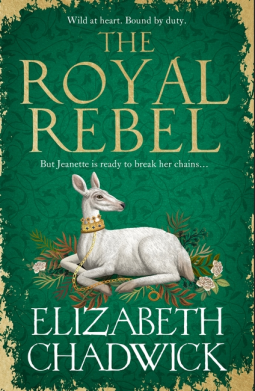
 This is the first of a planned pair of novels telling the story of Joan of Kent, cousin of King Edward III. Chadwick refers to her throughout the book as Jeanette because that was the name given to her by the King’s son, Edward (known as the Black Prince), who had it engraved on a silver cup. I’ll do the same in this review to avoid confusion.
The Royal Rebel opens in 1338 with Jeanette preparing to leave her family behind and travel overseas with the royal court for the first time. Jeanette is only twelve years old, so in the absence of her mother she is chaperoned by Katerine, Countess of Salisbury. During the journey to Antwerp, Jeanette is drawn to one of the King’s household knights, Thomas Holland, and once they reach their destination they find opportunities to spend time together away from the watchful eye of the Countess. They continue their relationship for more than a year until Jeanette becomes pregnant and they decide to marry in secret, knowing that they would be unlikely to get the consent of her family or the King.
Soon after the wedding, Jeanette loses the child and then Thomas leaves to go to war. In his absence, Jeanette is forced into marriage with William Montagu, her younger brother’s friend whom she has always disliked. William is the son and heir of the Earl of Salisbury and both Jeanette’s mother and the Countess of Salisbury see it as a wonderful match. Although Jeanette confesses that she is already married and can provide evidence, the two women refuse to acknowledge it and the Montagu marriage goes ahead anyway. The rest of the novel follows Thomas and Jeanette in their long battle to prove the legitimacy of their marriage so that they can live together as husband and wife at last.
I love Elizabeth Chadwick’s books but wasn’t sure I was going to like this one at first. Most of the first half of the novel is devoted to the romance between Jeanette and Thomas and not much else – and with this being the first of two books on Jeanette’s life, Chadwick takes her time in developing this part of the story. Eventually, though, things do get much more compelling as our hero and heroine become embroiled in their mission to have their marriage ruled valid by the Pope. Jeanette’s mother, Margaret Wake, and the Countess of Salisbury are very much the villains here as they destroy evidence, play politics behind the scenes and even imprison Jeanette to ensure nothing interferes with their plans (in reality, it seems unclear whether they were aware of Jeanette’s marriage to Thomas Holland before pushing her into a bigamous marriage with William Montagu).
William is depicted as weak and immature, unwilling to defy his mother and make decisions of his own, but I – and I think Jeanette as well – began to feel sorry for him as the novel progressed, because he was under the control of the Countess just as much as she was and was wasting years of his life trapped in a false marriage to someone who would never love him. Jeanette, on the other hand, is the ‘rebel’ of the title and although, like William, she’s constrained by society and her noble status, she knows what she wants out of life and is determined to find a way to get it, however long it takes. Her brother, John, sums up the situation perfectly:
‘Women, when they gather together in their sewing groups to gossip, arrange marriages for their relatives like stitching secret patterns on their embroideries. I envy you because you have chosen to sew your own colours and to walk away from it all, even at a great cost to yourself and others.’
Jeanette’s age, being barely in her teens at the time of her marriage to the older Thomas, will obviously be problematic to a modern audience so Chadwick chooses not to focus on it too much. Although she does tell us at the beginning how old Jeanette is, she doesn’t make a big thing of it and it’s easy to forget about the age difference as you read. This first novel only covers the early part of Jeanette’s life, ending in 1350, so anyone who knows this period of history will know that there’s a lot more to come in the second novel. There’s no news on its publication yet, but I’ll be looking out for it.
Thanks to Little, Brown Book Group UK for providing a copy of this book for review via NetGalley.

Book 52 for the Historical Fiction Reading Challenge 2024



 She Reads Novels