Isabella by Colin Falconer

Isabella Isabella is only twelve years old when she comes to England as the wife of King Edward II. As the daughter of Philip IV of France, Isabella is no stranger to life at court and with her father’s parting words still fresh in her mind (“You will love this man. Do you understand? You will love him, serve him, and obey him in all things. This is your duty to me and to France…”) she knows what is expected of her. Nothing could have prepared her, however, for marriage to a man who cares more for his beloved friend, Piers Gaveston, than he does for his young wife, his reputation and his country.

As Isabella grows older she begins to fall in love with Edward, but when Gaveston is executed in 1312 and another favourite, Hugh Despenser, takes his place in the king’s life, she is forced to accept that her love will never be returned. Despenser repeatedly comes between Isabella and her husband, and eventually she finds herself with a choice to make: should she remain loyal to Edward or should she join forces with one of his noblemen, Roger Mortimer, in an attempt to remove him from his throne?

This fictional account of Isabella’s life is the first book I’ve read by Colin Falconer. I was vaguely aware of his name but knew nothing about any of his books or what I could expect from them, so I was pleased to find Isabella available on NetGalley. I have read about Isabella before (in the Edward II section of The Plantagenets by Dan Jones and in fictional form in Maurice Druon’s Accursed Kings series) and she seemed a fascinating woman, so I was looking forward to reading more.

I have to admit, I wasn’t very impressed with this book at the beginning. The combination of third person present tense, simple sentence structure and very short chapters wasn’t very appealing at all. I kept reading, though, and after a while either the writing improved or I got used to the style – I’m not sure which – and the story did start to become more gripping.

With the novel being written from Isabella’s perspective, she is the character we naturally sympathise with. While we can see that Edward truly loves Piers Gaveston, we can also share Isabella’s humiliation at the lack of respect he shows his wife and her frustration at his inability to rule the country effectively while Piers is around. Things become worse for Isabella when Hugh Despenser takes Gaveston’s place and she eventually begins an affair with Roger Mortimer. I was not convinced by Falconer’s portrayal of Isabella and Mortimer’s relationship, however; there was no chemistry between the two characters and Mortimer himself never came to life on the page.

Isabella is a very quick read and a light one, although not quite as light as I thought it would be at first. It would probably be a good introduction to Isabella’s life if you’ve never read anything about her before, as it does seem to follow the historical facts very closely; it was only the style of the writing that I had a problem with. I was sorry, though, that the novel doesn’t span the whole of Isabella’s life – only her marriage to Edward and the Mortimer rebellion are covered, with nothing of her later years or the reign of her son, Edward III. I was left wanting to know more about some of the people and events mentioned in the novel and am now reading She-Wolves by Helen Castor, a non-fiction book which explores the lives of several medieval queens, including Isabella.

I received a copy of Isabella for review via NetGalley.

The Invention of Fire by Bruce Holsinger

The Invention of Fire This is the second in Bruce Holsinger’s series of historical mystery/thrillers set in 14th century England. A Burnable Book introduced us to John Gower, poet and ‘trader in secrets’, and followed his search for a book of prophecies containing a treasonous prediction foretelling the King’s death. In The Invention of Fire we enter Gower’s world again as he attempts to solve a second mystery. It’s not necessary to have read A Burnable Book first, although I would recommend doing so; I read it last year and enjoyed it, so have been looking forward to this new one.

The Invention of Fire begins in the year 1386 when sixteen dead bodies are found in a London privy one night. The cause of death is not obvious at first, but it soon becomes clear that the men were killed by a weapon few people in England have seen or even heard of. John Gower’s mission is to investigate the murders – an investigation that will lead him on a journey into the Kent countryside with his friend, Geoffrey Chaucer, and then across the sea to Calais where he is reunited with a face from his past. But when it is revealed that some of England’s most powerful men are involved in the crime, Gower becomes aware of the danger his own life is in – and of the implications of the new weapon on the future of warfare.

John Gower is an interesting character to build these novels around. He is a person who really existed in the 14th century, but one who is not particularly well known today. This gives Holsinger scope to use his imagination and create some fascinating fictional storylines for the character, while at the same time incorporating the few facts that we do know about the real John Gower: for example, his work as a poet, his friendship with fellow poet Geoffrey Chaucer, and the fact that he became blind in later life.

I have seen the John Gower novels compared with CJ Sansom’s Shardlake series and there are definitely some similarities. This book reminded me very much of Sansom’s Dark Fire which I read earlier this year; the time period is completely different, of course, but the plot is quite similar and both deal with the discovery of a new weapon. I have to admit, the weaponry aspect of this book didn’t particularly interest me, and with everything that has been going on in the world recently it’s depressing to read about the invention of new ways to kill. I was more interested in Gower’s personal story – his relationship with his son, his efforts to cope with his gradual loss of sight, and his conversations with Chaucer, who is working on The Canterbury Tales.

I had hoped there would be a third book in this series, but Bruce Holsinger has said that his next novel will be a ‘transhistorical fantasy’. That sounds intriguing but I hope he might still return to John Gower in the future.

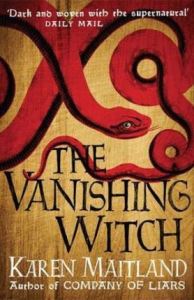
The Vanishing Witch by Karen Maitland

The Vanishing Witch Karen Maitland is an author I’ve been meaning to try for a while. With two of her novels on my tbr pile to choose from, I decided to start with this one, The Vanishing Witch, as it had been waiting the longest.

The story is set in Lincoln and covers the period between September 1380 and September 1381. As you may know, 1381 was the year of the Peasants’ Revolt when large sections of the English population rebelled in protest against excessive taxes. I actually read a non-fiction book about the Revolt just before Christmas – England, Arise by Juliet Barker – and this provided me with a lot of background knowledge. However, even if you know nothing about this period of history, you should still find The Vanishing Witch easy enough to follow. The Revolt does play an important part in the plot, but this is first and foremost the story of fictional Lincoln wool merchant, Robert of Bassingham, and his family.

When an attractive widow called Catlin asks Robert for advice regarding an investment, the merchant is only too pleased to help. Despite his reassurances to his wife, Edith, that his relationship with Catlin is purely business-related, he soon finds himself falling in love and it’s not long before the widow, her young daughter Leonia and adult son Edward have become part of Robert’s household. With Edith seriously ill, Robert’s two sons, Jan and Adam, become suspicious of Catlin’s motives – a suspicion shared by the family servants.

A few miles away, in the village of Greetwell, another man is also facing difficult times. His name is Gunter and he is a boatman, responsible for collecting and delivering cargoes of cloth. Work has been sparse lately and when the King’s commissioners arrive in the village, Gunter knows he will struggle to pay his taxes…

I found The Vanishing Witch a very entertaining and enjoyable novel and am quite happy with my first introduction to Karen Maitland’s work. There were plenty of things to like – the time period (not a very popular choice for historical fiction, which made it all the more interesting), the dark atmosphere, the touches of the supernatural, and the plot, which twists and turns as secrets are uncovered and revelations are made. I particularly loved the way Maitland altered my perceptions of the characters as the focus moved from one to another; she made me wary of some of them from the beginning, but I was never quite sure whether or not that wariness was justified!

By telling the stories of both Robert of Bassingham – a wealthy merchant – and Gunter, one of his workers, Maitland is able to explore what life was like in the 14th century for people at different levels of society. However, while the mystery revolving around Robert and Catlin was compelling, the storyline surrounding Gunter’s family and the Peasants’ Revolt felt less developed. This subplot had the potential to be as interesting as the other one and I was disappointed that it wasn’t explored in as much depth.

I’ve mentioned that the author has added some supernatural touches to the novel: each chapter begins with a superstition, a piece of folklore or a description of a spell. These don’t have a lot of direct significance to the story but they are fun to read and are part of the overall atmosphere of the book. There are also some sections of the novel narrated by a ghost, whose identity and role in the story we don’t learn until the end of the book. I didn’t guess who the ghost was and I was surprised when I discovered the truth!

So will I be reading more Karen Maitland? Yes, of course! I’ll start with her new one, The Raven’s Head, then go back to explore her earlier novels.

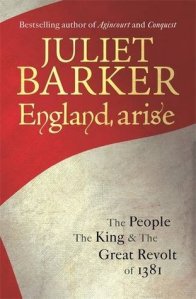
England, Arise by Juliet Barker

England Arise After reading Dan Jones’ The Hollow Crown recently, I moved straight on to another non-fiction book on English history while I was still in the right mood! But while The Hollow Crown looked at the Wars of the Roses, a period I’m starting to become very familiar with, this book deals with an entirely different subject and one that I previously knew very little about: the Peasants’ Revolt of 1381.

The first thing I discovered on beginning Juliet Barker’s England, Arise was that even the little I thought I did know about the revolt was incorrect. To call it the ‘Peasants’ Revolt’ is inaccurate because the people involved actually came from a range of different backgrounds and included craftsmen, artisans and apprentices as well as agricultural workers. Peasants’ Revolt was a label used by 19th century historians; Barker replaces it in this book with other terms such as ‘Great Revolt’, which is a more accurate description. I also hadn’t realised that there was not just one single revolt, but a whole series of uprisings, riots and rebellions taking place across large areas of the country.

In the first few chapters of the book, Barker puts things into context for us and explains some of the possible causes and motives for the revolt. First, she provides some political background by discussing the final years of the reign of Edward III and the challenges faced by his successor, his grandson Richard II, who came to the throne at the age of ten. The ongoing war with France meant that money was urgently needed and the solution was to tax the English people…three times, in quick succession. There was widespread discontent and resentment over the collection of the taxes and this is what sparked the rebellion. Of course, it wasn’t quite as simple as that – in some cases the anger was directed at the church or at corrupt officials, and this is also discussed in the book.

Next, we are given some information on living conditions in England at that time: the feudal system and why it was starting to break down, the effects of the plague on the population, the differences and similarities between rural and urban societies, and the types of employment people could expect to find. The author also tries to dispel some popular perceptions of medieval life, suggesting that literacy levels were higher than we tend to think and that travel from one place to another was much more common. People were becoming increasingly literate and well informed but still had little say in how the country was run. All of these things may have contributed to the circumstances that led to the revolt.

I loved reading about the lifestyles of medieval people, but the part of the book dealing with the revolt itself was actually of less interest to me. I found it too detailed for the general reader, describing countless incidents that occurred in each county and giving names of dozens of individuals who rebelled and who they were rebelling against. I didn’t feel that I really needed all of this information and it quickly started to become repetitive. The book does seem to be very sympathetic towards the rebels. At first I thought this was fair but as I read one account after another of their burning and looting, stealing from churches and plundering palaces, beheading the Archbishop and Chancellor, storming prisons, destroying legal documents and murdering Flemish immigrants, I wasn’t so sure!

The only individual name I had ever heard of in connection with the revolt (or the only one whose name has stuck in my mind, at least) was Wat Tyler, but it seems that Wat Tyler played a much smaller part in the revolt than I had imagined. He and two other names commonly associated with the period – Jack Straw and John Balle – are each given their own appendix at the end of the book, but there were many, many other participants in the revolt whose roles are also discussed throughout the text. The reaction of Richard II and the way he tried to respond to the rebels is examined too, and the final chapters of the book look at the aftermath and consequences of the revolt.

England, Arise was a fascinating read and I do recommend it but, as I didn’t find the actual revolt as interesting to read about as I’d hoped, I think a more general social history of the 14th century would probably have been a better choice for me. I would still like to read Juliet Barker’s biography of the Brontës, though – it’s only the length that has been putting me off that one!

I received a copy of this book for review via NetGalley.

The King’s Sister by Anne O’Brien

The Kings Sister The King’s Sister is a light but enjoyable historical novel set in the 14th century and telling the story of Elizabeth of Lancaster. As the daughter of John of Gaunt, uncle to the young King Richard II, Elizabeth does not have the freedom to marry as she chooses. At seventeen, an age when she is hoping for romantic love, she is forced into marriage with the eight-year-old Earl of Pembroke who is more interested in parrots and dogs than in his new wife.

As she waits impatiently for her husband to grow up, Elizabeth meets the King’s half-brother, John Holland. Holland is charming and charismatic, a man where Pembroke is a boy, and despite the warnings of her friends and family, Elizabeth soon finds herself breaking her marriage vows. An annulment follows and Elizabeth weds again, this time to the man she loves. But when King Richard is deposed and replaced on the throne by Elizabeth’s own brother, now Henry IV, she finds herself in an impossible position. With her husband still loyal to his half-brother, the former king, Elizabeth must decide where her own loyalties lie: with John Holland or with Henry?

I’ve read other novels set in this time period but I’ve never read one that focuses on Elizabeth of Lancaster as a main character. The King’s Sister is narrated by Elizabeth herself so we are able to get very close to her, accompanying her through all the ups and downs of her life, sharing her agony as she is forced to make a decision nobody should ever have to make. She is portrayed as a headstrong, defiant young woman used to getting her own way, who gives little thought to the consequences of her actions. While I understood Elizabeth’s disappointment with her first marriage, I did feel sorry for the little Earl of Pembroke who couldn’t help being young, after all – and I often felt frustrated with her for refusing to heed anyone’s advice and ignoring the warnings she was given against John Holland. However, Elizabeth is aware that she has flaws and that she can be selfish, and she does develop as a person over the course of the novel, which made it possible for me to have some sympathy for her.

Although I didn’t like Elizabeth very much (or John Holland either – I agreed with the general opinion of Elizabeth’s friends that he was untrustworthy and self-centred) there were some great secondary characters. I particularly liked Joan of Kent, mother of both John Holland and Richard II, and Katherine Swynford, the Duke of Lancaster’s wife. These are both women I have read about before, Joan in A Triple Knot by Emma Campion and Katherine in the wonderful Katherine by Anya Seton, and Anne O’Brien draws parallels between their stories and Elizabeth’s. All three are women who had to fight to be with the man they loved, despite the disapproval of everyone around them.

Like the other Anne O’Brien book I’ve read (The Forbidden Queen), this is a novel which concentrates on love and romance, feelings and emotions rather than on politics or battles. However, the author still manages to make the 14th century come alive with descriptions of jousts and tournaments, balls and court gatherings. We are given just enough information on the historical background, the political situation and the ever-changing alliances at court that I came away from this novel with a better understanding of the time period and a feeling that I’d learned something new. With over 500 pages The King’s Sister is a long book and really felt like a long book – even while I was absorbed in the story – but I did enjoy it and look forward to exploring O’Brien’s earlier novels which I haven’t read yet.

A Triple Knot by Emma Campion

A Triple Knot There are some historical women whose lives have been covered many times in fiction – Elizabeth I is one example and Anne Boleyn is another. The heroine of Emma Campion’s latest novel, A Triple Knot, is a less popular choice: she is Joan of Kent, cousin of King Edward III and once described as “the most beautiful woman in all the realm of England”.

Joan is the daughter of Edmund, Earl of Kent, and his wife, the Countess Margaret. Edmund, the younger half-brother of the deposed Edward II, is executed for treason several years before our story begins, leaving Joan and her brother to grow up in the household of their cousin, Edward III, and his wife, Philippa of Hainault. Joan’s Plantagenet blood and her great beauty give the King reason to hope that he can negotiate a marriage for her that will be useful to him from a political perspective. When he and Philippa notice that their own son, Ned (who will become known as the Black Prince), seems to be showing too much interest in Joan, they decide that she needs to be married off sooner rather than later. However, Joan has other ideas.

On a journey to the Low Countries to see the father of a potential husband picked out for her by Edward and Philippa, Joan meets and falls in love with Sir Thomas Holland. Thomas is twenty-six and Joan is only twelve, but while their relationship would be shocking by modern standards, this is the fourteenth century and an age difference like this is not too uncommon. They marry in secret, knowing that the King would not approve, but are soon parted when Thomas has to return to the army. Back at home with her family, Joan is forced into a second marriage with William Montague, the Earl of Salisbury’s son, and faces a long, difficult battle to prove that her marriage to Thomas was legal. But as she and Thomas struggle to have their marriage recognised, the Black Prince waits for his chance to win back the woman he has always wanted more than any other.

A Triple Knot is the first book I’ve read by Emma Campion, but I’m aware that she has also written a novel about Alice Perrers, mistress of Edward III, as well as a series of historical mysteries published under the name Candace Robb. Having read this one, I’m not sure I would want to try any of her others, as I didn’t really enjoy it very much. While it was good to learn more about a woman I previously knew very little about, I was left thinking that maybe there’s a good reason why not many novels have been written about Joan of Kent – her story just wasn’t interesting enough to sustain a novel of this length. Apart from her relationships with Thomas, William and Ned (I’m assuming this is what the ‘triple knot’ of the title refers to) other aspects of Joan’s life aren’t given much attention. As for Joan herself, I was surprised every time her age was mentioned as she didn’t feel like a child to me – in fact, she didn’t seem any older at the end of the book than she did at the beginning, even though many years had gone by!

There were some things that I did like, of course, otherwise I wouldn’t have been able to continue reading. The novel felt very well-researched and there were lots of details of fourteenth century life, both at court and away from it. The historical background is quite complex and it was sometimes difficult to untangle the relationships between various members of the royal family, especially in the first few chapters of the book, but I love reading about medieval history so I didn’t mind this. Overall, though, I was quite disappointed with this book – and as a side note, I really dislike the cover. It’s definitely not an image I would have chosen to represent the story and the time period!

I received a copy of this book via NetGalley for review.

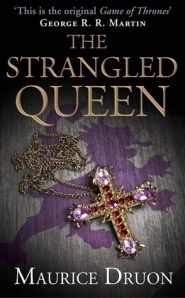
The Strangled Queen by Maurice Druon

The Strangled Queen This is the second book in Maurice Druon’s Accursed Kings series (Les Rois Maudits in French). There are seven novels in the series, all published between 1955 and 1977, telling the story of the monarchs of medieval France. The front covers of these new HarperCollins editions tell us that The Accursed Kings inspired George R.R. Martin’s A Game of Thrones, but be aware that this is not a fantasy series!

In the first book, The Iron King, we saw how Philip IV the Fair of France brought about the destruction of the Knights Templar. Before being sent to burn at the stake, the Grand Master, Jacques de Molay, cursed Philip and his descendants to ‘the thirteenth generation’. Philip was the first victim of the curse, but now he is dead and in The Strangled Queen we see how his son, Louis, becomes the next to suffer. Unlike his father, the newly crowned Louis X proves to be a very weak king and allows himself to be manipulated by his uncle, the Count of Valois, who is engaged in a power struggle with Enguerrand de Marigny, the former king’s chief minister.

Louis’ personal life is also a disaster – his wife, Marguerite of Burgundy, has been imprisoned for adultery following the Tour de Nesle Affair (described in the previous book) and as there is currently no Pope, he is unable to obtain a divorce so that he can find a new queen. Valois is hoping to arrange a marriage between his niece, Clemence of Hungary, and Louis, but first a new Pope will have to be chosen. However, Enguerrand de Marigny has other ideas and will do whatever it takes to thwart Valois’ plans.

I enjoyed The Strangled Queen, though not as much as The Iron King which I read more than a year ago and loved. I wished I hadn’t let so much time go by between reading the first book and the second as this really does seem to be a series that needs to be read in order with each book following on directly from the one before. Storylines that were begun in The Iron King were picked up again and continued in this book and I found myself struggling to remember exactly what had happened previously. I had forgotten all about Tolomei, the Lombard banker and his nephew Guccio, for example, but I was very pleased to see Guccio again as he is one of the few likeable characters in the series.

My only real complaint with this book is that, as someone who doesn’t know much about this period of French history, the title is a very big spoiler in itself. Knowing that the queen was going to be strangled took away some of the suspense! Luckily, though, the queen’s fate only forms a part of the story. Most of the novel is actually devoted to the rivalry between Charles of Valois and Enguerrand de Marigny…so you can expect lots of plotting, scheming and intrigue! And these are not the only plotting, scheming characters – there’s also Robert of Artois, still hoping to find a way of reclaiming his lands from his detested Aunt Mahaut.

I think the element of the book I found most interesting, though, is the portrayal of a young man (Louis X) who is unexpectedly forced to accept responsibilities that he is not ready for and not able to deal with. While I certainly didn’t like Louis (I find it difficult to have sympathy for someone whose idea of fun is shooting doves in an enclosed barn), I could understand his fears and insecurities and could see why it was so easy for the people around him to take control.

The third book in the series is called The Poisoned Crown so it sounds as if there’s still more trouble ahead for the sons of Philip the Fair!