A Burnable Book by Bruce Holsinger

There seem to have been a lot of historical thrillers in recent years that focus on the search for a valuable item – a book, a crown or a manuscript. A Burnable Book is another one, but with enough differences to make it feel refreshing and original. While many authors (CJ Sansom, SJ Parris, Nancy Bilyeau to name a few) set their stories in the Tudor period, this one is set in the 14th century, during the reign of Richard II, a period covered less often in historical fiction. The missing item in question is a book of prophecies which accurately predicts the deaths of the previous twelve Kings of England…and the one who is currently on the throne, King Richard II.

This book – and the embroidered cloth in which it is wrapped – has fallen into the hands of Agnes Fonteyn, a ‘maudlyn’ (or prostitute), who receives it from another girl whom she meets just outside London’s city walls. Minutes later this girl is murdered, leaving Agnes, who is unaware of the book’s contents, wondering what is so special about it that someone was prepared to kill for it.

John Gower, poet and ‘trader in information’, hears about the book from his friend, Geoffrey Chaucer, who asks John to find it for him but refuses to explain exactly why he wants it so desperately. When John begins his search for the book he soon discovers that he and Chaucer are not the only ones looking for it and that the prophecies it contains could implicate one of England’s most important noblemen in a plot against the King. As the action moves from one side of London to the other, over the Thames to Southwark, to the libraries of Oxford and then to Florence and back again, the history of this ‘burnable book’ is slowly revealed.

The name of the author, Bruce Holsinger, should be familiar to anyone who took the Coursera course “Plagues, Witches and War: The Worlds of Historical Fiction” last year (Holsinger was the instructor). This is his first novel and after listening to him talk about other works of historical fiction during the course, I was interested to see what his own book would be like. I’m pleased to report that it’s very good! The setting is believable, the historical background feels thoroughly researched, the plot is cleverly constructed and the story is exciting.

I did have a slight problem with the number of characters in the book as I found some of them difficult to distinguish from each other, particularly some of the bishops and noblemen who only played a minor role in the story. After a while, though, several characters began to emerge as stronger and more interesting than the others: John Gower, whose strained relationship with his exiled son, Simon, is tested during the course of his investigations; Millicent Fonteyn, sister of Agnes, who will do anything to avoid returning to life in the brothel where she grew up; and Edgar/Eleanor Rykener, born “a man in body, but in soul a man and woman both”. I liked the fact that the novel shows us the lives of people from all levels of society, from the nobility and clergy of England to London’s lower classes, including butchers’ apprentices and the ‘maudlyns’. Eventually the stories of each of these characters and more begin to come together, connected by the common thread of the burnable book and its treasonous prophecies.

Bruce Holsinger is a medieval scholar and it shows in his portrayal of the 14th century world which feels accurate and authentic. I can’t say the same for the dialogue, which is too modern for the period, but this didn’t irritate me as much as it sometimes does and the slang probably reflected the way some of the characters would have spoken. When reading the author’s note at the end I was interested to find that some of the things I’d assumed were fictional were actually based on fact. The character of Edgar or Eleanor Rykener, for example, was inspired by historical records of a transvestite prostitute. The poet John Gower really existed but not many details of his life are known, so Holsinger was able to use his imagination to fill in the gaps.

I think my favourite aspect of the novel was the concept of the ‘burnable book’ itself and the cryptic messages it contains. It was fascinating to learn more about the process of creating and breaking ciphers and codes and to watch as various characters tried to interpret the meanings of the prophecies. I also enjoyed following Gower’s mission to locate the book and identify its author, and the problems faced by Agnes and the other maudlyns in deciding what to do with such a dangerous possession. I don’t know if Bruce Holsinger is planning to write a sequel to A Burnable Book but I hope so as I would love to meet some of these characters again!
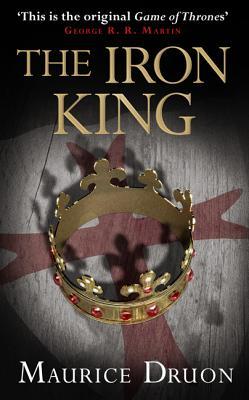
The Iron King by Maurice Druon

The Iron King “This is the original Game of Thrones” it says on the front cover, but anyone picking this book up hoping for an epic fantasy novel is going to be disappointed. The French novelist Maurice Druon may have been George R.R. Martin’s inspiration (I haven’t read Martin’s books so wouldn’t know how strong the influence actually is), but this is definitely not fantasy – it’s an historical fiction novel and an excellent one too. While I think it’s good that Martin’s recommendation is encouraging people to read The Iron King, I do think it was maybe a mistake for the publisher to market the book in this way, as looking through the various reviews on Amazon it seems a lot of people have not got the novel they were expecting and as a consequence The Iron King has ended up with a lower rating than it deserves.

Anyway, now that we’ve established what type of book this is, let me tell you what it’s about! Originally published in the 1950s, this is the first in the seven-volume “Accursed Kings” series and tells the story of a fascinating period of French history. The Iron King of the title is Philip IV of France, who was also known as Philip the Fair. For seven years Philip has been persecuting the Knights Templar who he wishes to destroy because of their power and riches, and he finally succeeds in having their Grand Master, Jacques de Molay, burned at the stake. But before the Grand Master goes to his death, he puts a curse on the King and his descendants – “accursed to the thirteenth generation!”

Things soon start to go badly for Philip and his family when it emerges that his sons’ wives are cheating on them with two young courtiers. Philip’s daughter Isabella, who is in a loveless marriage to King Edward II of England, sees an opportunity to bring their adultery to light, with the assistance of her ambitious and vengeful cousin, Robert of Artois, who is forming a plot of his own to reclaim his lands from his hated Aunt Mahaut. It seems that the Grand Master’s curse has been successful…

As this is a novel first published in 1955 and translated from French, it does have a very different feel in comparison to most of the historical fiction novels that are being written today and this was something I really liked about the book. Unfortunately I don’t have the language skills to be able to read it in its original French, but as far as I could tell, the translator (Humphrey Hare) has done a good job and The Iron King was one of the most entertaining historical fiction novels I’ve read for a while. There were so many interesting things to learn about – the origins of the famous ‘Tour de Nesle affair’; the demise of the Knights Templar; the community of Lombard bankers in Paris – and with a plot involving murder, torture, poisonings, court intrigue, and family feuds, there was always something happening.

Don’t worry if you know nothing about this period of French history – I had absolutely no previous knowledge of Philip the Fair and his family before reading this book but that was not a problem at all because this edition of the book makes the story easy to understand and follow. Everything you need to know regarding the historical background, the politics or the causes of feuds and disputes is clearly explained in the notes at the back of the book and the character list at the front helped me remember who everyone was and how they were related to each other. I am now looking forward to the second Accursed Kings book, The Strangled Queen. I hope the publisher will continue to reissue the rest of the series!

The Master of Verona by David Blixt

The Master of Verona by David Blixt The Master of Verona is set in Northern Italy in the early 14th century. At the beginning of the novel the great poet Dante Alighieri, after years of exile from Florence, has been invited to the city of Verona by its ruler, Francesco della Scala, known as Cangrande. Dante and his two sons, Pietro and Jacopo, arrive in Verona at a turbulent time for the city; not only has war broken out with Padua, but Cangrande’s heir, Cesco, has been the target of an assassination attempt.

When seventeen-year-old Pietro impresses Cangrande with his courage and loyalty, he becomes caught up in Verona’s battles with Padua and is also entrusted with trying to help protect the life of baby Cesco. As if this wasn’t enough, Pietro’s two best friends, Mariotto Montecchio and Antonio Capecelatro have both fallen in love with the same girl and an ancient feud between their two families looks set to be reignited…

This was one of the final books I read in 2012 and I finished it just in time for it to make my list of favourite books of the year. It has taken me a while to actually write this post as there’s so much going on in the novel and so many different aspects to the story, it’s difficult to know where to begin! First, there’s a link with Romeo and Juliet; although this is not a retelling of Shakespeare’s play, Blixt suggests a possible theory to explain how the feud between the Montagues and Capulets may have originated. I noticed allusions to some of Shakespeare’s other plays too, but the story could still be understood and enjoyed even if you have no knowledge of Shakespeare at all as this is just one small element of the novel.

The plot does become quite complicated and some concentration is needed at first to keep all the characters straight, especially as many of them are also referred to by their titles or nicknames (Cangrande, for example, is sometimes referred to as Francesco della Scala, the Scaliger, the Greyhound or the Capitano). However, I never had any problems understanding what was happening and could even manage to follow the battle scenes! This is a great book for those of us who like our historical fiction novels long, detailed and complex but with plenty of action at the same time. There’s always something happening, whether it’s a battle, a chase, a festival or a duel. One of the most memorable episodes of the story describes Pietro’s participation in the Palio, a dramatic horse race through the streets of Verona. It’s all breathtakingly exciting and makes the book a much quicker read than you might expect considering the length of it.

But it’s not all non-stop action; in quieter moments, the characters have lots of discussions on religion and philosophy, mainly with reference to Dante’s work – the concepts of Heaven and Hell, the significance of stars, etc – which made me wish I had actually read Dante so I knew what they were talking about! He is definitely on my list now for future reading. There are also some fascinating passages in which we see the 14th century literary world of booksellers and scribes through the eyes of Dante’s daughter, Antonia Alighieri.

Many of the characters in the book are real historical figures of the period. Cangrande, the ‘Master of Verona’ who is believed by some to be the legendary ‘Greyhound’ or saviour of Italy, is fascinating and charismatic, a complex character with several different sides to his personality. As all good historical fiction novels should, this book left me wanting to know more about the real life Cangrande. Dante himself is someone I have never read much about, so knowing very little about his life, I have no idea how accurately he was portrayed in this book. The spelling Alaghieri is sometimes used in place of Alighieri but the author explains his reasons for this both in the text of the story and in his notes at the end of the book, and again, I don’t really have enough knowledge of Dante to be able to comment on this. There are some strong and interesting female characters in the book too: I’ve already mentioned Antonia, but there’s also Katerina della Scala, Cangrande’s sister. And even little Cesco, despite being not much more than a baby, has a very strong personality of his own.

The only negative thing I can say about this book is that the dialogue felt a bit too modern at times (I’m sorry for mentioning this yet again – I feel as if I’ve been complaining about the dialogue every time I’ve reviewed historical fiction recently!) but luckily I was enjoying the story so much I could overlook the occasional word that didn’t sound right.

This book is the first in a series and I’m already looking forward to reading the second one, Voice of the Falconer!

Lion of Alnwick by Carol Wensby-Scott

Set in the 14th century during the reigns of Edward III and Richard II, Lion of Alnwick tells the story of Henry (Hal) Percy, 1st Earl of Northumberland. The novel begins in the year 1357 and ends in 1409, covering all the major events of Hal’s adult life including his marriage to Margaret Neville, sister of his bitter enemy and rival Northern lord, his conflict with John of Gaunt, the Duke of Lancaster, and his relationship with his son Harry “Hotspur” Percy.

Before I say any more about this great historical fiction novel, I should point out that this book has now sadly gone out of print, but for anyone who loves fiction set in medieval England it is definitely worth reading if you can manage to find a copy. Please don’t let the cover (pictured above) put you off – it has to be one of the worst covers I’ve ever seen and is really not representative of the quality of the story!

I can’t remember how this book first came to my attention, but the reason it appealed to me is because I only live an hour away from Alnwick and have been there several times (usually to visit the castle, the gardens or Barter Books) so I was attracted by the mention of Alnwick in the title. There are so few books that focus on the north east of England that whenever I do come across one I always feel I should read it (though of course, with this novel being so epic in scale, the action is not just confined to Northumberland but also sweeps down to York and Westminster and across to Wales).

The story concentrates on Hal, his son Harry, and their respective wives, Margaret Neville and Elizabeth Mortimer, but we also meet lots of other fascinating characters, most of them real historical figures of the period. One of the most intriguing characters, I thought, was Hal’s enemy from over the border in Scotland, Archibald Douglas, known as The Black Douglas. His rivalry with Hal is a recurring theme throughout the novel and I looked forward to all of their encounters. I also thought the characterisation of Richard II as a young and incompetent king unable to command the respect of his men while bestowing gifts and titles on his favourites, was very well done.

The author does seem to assume that the reader already has a good knowledge of the period; the history becomes very complex and detailed, so this is the type of historical fiction novel I would recommend only to readers who really do love history! It’s such a shame this book is out of print; it was very well-written and well-researched, maybe not as much fun to read as a Sharon Penman or Elizabeth Chadwick novel, but almost as good. If you’re interested in reading this book I would suggest trying to get a copy of this one and the other two in the trilogy (Lion Dormant and Lion Invincible) as soon as you can, before they become impossible to find!

The House on the Strand by Daphne du Maurier

Dick Young is at a turning point in his life. He has recently left his job at a London publishing firm and needs to decide what he wants from his future. He’s been offered another job in New York and his American wife Vita wants him to accept it, but Dick’s not so sure. When his friend Professor Magnus Lane invites him to stay at his farmhouse in Cornwall for the summer, he agrees, looking forward to a few days of peace before Vita and his two stepsons join him. But when Dick arrives at Kilmarth, Magnus convinces him to take part in a secret experiment: he has developed a new drug which allows the user to travel back in time – and he wants Dick to test it for him…

Choosing to begin 2011 with a book by one of my favourite authors was the right decision. The House on the Strand is a strange and unusual book which blends historical fiction, science fiction, time travel and psychology. I loved it! In fact, it might even make my best of 2011 list at the end of the year. Although Rebecca is still my favourite Daphne du Maurier book, this one ties with The Scapegoat as my second favourite. It actually has a very similar mood and feel to The Scapegoat even though the plots of the two books are entirely different. Both books have a male narrator and both have themes of identity and escaping from reality.

I enjoy reading about time travel and this book took a slightly different approach to the question of time travel than any other book I’ve read. Rather than physically going back in time, it’s only Dick’s mind that travels while his body stays in the present – and as you can imagine, this has some disastrous and embarrassing results. The 14th century world that Dick witnesses when under the influence of the drug seems completely vivid and real to him, yet he’s unable to interact with any of the people he meets. He feels a special connection with Roger Kylmerth, steward to the Champernoune family, and also with the beautiful Isolda Carminowe. As Dick’s fascination with Roger and Isolda grows, he spends more and more time in the past and becomes increasingly dependent on the drug.

Du Maurier wrote this book in the late 1960s when psychedelic drugs such as LSD were at the height of their popularity and the drug which Magnus invents seems to be very similar to what I’ve read about LSD. As Dick becomes psychologically addicted to the drug, he gradually grows more distant and withdrawn and his relationships with his family start to suffer. His life in the present is portrayed as dull and boring in comparison to the vivid events of the 14th century and when seen through Dick’s eyes, Vita and her two sons are unlikeable and obnoxious. To me though, they were normal, reasonable people who were trying to make sense of their husband and stepfather’s bizarre behaviour.

Despite my own interest in history and historical fiction, I didn’t find the 14th century subplot particularly compelling. The story wasn’t very strong and there were too many characters with similar names who all seemed to be married to their cousins, which made it very difficult to keep all the relationships straight. I was constantly turning to the family tree at the front of the book and still couldn’t remember who was who. My advice to anyone reading The House on the Strand would be not to worry too much about following the 14th century story. By far the most interesting part of the book is the part which takes place in the present.

There were only one or two other negative points. First of all, I was disappointed that we didn’t get to know Magnus better, as I thought he was potentially the most interesting character in the book. Secondly, du Maurier made a point of describing the landscape and the locations of the various 14th century farmsteads and manor houses in great detail. I know this was supposed to show us how the appearance of the landscape had changed over the centuries (which is quite important to the plot), but I found it confusing and even by referring to the map at the front of the book, I couldn’t seem to build a picture in my mind of what the area looked like. Apart from these minor complaints though, I loved this book.

I’ve now read around half of du Maurier’s books. The good news is that I still have the other half to look forward to!