The Hunchback of Notre-Dame by Victor Hugo

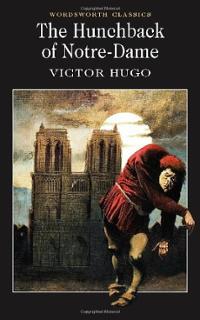
The Hunchback of Notre-Dame Or Notre-Dame de Paris, to give it its original French title and one which is much more appropriate. Quasimodo, the hunchback, has a surprisingly small role in the book while the cathedral of Notre-Dame itself is at the heart of the story, with most of the action taking place within its walls, on top of its towers or in the streets and squares below.

Set in 15th century Paris, the novel follows the stories of three tragic and lonely people. First there’s the beautiful gypsy dancer, La Esmeralda, who captivates everyone she meets with her looks, her dancing and her magic tricks. Alone in the world with only her goat, Djali, for company, she dreams of one day being reunited with her parents. Then there’s Claude Frollo, the Archdeacon, once a good and compassionate man who rescued Quasimodo as a child and raised him as his son. He becomes obsessed with Esmeralda after seeing her dancing in the Place de Grève and descends into a life dominated by lust and envy, turning away from the church and towards black magic. Finally, of course, there’s Quasimodo himself, the bell-ringer of Notre-Dame. Outwardly deformed and ugly, his kind heart and his love for Esmeralda lead him into conflict with his adoptive father, Frollo.

I read Hugo’s Les Miserables almost exactly five years ago and I really don’t know why it has taken me so long to read another of his books. I loved Les Miserables and I loved this one too, though not quite as much; this is a shorter and slightly easier read, but I didn’t find the story as powerful or emotional. It was a good choice for the R.I.P. challenge, though – the atmosphere is very dark and there are plenty of Gothic elements.

At least having had some previous experience of Hugo meant that I knew what to expect from his writing! You need to be prepared for some long diversions and chapter after chapter that has almost nothing to do with the plot or the main characters. Hugo devotes a lot of this novel to discussing Gothic architecture, the structure of the cathedral, the geographical layout of Paris and other topics which may or may not be of interest to the reader. I’m happy to admit that I didn’t read every single word of these sections (in fact, I skipped most of the chapter entitled A Bird’s-Eye View of Paris) and I don’t feel that I missed anything as a result.

The version of the book that I read is not actually the one pictured above (I just wanted a book cover to illustrate my post). I downloaded the free version from Project Gutenberg for my Kindle, which is Isabel F. Hapgood’s 1888 translation. I was very happy with it, but I’m used to reading older books and older translations; depending on your taste you might prefer a more modern translation. And just as a side note, does anyone else love books with imaginative chapter titles? There are some great ones here, including The Inconveniences of Following a Pretty Woman through the Streets in an Evening, The Effect which Seven Oaths in the Open Air Can Produce and The Danger of Confiding One’s Secret to a Goat. Much more intriguing than just numbering them 1, 2, 3!

As I’ve now read Hugo’s two most popular books, can anyone tell me if there are any others that I should read? I like the sound of Ninety-Three and The Man Who Laughs, but are they worth reading?

Wolves in Winter by Lisa Hilton

Wolves in Winter Beginning in 1492, Wolves in Winter is the story of Mura Benito, the young daughter of a bookseller from Toledo. Even at the age of five, Mura knows she is not like other children. With her mixture of Moorish blood (from her father) and Nordic blood (from her mother) and her pale, androgynous appearance, she has always looked different. She has also grown up listening to her father read to her from his books and possesses a wealth of arcane knowledge which would be unknown to most little girls.

When Mura’s father is arrested by the Inquisition, he leaves his daughter in the care of his friend, Adara, but Mura is eventually sold into slavery and finds herself taken to Florence where she becomes a maid in the household of Piero de’ Medici. Here she continues her education under the eye of the great scholar Marsilio Ficino, learns the arts of healing and fortune telling with the help of the wise woman Margherita, and makes a special friend called Cecco who shows her the sights of Florence. However, Mura’s life is soon to undergo another big change: the downfall of the Medici, the rise to power of the monk Savonarola and the threat of war with the French mean that these are uncertain times in Florence. Fate will take Mura next to Forli and the home of the Countess Caterina Sforza, known as the Lioness of the Romagna.

I picked up Wolves in Winter while browsing the shelves in the library and was intrigued by the promise on the cover of “poison, alchemy and intrigue in the court of the Medici”. I had never heard of either the book or the author but thought I would take it home and give it a try. I did enjoy some aspects of the novel – it’s an entertaining, imaginative story set against a fascinating historical backdrop – but it wasn’t as good as it could have been or as I’d hoped it might be. The positives first: I loved the atmosphere and the richness of Lisa Hilton’s writing (I particularly liked the way she used colour in her descriptions) and the various settings were vividly described. In 350 pages we move from a Spanish bookshop to a Florentine palazzo, from the camp of a travelling circus troupe to a castle under siege!

It was the fictional story of Mura that I had a few problems with. First, she narrates in the first person and although she does age over the course of the novel, she never feels significantly different from the child she is at the beginning. Then there are the supernatural elements of the book – for example, Mura believes she has the ability to communicate with wolves and that she has the gift of the Sight. I just don’t feel that this added very much to the story. Renaissance Italy is always an interesting setting anyway and you would expect any novel featuring both the Medici and the Borgias to be full of intrigue and drama. Add Caterina Sforza, a fascinating character (and one I haven’t read about until now), and there should already have been enough material here to tell a compelling story without the addition of the ‘magical’ elements.

Mura herself is an unusual heroine; I liked her, but I think her strangeness made her a difficult character to fully engage with. I did appreciate, though, that Lisa Hilton was trying to do something a bit different here and that this was not supposed to be your average heroine or your average historical novel! Another way in which Mura’s story is unusual is that it doesn’t involve a lot of romance – she does have a romantic interest but it only forms one small part of the novel. There’s a good reason for this, which I won’t explain here but which will be revealed if you read the book.

Wolves in Winter was an enjoyable, easy read but it lacked the sort of depth I prefer in historical fiction. This edition of the book includes a preview of the author’s next novel, The Stolen Queen, which is about Isabelle of Angoulême. It looks promising but I’m not sure I’ll be reading any more by this author.

Gutenberg’s Apprentice by Alix Christie

Gutenbergs Apprentice I think it’s safe to assume that if you’re reading this post you’re someone who likes to read books. You will probably agree that the printing press was one of the most important inventions in history and you’re probably already familiar with the name Gutenberg. But have you ever heard of Peter Schoeffer or Johann Fust and do you know what part they played in developing the art of printing?

This novel, Alix Christie’s first, takes us to the German city of Mainz in the year 1450. Peter Schoeffer, a talented young scribe, has been called home from Paris by his adoptive father, Johann Fust, who is investing in an exciting new project: Johann Gutenberg’s mission to produce the first printed copy of the Bible. Fust has agreed to help finance this new enterprise and is keen for his son to become apprenticed to Gutenberg in return. Peter’s first reaction to Gutenberg’s printing press is one of horror and distrust; as a trained scribe he takes a lot of pride in the beauty of the handwritten word. In the end, though, Fust gets his way and Peter begins his apprenticeship in Gutenberg’s workshop.

What follows is the story of the long, slow process of creating the world’s first book to be printed with movable type. It’s a journey that will take four years and result in the printing of around one hundred and eighty copies of the Bible. Johann Gutenberg’s name will be remembered by history, but Gutenberg’s Apprentice shows us that Gutenberg did not work alone and Peter Schoeffer and Johann Fust are given the attention they deserve.

I was not at all surprised to learn that Alix Christie herself was apprenticed to master printers and can operate a press – I could tell that this book was written by someone with not only an excellent knowledge of printing but also a love and passion for the subject. We are given lots of detailed information on printing techniques, the design of alphabets and the creation and casting of metal type. Because these methods were so new and innovative, Peter, Gutenberg and the other craftsmen in the novel are learning as they go along, improvising and modifying things where necessary. It was all very interesting, but there were times when I would have liked a little less technical information and a little more story. With Peter and the others facing opposition from certain members of the church, the need to enlist the help of the town guilds, and the possibility of their secret project being discovered, this could have been an exciting and dramatic novel, but instead I found it slightly dry and unemotional.

I couldn’t help wondering if a non-fiction book on the same subject would have worked better for me because although I never managed to fully engage with Peter’s story, there’s no doubt that it’s a fascinating subject. Some of the themes the novel covers are timeless and universal, such as the conflict between new technology and traditional methods. From Peter’s perspective, after spending years perfecting the art of hand lettering, he initially sees the use of metal type as soulless and lacking skill and beauty. Gutenberg and Fust, however, insist that the printing press will allow books to be created cheaply and quickly, making them accessible to a much wider readership and Peter gradually begins to understand this point of view.

I learned a lot from Gutenberg’s Apprentice, so despite having one or two problems with it, I still thought it was worth reading. I have come away from this novel with a better understanding of something I knew very little about and an appreciation for the history behind the printed books I take for granted.

I received a special limited edition of this book from Bookbridgr for review.

Roseblood by Paul Doherty

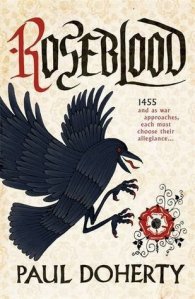
Roseblood It’s 1455 and England is heading towards civil war. Henry VI is still on the throne but he is a weak ruler and there are many who think he is not fit to be King. The Duke of York believes his claim is stronger than Henry’s and with the support of some of England’s most powerful noblemen he is determined to win the crown for himself. The scene is set for the period of history that will become known as the Wars of the Roses.

In Roseblood we meet two men who are on opposite sides of the conflict. Simon Roseblood is a Lancastrian, loyal to Henry VI and his wife, Margaret of Anjou. As the owner of a busy London tavern, Roseblood is in an ideal position to be able to obtain information and intelligence that will help the Lancaster cause. But while Roseblood is doing all he can in support of his king, he also has business of a more personal nature to attend to. Five years earlier, his brother, Edmund Roseblood, was murdered during a rebellion led by Jack Cade. Simon has reason to believe that the men responsible were members of the mysterious gang known only as LeCorbeil and he knows he must find a way to avenge his brother’s death.

Amadeus Sevigny is the nephew of the Sheriff of London and clerk to Richard, Duke of York. As a loyal Yorkist, Sevigny is in direct opposition to Simon Roseblood and they are first drawn together when Sevigny tries to frame Roseblood for a crime he didn’t commit – only to discover that Roseblood is his equal when it comes to plotting and scheming. Their paths cross again in a race to hunt down a man who possesses information which would be damaging to both Lancaster and York, but it could be Roseblood’s daughter, Katherine, who holds the key to bringing their rivalry to an end. And throughout all of this, LeCorbeil wait in the background for their chance to complete their destruction of the Roseblood family…

I have read a lot of novels set during the Wars of the Roses (it’s one of my favourite periods of history) but Roseblood is not like any of the others I’ve read and is actually quite a difficult book to describe. It’s a mixture of history, mystery and intrigue with a large cast of colourful characters – many with Dickensian names such as Candlemas, Wormwood and Skulkin. It’s an unusual novel and not really what I’d expected at all! While I found it confusing at the beginning (we are given a lot of historical information in the opening sections, and being thrown straight into one of Sevigny’s schemes and Roseblood’s attempts to thwart it, I struggled to follow exactly what was happening) I eventually found myself drawn into this fascinating, complex story.

Although the novel is set at the beginning of the Wars of the Roses and historical figures such as Henry VI and the Duke of York do make brief appearances, the focus is always on the lives of the fictional characters. Much of the story is told from the perspectives of Roseblood and Sevigny, but there are also some chapters which give us the points of view of Roseblood’s son, Raphael, and daughter, Katherine. I didn’t find Raphael very interesting, but I thought Katherine, with her obsession with Arthurian legend and her imaginary friend, Melisaunde, was a much more memorable character.

Doherty seems to be an author who knows London well – not just London as it is today but as it was in medieval times too – and each location, whether it’s a marketplace, a church or a tavern, is described in minute detail. It was actually a bit too descriptive for me at times – almost like walking down a busy street and having your senses assailed by so many sounds, sights and smells that you start to feel overwhelmed – but I’m sure other readers will love the level of detail he goes into. I was certainly left with the impression that he had thoroughly researched every aspect of both the setting and the time period, which is obviously a good thing!

I’m surprised that I’ve never come across Paul Doherty before, as he appears to have written a huge number of historical novels, many of them mysteries, under several different pseudonyms. I would like to try more of his books, though as there are so many I have no idea where I should start. I’ll also be looking out for a sequel to Roseblood – the way it ended with so much still unresolved, I’ll be disappointed if there isn’t one!

Thanks to Headline for providing a review copy via NetGalley.

Kingmaker: Winter Pilgrims by Toby Clements

Winter Pilgrims On a cold winter’s morning in 1460, a band of armed horsemen approach the Priory of St Mary near Lincoln. One of the monks, Thomas Everingham, is outside the priory walls that morning, having been sent out to kill a fox that has been caught in a trap, and when he notices that the soldiers are about to attack two nuns (one of whom is Sister Katherine, a young woman who has spent most of her life in the priory) he decides to intervene. In the scuffle that follows, Thomas seriously injures one of the men, who happens to be the son of the nobleman Sir Giles Riven. With the furious Sir Giles seeking revenge, Thomas and Katherine (disguised as a boy called Kit) are forced to flee the priory.

After living for so many years in their isolated religious community, Thomas and Katherine have little knowledge of the world beyond and are surprised to find that England is in the midst of war. Henry VI is still on the throne but is under threat from the Duke of York and Earl of Warwick, whose armies are gathering in Calais in preparation for the next stage of what will become known as the Wars of the Roses.

With the help of pardoner Robert Daud, who leaves them a bag containing a mysterious book, Thomas and Katherine reach Calais and join the company of two of Warwick’s men, Sir John Fakenham and his son, Richard. Here Thomas learns to use a bow and Katherine increases her knowledge of healing, skills they will need when they return to England to face their enemy, Sir Giles Riven, and to play their part in the bloody battles of Northampton and Towton.

Although this book has already received lots of glowing reviews, I’ll admit that I had my doubts about it before I started reading. I thought it might be too similar to Conn Iggulden’s Wars of the Roses novel, Stormbird, which I read last year and struggled with. Luckily, while there were some similarities and I suspect that most people who did love Stormbird will love this book too, I did enjoy this one quite a bit more.

This is one of my favourite historical periods but I never get bored with reading about it; each book I pick up offers something new and adds to my knowledge of the subject. This novel is slightly different from most of the others I’ve read that are set during the Wars of the Roses, because instead of concentrating on the kings and queens, the rich noblemen and powerful battle commanders, the focus here is always on the ordinary people – people like Thomas, Katherine and their friends who have no involvement in politics and decision-making, but are risking their lives for York or for Lancaster.

I was interested to learn that Toby Clements had attended re-enactments and living history camps and even tried using a longbow, all as part of his research for this novel. The research has really paid off because his writing has a feel of authenticity that is sometimes lacking in other books. I could almost imagine that I really was standing in the middle of a muddy battlefield with arrows flying around me, walking through a smelly, bustling market place or watching Katherine performing surgery without the benefits of modern medicine. There’s certainly nothing glamorous about this story!

I only have two minor complaints about the book – and both are entirely a matter of personal taste. First, it is written in present tense which is something I almost always find slightly irritating. It seems to be an increasingly common choice of authors these days and is becoming difficult to avoid, but I still don’t like it and find past tense much easier to read. Clements also devotes more time to the battles (and fights, brawls, archery sessions etc) than I would have liked, but although I didn’t particularly enjoy reading these scenes I can appreciate that they were written very well, especially the Battle of Towton. As I said, though, other readers will not necessarily have a problem with either of these things.

Kingmaker: Winter Pilgrims is the first in a series. At the moment I’m undecided as to whether I want to continue with the second book, but I did end up enjoying this one for the different perspective it offered on a period I love.

I received a copy of this book from the publisher for review via NetGalley

Meeting Katherine de Valois

I have read two historical fiction novels recently both on the subject of the fifteenth century French princess, Katherine of Valois, the wife of King Henry V of England. The Forbidden Queen by Anne O’Brien and The Agincourt Bride by Joanna Hickson both tell Katherine’s story but in very different ways and as I’ve read them so close together, I thought it would be interesting to combine my reviews into one post.

The Forbidden Queen Let’s start with The Forbidden Queen by Anne O’Brien, my favourite of the two books. The novel is narrated by Katherine herself and covers most of the significant events of her life. The youngest daughter of King Charles VI of France and his wife, Isabeau of Bavaria, Katherine is married to Henry V several years after the English victory over the French at the Battle of Agincourt in 1415. Queen Isabeau has agreed to a settlement with Henry that would make him heir to the throne of France in place of Katherine’s own younger brother, the Dauphin.

When Henry dies just a few years into their marriage, Katherine falls in love with his cousin, Edmund Beaufort – but does Edmund love her in return or is he more interested in the power he would gain as husband of the Queen Dowager? It’s not until Katherine gets to know her Welsh Master of Household, Owen Tudor, that she finally has a chance of true happiness.

This is quite a romance-based novel, but maybe that’s to be expected as Katherine sadly didn’t seem to have much of a part to play in politics or in the reign of her son, the young Henry VI. O’Brien did such a good job of making me see how Katherine was desperate for love and affection and how disappointed she was when she realised that she was going to get neither of these from the King. Henry V was not portrayed as a cruel or deliberately unkind husband, just one who was insensitive and indifferent, and it was so sad when Katherine realised the true nature of the man she was married to. But while I could have a lot of sympathy for the young, naïve Katherine I did start to wish that, as she got older, she would become more mature and independent. It was sad and frustrating to see her making the same mistakes again and again, looking for love where there was obviously none.

Although Katherine sometimes irritated me, I did like her. I also thought O’Brien’s characterisation of the three very different men in Katherine’s life was very well done: the distant, preoccupied King, interested only in battle strategies and military campaigns; the charismatic but ambitious and untrustworthy Edmund Beaufort; and the proud, quiet Welshman Owen Tudor. This is the first Anne O’Brien book I’ve read and I was quite impressed with the overall quality of her writing and her ability to tell a good story.

I received a copy of this book from Netgalley for review.

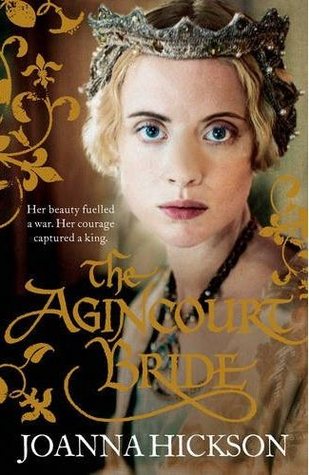
The Agincourt Bride Now for The Agincourt Bride by Joanna Hickson. In this book, the author has used the alternative spelling, Catherine, rather than Katherine, so I have done the same in this review. This is actually the first of two volumes and covers only the early part of Catherine’s life, from her childhood until shortly after her marriage to Henry. The sequel, The Tudor Bride, is due out later this year.

This novel is narrated by Catherine’s nursemaid, Guillaumette Dupain (known as Mette). Mette, the daughter of a baker, is brought to the royal household to act as wet nurse for the baby Catherine, having recently had a stillborn child of her own. With Catherine neglected and ignored by her parents, Mette becomes almost like a mother to the princess. They are separated during Catherine’s years in the convent at Poissy but are reunited when Catherine is thirteen. Despite the attempts of others to part them again, Mette is devoted to Catherine and manages to stay with her, becoming her Mistress of the Wardrobe and her friend and confidante.

While both this book and the one above are at the lighter end of the historical fiction range (as you would probably expect from the cover designs and titles) this one was a bit too light for me. I also thought it was too long and I’m not sure there was really enough material for a book this length focusing on only the first years of Catherine’s life. Mette’s own personal story didn’t interest me much; her main function in the novel is to provide the perspective of someone close to Catherine, and there have been so many historical fiction novels published in recent years narrated by a conveniently placed servant that I think it’s becoming boring and formulaic. Seeing Catherine only through Mette’s eyes, I couldn’t engage with her the way I did in Anne O’Brien’s book and as a result I didn’t like this version of Catherine very much.

Joanna Hickson does go into a lot of depth in areas of Catherine’s early life that O’Brien didn’t have time to explore. I was intrigued by the storyline involving John the Fearless, Duke of Burgundy, who is portrayed here as a violent monster and I would be interested to know if there’s any evidence that he really behaved like this. We also get to know Catherine’s brothers and sisters much better than in the O’Brien book. None of them are particularly endearing characters, but Mette, having known them all since they were children, displays an amazing amount of patience and understanding with each of them. Their mother, Isabeau, comes across as completely selfish and heartless, and their father, Charles VI, suffers from a mental illness that causes him to believe he is made of glass and will shatter if anyone touches him. I got a real feeling for the sadness and loneliness Catherine and her siblings may have experienced as children, and could also see how France had been left in a vulnerable position without strong leadership.

The Agincourt Bride ends as Catherine travels to England for her coronation. It’s quite an abrupt ending, but presumably the next book is going to pick up the story from this point.

Having read both of these novels I’m glad to have had the opportunity to learn about a period of history I previously knew very little about. If you only want to read one book about Catherine (or Katherine) of Valois, I would say read The Forbidden Queen as it covers Catherine’s whole life and I enjoyed it a lot more than The Agincourt Bride. I would be happy to read more books by Anne O’Brien but I’m not sure about Joanna Hickson yet and will have to decide whether or not I want to continue with The Tudor Bride.

The Master of Bruges by Terence Morgan

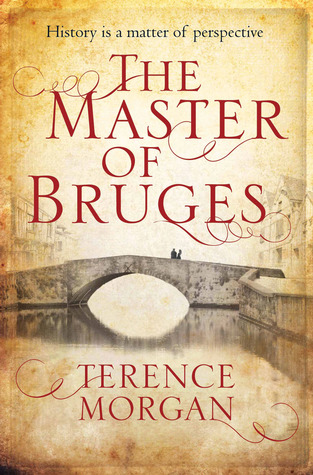
The Master of Bruges The Master of Bruges is presented as the fictional memoirs of the 15th century artist, Hans Memling. In December 1464, following the death of his master, the Flemish painter Rogier van der Weyden, Hans travels to Bruges where he works at the Burgundian court, painting portraits of the nobility. As an artist, Memling is naturally a very observant, perceptive person and can offer the reader some insights into both the politics of the period and the lives and personalities of the people he meets in Bruges.

One night two strangers calling themselves ‘Ned and Dick Plant’ come to seek refuge at Memling’s house and Hans finds himself drawn into the drama and intrigues of the Wars of the Roses, the conflict between England’s House of York and House of Lancaster. And when several years later he is invited to England and renews his acquaintance with Ned and Dick, he becomes caught up in one of history’s greatest mysteries: the disappearance of Edward IV’s sons, the Princes in the Tower, who many people believe were murdered by their uncle, Richard III.

Before reading this book I had heard of Hans Memling but was not familiar with his work. The only one of his paintings I knew anything about was his triptych The Last Judgment, which featured a portrait of the banker Tommaso Portinari being weighed in St Michael’s scales, and was captured by the Danzig pirate Pauel Benecke as it was being shipped to Italy. The only reason I was aware of this anecdote was because it formed a minor plot point in Dorothy Dunnett’s House of Niccolo series (specifically, in To Lie with Lions and Caprice and Rondo). Luckily, many of Memling’s paintings can be seen online and I can guarantee that you’ll want to look at them as you read. There are also some short chapters interspersed throughout the novel in which Hans shares with us his views regarding artistic technique, perspective, focus, colours, and some of the tricks artists use to please their sitters, and I enjoyed reading these. As well as being fascinating to read, these chapters are relevant to the story as Memling’s descriptions of his techniques are either directly or indirectly linked to aspects of the plot.

I thought the first part of the novel, which details Hans’ early days as an artist, worked very well but not the second part, after he travels to England. I was interested in learning about Hans and his portraits and I was also interested in the Richard III story – it was the way the two were combined that didn’t work for me. Despite the Wars of the Roses being one of my areas of interest in historical fiction, I think I would have liked this book more if it had continued to tell the story of Memling’s life in Bruges rather than changing focus halfway through to concentrate on the mystery of the Princes in the Tower.

I don’t expect historical novelists to always stick rigidly to the facts, otherwise they would be writing non-fiction rather than fiction, but this particular book stretches credibility too much for me. I appreciated the author’s note at the end of the book, but I wished it had given more information on exactly which aspects of the story were based on fact and which were fictional. As far as I can tell there is no evidence to suggest that Hans Memling ever came to England or had any involvement with the Plantagenets. I also found it hard to believe Morgan’s theories regarding what happened to the two princes (especially a plan of Edward IV’s to have them declared illegitimate), though they were certainly very imaginative ideas. I was happy enough with the characterisation of Richard III, though – he is one of my favourite historical figures and I am definitely of the opinion that he has been unfairly treated by history, so it was good to see him portrayed in a more positive light in this book.

Because of the problems I’ve noted above, I can’t say that I loved The Master of Bruges, but I’m glad I kept reading to the end as there were some big surprises within the final chapters. I think as long as readers are aware that this book does not always give an entirely historically accurate account of the period and that it sometimes takes a more speculative approach to what might possibly have happened, it can be enjoyed as something refreshingly different and fun.