The Kingmaker’s Daughter by Philippa Gregory

This is the fourth book in Philippa Gregory’s Cousins’ War series which looks at the Wars of the Roses (the series of conflicts in the 15th century between the House of York and the House of Lancaster) from a female perspective. The others in the series are The White Queen, the story of Edward IV’s wife Elizabeth Woodville, The Red Queen, which follows Margaret Beaufort, the mother of Henry VII, and The Lady of the Rivers, the story of Elizabeth Woodville’s mother, Jacquetta. This one, The Kingmaker’s Daughter, focuses on the life of Anne Neville.

Anne is the daughter of the powerful nobleman Richard Neville, the Earl of Warwick, known as the Kingmaker for the part he played in putting Edward IV on the throne in place of Henry VI. When Edward marries the beautiful Elizabeth Woodville despite Warwick’s attempts to negotiate a marriage for him in France, Warwick changes allegiance and rebels against the King he had once helped raise to power.

Warwick has no male heirs, but he does have two daughters, Isabel and Anne, and is determined to make one of them Queen of England. Anne, our narrator, is only eight years old at the beginning of the book but soon both she and her sister become caught up in their father’s political machinations. Isabel is married to Edward IV’s brother George and Anne to Henry VI’s son, Edward of Lancaster. But after Warwick’s rebellion fails and Anne finds herself widowed, she marries again – this time to the Duke of Gloucester, the man who will become Richard III.

I’m sorry if I’ve made this sound very confusing, but it was a confusing period of history and Philippa Gregory does a good job of presenting the information in a way that is easy for the reader to follow and understand even if you’ve never read about the period before. Although this is the fourth in the series, these books could be read in any order and all four also work as standalone novels as Gregory does not assume that the reader has any knowledge of events that happened in the previous books. However, reading the whole series helps to build up a full and well-balanced picture of the period. I love the way the books overlap, showing us some of the same events but from different perspectives. This book, for example, seen through Anne Neville’s eyes, is extremely biased against Elizabeth Woodville and her family, the Rivers – but if you also read The White Queen you get Elizabeth’s point of view which is obviously very different!

Like The White Queen and The Lady of the Rivers, this book has strong themes of witchcraft and magic. Elizabeth Woodville and her mother Jacquetta were supposedly descended from the water goddess, Melusina, and Gregory suggests that they might have had magical powers. There’s a lot of focus on this in The Kingmaker’s Daughter, with Anne becoming more and more convinced that Elizabeth is using witchcraft to attack her family, to whistle up storms and put curses on people. This is one aspect of the series that just hasn’t been working for me; I feel that this period of history is already interesting enough without needing to bring in an element of fantasy.

Richard III is one of my favourite historical figures and I was happy enough with the way he is portrayed in this book. He’s not perfect, but he’s certainly not the villain of Shakespeare’s play either – he comes across as a loyal brother and husband and a good king who really cares about the future of his country. This book is also more sympathetic towards George, the Duke of Clarence, than any other novel I’ve read and it was refreshing to be shown the good sides of his character as well as the bad. The characterisation of Anne, though, was not quite what I would have expected or hoped for. In other books that I’ve read about her, she has been portrayed as quiet and gentle with a lot of inner strength and dignity, but this version of Anne doesn’t display much strength or courage, while being too ready to blame other people (usually Elizabeth Woodville) when things go wrong. But I did think the relationship between Anne and Isabel was handled well, showing how they were friends one minute, rivals the next – the ‘sisters’ aspect of the book reminded me of Mary and Anne Boleyn in The Other Boleyn Girl.

This was not my favourite of the Cousins’ War books but I’m enjoying the series and will look forward to the next instalment. Apparently the fifth book will be about Elizabeth of York, the sister of the Princes in the Tower and daughter of Edward IV and Elizabeth Woodville.

I received a copy of this book from Simon & Schuster for review
Race of Scorpions by Dorothy Dunnett

This is the third book in the House of Niccolò series, the first two being Niccolò Rising and The Spring of the Ram. The series is set in the 15th century and follows the adventures of Nicholas vander Poele as he travels throughout Renaissance Europe and beyond. By the time this third volume begins, Nicholas’s spectacular rise from dyer’s apprentice to head of a successful trading company, bank and mercenary army has not gone unnoticed and has brought him to the attention of various people who are hoping to use his skills for their own purposes.

In Race of Scorpions Nicholas finds himself kidnapped and taken to Cyprus, an island torn apart by civil war. Cyprus is in a strategically important location and has become the centre of power struggles between various groups including Christians and Muslims, Genoese and Venetian merchants, Egyptian Mamelukes, Portuguese traders, the Pope, the Sultan, the Knights of the Order of St John – and the two Lusignan siblings who are fighting for the crown. Both of the claimants to the throne, Queen Carlotta and her half-brother James de Lusignan (known as Zacco), are determined to recruit Nicholas and his army to their side and are prepared to use any means possible to do so. Nicholas must choose which of them, if either, to support in their battle to gain control of Cyprus, but as well as being drawn into the conflict between Carlotta and Zacco, Nicholas faces some problems of a more personal nature when he is reacquainted with Katelina van Borselen, who we first met in Niccolò Rising.

Many of the characters we have been getting to know over the previous two books are here again – including Tobie, Loppe, Astorre and John le Grant – and we are also introduced to some new ones. A lot of the other characters in the book are real historical figures and one of the most fascinating, I thought, was Zacco’s mother Marietta (known as Cropnose after her nose was bitten off by her rival). Nicholas also meets his young cousin Diniz Vasquez for the first time, contends with a new villain in the form of the Mameluke emir, Tzani-bey al-Ablak, and tries to unravel the complex motives of Primaflora, a beautiful courtesan who is working for Queen Carlotta…or is she really working for Zacco?

Luckily, with his talent for solving puzzles and coming up with labyrinthine plots and schemes, Nicholas is adept at getting out of the difficult situations he finds himself in and although his plans don’t always work out exactly as he wanted them to, he usually manages to stay at least one step ahead of everyone else, including the reader – or this reader at least, and I don’t mind admitting that! But despite not quite understanding everything that is happening or being said, I still loved this book. It also features one of the best scenes in the series so far, certainly one of the most eerie and atmospheric. I’ll never be able to see a moth again without thinking of it!

I loved the setting too – I haven’t been to either Cyprus or Rhodes (Dorothy Dunnett’s books always make me aware of how little of the world I’ve actually seen) but as usual every location is described so thoroughly I can form a vivid picture of them without ever having been there. And not only have I never visited these countries, I know almost nothing about their histories either so it was good to have an opportunity to learn about the Cyprus civil war – a fascinating piece of 15th century history I’d never read anything at all about before.

However, I wouldn’t recommend reading Race of Scorpions unless you’ve read the previous two novels in the series first. These books are complicated enough as it is without reading them out of order and you would also miss watching the development of Nicholas’s character over the course of the series. I really enjoyed this one, and luckily for me I still have five more House of Niccolò books to read. Scales of Gold is next!

The Spring of the Ram by Dorothy Dunnett

This is the second book in the eight-volume House of Niccolò series. In the first book, Niccolò Rising, we saw how Nicholas, a young dyer’s apprentice, rose in the world to become head of the Charetty trading company. In The Spring of the Ram, Nicholas and the other men of the Charetty company – including the doctor Tobias, notary Julius, priest Godscalc, engineer John le Grant and mercenary leader Astorre – journey to the Black Sea port of Trebizond to establish a trading post. With them every step of the way is Pagano Doria, a sea adventurer who has married Nicholas’s thirteen-year-old stepdaughter, Catherine de Charetty, and is now in a position where he may be able to seize control of the company through his marriage.

One of the things I love about Dorothy Dunnett’s books is that they give me an opportunity to learn about people and places I might never have known anything about otherwise. Dunnett’s novels open up whole new worlds, focusing on periods of history and geographical locations that are usually ignored in historical fiction. This is the first book I’ve read about Trebizond, a final outpost of the Byzantine Empire which at the time the story is set (1461) is under threat of falling to the Turkish army at any moment, and I thought it was a fascinating setting. I loved all of the beautiful descriptions of Trebizond and the other places Nicholas and his companions pass through on their journey to and from the Black Sea coast. This, for example, is the moment when the two ships belonging to Doria and Nicholas finally arrive at Trebizond:

So there came to the poisonous honey of Trebizond the two vessels from barbarian Europe, the four months of their travelling over, and winter turned into spring. One after the other, they crossed the wide, irregular bay towards the green amphitheatre which lined it. In its midst, the classical City gleamed on its tableland, alight with marble and gold against the dark mountain forests behind. There stood the fabled City, treasure-house of the East.

I enjoyed The Spring of the Ram much more than the first book, Niccolò Rising, possibly because I’m more familiar with the characters now and so found it easier to get straight into the story. And of course when I first started to read Niccolò Rising it was inevitable that I was going to compare it with Dunnett’s other series, the Lymond Chronicles, however hard I tried not to, and although I liked Nicholas and Marian de Charetty, most of the other characters seemed to me to be less interesting than the ones in the Lymond Chronicles. It seems that I just needed to give myself time to get used to them though, because now that I’ve read two Niccolo books I feel that I’m starting to get to know and understand some of the characters better. Nicholas himself continues to amaze me with his complex machinations and intricate trading deals, but despite the amount of time we spend inside his head in this book (which is more than we were ever allowed to spend inside Lymond’s) his character and motivations still remain a bit of an enigma to me. Most of what we learn about him is through the observations of the people around him – Tobie, Godscalc and the others – but we have to remember that none of them truly understand Nicholas either and have a tendency to misinterpret his actions.

All of Dunnett’s books are clever, complex and intricately plotted; this one, I thought, was particularly complicated because there seemed to be so much happening behind the scenes, so many different forces and factions all vying against each other, pulling in different directions and trying to turn things to their own advantage. The main trading powers – Venice, Florence and Genoa – are all rivals with conflicting business interests, then there are the various rulers and leaders – Emperor David of Trebizond, Uzum Hasan of the White Sheep Tribe, Sultan Mehmet II of the Ottoman Empire, and others. Members of Nicholas’s family also seem to have agendas of their own, and finally there are Violante of Naxos and the mysterious Greek with the wooden leg, both of whom are also trying to control Nicholas’s actions. With so much going on, I won’t pretend that I fully understood everything that was happening in the book because I certainly didn’t, but as with all of Dunnett’s novels I’m looking forward to reading this one again!

It has taken Niccolo a bit longer to win me over than it took Lymond but I’ve been pulled into his world now and have already started the third in the series, Race of Scorpions.

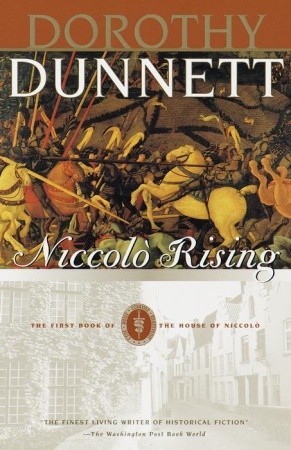
Niccolò Rising by Dorothy Dunnett

If you’ve been following my blog for a while, you’ll probably remember that I read (and loved) Dorothy Dunnett’s Lymond Chronicles earlier this year. I read the sixth and final book in the series in April and was planning to wait a bit longer before I started the House of Niccolò series, but in the end I couldn’t resist the temptation.

The House of Niccolò books were written after the Lymond Chronicles but are set in an earlier period (the 15th century rather than the 16th) and there are some links between the two series. Niccolò Rising, as the title suggests, follows our hero Nicholas as he begins to rise in the world to become a successful merchant and courier. And that’s really all I can tell you about the story. It has so many different layers and is so complex, intricate and cleverly plotted that I wouldn’t know where to begin writing any kind of summary. It’s also difficult to know how much I can say without spoiling things for future readers; if you started reading this book without knowing anything at all about it, it’s possible that you might not even be able to tell at first who the main protagonist of the series is going to be, as Nicholas goes by a different name for the first half of the book.

This book, like all the other Dorothy Dunnett novels I’ve read, was not the easiest of reads but in my opinion it was definitely worth making a bit of extra effort. I did find myself feeling completely confused on many occasions while I was reading, but some of my questions had been answered by the end of the book and the rest I’m hoping will become clearer later in the series or on a re-read. The biggest problem I had was trying to keep the characters straight in my mind. There are over one hundred of them listed in the character list at the front of the book (many of them are real historical figures) though with even the help of the list I still couldn’t seem to keep track of them all! The historical setting for this story is not one that I’m at all familiar with (the world of trade, banking and politics in Flanders and Italy in the 15th century), but I enjoyed learning more about it. Bruges, where a lot of the action in the book takes place, is somewhere I’ve wanted to visit for a long time and it has now moved even higher on my list.

All the time I was reading this book I was trying my best not to compare it with the Lymond Chronicles or Nicholas with Francis Crawford but really it was almost impossible not to. So the question is, as an introduction to the series did I like this book as much as the first Lymond book, The Game of Kings? The answer is no. The writing style is quite different and I didn’t find it as much fun to read. I was enjoying it enough to be in no doubt that I would keep reading to the end, but it never quite reached ‘unputdownable’ status. Nicholas, I suppose, could be considered more instantly likeable than Lymond (though it soon becomes obvious there’s a lot more going on behind his seemingly cheerful exterior than anybody realises) but he hasn’t quite won me over yet; we’ll see how I feel about him when I get further into the series.

When I came to the end of this book I didn’t feel compelled to immediately pick up the next one the way I did with the Lymond Chronicles, but I will definitely be continuing with the series. A copy of The Spring of the Ram is already waiting on my shelf.

Treason by Meredith Whitford

Treason is the story of Richard III, beginning with his childhood as the youngest son of the Duke of York and moving on through the various battles of the Wars of the Roses, the reign of his brother Edward IV, Richard’s own time as King and his eventual defeat by Henry VII at the Battle of Bosworth. The story is narrated by Martin Robsart, one of only a few fictional characters in the book. As Richard’s cousin and closest friend, Martin is present at some of the most important moments in English history.

I thought telling the story from the perspective of Richard’s fictional cousin and best friend worked very well and I could almost believe Martin had really existed. He has his own storylines, including a romance with Innogen Shaxper (another fictional character), but his main role as narrator is to share with us his observations on Richard, Edward and the others.

In Treason, Richard is not portrayed as the evil, scheming hunchback he is often believed to be, thanks to Shakespeare’s play. Instead, he is shown as being brave, intelligent, loyal to his brother, respected by his men, and a loving husband to Anne Neville. And although his reign is so tragically cut short at Bosworth, during his brief time on the throne he proves himself to be a good king. He does have a few faults, but nothing that would make me think he was a man who was capable of murdering his own nephews or committing all the other crimes he’s been accused of. On the subject of the disappearance of the ‘Princes in the Tower’, by the way, the author offers an interesting and believable theory, though not one that I personally think is very likely.

I was impressed with the depth given to the other characters too. I thought Richard’s brother George, Duke of Clarence, was portrayed more sympathetically than in other books I’ve read. He did some terrible things, but I see him more as a person who was weak and easily led, and his eventual fate was, for me, one of the saddest moments of the story. Elizabeth Woodville (Edward IV’s wife) and her family are shown in a very negative light, but it’s worth remembering that we are seeing everybody through Martin’s eyes and as his loyalties lie firmly with Richard it’s understandable that his opinions of other characters aren’t always going to be completely unbiased.

The dialogue is quite modern – too modern at times, maybe – but I know this is something which is very difficult to get exactly right in historical fiction. I find that when an author tries to make the language sound more authentic, it can either work very well or very badly! I didn’t have a problem with the dialogue in this book and I could tell that Meredith Whitford had given a lot of attention to period detail (food, clothing etc) which made the descriptions of fifteenth century life feel very convincing. Battle scenes are an aspect of historical fiction that I sometimes find difficult to follow, but there are only a few in Treason and the author makes them easy to understand by concentrating on Martin’s emotions and personal experiences of the battle rather than giving us pages and pages of military tactics.

Reading Treason was proof, if I needed it, that it’s worth looking beyond the more popular names in historical fiction and taking a chance on a book I had never heard about before. It’s a shame this book is not better known as I’m sure many readers who enjoyed books like Sharon Kay Penman’s The Sunne in Splendour or Josephine Tey’s The Daughter of Time would probably enjoy this one too. And for anyone new to Wars of the Roses fiction, this would also be a good starting point – it makes a very complicated period of history both easy to understand and fun to read about. I loved it!

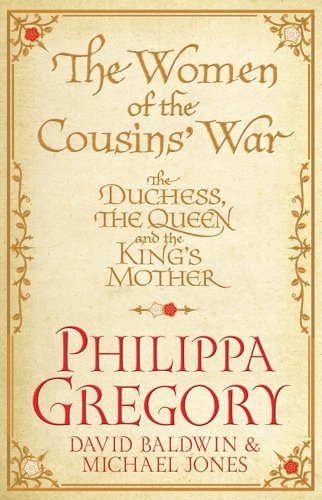
The Women of the Cousins’ War by Philippa Gregory, David Baldwin and Michael Jones

The Women of the Cousins’ War: The Duchess, the Queen and the King’s Mother is a non-fiction companion book to Philippa Gregory’s Cousins’ War series of historical fiction novels. The series tells the story of the Wars of the Roses from the viewpoints of some of the women who were involved, including Jacquetta of Luxembourg, her daughter Elizabeth Woodville, who was married to Edward IV, and Margaret Beaufort, the mother of Henry VII. Their stories were told in The Lady of the Rivers, The White Queen and The Red Queen respectively. The Women of the Cousins’ War features an essay on all three of these women, each written by a different historian, and in addition to the essays we are given some family trees, maps, list of battles, illustrations and colour photographs.

The book begins with a long introduction written by Philippa Gregory, which I actually found as interesting to read as the rest of the book! The introduction discusses the possible reasons why women in history have often been ignored and overlooked, and why it’s important to study the roles they played. Gregory also looks at the differences between writing history and writing historical fiction, and as a lover of historical fiction myself I find it fascinating to read about an author’s reasons for writing it.

The introduction is followed by Gregory’s essay on the life of Jacquetta of Luxembourg. Unfortunately very little is known about Jacquetta, there are no existing biographies and apparently there are only a few occasions where she actually appears in historical records, so Gregory didn’t have a lot of information to give us. For most of the essay she can only guess at what Jacquetta may or may not have done and how she probably reacted to the historical events going on around her. However, this was the essay I enjoyed the most and it was as easy to read as Gregory’s fiction. It sounds as if Jacquetta had a fascinating life and it’s a shame that so few historians have taken the time to study her.

The second essay is written by the historian David Baldwin and looks at Elizabeth Woodville. I did find Baldwin’s writing style slightly dry, but Elizabeth Woodville is a historical figure who interests me, so I still enjoyed reading the essay. The book’s final section is written by Michael Jones and examines the life of Margaret Beaufort. Again, there’s not a huge amount known about Margaret, but I thought Jones did a good job of working with what little information is available. He also spends some time discussing Margaret’s family history to help us understand the background she came from and to build up a more complete picture of the sort of person she was.

This book could be read either as a stand-alone non-fiction/reference book or as an accompaniment to Philippa Gregory’s three Cousins’ War novels. I’m not sure how satisfying it would be for a serious historian or history student though, as there are no footnotes or endnotes and only some brief lists of sources. I should point out that I have never studied the Wars of the Roses in any depth (most of what I know about the period comes from the small number of historical fiction novels I’ve read set during that time) and for the general reader like myself I would say that the book is very accessible and easy to follow. It filled some of the gaps in my knowledge and I thought it was worth reading, particularly for the wonderful introduction!

I received a copy of this book for review from Simon & Schuster

The Lady of the Rivers by Philippa Gregory

The Lady of the Rivers is the third book in Philippa Gregory’s Cousins’ War series. This series is set during the Wars of the Roses, with a focus on some of the women who played an important role in this period of English history. The two previous novels, The White Queen and The Red Queen, told the stories of Elizabeth Woodville, wife of King Edward IV, and Margaret Beaufort, mother of King Henry VII. In The Lady of the Rivers it’s the turn of Jacquetta Woodville, Elizabeth’s mother.

Before beginning this book I knew almost nothing about Jacquetta (apart from what I learned about her in The White Queen) and it was good to have the chance to read a historical fiction novel about a woman who has so often been overlooked and forgotten. This novel follows Jacquetta throughout her life, beginning with her teenage years and moving on to her first marriage to the Duke of Bedford, an uncle of England’s King Henry VI. Left a widow at nineteen, Jacquetta marries again, for love this time, to one of the Duke’s squires, Richard Woodville. Over the following years, she becomes a close friend and advisor to Margaret of Anjou, the young wife of Henry VI, and is at the queen’s side during some of the most important moments of Henry’s reign.

Jacquetta’s family claim to have descended from the water goddess, Melusina, and supposedly have magical powers, including the ability to predict the future. For example, Jacquetta hears singing when someone in her family is about to die. As in The White Queen, magic is a major theme of this book. There are lots of references to alchemy, herbalism, tarot cards, and also to the ‘wheel of fortune’, which Jacquetta sees as a reminder that while it’s possible for a woman to rise to the very top, there’s an equal chance that she can fall to the very bottom.

I like the fact that the novels in this series are written from a woman’s perspective, with a focus on how women were treated in 15th century society and how difficult it could be for them to find a place for themselves in a world dominated by men. I also like the way the books take a very personal approach to history, showing how the historical events directly affect the characters and their lives. The present tense gives the feeling that you’re there with the narrator as events unfold, and the first person narration creates an intimate feel. Of the three books in the series so far, this one had the most likeable narrator and I’ve been left with a sense of unfairness at how Jacquetta has been ignored by history.

Finally, in case anyone is wondering where to begin with this series, I don’t think it’s necessary to read them in any particular order as they do all stand alone. In fact, this one, The Lady of the Rivers, despite being the most recently published book, is set before The White Queen so could be a logical place to start. According to Philippa Gregory, the next novel in the series is going to be about Anne and Isabel Neville, the daughters of the Earl of Warwick. I’m already looking forward to that one!

I received a review copy of this book from Simon & Schuster. I also received a copy of the non-fiction companion book to the series, The Women of the Cousins’ War, so you can expect to see my thoughts on that one soon too.