Kit by Marina Fiorato

Kit Marina Fiorato’s latest novel, Kit, tells the story of Kit Kavanagh, a young woman from Ireland who disguises herself as a man and follows her husband to war. Those of you who have never heard of Kit Kavanagh (and I hadn’t until I read this book) may be surprised to know that she was a real person and that this novel is loosely based on a true story.

Kit’s adventures begin one evening in a Dublin inn when her husband, Richard Walsh, is pressed into the British army and disappears overnight. Having only been married for a few weeks, Kit is devastated and can’t stop thinking of her beloved father who was killed in battle several years earlier. Determined to save Richard from the same fate, she decides to dress as a man and enlist in the army herself. Soon Kit finds herself on a ship heading for Italy where she will serve with the Scots Grey Dragoons under the command of the handsome Captain Ross.

It’s 1702 and the death of the last Habsburg king of Spain has sparked conflict across Europe. The heir to the throne is the grandson of King Louis XIV of France, meaning that both Spain and France could potentially be ruled by the same monarch. In an attempt to prevent one man from gaining so much power, England and Scotland have formed an alliance with the Holy Roman Empire and the Dutch Republic in support of a rival claimant, Leopold I. The two opposing armies are battling for control of the north of Italy as Kit arrives in Genova to begin her search for Richard Walsh.

The first half of the novel follows Kit as she fights alongside the men of her regiment, hoping that her luck will hold out and her true identity won’t be revealed before she catches up with her husband. To complicate things further, she finds herself falling in love with Captain Ross – but as he believes her to be a man, she is unsure how he really feels about her. The second half of the novel is where Fiorato moves away from reality and further into the realms of fiction, creating a storyline in which Kit is recruited by the scheming Duke of Ormonde to spy on the French.

Kit is the third book I’ve read by Marina Fiorato (the other two are The Glassblower of Murano and Beatrice and Benedick) and this is my favourite so far. I loved Kit as a character and was completely gripped by her story. This is the first time I’ve ever read about the War of the Spanish Succession, but as Kit also knows nothing about it, we have the opportunity to learn along with her. Battle strategies and political intrigue are clearly explained and we meet important historical figures of the period such as the Duke of Marlborough and Prince Eugene of Savoy.

I particularly loved the first part of the book – The Sword – which concentrates on Kit’s time in the army, the beginning of her relationship with Captain Ross, her friendships with the other dragoons (whose names Fiorato chose from her local war memorial), and her clashes with the villainous Sergeant Taylor and the sinister army surgeon Atticus Lambe. I was very impressed by the amount of detail Fiorato goes into in showing how thoroughly Kit prepares herself for life as a man, not only by changing the way she dresses, but also by adjusting her speech, her mannerisms and her whole persona. Knowing that the character is based on a woman who really existed just makes Kit’s story even more fascinating!

The second part of the novel – The Fan – in which Kit falls into the hands of the Duke of Ormonde, has a different feel and I didn’t like it as much as the first part, although I did enjoy watching the development of Kit’s friendship with the Italian castrato singer, Lucio Mezzanotte. The various threads of the story came together nicely at the end, and while I didn’t really think the epilogue was necessary it did mean that all the loose ends were tied up.

In Kit I found the combination of history, adventure and romance that I love in historical fiction and I’m now looking forward to reading the rest of Marina Fiorato’s novels. The Madonna of the Almonds, The Botticelli Secret and The Venetian Contract all sound appealing, but I should probably start with Daughter of Siena, which I already have on my shelf.
The Last Confession of Thomas Hawkins by Antonia Hodgson

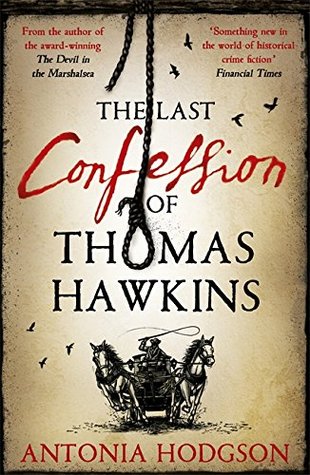
The Last Confession of Thomas Hawkins It’s 1728 and Thomas Hawkins is being escorted through the streets of London towards the gallows at Tyburn. Although he has been found guilty of murder and sentenced to hang, Tom has been promised a pardon and is sure he will be freed. But as he gets closer and closer to the gallows and the pardon doesn’t come, he begins to lose hope. Could this be the end for Thomas Hawkins?

Antonia Hodgson’s debut novel The Devil in the Marshalsea was one of my favourite books of last year. I loved the setting (an eighteenth century debtors’ prison), I loved the entertaining plot, and I loved learning about life in Georgian London, so I was pleased to find that there was going to be a sequel. If you haven’t read the first book, though, that shouldn’t be a problem because The Last Confession of Thomas Hawkins can be read as a ‘standalone historical mystery’, as stated on the book cover. I would still recommend reading the two books in order as there are some minor spoilers in the second one, but it isn’t really necessary.

If you have read The Devil in the Marshalsea you will already have met Thomas Hawkins and will know what he experienced during his time in the notorious Marshalsea Prison. Sadly, as the sequel begins, it seems that Tom has forgotten the lessons he learned in the Marshalsea. He has started to build a new life for himself with Kitty Sparks, bookseller and print shop owner, but this is not enough for Tom and he has returned to his old habits of drinking, gambling and looking for adventure.

It’s not long before things start to spiral out of control again and this time Tom finds himself embroiled in the affairs of Queen Caroline and the king’s mistress, Henrietta Howard, as well as becoming a suspect in a murder investigation. Alternating between Tom’s journey to the gallows and the events leading up to his death sentence, Tom’s story – his ‘last confession’ – gradually unfolds.

This is another great book from Antonia Hodgson and I enjoyed it almost as much as the first. I say ‘almost’ because the fact that The Devil in the Marshalsea was set almost entirely within a debtors’ prison gave the first book a feeling of novelty and originality that this second one doesn’t have. That doesn’t mean I didn’t like the setting of this book too, of course. Hodgson’s portrayal of 1720s London is wonderful: a cockfight in a crowded tavern; a gang leader’s lair in a crumbling slum building; the beautifully furnished rooms of St James’s Palace – all of these are described in vivid detail.

Tom Hawkins, as our narrator, is the perfect character to guide us through Georgian London. His lifestyle means he is familiar with the darker side of society, but his family background makes him a gentleman and it is this combination that brings him to the attention of those who hope to use him for their own ends…including the clever, scheming Queen Caroline (a historical figure I’ve never read about until now). Tom is frustrating, flawed and a bit of a rogue, but he’s also a person you can’t help but like. I’m obviously not going to tell you whether or not he does escape the hangman’s noose, but what I will say is that Antonia Hodgson keeps us in suspense until the end. The final chapter gave me hope that there could be a third book in this series – but if you want to know whether Thomas Hawkins will survive that long, you’ll have to read The Last Confession to find out!

The Devil on her Tongue by Linda Holeman

The Devil on her Tongue One day in 1745, a Dutch sailor called Arie ten Brink leaves his home on the Portuguese island of Porto Santo and sets sail for Brazil where he hopes to make his fortune. His thirteen-year-old daughter, Diamantina, is heartbroken; left behind on Porto Santo with her mother, a former African slave, life is not easy and she vows to join her father in Brazil one day.

While she waits for a letter saying that he has reached his destination, Diamantina faces struggles with poverty, her mother’s reputation as a witch, and men who are ready to take advantage of a lonely, vulnerable young woman. Eventually an offer of marriage gives Diamantina a chance to escape, but the marriage is not what she would have hoped for and it seems that her ordeals are not yet over.

I love Linda Holeman’s books (I’ve read all of her adult novels apart from her first one, The Linnet Bird) so it was disappointing to find that The Devil on her Tongue was initially published only in Canada. Luckily for me, Traverse Press have now made it available as an ebook, as they did with the previous one, The Lost Souls of Angelkov, so readers in the UK and US are now able to read it as well.

There are a few things I’ve come to expect from Linda Holeman’s novels; one of them is an interesting and unusual historical setting. I know there must be other books set in 18th century Portugal, but this is the first I’ve read; it’s not a common choice for historical fiction and it made a refreshing change. There are some beautiful descriptions of Porto Santo, and later, of Madeira and Lisbon, and we are given insights into what life was like in each of these places. While the focus is on Diamantina’s personal story, it is played out against a historical background that feels well researched and believable. I particularly loved the vivid depiction of the earthquake that destroyed most of Lisbon in 1755.

Another thing I expect is a long, engrossing and emotional story – and that’s what I got from The Devil on her Tongue. But although Diamantina’s story is certainly very compelling, it’s also very sad; I couldn’t believe one person could experience so much misery and have so little luck in life. I felt so sorry for her but I also admired her resilience as she tried to build a new life for herself in the face of so much betrayal, disappointment and unhappiness. One aspect of Holeman’s novels I really like is the way they explore attitudes towards women in different time periods and cultures – in previous books we have seen how women were treated in 19th century India, Afghanistan and Russia, in 1930s Morocco, and now in a small community in Portugal during the 1700s.

I don’t think this is my favourite of Linda Holeman’s novels (that would probably be the book set in Morocco, The Saffron Gate) but it’s beautifully written and I did enjoy reading it, despite finding the story so sad.

Thank you to Traverse Press for providing a copy of this book for review.

Ross Poldark by Winston Graham

Ross PoldarkI’ve often thought about reading the Poldark novels but there was always some reason why I didn’t; it never felt like the right time to start a twelve volume series or I could only find copies of the later books and not the first one. I had been aware that the BBC were making a new adaptation to be shown this year but I had forgotten about it until seeing a trailer a few weeks ago. That left me with a dilemma as the first episode is being shown on Sunday and obviously I wouldn’t have time to read the whole series by then. But I could at least read the first book and that is what I’ve done.

Ross Poldark is set in 18th century Cornwall (in fact, it is subtitled A Novel of Cornwall 1783-1787). At the beginning of the novel, Ross Poldark returns home from fighting in America to discover that things have changed in his absence. His father has died, leaving his estate, Nampara, to Ross – and Elizabeth, the woman he loves, has just become engaged to his cousin, Francis. With his heart broken, Ross devotes his time to restoring Nampara, which has fallen into disrepair having been left in the hands of the servants, and investigating the possibility of opening a new copper mine.

Life is not easy for Ross – as well as managing his father’s lazy, drunken servants, Jud and Prudie, and dealing with the problems of the tenants and workers who live on the estate, he also has to cope with seeing Francis and Elizabeth together at family gatherings. Then one day, Ross rescues fourteen-year-old Demelza Carne from a brawl at the fair and brings her home to work in his kitchen. With an age difference of ten years, the relationship between Ross and Demelza is at first one of master and servant, but as time goes by a friendship forms and Ross will eventually discover whether or not he is able to love again.

When I began to read Ross Poldark last weekend I thought I might have started it too late to finish by Sunday, but I needn’t have worried; I found it so easy to get into and the story so compelling that it turned out to be a very quick read. I loved the Cornish setting; I won’t comment on the accuracy of the descriptions or the dialect, not being from Cornwall myself, but I thought the overall sense of time and place was very strong. Although they’re quite different stories, the setting and the mining element made me think of another book I enjoyed: Penmarric by Susan Howatch.

As the title character, this is very much Ross Poldark’s story (and Ross is the sort of hero I could immediately like and care about, right from the moment he arrives home to find that the woman to whom he was planning to propose is marrying his cousin) but I found Demelza an even more intriguing character. She changes quite a lot over the four or five years the novel covers and she does slowly grow in confidence, yet never quite shakes off her insecurities and her feeling that the Poldarks are looking down on her because of her background. She is still just in her teens when the novel ends and I’m sure there will be more development to come in the second book. I also liked Verity, Ross’s cousin, and found her personal storyline as interesting as Ross and Demelza’s.

As well as the main characters, there are also lots of memorable secondary characters representing all different levels of society, from the Poldarks and their friends to the farmers and miners who work for them. Quite a lot of time is devoted to the servants Jud and Prudie, and also to one of Ross’s young tenants, Jinny Martin, and two rivals for her love, farm boy Jim Carter and the villainous Reuben Clemmow. Whenever the focus switches to these characters, it provides a diversion from the main plot, sometimes funny, sometimes moving, as well as showing us how Ross handles the problems on his estate and interacts with the people around him.

At the end of this book there are still a lot of unresolved storylines and loose ends and I’m looking forward to continuing the series with the second book, Demelza.

The Silent Boy by Andrew Taylor

The Silent Boy “Say nothing. Not a word to anyone. Whatever you see. Whatever you hear. Do you understand? Say nothing. Ever.” These words are spoken to ten-year-old Charles on the night of 10th August 1792. This is the night the Tuileries Palace is stormed and the French monarchy falls – one of the defining moments of the French Revolution. It seems that poor Charles has witnessed the brutal murder of his mother and has fled the scene in panic vowing to do as he has been told and never say a word to anyone ever again.

The boy’s silence causes a lot of frustration for a lot of people, including Edward Savill. Savill is the estranged husband of Charles’ mother, Augusta, and is legally, though not biologically, his father. Augusta’s uncle, the wealthy and powerful Mr Rampton, is interested in making Charles his heir and has ordered Savill to bring the boy to him. This proves to be more difficult than expected, however, as Charles has already been claimed by Augusta’s lover, the Count de Quillon, who has come to England to escape the Revolution. The Count insists that Charles is his son…and he has no intention of letting him go.

The Silent Boy follows Edward Savill on his mission to rescue Charles from the clutches of others who have reasons of their own for wanting the boy. Along the way we learn more about Augusta and what happened to her on that fateful night in Paris. There are also some sections of the novel told from the perspective of Charles himself, describing his traumatic experiences in France and his adventures after he is brought to England.

I found Charles’ story both fascinating and frustrating. He’s clearly an intelligent and resourceful boy, but one who has been so badly frightened by what he has seen and heard that he is no longer able to trust anyone at all. His refusal to speak gives him power over the adults who are desperate to hear what he has to say, but it also makes him vulnerable and it’s sad to watch a child cutting himself off so completely from everyone around him. But Charles is not the only one in danger – Edward Savill is also in a difficult position, being used as a pawn by his in-law and patron, Mr Rampton, whose motives are always in doubt.

The Silent Boy is a sequel to The Scent of Death, which was the first of Andrew Taylor’s historical mysteries/thrillers to feature Edward Savill. I enjoyed The Scent of Death but had somehow missed the fact that a sequel had been published last year, so it was a nice surprise for me to see this one in the library. It’s not necessary to have read the first book before this one – the two are very different stories and set during two different Revolutions (American and French) – but The Scent of Death does provide some useful background information on the characters, so I’d recommend reading them in order if you possibly can.

I enjoyed this book but not as much as the other Andrew Taylor novels I’ve read. After the dramatic opening chapter in Paris, I thought the story became very slow and didn’t really pick up again until halfway through. The end was worth waiting for, though, as the tension increases and some surprising revelations are made. I do like Edward Savill as a character and it was nice to meet his daughter, Lizzie, whom he had missed so much while he was away in America in the previous novel. I never quite managed to connect with Charles, but I can appreciate that we probably weren’t really supposed to – the whole point was that Charles had built up a protective wall of silence around himself and wouldn’t let anybody break through it.

Now I’m wondering if there will be a third Edward Savill novel. I do prefer Andrew Taylor’s standalones, such as The American Boy and The Anatomy of Ghosts, but I would be happy to read another book in this series if and when he writes one.

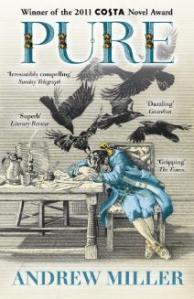
Pure by Andrew Miller

Pure This is another book that I’ve read for my Reading the Walter Scott Prize project and another interesting read – though a very dark one.

The story is set in France in 1785, just a few years before the French Revolution. Jean-Baptiste Baratte, a young engineer from Normandy, has arrived in Paris commissioned with an important but gruesome task – the destruction of the cemetery of Les Innocents. As the oldest and largest cemetery in the city, Les Innocents has now become overcrowded, smelly and unsanitary. To prevent it becoming even more of a health hazard than it already is, Jean-Baptiste has been given the job of destroying the cemetery and its church, emptying the graves and arranging for reburial elsewhere.

The novel is based on historical fact – Les Innocents really did need to be removed in the 18th century in order to purify the surrounding area and a market place was later built on the site of the old cemetery. However, Jean-Baptiste Baratte is fictional and in Pure Andrew Miller imagines what it may have felt like to be the person responsible for carrying out such an unpleasant and controversial task. Everyone has an opinion on the destruction of the cemetery and as Jean-Baptiste continues his work, he learns just how deeply people feel about it.

During his time in Paris, Jean-Baptiste lodges with the Monnards, whose daughter Ziguette is not at all pleased with the removal of the cemetery she has been able to see from her window all her life. On his first inspection of the church, he meets the organist Armand de Saint-Méard, who will lose his job when the building is demolished. In another building on the site live the sexton and his young granddaughter, Jeanne, both of whom have devoted their lives to Les Innocents. And then there are the men – ex-miners from the mines of Valenciennes – summoned to Paris by Jean-Baptiste to help with the excavations of the graves. All of these people are affected in some way by what is happening and Jean-Baptiste receives both support and opposition.

I enjoyed the first half of this book which deals with Jean-Baptiste’s first days in Paris, getting to know the people in and around the cemetery, and deciding how to proceed with the job he has been given. I loved the portrayal of a young man experiencing life in a big city, so desperate to fit in that he lets his new friends persuade him to exchange his smart brown suit for a pistachio green silk one. France is heading towards Revolution and although this never becomes a big part of the plot, the hints are there in the references towards progress, a group of rebellious young men who call themselves the ‘party of the future’, grafitti daubed on walls, the contrast between the working class and the aristocracy – and a doctor called Guillotin who arrives at the cemetery to study the skeletons.

I’m not sure what went wrong with the second half of the book, but I started to lose interest at the point when the miners arrived in Paris and work on the cemetery began. I had found it interesting to read about the preparations, the inspections that had to be made and what the work would involve, but the descriptions of the actual excavations started to feel repetitive. I was also hoping for more character development, but apart from Jean-Baptiste himself the other characters have very little depth. Two of them commit acts of violence towards the end of the book, yet I didn’t feel that their motivations were fully explored and the consequences of both actions seemed to be resolved too quickly.

Pure is a fascinating novel, especially if you’re interested in historical fiction set in pre-Revolutionary France. I really liked Andrew Miller’s style of writing, but my lack of emotional engagement with the characters and the other problems I’ve mentioned above left me feeling slightly disappointed at the end.

The Devil in the Marshalsea by Antonia Hodgson

The Devil in the Marshalsea This is a murder mystery with a difference, being set almost entirely within the confines of an eighteenth century debtors’ prison. Our narrator, Tom Hawkins, is a young man who has rebelled against his clergyman father’s plans for his future and is enjoying himself in London, spending all his money on drinking and gambling. After a big win at the card tables one night, Tom is attacked on his way home and his winnings are stolen, leaving him unable to pay his debts. Taken to the notorious Marshalsea Prison, he is horrified to discover that the last occupant of his cell, Captain Roberts, was murdered. The killer has never been caught, but Tom’s new roommate, the charismatic and mysterious Samuel Fleet, is the man most people believe to be the murderer.

The Marshalea is privately run for profit, so it’s not surprising that the prison governors want the killer identified as quickly as possible to avoid any further scandal. Told that his only chance of being released depends on whether or not he can solve the mystery of Roberts’ death, Tom agrees to investigate. Unsure who can be trusted and beginning to wonder whether such things as truth and justice even exist in a place as corrupt as the Marshalsea, Tom eventually uncovers a web of betrayal and deception on a scale he could never have imagined.

Other authors have written about the Marshalsea, most famously Charles Dickens in Little Dorrit, but Dickens’ Marshalsea was a newer building on a site further down the road; set in 1727, Antonia Hodgson’s novel refers to the original prison. Not knowing anything at all about the Marshalsea, this was quite an eye-opening book for me. I was aware that prisoners were often able to offer bribes in return for better living conditions and privileges, but I hadn’t realised there was such a great disparity between the fate of those who could afford to pay and those who couldn’t.

The prison was divided into two sections. The prisoners who had some money to spend or who had influential friends, lived on the Master’s Side, which was almost like a complete town in itself, with coffee houses, bars, restaurants and even a barber. They had the freedom to move around and in some cases were even given permission to go out into London during the day. For the poor people on the Common Side, things were much worse. Crammed into tiny cells and suffering from starvation, disease and overcrowding, they died at a rate of up to twelve a day. Tom Hawkins, whose best friend happens to work for Sir Philip Meadows, Knight Marshal of the Marshalsea, is lucky enough to find himself on the Master’s Side but with the knowledge that if his luck should run out, he could find himself thrown into the Common Side to meet his death with the others.

This is not a book for the faint-hearted as there are some horrible descriptions of sickness, torture and brutality, not to mention the dirty, squalid conditions the unfortunate inmates of the Common Side were forced to endure. Knowing that this was an experience many people really did have to go through makes it even more horrific. Despite this, I found The Devil in the Marshalsea very entertaining and fun to read. The book is filled with larger than life characters and I was surprised to find, when I read the notes at the end of the book, that many of these people really existed and were mentioned in the diary of John Grano, a debtor who spent a year in the prison from 1728-1729.

As a mystery novel, The Devil in the Marshalsea kept me guessing right until the end. I did not work out who the murderer was and even after the truth was revealed there were still more plot twists and revelations to come. As a work of historical fiction it’s equally impressive; I loved the portrayal of eighteenth century London both inside and outside the Marshalsea. I was so pleased to find that there’s going to be a sequel to this book and I’m already looking forward to meeting Tom Hawkins again!

I received a copy of this book from the publisher for review