The Little Chronicle of Magdalena Bach by Esther Meynell

Magdalena Bach Novels about the wives of famous men seem to have become very popular over the last few years. Books on Zelda Fitzgerald, Anne Morrow Lindbergh, Hadley Hemingway, Lizzie Burns (Engels) and Virginia Clemm Poe are just a few that I’ve read or heard about. You could be forgiven for thinking that with The Little Chronicle of Magdalena Bach, Esther Meynell is following the current trend – until I tell you that this book was published in 1925.

Anna Magdalena Bach was, of course, the wife of the composer, Johann Sebastian. In this novel, Meynell imagines that, following Bach’s death, Magdalena is visited by Caspar Burgholt, a former pupil of her husband’s, who suggests that she write down everything she remembers about him. The Little Chronicle is the result.

“Write,” he said, “write a little chronicle of that great man. You knew him as no one else knew him, write all that you remember — and I do not suppose your faithful heart has forgotten much — of his words, his looks, his life, his music. People neglect his memory now, but not always will he be forgotten, he is too great for oblivion, and some day posterity will thank you for what you shall write.”

Magdalena begins by telling us about her first encounter with Bach in the winter of 1720, when she hears him playing the organ in St Katharine’s Church in Hamburg. Unaware of the organist’s identity, Magdalena is mesmerised by the beauty of his music, but runs away in a panic when he turns to look at her. Her father tells her later that the man whose playing she loved so much is Johann Sebastian Bach, the Duke of Cöthen’s Capellmeister (director of music). In 1721, more than a year after the death of Bach’s first wife, Barbara, he asks for Magdalena’s hand in marriage. Magdalena is overjoyed – and goes on to devote the rest of her life to caring for her husband and raising their children.

And that is the problem with this book. Magdalena’s life (at least as it is portrayed by Meynell here) just isn’t very interesting. Of course, I’m aware that eighteenth century women weren’t usually expected to do anything more than be a wife and mother, and it’s possible that Magdalena was content with that, but I’m sorry to say that I found her story quite tedious to read. The real-life Magdalena apparently shared her husband’s passion for music – she was a talented singer and she also worked as a copyist, transcribing Bach’s music – but the fictional Magdalena constantly plays down her own achievements and gifts, happy in the knowledge that she could never compete with her husband’s genius. On reaching the end of the book, I didn’t feel that I’d really learned anything about Magdalena as a person; I had no idea how she really felt about anything, what she liked and disliked or what her hopes and dreams were. All I knew was that she loved and worshipped her husband, because she told us so over and over again.

I did learn quite a lot about Bach himself (while remembering that, as is stated at the end of the book, some parts of the story are imaginary). Magdalena’s chronicle takes us through all of the key moments of Bach’s career and also spends some time discussing his music. I think, though, that the musical aspect of the book could be too detailed for readers who are more interested in the human side of the story, while not scholarly enough for those who already have a good knowledge of Bach’s music. And again, it seems that Bach didn’t have the most exciting or dramatic of personal lives, which makes me think that maybe he and Magdalena just aren’t good subjects for a work of fiction.

It’s a shame, because there’s nothing wrong with Esther Meynell’s writing; it’s the story itself which lacks colour and vibrancy. I was pleased this was such a short novel because had it been much longer I’m not sure I could have persevered with it. I was disappointed but, if nothing else, reading this book has made me more interested in listening to Bach’s music, which can only be a good thing.

I received a copy of this book via NetGalley for review.
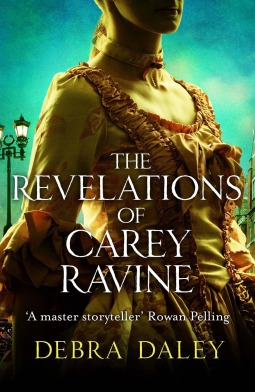
The Revelations of Carey Ravine by Debra Daley

The Revelations of Carey Ravine There was always a good chance that I was going to love The Revelations of Carey Ravine. A book which has been compared with “Sarah Waters, Amitav Ghosh’s The Sea of Poppies, and Jamaica Inn” sounded perfect for me…and it was. Set in 1770s London, this is a dark tale of deception and betrayal in which nothing is as it seems. Our guide through all of this is Carey Ravine, an intelligent and spirited woman with an interesting past.

On the surface, Carey and her husband, Oliver Nash, appear to be the perfect couple: rich, good-looking, charming and leading a life of glamour and luxury. In reality, their lavish lifestyle is funded by Carey’s dwindling savings – and as their finances become stretched to the limits, cracks in their marriage begin to appear. When Carey finds a dossier in Nash’s desk describing the death by poisoning of a young man during a medical experiment in India, she confronts her husband and asks for an explanation. It’s obvious, though, that Nash doesn’t want to talk about it, so Carey is left to investigate on her own…

Towards the end of the novel, revelation follows upon revelation as the mystery surrounding the poisoning starts to unfold…but Carey also makes some important discoveries about herself and the sort of person she really wants to be. The novel is narrated by Carey herself, which means the reader can only know as much as Carey does – and it quickly becomes obvious that there are some big gaps in our heroine’s knowledge. The fate of her father, the horticulturalist Daniel Ravine, for example, is unknown to Carey. The last she heard of him was when he wrote to her from India ten years earlier to tell her of her mother’s death in Calcutta. Having had no further news, Carey has given up hope of ever seeing or hearing from him again. Eventually, though, the truth about Daniel Ravine begins to emerge, and as we learn more about Carey’s family and her past, some light is shed on her present circumstances.

Carey is a wonderful character – she’s strong and resourceful but she’s still convincing as a woman of her time and her actions never fall outside of the realms of plausibility. Through her eyes we see what it was like to be female in the 18th century, facing a range of challenges, some of which were unique to the time period and others which we can still identify with today. Carey’s relationship with Nash is particularly interesting; she’s in love with her husband and wants to please him, but not at the expense of losing her own identity. Although her freedom is restricted as a married woman, she still does what she can to support herself independently and finds work translating scientific texts.

The setting for this novel is one that I always enjoy – Georgian England – and Debra Daley does a wonderful job of bringing the time period to life with descriptions of flamboyant clothing of silk, velvet and lace, popular dances (the cotillion, for example), and entertainment (masquerade balls and card games such as faro). But it’s the lesser-known details of Georgian life and culture that I like reading about the most; I love the idea that pineapples were seen as such a status symbol in the 1770s that it was possible to hire one to use as a table decoration for your dinner party!

Too many good novels are let down by a poor ending which leaves the reader wondering what was the point of it all. Carey Ravine, though, feels like a complete novel with a beginning, a middle and a satisfying ending. I was also happy, on reaching the end of the book, with the level of character development throughout the story – Carey changes and grows as a person as the novel progresses and by the time we come to the final page she is a rather different woman than she was at the beginning.

This is the second novel by New Zealand author Debra Daley; her first, Turning the Stones, was published in 2014. I will certainly be going back to read that one, as well as looking forward to any future books from Daley.

Gilded Splendour by Rosalind Laker

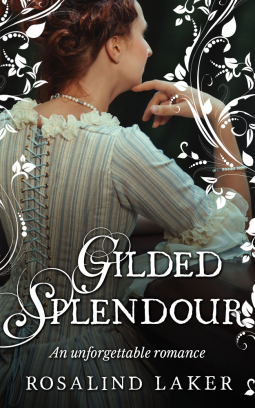
Gilded Splendour First published in 1982, this is the story of the famous 18th century cabinet-maker and furniture designer, Thomas Chippendale, author of The Gentleman and Cabinet Maker’s Director. Not knowing anything about Chippendale before beginning this book, I was interested in learning more and curious to see why Rosalind Laker had thought he would make a good subject for a novel.

It seems that the amount of information available on Thomas Chippendale is limited; although there are plenty of documents which shed some light on his professional career, we know very little of his personal life, which leaves a lot of scope for an author to use his or her imagination. And use her imagination is exactly what Rosalind Laker does, intertwining Chippendale’s story with that of Isabella Woodleigh, who provides a love interest for Thomas throughout the novel – and who is a completely fictional character.

At the beginning of the novel, Isabella is staying with friends of her father’s at Nostell Priory, a grand estate in Yorkshire, while she recuperates following an illness which has left her weak and frail. When she takes delivery of a wooden wheelchair made especially for her by a local carpenter’s apprentice, she is so grateful and impressed that she becomes determined to meet its creator. This is how Isabella is first brought into contact with Thomas Chippendale, a young man who is just starting out on a career in furniture design.

It’s not long before Isabella falls in love with Thomas and at first it seems that her feelings may be returned – until Isabella’s envious younger sister, Sarah, arrives for a visit and immediately begins to cause trouble. Left with no choice other than to marry the wealthy politician Nathaniel Trench, a man she knows she will never love, Isabella’s life starts to follow a very different course to the one she had expected and hoped for. Meanwhile, Thomas leaves Yorkshire for London, where he sets about establishing his own business. His path crosses with Isabella’s again and again, but is there still any chance that Isabella’s dreams will come true?

With a lot of focus on Chippendale’s love affairs, this book will probably be enjoyed by fans of older-style historical romances. Having said that, I didn’t find this a particularly romantic story, mainly because so many of the characters were so difficult to like. While I admired Thomas for what he achieved as a craftsman, I lost respect for him during an incident with Isabella’s sister, Sarah, early in the novel, and after this I wished Isabella would just forget about him and move on. The other men in Isabella’s life treat her badly too, as does Augusta, her own mother – and Sarah is a horrible, manipulative person, with no real explanation given for why she is so cruel and vicious towards everyone she meets.

Despite disliking most of the characters, including the hero, I still found this an interesting read with more to offer than just the romance. We are given a lot of information on architecture, furniture making and interior design; it was impressive to see the amount of effort and hard work which Chippendale put into perfecting his skills and learning new ones – including carving, veneering, marquetry and gilding. I particularly enjoyed reading about the dolls’ house Thomas creates at Nostell; so much care and attention to detail was required to carve miniature bedposts and create little frames for tiny paintings and mirrors.

Gilded Splendour provides some fascinating insights into Thomas Chippendale’s life and work. The only problem is that with so much of the novel devoted to his relationship with an imaginary character, it’s difficult to know which parts of the story are based on fact and which are purely fictional. As long as that doesn’t bother you, I think this book is definitely worth reading.

I received a copy of Gilded Splendour via NetGalley for review.

The Butcher’s Hook by Janet Ellis

The Butchers Hook Life is not easy for Anne Jaccob, the young protagonist (more anti-heroine than heroine) of The Butcher’s Hook. Her mother is an invalid, her father is cold and distant, and she is struggling to warm to her new baby sister, who will never, ever take the place of the beloved little brother who died. The one bright spot in Anne’s life is her secret romance with Fub, the butcher’s apprentice, but even this is threatened when her father announces that he is arranging a marriage for her with the vile Simeon Onions. It seems that Anne is going to have to take matters into her own hands…

The Butcher’s Hook is the debut novel of Janet Ellis, who is probably best known for presenting the BBC’s long-running children’s show Blue Peter in the 1980s. It’s an unusual and imaginative story set in a Georgian London populated with colourful, larger-than-life characters. Many of them feel as though they could have stepped out of the pages of a Charles Dickens novel. There’s Titus Levener, the grotesquely fat butcher, and Dr Edwards, the sinister tutor who gives the young Anne an education she’ll never forget. There’s Angus, the Scottish soldier defeated in the recent Jacobite rising, who wanders the streets of London hungry, ragged and cold. And then, of course, there’s Anne.

From the beginning I was drawn into Anne’s world – the world of a lonely, confused young woman who has difficulty fitting in with the people around her. As the story progresses, Anne decides to take control of her life and shape her own destiny despite the obstacles which have been placed in her way. From this point on, things become very dark and twisted! I don’t want to say too much, but you need to be aware that you’ll be spending a lot of time in the company of a character who is seriously flawed and capable of the most horrifying things.

The Butcher’s Hook is an unsettling and atmospheric novel, with a plot that took me by surprise several times with its unexpected changes of direction. Based on this first effort, I’m sure Janet Ellis can look forward to a successful new career as a writer. To think that I nearly didn’t read it because I’m a vegetarian and found the title off-putting! My only disappointment was that I thought the ending felt slightly unfinished, as if there was more of Anne’s story still to be told; I don’t know whether there will be a sequel, but if not I’ll be interested to see what Janet Ellis writes next.

I had the opportunity to read this book just before Christmas, but have been waiting to post my review here until after the UK release date – which was yesterday. Thanks to Lovereading for the review copy.

The Georgian Menagerie by Christopher Plumb

Elephants, kangaroos, parrots, zebras, bears, tigers, camels – we all know what they look like and how they behave; even if we haven’t actually encountered them for ourselves in a zoo or on safari, we’ve certainly seen them on television and read about them in books. But there was a time when, for British people at least, these animals and birds were new and unusual. The Georgian Menagerie: Exotic Animals in Eighteenth-Century London is a fascinating account of how these creatures were brought to Britain and what happened to them when they arrived.

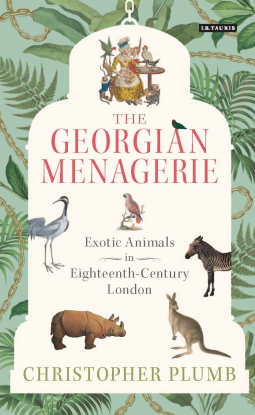
The Georgian Menagerie Christopher Plumb draws on a wide range of sources including diaries, court cases, wills and other legal documents, advertisements, newspapers, letters and even poems and jokes to explore the stories of exotic animals and birds in Georgian society. As the British Empire grew during the 1700s, overseas trade and shipping increased and it became easier to travel to faraway destinations; this meant that menagerists and private collectors were able to obtain animals from distant continents and – as long as they were able to survive a long sea journey – bring them home to exhibit to the public.

The book features anecdotes from all over Britain, but specifically London, where most of the early menageries were located – including Pidcock’s Menagerie in the Exeter Exchange and Kendrick’s Menagerie at Piccadilly. While a lot of attention is given to the menageries with their large collections of creatures, eventually some of the animals and birds (canaries, for example) became more common and ordinary people could sometimes afford to buy one to keep in their own home.

Unfortunately, though, some of the animals being imported were required for a different purpose. In a section entitled Ingredients, we learn about the popularity of turtle soup, the use of bear grease by wigmakers and the demand for perfumes made with oil from the glands of civet cats. And even dead animals were of interest to the Georgians: they could be studied by anatomists, artists and naturalists, and were often then stuffed and put on display in museums.

As you can probably imagine, many of the anecdotes in the book are very sad to read. The people who were removing these animals from their natural habitats had no idea how to look after them correctly and, in most cases, didn’t seem to care. The animals and birds usually didn’t live very long in captivity and had short, miserable lives, being fed inappropriate food and provided with inadequate housing. There are stories of a young polar bear kept for a month in a wooden barrel with fresh water poured in daily and a parrot left unable to walk after being tethered to a perch on a short chain, to give just two examples.

Sometimes the animals would take their revenge. In a chapter called Bitten, Crushed and Maimed you can read about owners, keepers and spectators being injured or attacked by animals – not always because the animal was being tormented or badly treated, but also due to human ignorance. If people didn’t know how to care for the animals, they didn’t know how to behave around them either and seemed to have no understanding of the dangers of taunting rattlesnakes, trying to climb on elephants’ backs or poking fingers between the bars of cages!

The Georgian Menagerie is not always a pleasant read, then, but I suppose not everything in our history is very pleasant. And of course, there are lots of amusing and lighthearted anecdotes in the book too, particularly in the final section, Humour, which discusses the novelty of electric eels, the jokes surrounding Queen Charlotte’s zebras, and the relationships between parrots and their owners. Christopher Plumb’s style throughout the book is engaging and easy to read and there are plenty of beautiful illustrations by artists of the period. References and sources are provided both within the text and at the back of the book.

Despite the sometimes distressing descriptions of animal cruelty, I found The Georgian Menagerie completely fascinating. I love reading about the eighteenth century and this book gave me an opportunity to explore an aspect of Georgian life about which I previously knew very little. Definitely recommended!

Thanks to the publisher for providing a review copy via NetGalley.

The Master of Ballantrae by Robert Louis Stevenson

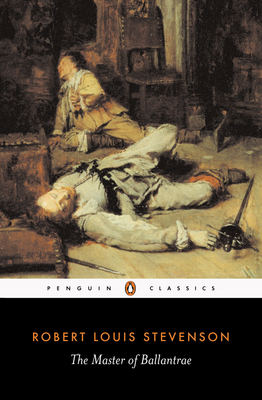
The Master of Ballantrae My experiences with the work of Robert Louis Stevenson so far have been mixed. I liked Dr Jekyll and Mr Hyde, although knowing the basic plot beforehand spoiled it slightly; I gave up on Kidnapped halfway through (but would like to give it another chance); and while I did read Treasure Island as a child, it was an abridged version for children, and I have no idea what I would think of the book as an adult. I wasn’t sure what to expect from The Master of Ballantrae, then, but I’m pleased to say that I enjoyed it.

Published in 1889, The Master of Ballantrae: A Winter’s Tale is set much earlier, opening in Scotland in 1745, just before the Jacobite Rising. When news of Bonnie Prince Charlie’s arrival in Scotland reaches the Duries of Durrisdeer and Ballantrae, the family must decide what to do. There is no question of Lord Durrisdeer himself joining the rebellion, but his two sons – James Durie (the Master of Ballantrae), his eldest son and heir, and Henry, his younger brother – are both keen to go. A coin is tossed and it is decided, to Henry’s disappointment, that the Master will join the Jacobites while Henry stays at home and remains loyal to King George. This way, the family titles and estates will be safe no matter which side wins.

As history tells us, the rising will fail – and it is not long before the Duries receive reports that James has been killed. Henry becomes heir in his brother’s place and, at his father’s urging, marries the Master’s grieving fiancée, Alison. These are difficult times for Henry: his neighbours see him as a traitor for not taking part in the rising, and he knows that his father and wife will never stop mourning for James, always the favourite son. But things are about to get a lot worse for Henry – it seems that the Master of Ballantrae is not dead after all and is about to come home to Durrisdeer to take his revenge.

The Master of Ballantrae has all the elements of a typical adventure story – duels, pirates, sea voyages, buried treasure – but it is also a fascinating psychological novel about the relationship between two very different brothers. James, the Master, is the charming, charismatic brother whom everyone seems to love, yet he is also devious, scheming and manipulative. Henry is his opposite – quiet, responsible and dutiful, but less glamorous and less popular. At first it seems that this is another Jekyll and Hyde story, with one character representing good and the other evil, but it soon becomes obvious that it is not as simple as this and Henry’s personality begins to change as his obsession with his brother starts to rule his life.

We get to know these two men from the perspective of Ephraim Mackellar, a family servant at Durrisdeer, but I couldn’t help thinking that Mackellar is not a very reliable narrator. It is clear from the start that he is loyal to Henry and his narration is definitely biased towards the younger brother, but whenever he spends time alone with the Master his opinion seems to change slightly and he is able to acknowledge that the elder brother also has some good points as well as bad.

Not all aspects of The Master of Ballantrae worked as well for me as others: the purely ‘adventure’ scenes, such as the encounters with pirate ships at sea and the treasure hunts in the American wilderness, became a bit tedious, especially whenever the narration switched away from Mackellar while another narrator took his place. But I loved the central storyline and the rivalry between the two brothers; I particularly loved the Master, who may have been the devilish brother, but was so much more interesting to read about than poor Henry! I will read more by Robert Louis Stevenson, though I’m not sure whether to move straight on to one of his other books, maybe The Black Arrow, or to try re-reading Treasure Island and Kidnapped first.

The Glass-Blowers by Daphne du Maurier

A glass blower, remember, breathes life into a vessel, giving it shape and form and sometimes beauty; but he can, with that same breath, shatter and destroy it.

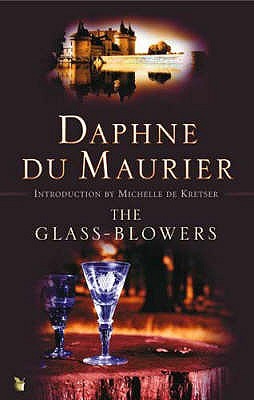
The Glass-Blowers The Glass-Blowers was the book selected for me in the last Classics Spin at the end of August. The deadline for reading our Spin book is this Friday, so I’ve finished just in time! Although it has taken me a while to actually pick this novel up and read it, that’s not because I wasn’t looking forward to it. Daphne du Maurier is one of my favourite authors and I fully expected to love this book as I’ve loved most of her others. That didn’t really happen, unfortunately, but I did still find things to enjoy.

Published in 1963, The Glass-Blowers is historical fiction based on the lives of du Maurier’s own ancestors who lived in France during the Revolution. The story is narrated by Sophie Duval, an elderly woman writing her family history in the form of a letter to send to her nephew. Sophie begins by looking back on her childhood growing up in the Loir-et-Cher region of France as the daughter of master glass-blower Mathurin Busson. Most of her early memories revolve around her eldest brother, Robert, who is constantly getting into debt and finding himself in trouble. It is Robert who will eventually move to England and provide the link to Daphne du Maurier herself.

In France, meanwhile, Sophie and her other siblings – Pierre, Michel and Edmé – become swept up in the drama of the French Revolution. So much of what I’ve read about the Revolution is focused on Paris, so it was fascinating to read about the ways in which it affected the lives of those living in the countryside and in other cities such as Le Mans. The section set during the War in the Vendée is particularly gripping and vivid – probably because Sophie herself is caught up in the uprising and experiences it directly. Other major events happen in the background and Sophie only hears thirdhand accounts, which takes away some of the emotional impact of the story (I kept thinking of The Brethren by Robert Merle, another novel set in France which is written in a similarly passive style).

The distance between narrator and reader meant that I never became fully engaged in the lives of the Bussons and never felt that I had really got to know Sophie. Her brother and sisters were stronger characters, particularly Michel, who becomes a political activist and joins the National Guard, and Robert, who repeatedly reinvents himself as one business venture after another ends in failure. Robert infuriated me at first but he eventually became my favourite character and I found myself looking forward to his scenes as they added a spark of life to what I was beginning to find quite a tedious story.

One of the things I usually love about du Maurier is her descriptive writing and the way she creates a strong sense of time and place – and this is something that I thought was missing from The Glass-Blowers (apart from in the Vendée scenes, as I mentioned above). This hasn’t become a favourite du Maurier book, then, but in my opinion even her weaker novels are still worth reading. Now that I’ve read this one I’m planning to read Mary Anne, another fictional account of one of du Maurier’s ancestors, this time on the English side of the family. After that I’ll only have Frenchman’s Creek and Castle Dor left to read.