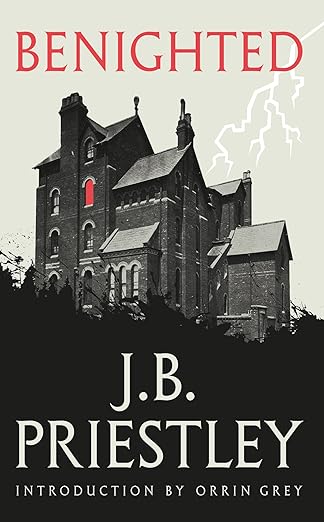
Benighted by J.B. Priestley

This is the first book I’ve read by J.B. Priestley and a great choice for this time of year. Published in 1927, it was filmed as The Old Dark House in 1935, although I don’t think I’ve seen it so can’t comment on how similar or different it is from the book.

The novel begins as married couple Philip and Margaret Waverton, accompanied by their friend Roger Penderel, get caught in a storm as they try to drive home through the Welsh countryside one night. The rain is torrential and with the roads starting to become impassable, they decide to seek shelter in an old, crumbling mansion, the only house they can see for miles around. It doesn’t look very inviting…

It was the house itself that was so quiet. Driving up like this, you expected a bustle, shadows hurrying across the blinds, curtains lifted, doors flung open. But so far this house hadn’t given the slightest sign in spite of its lighted windows. It seemed strangely turned in upon itself, showing nothing but a blank face in the night. You could hardly imagine that great front door ever being opened at all.

The door is eventually opened by a huge, silent butler and as the trio step inside their sense of unease continues to grow. The house is home to the Femms – the strange and nervous Horace and his fanatically religious sister, Rebecca. The Femms reluctantly allow them to stay for the night, but it quickly becomes obvious to the visitors that they’re unlikely to get much sleep in such an eerie, unwelcoming house. After a while, they are joined by two more people looking for shelter – Sir William Porterhouse, a wealthy businessman, and Gladys du Cane, a chorus girl. The rest of the novel describes the unpleasant, frightening experiences the five guests undergo during their night in the Femm household. It seems that there are other members of the Femm family who haven’t made an appearance yet – and when they do, the guests begin to wish they had stayed outside in the storm after all!

Benighted is a short, quick read and one that I enjoyed, with a few reservations. By the standards of modern horror novels it’s quite tame – I would describe it as creepy and unsettling rather than terrifying – but as a book from the 1920s, it has clearly had a huge influence on what Orrin Grey in the introduction describes as the ‘old dark house’ subgenre. There’s nothing supernatural going on in the novel; the creepiness comes entirely from the portrayal of the odd, sinister characters, the descriptions of the dark, desolate house and the mystery surrounding a locked door upstairs and what lies behind it. I was intrigued to learn that the Addams Family creator, Charles Addams, drew the illustrations for the opening sequence of a 1963 remake of The Old Dark House, because there are some unmistakable similarities between the Addams and Femm families!

Perhaps the real horrors being described in Benighted are the effects of the First World War, which ended less than ten years before the book was published. Priestley himself is quoted as saying that the novel’s characters are “forms of postwar pessimism pretending to be people”. This leads to some long passages in which Priestley explores the mental states of the characters and how they are affected by their night in the Femm house, most notably Roger Penderel who has experienced various traumas during the war, including the loss of his brother at the Battle of Passchendaele, and has been left disillusioned and cynical. These passages added depth to the novel, but at the same time I felt that they slowed down the pace of the plot and pulled me out of the story. In the end, this book didn’t quite work for me either as a horror novel or a psychological study, but it was still an interesting read and has definitely piqued my interest in reading more books by Priestley.

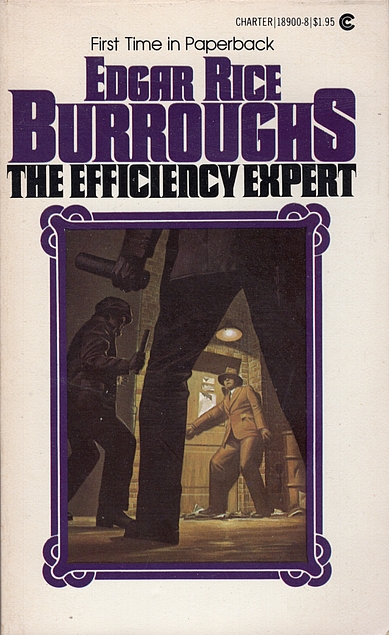
The Efficiency Expert by Edgar Rice Burroughs

Edgar Rice Burroughs is not an author I’ve ever considered reading; neither his Tarzan series nor his John Carter of Mars books have ever appealed and I hadn’t thought to look into what else he had written. The Efficiency Expert was suggested by one of my blog readers (thank you, Cheryl!) and it proved to be an excellent recommendation. The book was published in 1921 and seems to be one of only a few novels Burroughs wrote about ordinary people leading ordinary lives.

Jimmy Torrance is in his final year at university when he discovers that, having devoted his time to football, baseball and boxing instead of his studies, he is now in danger of failing his course. After working hard for the rest of the semester, he manages to get his diploma and ‘would have graduated at the head of his class had the list been turned upside down’. Unimpressed, his father orders him to come home before he can acquire any more debt, but Jimmy heads for Chicago instead, determined to get a good job and make his father proud of him.

Arriving in Chicago, Jimmy begins to look for work but soon finds that his college education counts for nothing without any experience. Forced to accept that nobody is going to employ him as an office boy, let alone the general manager’s position he had hoped for, he embarks on a series of increasingly embarrassing jobs including selling ladies’ hosiery in a department store and working as a waiter in a disreputable nightclub. Eventually, just as he reaches his lowest ebb, he is offered the position of ‘efficiency expert’ in a factory. Things seem to be looking up at last – but when he notices a discrepancy in the company’s accounts, he must decide whether to act and risk losing the only good job he’s ever had.

The first half of the book is entertaining and quite amusing as Jimmy stumbles from one disastrous job to another, while repeatedly encountering two young women who are mystified to find him serving at tables one day and driving a milk wagon the next. Jimmy is very naïve when he first arrives in Chicago, assuming that as a graduate he will be able to walk straight into any job, and his story will resonate with other young people who have had to work their way up from the bottom. I admired him for not asking his rich family and friends for help, which would have made things easier for him, but it’s this same sense of pride and integrity that results in him losing or leaving job after job.

Jimmy makes two new friends in Chicago – a pickpocket and safe-breaker known as the Lizard, and Little Eva, a prostitute he meets during his nightclub job – both of whom become better people due to their association with Jimmy. There’s a clear message here that decent people can be found in all walks of life and nobody is beyond redemption if they are only given a chance. The more privileged characters in the book (or some of them anyway) are not shown in such a good light! There’s a romantic element to the story too, with Jimmy having three possible love interests. The one he ends up with is neither the one I’d hoped for nor the one I’d expected, but at least that means the book isn’t completely predictable!

After Jimmy starts working as an efficiency expert, the story takes a different turn and the book becomes more of a thriller than the light comedy it had seemed at the beginning. It’s exciting for a while, but I thought it fell apart slightly at the end, with characters who had become inconvenient to the plot being too easily disposed of and loose ends tied up too neatly. Still, this book was fun to read and although I’m still not drawn to Tarzan or the science fiction novels, I’m pleased to have found an Edgar Rice Burroughs book that I did want to read and did enjoy.

If you have trouble finding a copy of this book, it’s available through Project Gutenberg.

Fortune by Amanda Smyth

My first book for this year’s 20 Books of Summer is also one of the shortlisted titles for the 2022 Walter Scott Prize for Historical Fiction. The winner is going to be revealed at the Borders Book Festival on Friday 17th June, so I wanted to read this one before the announcement. It’s the second of the four titles on the shortlist that I’ve read – the other is the excellent Rose Nicolson; I am currently halfway through the third, The Magician, but am not sure if I’ll finish it in time, and I won’t get to the fourth one, News of the Dead, now either.

Anyway, Fortune is set in Trinidad in the 1920s and begins with a chance meeting between two men. One of them, Eddie Wade, has spent the last few years working in the US oilfields and has recently returned home, hoping to make his fortune on the island. He’s convinced that the land beneath Sonny Chatterjee’s cocoa plantation is rich in oil and is on the verge of persuading Sonny to let him start drilling when his truck breaks down on the road. Businessman Tito Fernandez stops to help and when he hears about Eddie’s project, he agrees to invest.

Soon Eddie and Tito are the best of friends and their trust in each other pays off when the oil begins to flow. However, as Eddie spends more and more time visiting the Fernandez family and becoming part of their social circle, he finds himself increasingly drawn to Tito’s beautiful wife, Ada – and the attraction is mutual.

The novel is inspired by a real event which took place in Trinidad in 1928, but I would recommend not looking it up before reading the book. Although I did eventually guess what was going to happen, I’m glad I didn’t know for certain as it would have taken away some of the impact of the story. The characters also seem to be loosely based on real people, but with different names and obviously with fictitious storylines created around the historical facts.

I can’t think of any other books I’ve read set in Trinidad and I’m ashamed to admit that it’s a place I know very little about, but Amanda Smyth, who is an Irish-Trinidadian author, brings it to life beautifully – the landscape, the plants and wildlife, the bustling streets of Port of Spain, and the cultures, beliefs and traditions of the Trinidadian people. At the time of our story, the island is going through a period of change; the cocoa trees that had formed such an important part of the economy are dying and new sources of income are needed. With the growing popularity of cars and planes, Trinidad’s oil boom comes at just the right time. Smyth does a wonderful job of portraying the ambition and greed of the various oil prospectors, the reluctance of Sonny Chatterjee to give up on his cocoa farming and allow drilling on his land, the fears of his wife Sita, who is mistrustful and suspicious of the whole business, and the excitement the characters feel when the first well is struck.

The tensions between the characters are also very well done; the relationship between Eddie and Ada develops slowly but once their affair begins they take so many risks it seems inevitable that Tito will find out and you wonder what will happen when he does. The personal stories of the characters play out against the backdrop of the oil rush, with all the different elements of the novel falling into place to build towards a dramatic conclusion. Although I still prefer Andrew Greig’s Rose Nicolson, this is an impressive novel too and while it hadn’t sounded very appealing to me at first, I can see now why the Walter Scott Prize judges decided to shortlist it.

This is book 1/20 from my 20 Books of Summer list.

This is book 26/50 read for the Historical Fiction Reading Challenge 2022.

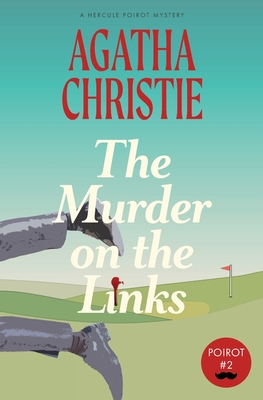
The Murder on the Links by Agatha Christie

The May theme for Read Christie 2022 is “a story set in Europe” and The Murder on the Links is the perfect choice as the story takes place almost entirely in France.

First published in 1923, this is a very early Poirot novel (just the second in the series, in fact) and one of several to be narrated by Captain Arthur Hastings. Hastings, a close friend of Poirot’s, is on his way home to England from France when he meets a girl on the train who introduces herself only as ‘Cinderella’. For Hastings, it’s love at first sight, but when they part ways he doesn’t expect to ever see her again.

The next day, Hastings learns that Poirot has just received a letter from a Mr Paul Renauld requesting him to come to his home in France as soon as possible because he believes his life is in danger. The two set off at once, only to discover that Renauld had been murdered the night before, his body found on the new golf course which is under construction near his house. There are several suspects, but when Cinderella reappears and seems to have some involvement in the murder, Hastings will have to choose between his love for her and his loyalty to Poirot.

I enjoyed this, although I don’t think it’s one of the better Poirot novels I’ve read. None of the characters are particularly memorable or appealing; her characterisation would be stronger in later books in the series – maybe at this early stage she was still concentrating on developing the character of Poirot himself. In this book he has a rival – the French detective Monsieur Giraud – and we can see the contrast between their detecting methods. Poirot refers to Giraud as ‘a human foxhound’, someone who ‘sniffs out’ clues like footprints and cigarette ends while failing to see the bigger picture or to consider motive and psychology as well as physical evidence. Meanwhile, Giraud is equally scornful of Poirot’s approach to crime-solving. I’m sure I don’t need to tell you which of the two detectives will eventually solve the mystery!

I usually like the books narrated by Hastings, who is a sort of Watson to Poirot’s Sherlock Holmes. He provides a viewpoint close to Poirot, while also being as mystified as we are by Poirot’s methods and deductions. I did find him slightly irritating in this book, with his tendency to instantly fall in love with every young woman he meets, but the romantic subplot does have a purpose as it leads to Hastings departing for Argentina, only to make occasional reappearances for the rest of the series.

Overall, this is a typically clever and entertaining Christie novel, but probably not one that I’ll be tempted to re-read. As a final note, don’t be put off by the many covers of this book that show people playing golf – apart from the golf course being the location of the dead body, golf has absolutely nothing to do with the plot!

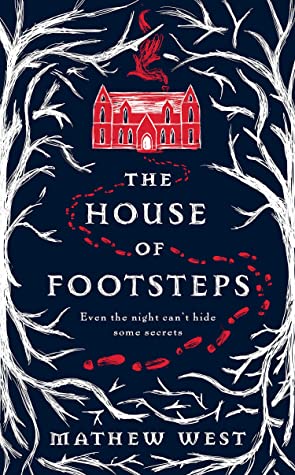
The House of Footsteps by Mathew West

“You make it sound like I’m on my way to Castle Dracula,” says Simon Christie, the narrator of Mathew West’s debut novel The House of Foosteps, after arriving in the remote village of Cobsfoot during a funeral procession and taking refuge in the nearest tavern where he asks for directions to Thistlecrook House – “a strange place, where the master takes dark, wild moods”. It’s 1923 and Simon has been sent by his auction house to evaluate a collection of rare artworks owned by the Mordrake family – and as he enters Thistlecrook House for the first time and makes the acquaintance of the reclusive, secretive Victor Mordrake, it was Dracula that continued to come to mind.

As I read on, I was reminded of other classic Gothic novels and ghost stories and each chapter seemed to raise more questions than it answered. Who is Amy, the beautiful young woman who sits curled up in a chair in the library every evening, begging Simon not to mention her presence to anyone else in the house? What really happened to Victor’s wife, said to have drowned in a frozen lake on the estate? What causes the dark shadows Simon can see under his bedroom door every night? And why does Victor, a vegetarian who can’t even bear having dead flowers in the house, have a whole collection of paintings depicting violent and macabre biblical scenes?

The answers to some of the novel’s many mysteries are revealed gradually as the story unfolds. Others are still unanswered at the end, leaving the reader to make up their own mind about what exactly was going on at Thistlecrook House. I do sometimes enjoy an ambiguous ending, but in this case I was disappointed that we weren’t given more clarity; I had been so intrigued by some of the strange happenings and really wanted to be given a proper explanation for them! However, I still thoroughly enjoyed reading this book – and until I reached that unsatisfactory ending, I had been going to say that it was one of my favourite reads of the year so far.

The novel has a wonderfully dark and sinister atmosphere and despite being set in the 1920s, the remote location – a rural village in the far north of England, close to the Scottish border – creates the feeling that the story could be taking place in a much earlier period. Although I was sometimes frustrated by Simon’s actions and choices, I was always completely absorbed in his story, wondering who could and could not be trusted and watching the boundaries blur between reality and fantasy. If you’ve enjoyed books like The Woman in Black or The Haunting of Hill House I would recommend giving The House of Footsteps a go.

This is book 8/50 read for the Historical Fiction Reading Challenge 2022.

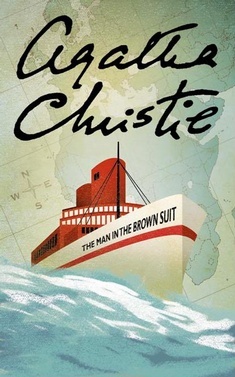
The Man in the Brown Suit by Agatha Christie

A new year means a new Agatha Christie reading challenge! After participating in all twelve monthly reads for Read Christie 2021, I’m not planning to do the same again this year – I do love Christie, but there are so many other authors I want to read too. However, I will still be dipping into Read Christie 2022 throughout the year whenever I’m tempted by the monthly theme. The topic for January is ‘A story inspired by Agatha’s travels’ and the suggested book is The Man in the Brown Suit, one that I hadn’t read before and that sounded quite appealing to me.

Published in 1924, this book is not part of the Poirot or Marple series, although it does feature another of Christie’s recurring characters, Colonel Race. Like They Came to Baghdad or The Secret Adversary, it’s more thriller than mystery; a murder does take place near the beginning, but this is only a starting point and not the main focus of the novel.

Most of the novel is narrated by Anne Beddingfield, the recently orphaned daughter of a famous archaeologist. Finding herself alone in the world, with a small inheritance to spend, Anne longs for an adventure to come her way so she can imitate the heroines of her favourite books and films. This wish becomes reality when she witnesses an accident in a London tube station and picks up a piece of paper dropped by the doctor who examines the victim. On this scrap of paper are some numbers and the words ‘Kilmorden Castle’; Anne is sure that these are clues and that she has found the adventure she’s been waiting for. When a woman is found dead the next day in the home of Sir Eustace Pedler, Member of Parliament, a man in a brown suit is suspected of the crime. Convinced that the two incidents are related, Anne deciphers the clues on the paper and boards a ship sailing to Cape Town, hoping to track down the brown-suited man.

Anne is a wonderful narrator and her intelligence, courage and quick wits mean that she is often – although not always – one step ahead of the villains. However, there’s also a second narrator and that is Sir Eustace Pedler. Sir Eustace’s narrative is interspersed with Anne’s and takes the form of a diary in which, in contrast with Anne, he describes his dislike of adventure, as well as his frustration with his annoying secretary Mr Pagett. The diary entries add a lot of humour to the story and I enjoyed hearing Sir Eustace’s voice now and then as a change from Anne’s.

Christie’s novels are always entertaining, but this is one I found particularly fun to read. Stolen diamonds, a revolution, travel through South Africa, a criminal mastermind known only as the ‘Colonel’…there’s such a lot happening and so many things to enjoy. The one aspect of the novel that I didn’t like was the romance between Anne and another character; I thought it seemed to come very suddenly out of nowhere and I was disappointed that Anne, being such a strong person in other respects, had the view that a woman should admire a man’s strength and prepare to be submissive.

Going back to the theme for this month’s read, this novel was inspired by a round-the-world trip taken by Agatha and her first husband Archie Christie in 1922. You can see the full list of categories for Read Christie 2022 at the bottom of the challenge page on the Agatha Christie website.

A Fatal Crossing by Tom Hindle

I was drawn to A Fatal Crossing first by the cover, then when I saw that it was a Golden Age-style mystery novel set at sea in the 1920s, I was even more interested. I read the book in October and loved it, but have waited to post my review until publication day, which is today (here in the UK).

The whole story takes place over a four day period in November 1924 as the cruise liner Endeavour approaches New York from Southampton with two thousand passengers and crew on board. When an elderly man is found dead at the bottom of a staircase, the ship’s captain assumes – and hopes – that it’s an accident. However, James Temple, a Scotland Yard inspector, happens to be one of the passengers on the voyage and, after examining the body, he is convinced that the old man has been murdered. The captain gives Temple permission to investigate the crime, but only if he agrees to be accompanied by one of the ship’s officers, Timothy Birch.

Birch has no experience as a detective but follows Temple around the ship as he looks for clues, speaks to suspects and establishes alibis. They quickly discover a link between the dead man and a priceless painting stolen from another passenger, but the mystery deepens when more deaths occur and Temple and Birch find themselves racing against time to uncover the truth before the ship reaches its destination.

This is a complex and engaging mystery novel, with plenty of suspects, lots of red herrings and a strong sense of time and place. Although I felt that there were times when the plot was starting to become quite convoluted and I was struggling to keep track of who was who and who did what, I kept going and was rewarded by some spectacular plot twists near the end which I thought I had worked out in advance, but most definitely hadn’t!

Temple and Birch make an interesting partnership, particularly as it’s a very reluctant one! As an intelligent, competent and experienced detective, Temple is not at all happy about having an inept and bumbling ship’s officer shadowing his every move, saying the wrong things and interfering with the investigation. Birch is our narrator, and as we only see things from his point of view, Temple comes across as bad-tempered, rude and hostile, but there are hints that there’s more to each character than meets the eye. While Temple’s past and his reasons for boarding the Endeavour are shrouded in mystery, we learn that Birch is haunted by the disappearance of his young daughter Amelia and the breakdown of his marriage.

As well as the unusual detecting duo and that unexpected ending, I also loved the setting and the atmosphere. A ship on a long sea voyage is the ideal location for a murder mystery, as all of the suspects are confined in one place with nobody able to arrive or depart until the destination is reached. There’s some wonderful attention to detail as the action moves around the ship from the elegant first class decks to the less luxurious third class areas and the officer’s quarters.

A Fatal Crossing is Tom Hindle’s first novel; having enjoyed it so much, I’m already looking forward to his next one!

Thanks to Century for providing a copy of this book for review via NetGalley.