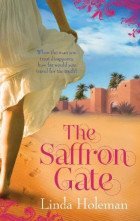
Review: The Saffron Gate by Linda Holeman

Linda Holeman’s books are perfect comfort reading for me. She writes the kind of historical fiction I love, with just the right combination of romance, history and adventure. One of the things I like about her books is the way she chooses such interesting settings (19th century Afghanistan in The Moonlit Cage, for example, or British-ruled India in In a Far Country). The Saffron Gate is set in 1930s Morocco, a time and place I know very little about, but Holeman really makes the setting come alive, from the noise and bustle of the souks in Marrakesh, the taste of hot couscous and mint tea, the vibrant colours of the trees and flowers.

But Morocco in the 1930s can be a dangerous place for a woman on her own, as our narrator soon discovers. Her name is Sidonie O’Shea and she’s travelling to North Africa from her home in Albany, New York in search of her fiancé Etienne Duverger, who disappeared without word, leaving behind a mysterious letter from his sister in Marrakesh. When Sidonie arrives in Morocco she realises the enormity of her task – she has no idea where to start looking for Etienne and it seems that certain people are determined to stop her from finding him at all costs. As Sidonie continues to search, she begins to fall in love with Morocco and at the same time uncovers some important truths about both Etienne and herself.

There were times when I wanted to throw this book across the room in disgust, not because it was badly written, but because one of the characters was just so horrible and so cruel to Sidonie I didn’t think I could bear to read any more. Not only that, but Sidonie is far too innocent and trusting, which started to frustrate me after a while. Somewhere in the middle of the book though, the story began to go in a different direction to what I was expecting and I started to feel more hopeful of a happy ending. Whether I got one or not I’ll leave you to find out for yourself.

I learned a lot from this book about the role of women in 1930s Morocco, how they lived, and how they were scorned and looked down upon if they didn’t have a husband. There was also a lot of information about their fashions, customs, superstitions – and some fascinating details, such as the rituals of the hammam (public baths).

I’ve enjoyed all of the Linda Holeman books that I’ve read, but I think this one has been my favourite so far. I would highly recommend The Saffron Gate to anyone who likes to read long historical fiction novels that allow you to immerse yourself in another culture for a while.
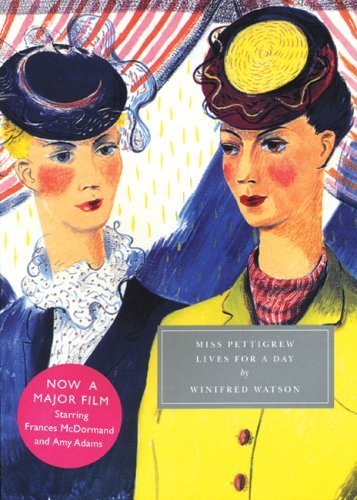
Review: Miss Pettigrew Lives for a Day by Winifred Watson


“She, Miss Pettigrew, spinster, maiden lady, dull nonentity, jobless, incompetent, was bound for a night club, clad in splendour: painted like the best of them, shameless as the worst of them, uplifted with ecstasy…”

Although I didn’t participate in the Persephone Reading Week hosted by Claire and Verity last month, I enjoyed reading everyone else’s reviews and they made me want to read some Persephone books myself. Miss Pettigrew Lives For a Day seems to be the usual recommendation for someone who is new to Persephone – I was a bit unsure about reading it because it didn’t sound like the kind of book I would usually choose to read, but when I found it in the library I grabbed it and immediately started reading it to see why so many people love the book so much.

Before I even started to read the story though, I was pleased to discover that Winifred Watson was from Newcastle like me. There are not many authors from the North East of England who have been internationally successful, so it’s quite exciting to unexpectedly discover one!

Now, what about the novel itself? I’ve seen it described as a romantic comedy, a fairy tale and a Cinderella fantasy – and it’s all of those things and more. It tells the story of Guinevere Pettigrew, a timid middle-aged governess.  When her employment agency accidentally send her to the wrong address, she finds herself at the home of the beautiful young actress and singer, Miss LaFosse.  Waiting for the right moment to tell Miss LaFosse that she thinks there’s been a mistake, and realising that her new friend needs her help, Miss Pettigrew is swept into a glamorous world of night clubs and cocktail parties – and to her surprise, discovers that she’s enjoying every minute of it!

I found Miss Pettigrew Lives for a Day very easy to read, and with the entire story taking place in a day, it moved along at a fast pace.  The perfect choice if you’re in the mood for something light hearted, fun and frivolous.  Although it didn’t immediately become a favourite book, it was a lively, entertaining read full of amusing scenes and witty dialogue that made me smile.  Here Miss Pettigrew attends a party wearing make-up and fashionable clothes for the first time in her life:

“I think,” said Miss Pettigrew simply, “I will stand just over there, so that if I look up I can see myself in the mirror across the room…I am not accustomed to myself yet, and if I can glance up every now and then merely to reassure myself of what I don’t look like, it will give me tremendous strength and encouragement”.

Although the book was written in the 1930s and does have a certain old fashioned charm, it still has a lot of relevance. I’m sure we’d all love to have a day like Miss Pettigrew’s where all our dreams comes true and we finally do all the things we’ve never been brave enough to do before.

I did like this book – and was surprised by how much I enjoyed it, as I wasn’t really expecting to – but I didn’t love it and will wait until I’ve read more Persephone books before I make up my mind about them. I have Little Boy Lost by Marghanita Laski waiting to be read and I think that one will probably be more to my taste.

As a side note, I really loved the illustrations in this book! It’s always nice to see illustrations and these beautiful drawings by Mary Thomson really added something extra to the story and helped bring the scenes to life.

Recommended

Publisher: Persephone Books/Year: 2008 (originally published 1938)/Pages: 256/Source: Library book

Review: I’ll Never Be Young Again by Daphne du Maurier

I’ll Never Be Young Again was Daphne du Maurier’s second novel, written when she was only twenty three years old. It’s different from the other books of hers that I’ve read so far. It doesn’t have the suspense or the gothic feel of some of her other works – this is more of a psychological, character-driven book. It’s the story of Richard, a young man who has grown up in the shadow of his famous father, and his struggle to find his own identity. I’m not really a fan of ‘coming-of-age’ novels, but I’m glad I chose to read this one. It certainly seems to be one of her least well known novels –  and I was concerned that this might mean it wasn’t very good. Well, I can tell you that it is good and I enjoyed it a lot more than I was expecting to.

The book opens with Richard – or Dick as he prefers to call himself – standing on a bridge, preparing to jump. Immediately the reader is intrigued, wondering what has happened to drive him to suicide.  At the last minute Dick feels a hand on his shoulder – this is Jake, a complete stranger who saves his life and becomes his closest friend. The first half of the book follows the adventures of Dick and Jake as they leave England and sail to Scandinavia together in search of a new life. The second half is the story of Dick’s relationship with Hesta, a girl he meets in Paris.

The whole book is written in the first person from Dick’s perspective, which is significant as it was apparently the first time Daphne du Maurier wrote from a man’s point of view – and I thought she captured the male voice perfectly. The only problem I had was that I just didn’t like Dick very much. I found his immaturity and whining very irritating – although I understood that the point of the book was to follow his development from an insecure, selfish youth into a sensible, mature adult. Eventually he does begin to grow up and want different things out of life, but this comes too late in the book for me to be able to warm to him. However, the book is so well-written I could still enjoy it even with such an unsympathetic narrator. Her writing is absolutely beautiful and quite dreamlike, as she lets us get right inside Dick’s head and share his thoughts and emotions. There are also some vivid descriptions of the mountains and fjords of Norway and the other places that the characters visit, particularly Paris with its cafés and boulevards.

This would probably not be the best Daphne du Maurier book for a newcomer to begin with, but it’s a good choice for someone who wants to venture away from Rebecca and read one of her less popular novels. A word of warning, though – if you’re going to read the Virago Modern Classics edition, leave the introduction until last as it gives away the entire plot, including the ending (this is good advice with any book – I’ve learned from experience never to read the introduction first).

This is my first book for the Daphne du Maurier Challenge hosted by Chris at Book-a-rama. I wasn’t planning to take part in this challenge until I discovered my local library had almost all of her books. I’m looking forward to reading some more of her work during the next year, as there are still a lot of her books I haven’t read yet. This book also counts towards the 1930s challenge as it was a contemporary novel published in 1932 and set in 1930s Europe – and also the Typically British challenge.

Pages: 304/Publisher: Virago Press (Virago Modern Classics 515)/Year: 2005 (originally published 1932)/Source: Library book