A Glimpse into 1960s Paris – a guest post by Rachel Hore

It’s not often that I have the chance to introduce a guest post here at She Reads Novels, but today I’m pleased to welcome author Rachel Hore to the blog to tell us about researching 1960s Paris for her new novel A Week in Paris which has been published in the UK this week.

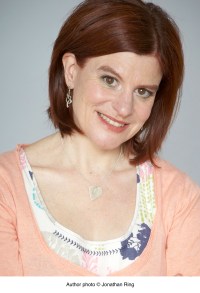
Rachel Hore

Rachel Hore

A GLIMPSE INTO 60s PARIS by Rachel Hore

My new novel, A Week in Paris, opens in 1961, when Fay Knox, a young English violinist, visits the city with her orchestra and learns secrets of her family’s wartime past. What was Paris like at that time and how did I go about researching it?

Reading histories of the period gave me the context. Paris, though glamorous, elegant and romantic, a cradle of new ideas in philosophy and high art, was still socially conservative, France as a whole even more so. In 1958, after a period of unstable government and succeeding crises over the war of independence in Algeria, General de Gaulle was recalled as President and a period of strong rule ensued. It wasn’t until the students’ riots and sit-ins of May 1968 that the young and dispossessed really challenged the aging, authoritarian head of government, and change was finally, if painfully slowly, set in motion.

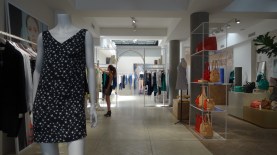
Boutique off Rue de Rivoli

Boutique off Rue de Rivoli (2014)

In other ways, too, the liberal sixties came late to Paris. A glance at the popular music hits of 1961 reveals months of No.1s for traditional French crooners Edith Piaf and Charles Aznavour, with a young Johnny Hallyday making an appearance with ‘Kili Watch’ and, bizarrely for January, Richard Anthony singing ‘Itsy Bitsy Petit Bikini’. This picture had not changed much by early 1964 when the Beatles played a series of concerts at the Olympia music hall. An interviewer had to ask, ‘What is Beatlemania?’ and there were no girls screaming and fainting. Jazz is still big in this period. On her arrival in the city, Fay spots a poster about the trumpeter Miles Davis playing the Olympia.

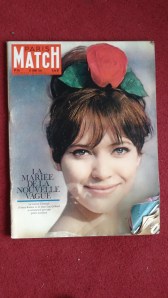
Paris Match March 1961

Paris Match March 1961

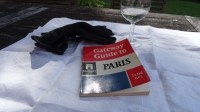
Guidebooks for 1961 were immensely helpful for my research. The Dolphin Guide to Paris, written for American tourists, was full of black and white photographs of the period; a student jazz band jamming on the quays of the Left Bank of the Seine and haute couture models wearing the latest boxy coats – like Fay’s. My copy of Paris Match magazine featuring film-maker Jean-Luc Godard’s elegantly sexy wife Anna Karina made its way into my narrative, as did the Gateway Guide’s advice to fashion-hunters on a budget to visit Worth, Dior and Schiaparelli’s ’ cheaper ‘boutiques’ or to satisfy themselves with the big department stores, Printemps and Galeries La Fayette.

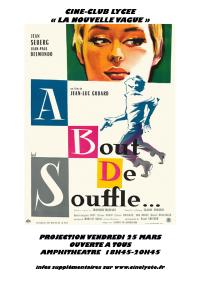
A Bout de Souffle

Poster of A Bout de Souffle

Much has been written about French film of the time. Fay’s fellow musician Sandra is excited when her French boyfriend holds out the possibility of meeting Alain Delon, the heart-breaker star of 1960’s Purple Noon. In the same year came A Bout de Souffle (Breathless) by Jean-Luc Godard, which with its bold visual style and innovative use of jump cuts was hailed as an important example of French Nouvelle Vague (New Wave). Other practitioners included Francois Truffaut (The 400 Blows) and Alain Resnais (Hiroshima, Mon Amour), both released in 1959. Movies, of course, can be a gift to the novelist conducting research as long as one weighs up their veracity.

A rest from sightseeing

A rest from sightseeing

Research can only take the fiction-writer so far. The trick for me was to recognize when to leave it all behind and to enter instead the world of 1961 Paris I’ve imagined – the world Fay sees and in which she lives and loves. When I could hear her voice I knew that it was time to put the books away.

Text and photos ©Rachel Hore 2014 unless stated otherwise.

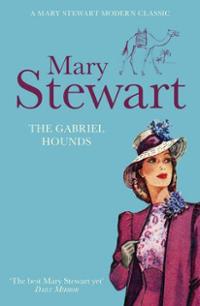
The Gabriel Hounds by Mary Stewart

The Gabriel Hounds The Gabriel Hounds is set in the 1960s and narrated by twenty-two-year-old Christy Mansel who is on a tour of Syria and Lebanon. After unexpectedly meeting her cousin Charles in a street in Damascus, they decide to visit their eccentric Great-Aunt Harriet who has lived near Beirut for several years. ‘Lady Harriet’, as she now calls herself, became a local celebrity after moving into an old, decaying palace by the Adonis River, dressing as a male Arab and modelling herself on the legendary Lady Hester Stanhope. Now over eighty years old, Harriet lives in seclusion with only her servants and her young English companion, John Lethman.

The cousins travel to the palace separately and Christy is first to arrive. She is not made to feel welcome but after a bizarre conversation with the old woman, she is allowed to spend the night there. It quickly becomes obvious that something is not right and when Charles joins her the next day they find that, in typical Mary Stewart fashion, they have stumbled upon a mystery!

Although Christy is in many ways very similar to Mary Stewart’s other heroines – beautiful, confident, brave and intelligent – I never managed to warm to her, or to her cousin Charles either. As Christy herself tells us at the beginning of the story, she and Charles both have “the ‘spoiled’ quality that we were so quick to recognise in one another; a flippant cleverness that could become waspish; an arrogance that did not spring from any pride of achievement but was, I am afraid, the result of having too much too young.” Luckily, though, the fact that I didn’t like the characters very much didn’t stop me enjoying the story and The Gabriel Hounds has joined Nine Coaches Waiting and The Moonspinners as one of my top three Mary Stewart novels so far.

As well as being an exciting page turner, I also loved the atmosphere and the unusual setting. The novel is very dated, I suppose – it’s hard to imagine young tourists like Christy wandering happily through the streets of Damascus and Beirut on their own today – but remembering that the book was written in the 1960s, they sound like fascinating places to have visited and Mary Stewart’s usual beautiful descriptions abound: the beauty of red anemones, the herds of goats grazing on the riverbanks, the scent of jasmine and roses, the fields of sunflowers grown for their oil.

The descriptions of the palace of Dar Ibrahim – with its labyrinth of dusty tunnels and corridors, wall mosaics, cracked marble floors and quiet courtyards – are wonderfully detailed and vivid, especially the scenes set in the old Seraglio, where Christy is given a room for the night. Then, of course, there’s the sound of Harriet’s saluki hounds howling in the distance as Christy explores the palace. Some parts of the book are quite creepy and there are some surprising plot twists too that made me want to immediately turn back and read previous sections again. The story also has what I’m coming to consider one of Stewart’s trademark dramatic, action-packed endings.

The final aspect of this novel I want to mention is the factual element. Lady Hester Stanhope was a real person and if you don’t know anything about her, I can almost guarantee that after reading this book you’ll be completely intrigued and will want to find out more about her amazing life, as I did. Mary Stewart has attributed a lot of Lady Stanhope’s characteristics and habits to the fictional Lady Harriet, including shaving her head and wearing a turban, and only admitting visitors to her room after dark. I’ve discovered that there’s a recent biography by Kirsten Ellis called Star of the Morning: The Extraordinary Life of Lady Hester Stanhope. Has anyone read it or is there another one you would recommend?

The Moonspinners by Mary Stewart

The Moonspinners “Sometimes, when you’re deep in the countryside, you meet three girls, walking along the hill tracks in the dusk, spinning. They each have a spindle, and onto these they are spinning their wool, milk-white, like the moonlight. In fact, it is the moonlight, the moon itself…all they have to do is to see that the world gets its hours of darkness, and they do this by spinning the moon down out of the sky.”

With spring still a few weeks away and the weather still cold, damp and miserable, The Moonspinners with its beautifully described Greek island setting was just what I needed!

The story is narrated by Nicola Ferris, who is taking a break from her job at the British Embassy in Athens to spend a few days visiting Crete. She has arranged to meet her cousin, Frances, there but Nicola arrives a day earlier than planned and decides to go exploring on her own. In the mountains above Agios Georgios, the village where they are going to be staying, Nicola stumbles into adventure when she meets a young Englishman, Mark Langley, who has been wounded after witnessing a crime.

Mark is being tended by his Greek friend, Lambis, but his younger brother, Colin, has been kidnapped by the criminal gang and Mark is worried that he might have been murdered. Nicola wants to help but it’s time to go down to the village and meet Frances, so she reluctantly leaves Mark and Lambis in their hiding place. After arriving at her hotel and speaking to the hotel owner and his assistant, Nicola thinks she has discovered who was responsible for Colin’s disappearance, but will she be able to find him before it’s too late?

I love Mary Stewart’s books because they’re fun and easy to read while still being well-written, intelligent novels with exciting plots and atmospheric settings. Her descriptive writing is so impressive in this book; whether she’s describing the colour of the sea, the warmth of the sun, the fishing boats in the bay, the unspoilt countryside or the picturesque sight of windmills with white sails, she always chooses the perfect words and makes everything sound beautiful and idyllic:

“A clump of tamarisk trees stood where the gravel gave way to the flat rock of the foreshore; this, smoothed and fissured by water, burned white in the sun. In every cranny of rock blazed the brilliant pink and crimson sunbursts of ice daisies, and just beside them, the sea moved lazily, silky and dark, its faint bars of light and shadow gently lifting and falling against the hot rock.”

I have never been to Crete but reading the wonderful, evocative way it is depicted in this book made me wish I was there, though as the book was written in the 1960s before the Greek islands became such popular tourist destinations (Nicola and Frances are the only guests at their tiny hotel in Agios Georgios) I’m sure the culture and landscape must have changed a lot since then!

Of the five Mary Stewart novels I have now read, this is one of my favourites so far and might be a good one to start with if you’ve never read any of her books. There’s also a 1964 Disney film version of The Moonspinners with Hayley Mills, though I haven’t seen it and have heard that it’s very different to the book. Has anyone seen it?

The Gabriel Hounds will be the next Mary Stewart book I read – I found it in the library last week and am looking forward to starting it in the next few days.

The Flight of the Falcon by Daphne du Maurier

Having read most of Daphne du Maurier’s more popular books I’m now slowly working through her lesser known novels (though I’m saving Frenchman’s Creek for last as I’m expecting to love that one and want to have something to look forward to). Published in the 1960s, The Flight of the Falcon was one of her final novels and although I didn’t think it was one of her best, I did still enjoy it. If you’re new to du Maurier I would recommend reading some of her other books first, but this one is definitely worth reading too.

Our narrator, Armino Fabbio, works for Sunshine Tours and at the beginning of the book he is showing a group of British and American tourists the sights of Rome. By chance he becomes indirectly involved in the murder of an elderly peasant woman, who he believes he recognises as his childhood nurse, Marta. Deciding to visit Ruffano, the town of his birth, in an attempt to find out what had happened to Marta, Armino begins to uncover some shocking family secrets.

After Armino’s arrival in Ruffano (which is based on the real Italian city of Urbino), the story begins to revolve around the city’s university and the rivalry between the Arts students and the Commerce & Economics students. The battle between these two groups reaches its climax during the preparations for a festival re-enacting the final moments of the city’s fifteenth-century ruler, the evil Duke Claudio – also known as The Falcon.

As I think I’ve said every time I’ve written about a du Maurier book, one of the things I love most about her writing is the atmosphere she creates. In The Flight of the Falcon she succeeds in making Ruffano, with its medieval streets, historic churches and ducal palace, seem beautiful and picturesque but claustrophobic and forbidding at the same time. Whether she’s writing about Cornwall, Italy, France or any other part of the world, her settings always feel vivid and real.

Not everything about this book worked for me, though. I found I didn’t really care about the university politics and rival student groups, which formed such a big part of the plot. I was much more interested in Armino’s personal story. Armino himself is not the strongest of characters, but I was fascinated by his relationship with his elder brother, Aldo. And I hadn’t realised how many of du Maurier’s novels have male narrators! My Cousin Rachel, The Scapegoat, The House on the Strand, I’ll Never Be Young Again and now this one. Are there any others?

In October, Simon from Savidge Reads and Polly of Novel Insights are hosting a ‘Discovering Daphne’ season, so if you still haven’t read any of Daphne’s books that could be a good time to start.

The Help by Kathryn Stockett

As I’ve mentioned before, I always find it difficult to write about a book that so many people have already read. I feel as if there’s nothing new I could possibly say and that nobody will want to hear about it yet again anyway (which I know is not true – there is no book that absolutely everybody in the world has read, however much it sometimes seems that way). But at least I’ve read The Help now and can see why it’s been getting so much attention. And I have to agree with all the bloggers who’ve been giving this book such glowing reviews because it really does deserve it.

The Help is told in the form of alternating narratives by three women living in Jackson, Mississippi during the early 1960s. Two of them, Aibileen and Minny, are black women working as maids, or ‘helps’, for white families. The third is Eugenia Phelan, nicknamed Skeeter because she’s ‘long and leggy and mosquito-thin’. In contrast to the first two narrators, Skeeter is a white woman from a rich family. Skeeter dreams of becoming a writer and convinces Aibileen and Minny to help her write a book throwing new light on the life of a black maid in Jackson.

I loved all three of the narrators, who were each given very different and distinctive voices of their own. I thought it was impressive that Stockett could write so convincingly from the perspectives of three such different people. The intelligent, dignified Aibileen was a lovely, engaging narrator and probably my favourite. But Minny was an equally captivating character – she was outspoken and funny and in some ways felt the most real. I liked Skeeter too but found that she didn’t come to life for me as vividly as the other two. I found it hard to believe that she hadn’t noticed how cruel and prejudiced her best friends were until she reached the age of twenty two (and also hard to believe that she would have been friends with people like them in the first place).

The Help is a powerful and thought-provoking read which raises a number of issues relating to various aspects of racial discrimination, segregation and the Civil Rights Movement, though I’m happy to leave it to people with more knowledge of these subjects to discuss them in the depth they deserve. Judging it purely on its merits as a novel, this was one of the most enjoyable books I’ve read this year. I was alternately enraged by the prejudice and injustice the black maids were forced to endure, amused by the antics of Minny and the other characters, intrigued by the well-meaning but very eccentric Celia Foote, and filled with loathing for Hilly Holbrook, one of the vilest characters ever!

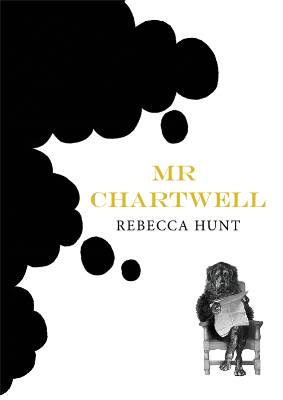
Mr Chartwell by Rebecca Hunt

It’s a well-known fact that British Prime Minister Winston Churchill experienced periods of depression which he referred to as ‘the black dog’. Just a metaphor, of course, but what if the black dog was real? Rebecca Hunt has used this idea as her inspiration for one of the most bizarre books I’ve read for a long time!

It begins with the 89-year-old Churchill waking up one morning in 1964 to find that he’s not alone in the room; someone – or something – is sitting in the opposite corner. Later that morning, librarian Esther Hammerhans is preparing to welcome the new tenant who’s going to be renting her spare room. When she opens the door and is confronted by a huge black dog who introduces himself as Mr Chartwell, Esther is shocked but agrees to let him have the room. He needs to stay in the area for a few days, he says, while he’s visiting a client. But what is Mr Chartwell’s job and who is his mysterious ‘client’?

If you’re going to read Mr Chartwell you need to be prepared to keep an open mind and just accept that one of the protagonists is a dog or you’re not going to get very far with this book! I thought bringing the ‘black dog’ of depression to life was a wonderful idea. Mr Chartwell, or Black Pat as he calls himself, is a fascinating character (and not just because he’s a huge talking dog). He’s manipulative and controlling but sometimes behaves in a more dog-like manner and can even be quite charming and likeable. But although the reader knows what the dog represents (and Churchill knows it too, having been well acquainted with him for many years) Esther has no idea what’s going on and is completely in the dark as to why Mr Chartwell has chosen her house to visit.

Another interesting aspect of the book is that there are little details of Churchill’s life incorporated into the plot, both directly and indirectly. Some of the things he says in the book are based on things that the real Churchill was quoted as saying. And even the dog’s name, Chartwell, was the name of the Churchill family home in Kent.

I loved the opening chapters of this book but started to lose interest a little bit as I got further into the story. The overall tone was quite light (which I know it was probably intended to be) but I think it would have worked better for me if it had been more serious in places and if Mr Chartwell had been portrayed as a less likeable character. The first half of the book in particular is very whimsical, though it does turn darker towards the end where Hunt starts to explain the significance of some of the metaphors and how they relate to depression. Overall though, I thought this was an impressive debut novel and I’ll be looking out for more Rebecca Hunt books in the future.