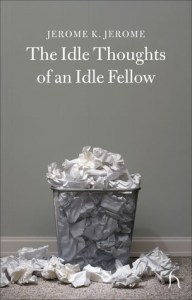
The Idle Thoughts of an Idle Fellow by Jerome K. Jerome

The Idle Thoughts of an Idle Fellow It is impossible to enjoy idling thoroughly unless one has plenty of work to do. There is no fun in doing nothing when you have nothing to do. Wasting time is merely an occupation then, and a most exhausting one. Idleness, like kisses, to be sweet must be stolen.

Jerome K. Jerome’s Three Men in a Boat is one of the funniest books I’ve ever read. I still pick it up from my shelf at times to re-read certain passages when I want to cheer myself up. The sequel, Three Men on the Bummel, wasn’t quite as funny but I did enjoy reading that book too and was looking forward to trying this one, The Idle Thoughts of an Idle Fellow (published in 1886, a few years before Three Men in a Boat).

Unlike the other two books I’ve read by Jerome, this is not a novel but a collection of short essays covering topics as diverse as Cats and Dogs, Eating and Drinking, Being in Love and Being Shy. The tone of his writing varies from essay to essay – sometimes he is melancholy and poignant, sometimes satirical and hilarious (I should warn you that if you read any of Jerome’s books in public, you won’t be able to stop yourself from smiling and should be prepared for people asking you what’s so funny).

A few examples:

On the vanity of cats…

I do like cats. They are so unconsciously amusing. There is such a comic dignity about them, such a “How dare you!” “Go away, don’t touch me” sort of air. Now, there is nothing haughty about a dog. They are “Hail, fellow, well met” with every Tom, Dick, or Harry that they come across. When I meet a dog of my acquaintance I slap his head, call him opprobrious epithets, and roll him over on his back; and there he lies, gaping at me, and doesn’t mind it a bit. Fancy carrying on like that with a cat! Why, she would never speak to you again as long as you lived.

On babies…

There are various methods by which you may achieve ignominy and shame. By murdering a large and respected family in cold blood and afterward depositing their bodies in the water companies’ reservoir, you will gain much unpopularity in the neighbourhood of your crime, and even robbing a church will get you cordially disliked, especially by the vicar. But if you desire to drain to the dregs the fullest cup of scorn and hatred that a fellow human creature can pour out for you, let a young mother hear you call dear baby “it.”

On buying an umbrella…

I bought one and found that he was quite correct. It did open and shut itself. I had no control over it whatever. When it began to rain, which it did that season every alternate five minutes, I used to try and get the machine to open, but it would not budge; and then I used to stand and struggle with the wretched thing, and shake it, and swear at it, while the rain poured down in torrents. Then the moment the rain ceased the absurd thing would go up suddenly with a jerk and would not come down again; and I had to walk about under a bright blue sky, with an umbrella over my head, wishing that it would come on to rain again, so that it might not seem that I was insane.

I did enjoy this book, but I didn’t like it as much as the two Three Men…novels. I found it very uneven – there are some great lines and anecdotes, but it’s also quite boring in places, especially when he becomes very sentimental. It’s worth reading (and the lack of a plot makes it a perfect book to dip in and out of when you have a few spare minutes) but I wouldn’t describe it as an essential, must-read classic. On the other hand, this is what Jerome himself says about the book in his Preface:

What readers ask nowadays in a book is that it should improve, instruct, and elevate. This book wouldn’t elevate a cow. I cannot conscientiously recommend it for any useful purposes whatever. All I can suggest is that when you get tired of reading “the best hundred books,” you may take this up for half an hour. It will be a change.

It was certainly a change!

The Crimson Petal and the White by Michel Faber

The Crimson Petal and the White “Watch your step. Keep your wits about you; you will need them. This city I am bringing you to is vast and intricate, and you have not been here before. You may imagine, from other stories you’ve read, that you know it well, but those stories flattered you, welcoming you as a friend, treating you as if you belonged. The truth is that you are an alien from another time and place altogether.”

With these words the unnamed narrator of The Crimson Petal and the White takes us by the hand and leads us on a journey into the depths of Victorian London where we meet a cast of fascinating, diverse characters from all levels of society. One of these is Sugar, a nineteen-year-old prostitute who is writing a novel in her spare time and is prepared to do whatever it takes to improve her situation in life. Another is William Rackham, heir to a perfumery business, who seeks out Sugar after seeing her name listed in More Sprees in London, a guide to the city’s pleasures. From their first meeting at Mrs Castaway’s brothel, a chain of events is set in motion that will change not only Sugar’s life but William’s too.

Sugar is a wonderful character and I came to love her over the course of the book. She’s intelligent, well-read and ambitious and although she sometimes makes mistakes and is not always very ‘nice’, it’s impossible not to sympathise with her and want to see her succeed. I should warn you that Sugar’s story is not a pleasant or comfortable one to read and her work as a prostitute is described in a lot of detail, often quite explicitly. However, I didn’t think it ever felt gratuitous and it all helped to build up a picture of what Sugar’s life was like and to look at the issue of prostitution in a way that 19th century authors didn’t have the freedom to do.

While Sugar is our heroine, there’s another woman who is given almost as much time in the novel – William’s beautiful wife, Agnes Rackham, who is suffering from an illness that is causing delusions, fits and irrational behaviour. We, the readers, know what is wrong with Agnes but as far as her husband is concerned, she is insane. As her story develops, Agnes becomes almost as complex and interesting a character as Sugar, though less sympathetic. Another subplot follows William’s brother, Henry, who has turned down a position in the family business to become a clergyman and has fallen in love with Emmeline Fox, a widow who works for the Rescue Society, an organisation which helps to reform prostitutes. Through the lives of all of these characters and others, Faber is able to explore many different aspects of Victorian society.

The novel is divided into five parts, with section headings ranging from The Streets to The World at Large, giving us some clues as to how Sugar’s story is going to progress. Her rise in the world is great to watch but exactly how she does it is something I’d prefer to leave future readers to discover for themselves – assuming that I’m not the last person to read this book, which is how it feels sometimes! Like The Book Thief which I finally read earlier this month, this is another book I’ve been meaning to read for years and I can’t really explain why it has taken me so long, especially as the Victorian period is one of my favourites.

I loved this book and thought it was beautifully written, but I did have one problem with it – the end. I’m sure I’m not the first person and won’t be the last to have been disappointed by the ending. After reading more than 800 pages, I was hoping for more resolution to the story. I know there’s a book of short stories, The Apple, which is a sort of sequel but I’ve seen mixed opinions of it. If you’ve read it, please let me know if you would recommend it!

Zemindar by Valerie Fitzgerald

Zemindar What a great book! A wonderful setting, a beautiful romance, characters I really cared about, an exciting story and lots of fascinating historical detail…definitely one of my favourite books of the year. I could see the influence of other books that I love – The Far Pavilions, Gone with the Wind and Jane Eyre – so it’s maybe not surprising that I loved this one too!

Zemindar is set in India before and during the Sepoy Mutiny of 1857. Laura Hewitt, a single woman of twenty-four, is accompanying her newly married cousin Emily and her husband Charles Flood on a trip to India as Emily, at eighteen, is considered too young to travel without another female in the party. Laura is happy to accept the position of paid companion – her parents are both dead and she has no money of her own – but she is also aware that it may not be a good idea to be in such close proximity to Charles, whom she had been in love with herself before he turned his attentions to the younger, prettier Emily.

After a brief stay in Calcutta, Laura and the Floods travel to Lucknow where Charles is planning to make the acquaintance of his half-brother Oliver Erskine who lives a few days’ journey away on the estate of Hassanganj. Charles and Oliver have never met but knowing that his brother is unmarried and seems likely to remain that way, Charles hopes to convince Oliver to make him his heir. On arriving at Hassanganj, however, it quickly becomes obvious that this will not be an easy task. As a zemindar (hereditary landowner), Oliver has been used to leading an unconventional lifestyle on his huge and isolated estate and is not the sort of man who can be made to do anything he doesn’t want to do!

Laura and Emily are both fascinated by Oliver Erskine, though while he shows nothing but kindness to Emily, Laura finds him arrogant and annoying. But when mutiny breaks out among the Indian sepoys in the army and Hassanganj comes under attack, she begins to see a different side to Oliver. Taking refuge in the Residency in Lucknow where the British army is preparing to withstand a siege, Laura must decide how she really feels about Oliver and whether she can see a future for herself in India. First, though, she needs to stay alive…

There are so many things I loved about this book it’s difficult to know what to focus on first, but I think I should start by praising Valerie Fitzgerald’s beautiful writing. Zemindar was published in 1981, but I almost felt I was reading something written by Jane Austen or Charlotte Brontë. Laura’s story is told in the first person and her narrative voice sounds exactly as the voice of a 19th century woman should sound. The descriptions of India – the landscape, the culture, the contrast between life in the British colonial communities and the mofussil (the rural areas) – are stunning too.

The story takes place during a turbulent time in the history of British India, but don’t expect this to be a fast-paced novel – some parts are very slow allowing time for character development and fleshing out of the historical background. No previous knowledge is needed as we have the opportunity to learn along with Laura as the events leading up to the Indian Rebellion unfold. Later in the book, when the British begin to crowd into the poorly-fortified Residency for safety there are some quite graphic descriptions of the brutality and atrocities committed by both sides as Lucknow finds itself under siege and tales of even greater horrors suffered by those in Cawnpore reach Laura’s ears. Obviously we are seeing things from a British perspective but there’s some sympathy for the Indian point of view as well; having spent most of his life at Hassanganj, Oliver understands India and its people in a way that most of the other characters don’t and he tries to pass this understanding on to Laura.

The relationship between Laura and Oliver is a lovely and poignant one which takes its time to develop and is not without its difficulties and misunderstandings. At times it reminded me of the romance in Gone with the Wind, though while Oliver is similar in some ways to Rhett Butler, the quiet, sensible Laura is more like Jane Eyre than Scarlett O’Hara. Because I liked Laura and Oliver so much I was completely absorbed in their story and hoping for a happy ending for them both – it was not at all obvious whether they were going to get one so I was kept in suspense right to the end!

I hoped I’ve made it clear, though, that this book is not a fluffy romance or a silly bodice ripper. The romance is only one element of the story and is sometimes pushed into the background while we concentrate on the history, the battles and the sieges. My only disappointment on reaching the end of the book was discovering that Zemindar was Valerie Fitzgerald’s only novel. I know M.M. Kaye’s Shadow of the Moon is set during the same period so I’m hoping to read that one soon and see how it compares.

The Hunchback of Notre-Dame by Victor Hugo

The Hunchback of Notre-Dame Or Notre-Dame de Paris, to give it its original French title and one which is much more appropriate. Quasimodo, the hunchback, has a surprisingly small role in the book while the cathedral of Notre-Dame itself is at the heart of the story, with most of the action taking place within its walls, on top of its towers or in the streets and squares below.

Set in 15th century Paris, the novel follows the stories of three tragic and lonely people. First there’s the beautiful gypsy dancer, La Esmeralda, who captivates everyone she meets with her looks, her dancing and her magic tricks. Alone in the world with only her goat, Djali, for company, she dreams of one day being reunited with her parents. Then there’s Claude Frollo, the Archdeacon, once a good and compassionate man who rescued Quasimodo as a child and raised him as his son. He becomes obsessed with Esmeralda after seeing her dancing in the Place de Grève and descends into a life dominated by lust and envy, turning away from the church and towards black magic. Finally, of course, there’s Quasimodo himself, the bell-ringer of Notre-Dame. Outwardly deformed and ugly, his kind heart and his love for Esmeralda lead him into conflict with his adoptive father, Frollo.

I read Hugo’s Les Miserables almost exactly five years ago and I really don’t know why it has taken me so long to read another of his books. I loved Les Miserables and I loved this one too, though not quite as much; this is a shorter and slightly easier read, but I didn’t find the story as powerful or emotional. It was a good choice for the R.I.P. challenge, though – the atmosphere is very dark and there are plenty of Gothic elements.

At least having had some previous experience of Hugo meant that I knew what to expect from his writing! You need to be prepared for some long diversions and chapter after chapter that has almost nothing to do with the plot or the main characters. Hugo devotes a lot of this novel to discussing Gothic architecture, the structure of the cathedral, the geographical layout of Paris and other topics which may or may not be of interest to the reader. I’m happy to admit that I didn’t read every single word of these sections (in fact, I skipped most of the chapter entitled A Bird’s-Eye View of Paris) and I don’t feel that I missed anything as a result.

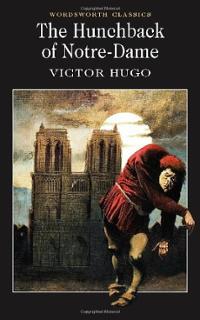
The version of the book that I read is not actually the one pictured above (I just wanted a book cover to illustrate my post). I downloaded the free version from Project Gutenberg for my Kindle, which is Isabel F. Hapgood’s 1888 translation. I was very happy with it, but I’m used to reading older books and older translations; depending on your taste you might prefer a more modern translation. And just as a side note, does anyone else love books with imaginative chapter titles? There are some great ones here, including The Inconveniences of Following a Pretty Woman through the Streets in an Evening, The Effect which Seven Oaths in the Open Air Can Produce and The Danger of Confiding One’s Secret to a Goat. Much more intriguing than just numbering them 1, 2, 3!

As I’ve now read Hugo’s two most popular books, can anyone tell me if there are any others that I should read? I like the sound of Ninety-Three and The Man Who Laughs, but are they worth reading?

Burial Rites by Hannah Kent

Burial Rites Based on a true story, Burial Rites is a fictional account of the final weeks in the life of Agnes Magnúsdóttir, the last woman to be executed in Iceland.

It’s 1829 and Agnes – along with two other people – has been found guilty of murdering her lover, Natan Ketilsson. Due to the lack of prisons in the north of Iceland, Agnes has been sent to the farm of District Officer Jón Jónsson where she will await the day of her beheading. Understandably, Jón’s wife and daughters are nervous and angry about having a convicted murderer coming to stay with them, but as they have no choice in the matter they must find a way to deal with their fear and distrust.

Agnes is visited at the farm by Assistant Reverend Thorvárdur Jónsson (known as Tóti), the young priest she has chosen to act as her confidant and spiritual adviser. At first Tóti is surprised to have been given this task and isn’t sure how he can help Agnes, but he soon discovers that all she needs is someone to talk to about her past and about the events leading up to the night of the murder. As Tóti and the Jónsson family listen, the story of Agnes Magnúsdóttir begins to unfold.

It seemed that everyone was reading Burial Rites a while ago, especially when it was shortlisted for the Women’s Prize for Fiction earlier in the year. Despite the good reviews, it was not a book that sounded very appealing to me and I wasn’t planning to read it, but when I noticed it in the library I thought I would give it a try. Now that I’ve read it, I can understand why it has been so successful – it’s beautifully written, the setting is stunning and the atmosphere is haunting – and I did enjoy it, though maybe not as much as other people have.

I loved the Icelandic setting. This is not a story that would have worked had it been set in any other time or place. Nineteenth century Iceland, its landscape, its weather and its small rural communities are as important to the novel as the characters and the plot. The author does a great job of portraying both the isolation of farms and crofts such as Jón Jónsson’s at Kornsá or Natan’s at Illugastadir and the claustrophobia of daily life (entire families lived and slept in one room, known as the badstofa). The book includes extras such as a map and pronunciation guide for readers who, like me, know very little about Iceland.

While Agnes tells part of her story herself in first person, other sections of the novel are told from other perspectives and these are important in helping us to understand the perceptions people have of Agnes. It’s not surprising that Jón’s wife, Margrét, and daughters, Steina and Lauga, react with fear and suspicion at first, but as they learn more about Agnes they begin to adjust the way they think about her. Tóti’s feelings also change over the course of the novel, and so does the reader’s: at the beginning of the book we know nothing about Agnes and have no idea whether she is really guilty or not; by the end, we are left with a sense of sadness and injustice, especially on learning that the other woman accused of the murder (who happens to be younger and prettier) is given the opportunity to appeal while Agnes isn’t.

Of course, the account the fictional Agnes gives of her life and the circumstances of Natan’s murder is not necessarily what happened in real life and we don’t know whether Iceland’s last execution really was a miscarriage of justice or not. Burial Rites is a combination of fact and fiction, the result of both careful research and the author’s imagination. I thought it was interesting that in her author’s note, Hannah Kent says that she doesn’t think of Agnes Magnúsdóttir as a feminist heroine or even a heroine at all; just a ‘human who does not want to die, and no more’. But whatever else Agnes was, she was a character I cared about and I’m pleased to have had the chance to read her story.

The Misbegotten by Katherine Webb

The Misbegotten I really enjoyed The Misbegotten; I don’t normally choose books depending on the season (unless for a specific event such as the R.I.P. challenge) but this was a perfect October book! A big, thick novel with an atmospheric nineteenth century setting, a dark and gothic feel, and a mystery at its heart: ideal for this time of year.

In 1803, a little girl known only as Starling is found wandering in the marshes and is taken in by Alice Beckwith, a loving, kind-hearted young woman with a mysterious past of her own. Having grown up with only an elderly servant for company – except for the occasional visit from her guardian, Lord Faukes, and his grandson, Jonathan Alleyn – Alice is delighted to have Starling living with them and they soon come to think of each other as sisters. The only threat to their relationship, as far as Starling is concerned, is Alice’s love for Jonathan.

In 1821, we meet Starling again, now working as a maid in the household of Jonathan Alleyn, who has been left mentally disturbed after returning from the Peninsular War. We learn that Alice disappeared several years earlier and that Starling believes Jonathan may have killed her.

Into the Alleyn home comes another young woman, Rachel Crofton, who has recently left her position as a governess to marry the wine merchant Richard Weekes. Married life isn’t quite what Rachel had hoped it would be and when Jonathan’s mother asks her to become a companion to her reclusive son, Rachel agrees. Soon she finds herself spending more and more time at the Alleyns’ house and as she gets to know both Jonathan and Starling better, she becomes determined to uncover the truth behind Alice’s disappearance.

The Misbegotten is a story of secrets: secrets between family members, between husbands and wives, between parents and children, between friends. As the story unfolds, we see the consequences of these secrets and how they lead to lies, to devastating tragedies and to the destruction of relationships. The suspense builds as Rachel and Starling come closer to discovering what really happened to Alice and the plot takes some unexpected twists and turns. I was reminded of one of my favourite Victorian authors, Wilkie Collins, whose novels also include similar elements – and I was also reminded of Jane Austen, because most of the action takes place in the city of Bath.

The characters are interesting and well developed and I found that I cared about them all. I cared about Rachel, trapped in an unhappy marriage and doing all she can to help another unhappy family. I cared about the gentle, loving Alice who had vanished without trace. I cared about Jonathan, struggling to cope with his wartime experiences and the loss of the woman he claims to have loved. And I cared about Starling, who is not at all easy to like but who is doing what she believes is right.

This is a long and complex novel and sometimes there are details, subplots or conversations that seem irrelevant – but as the various threads of the story come together we find that everything that happens is significant after all. The only time I began to get impatient was towards the end, when there are some lengthy passages describing Jonathan’s adventures in the Peninsular War. Although these are very well written (and again, very relevant) I was so caught up in the main plot by that point that I resented being pulled away from it even for a few pages!

This is the first Katherine Webb book I’ve read, but based on this one she seems to be just the sort of author I love. I’m sure I’ll be reading more!

The Lost Souls of Angelkov by Linda Holeman

The Lost Souls of Angelkov Linda Holeman is an author I discovered by chance five years ago when I picked up one of her books, The Moonlit Cage, in the library. I enjoyed it and went on to read two more of her novels, In a Far Country and The Saffron Gate, which I also loved. All three are long, engrossing historical fiction novels with fascinating settings including 19th century Afghanistan and India and 1930s Morocco. The Lost Souls of Angelkov was published in Canada in 2012 and I was disappointed to find that it was not being published in the UK…but Traverse Press came to the rescue a few weeks ago when they contacted me with the news that an ebook version is now available to UK and US readers.

The Lost Souls of Angelkov is set in Russia in 1861, the year serfdom is abolished by Tsar Alexander II. The emancipation of the serfs leads to huge changes in Russian society as the serfs try to adapt to their new freedom while their former owners struggle to manage their huge estates with nobody to work the land. One of these landowners is the fictional Count Konstantin Mitlovsky who owns the estate of Angelkov in the Province of Pskov.

One day the Count and his young son, Mikhail (Misha), are out riding when they are attacked by a group of Cossack horsemen. Ten-year-old Misha is kidnapped and Konstantin himself is wounded. As the Count’s health deteriorates, it is left to his wife, Antonina, to take control of the situation and continue the search for their missing child. Antonina, however, is an alcoholic and seeks comfort in drink, finding it difficult to cope with what has happened. And so she turns to the only two people she feels she can trust – her maid, Lilya, and the estate steward, Grisha, neither of whom are quite what they seem…

I’m so pleased that I’ve now had the opportunity to read The Lost Souls of Angelkov, because I enjoyed it as much as the other Linda Holeman books I’ve read. I wasn’t sure I was going to like it at first, though. Antonina is a very flawed character (as are most of the others in the novel) and I found her reactions to her son’s kidnapping very frustrating! On the other hand, people don’t always behave the way we would like or expect them to and as the story progressed I started to become aware of the reasons for Antonina’s behaviour. In an arranged marriage to a man old enough to be her father, her married life has been unhappy and lonely, and because of the lack of freedom available to women of her time she is unable to pursue her dream of playing the piano professionally. As I learned more about Antonina’s background I began to understand and have sympathy.

The stories of not only Antonina but also Grisha and Lilya unfold gradually through flashbacks and this helps to explain the complex relationships between the three of them. I think getting to know these three characters and discovering the truth about their pasts was actually a lot more interesting than the storyline of Misha’s kidnapping! There were a few coincidences that I couldn’t quite believe and I also found the ending a bit dissatisfying (not all of the characters had the happy endings I was hoping for), but The Lost Souls of Angelkov was still a great read. I didn’t have much previous knowledge of Russian serfdom and the challenges facing the serfs and landowners after emancipation, so I loved that aspect of the story.

I hope I won’t have to wait too long for a chance to read Linda Holeman’s next book, but meanwhile I should go back and read The Linnet Bird, the only one of her earlier novels I haven’t read yet.

Thanks to Traverse Press for sending me a copy of this book for review.