The Heir of Redclyffe by Charlotte M Yonge

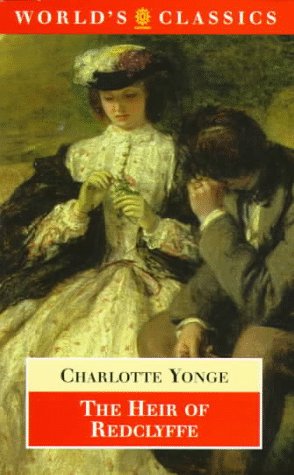
The Heir of Redclyffe I was supposed to be writing about Kristin Lavransdatter today – it was the book chosen for me in the last Classics Club Spin and today is the deadline for reading it – but there’s been a change of plan. For the last few weeks I’ve been engrossed in a completely different classic novel, so Kristin has had to wait. I’ve started reading it at last (and like what I’ve read so far) but for today, I’m going to talk instead about The Heir of Redclyffe.

When the elderly Sir Guy Morville dies, his title and his estate of Redclyffe pass to his grandson, another Guy. Being only seventeen years old, the new Sir Guy is taken in by another branch of the family, the Edmonstones, who provide him with a home and an education. With his generous, warm-hearted nature, Guy quickly wins the respect of Mr and Mrs Edmonstone, the friendship of three of his cousins – Charles (crippled with a disease in the hip), the beautiful Laura, and little Charlotte – and the love of the fourth, Amabel (known as Amy). In fact, the only person who doesn’t seem to like Guy is Philip Morville, another cousin.

To Guy’s dismay, Philip – who happens to be the next heir to Redclyffe – makes no secret of his dislike for him. Philip is a well-educated, confident and accomplished young man, and based on a long-ago family rivalry, is determined to disapprove of Guy, finding fault with everything he does. After Guy and Amy declare their love for each other, Philip decides to do everything he can to put a stop to their marriage. Meanwhile, he himself has fallen in love with Amy’s sister, Laura, but due to his financial situation he is reluctant to make their romance public and so he asks Laura to keep their relationship secret from her parents.

And that’s really all I want to say about the story, as it does become quite convoluted and I wouldn’t want to spoil things for future readers. I knew very little about this novel before I started it (although I remember that Lisa enjoyed it a few years ago) and part of the pleasure in reading it was wondering how things would turn out for Guy and Amy, Philip and Laura, and the others. Yonge took me completely by surprise once or twice with some plot developments that I hadn’t expected, one of which was very sad – although I would have been prepared for that if only I’d remembered that in Little Women, Jo March is found “eating apples and crying over The Heir of Redclyffe”!

I liked Guy – it would probably be difficult not to – and I also liked Amabel, although it irritated me that she is always referred to (by herself and others) as ‘silly little Amy’ when it’s obvious that she has far more sense and strength of character than anybody gives her credit for. I never felt that I really knew or understood Laura, but as for Philip, I found him completely annoying, arrogant and overbearing. He’s not a villain exactly (there are no villains in this book – only flawed human beings) and he does seem to believe that he’s acting with the best intentions, but those actions cause a lot of unnecessary misery for a lot of people. My favourite character, though, was probably Charles, one of the few people prepared to stand up to Philip and say what he thinks, while also trying to come to terms with his own illness and disability.

First published in 1853, The Heir of Redclyffe was a popular bestseller throughout the 19th century, yet how many people still read this book today? It seems that Charlotte Mary Yonge’s novels haven’t stood the test of time as well as books by other female Victorian authors, which is a shame as I found a lot to like about The Heir of Redclyffe. Maybe it’s too sentimental for modern tastes and with too much emphasis on faith and spirituality – not that any of those things stopped me from enjoying this book. I would definitely consider reading more of Yonge’s work in the future!

The Return of the Native by Thomas Hardy

The Return of the Native Egdon Heath, part of Hardy’s fictional Wessex, is a wild and haunting place, steeped in history and superstition. Many of the people who live and work there love the heath and appreciate its beauty, but there are some – including Eustacia Vye – who find the loneliness oppressive. Eustacia, who lives with her grandfather in an isolated cottage on the heath, is desperately looking for a way to escape and believes she has found it in Clym Yeobright.

Clym is the returning native of the title, home for Christmas from Paris where he has been working as a diamond merchant. Clym, who dislikes the diamond trade, is planning to stay at home and become a schoolmaster, but Eustacia sets her sights on marrying him in the hope that she can persuade him to take her back to Paris. After all, there is nothing to keep her on Egdon Heath now that her former lover, the innkeeper Damon Wildeve, has married Clym’s cousin, Thomasin.

Clym’s mother, Mrs Yeobright, is opposed to the idea of both marriages – her son’s with Eustacia and her niece’s with Wildeve – but although she reluctantly accepts Thomasin’s decision, a series of misunderstandings and disagreements damages her relationship with Clym and this will have tragic consequences.

I have mentioned five of the novel’s six main characters so far: the sixth is Diggory Venn, a reddleman (a seller of red ochre, which farmers use to mark their sheep). Diggory is in love with Thomasin and remains quietly devoted to her even after she marries Wildeve. The lives of these six people will draw closer together, with the actions of each one impacting on all of the others. For some, there will be a happy ending, but for others there will be only unhappiness and tragedy.

The Return of the Native was Thomas Hardy’s sixth published novel and first appeared as a serial in 1878. I’ve read almost half of his novels now and always enjoy my visits to Wessex and my glimpses of rural life in the 19th century. This book has a very memorable and atmospheric setting, with the heath itself being at the centre of the story. The way in which the lives of the characters are shaped by the heath is one of the driving forces of the plot, particularly as Clym and Eustacia have such different feelings about it:

Take all the varying hates felt by Eustacia Vye towards the heath, and translate them into loves, and you have the heart of Clym.

A common theme in Hardy’s novels is the progress of the industrial revolution and nostalgia for a way of life that, even in Hardy’s day, was rapidly disappearing. An example of this in The Return of the Native is the character of Diggory Venn, the reddleman, whose skin and clothes are stained with the red dye that he sells.

The traveller with the cart was a reddleman — a person whose vocation it was to supply farmers with redding for their sheep. He was one of a class rapidly becoming extinct in Wessex, filling at present in the rural world the place which, during the last century, the dodo occupied in the world of animals. He is a curious, interesting, and nearly perished link between obsolete forms of life and those which generally prevail.

We also meet some of the local people who live on Egdon Heath – many of whom work as furze (gorse) cutters. These characters provide some moments of comedy and also allow Hardy to explore some of the superstitions, customs and traditions of the region (one of the most memorable scenes occurs near the beginning of the book when dozens of bonfires are lit all around the heath).

As I mentioned above, not all of the characters in the novel are rewarded with a happy ending – but this is something you have to be prepared for with Hardy. The story does finish on a more positive note, although it was interesting to read the footnote at the end explaining that the ending was originally going to be slightly less positive and was changed during the serialisation of the novel.

I loved The Return of the Native, though not as much as some of the other Hardy novels I’ve read. I have one more to read on my Classics Club listThe Woodlanders – which I’m looking forward to reading.

The Odd Women by George Gissing

George Gissing - The Odd Women Published in 1893, George Gissing’s novel is based around the idea that there were at least half a million more women than men in Victorian England. As one of the characters in the story, Rhoda Nunn, explains:

“So many odd women – no making a pair with them. The pessimists call them useless, lost, futile lives. I, naturally – being one of them myself – take another view.”

Rhoda believes that it is possible for these ‘odd’ (that is, unmarried) women to lead lives that are both happy and useful. In partnership with her friend, Mary Barfoot, she runs an establishment in London where young middle-class women can learn typing and other secretarial skills that will enable them to earn a living if they remain single. Rhoda herself is now in her thirties and has no intention of marrying, but when Miss Barfoot’s cousin Everard comes to visit she is tempted to change her mind.

The Odd Women is also the story of Rhoda’s friends, the Madden sisters, faced with having to support themselves after the death of their father. With so few career choices available to them, the two elder sisters, Alice and Virginia, find work as a governess and a paid companion, while dreaming of opening their own school one day – a dream that is unlikely to ever become a reality. The youngest Madden girl, Monica, is working long hours in a draper’s shop and her future looks no brighter than her sisters’…until she receives a marriage proposal from Edmund Widdowson, a retired clerk much older than herself. Aware that this could be the only opportunity she gets, Monica jumps into marriage with a man she knows she doesn’t love.

When I first started to read The Odd Women, it seemed that Alice and Virginia were going to be the main focus of the novel, but that turned out not to be the case. Instead, the two elder Madden sisters quickly move into the background and we focus almost solely on the alternating storylines of Rhoda and Monica. Through the character of Rhoda, Gissing explores the views of a woman determined to resist marriage and make her own way in life, and through Monica he looks at the fate of a woman who chooses to marry simply because she is afraid of what her life will become if she stays single.

This is a fascinating novel and for a book written in the 1890s it feels very modern. With themes including feminism, marriage and the roles of women, it’s not the sort of book you would usually expect from a male Victorian author. It reminded me very much of Alas, Poor Lady by Rachel Ferguson. Both books show how women in Victorian/Edwardian society tended to be poorly prepared for an unexpected change in circumstances and how few options were open to them when they found themselves in need of employment.

I found this novel very readable, although the long discussions between Rhoda and Mary Barfoot did become a bit tedious at times and often felt more like lectures on feminism than believable conversations between two people (and I was disappointed that, while being so open-minded regarding unmarried middle-class women, they didn’t have the same sympathy for working-class women). Other than that, I enjoyed The Odd Women much more than I thought I would – although enjoyed is maybe not the right word to use, as this is really quite a bleak story. I would like to read more of George Gissing’s books, starting with New Grub Street, I think.

Cousin Bette by Honoré de Balzac

Cousin Bette Balzac is an author I have wanted to try for years but have kept putting off, partly because I thought he sounded intimidating and difficult to read and partly because he wrote so many books it was hard to know where to start! Then, last month I chose ten books at random from my Goodreads “to-read” shelf – and one of them was Cousin Bette, a novel I couldn’t even remember adding to my shelf in the first place, but which sounded very appealing. I obviously couldn’t put off reading Balzac any longer!

Cousin Bette (originally La Cousine Bette and sometimes translated as Cousin Betty) was published in 1846 and is set in 19th century Paris. The title character is Lisbeth – Bette – Fischer, a relation of the Hulot family who has always been jealous of her beautiful cousin Adeline. Plain, poor, and having turned down several marriage proposals, Bette is still unmarried at the age of forty-two. When she rescues a young Polish sculptor, Wenceslas Steinbock, from a suicide attempt and takes him under her wing, she is pleased to be able to tell everyone that she has a lover at last. Her happiness is shattered, however, when Adeline’s daughter, Hortense, falls in love with Wenceslas and marries him herself.

Bette vows to take revenge on the Hulot family and joins forces with Valerie Marneffe, her pretty young neighbour. Knowing that Adeline’s husband, the Baron Hulot, is a notorious womaniser and that Valerie is looking for a rich lover, Bette sees a way to ruin the Baron and destroy the rest of the family in the process.

I enjoyed Cousin Bette and I think it was a good choice for my first Balzac novel. I found it surprisingly easy to read and very entertaining, although I did need to concentrate to follow all the intricacies of the plot. The summary I have given above is only the beginning of the story; Bette is by no means the only character who plots and schemes and tries to cause trouble – and in fact, many of the misfortunes that befall members of the Hulot family are caused by their own personal weaknesses and flaws rather than the influence of others. Baron Hulot, for example, despite being one of the targets of Bette and Valerie’s cruelty, really only has himself to blame as he is unable to resist the temptation placed in his way.

I saw the three main female characters – Cousin Bette, Valerie Marneffe and Adeline Hulot – as representing three stereotypical views of 19th century women of different classes and social groups. Bette is the bitter, jealous middle-aged spinster, Valerie the selfish, manipulative beauty, and Adeline the faithful, loving wife who turns a blind eye to her husband’s many affairs. Any reader who is interested in gender roles and the portrayal of women in literature will find a lot to think about in Cousin Bette.

Before reading this novel I had no idea what the outcome of the story would be and I was kept in suspense until the end. Of course, I’m not going to tell you how it ends, but it’s not quite as simple as the ‘good’ characters being rewarded and the ‘bad’ ones being punished. It’s all very melodramatic – and all very bleak as well – but I enjoyed it and am looking forward to reading more Balzac. As he wrote more than one hundred books, I would love to know if you’ve read any of them and which ones you would recommend.

The Luminaries by Eleanor Catton

The Luminaries This is the novel that won the Booker Prize in 2013 but despite the hype surrounding it at the time and the fact that it did sound like a book I would enjoy, I have been putting off reading it, mainly because of its length. As well as the Booker Prize, though, it was also nominated for the Walter Scott Prize in 2014 and as I’m slowly working through the shortlists for that particular prize, I decided it was time I read it.

The Luminaries is set in the New Zealand town of Hokitika during the Gold Rush of the 1860s. The story revolves around several strange occurrences which all take place on the same night in January 1866: Emery Staines, one of the town’s richest men disappears without trace; prostitute Anna Wetherell collapses in the street in what is thought to be a suicide attempt; and the reclusive Crosbie Wells is found dead in his own home, surrounded by a large quantity of hidden gold. These things may not seem to be connected at first, but of course they are – as is everything else that happens throughout the 800 pages of this very clever and complex novel.

The first and by far the longest section of the book begins with the arrival of Scottish lawyer, Walter Moody, who is hoping to make his fortune on the goldfields. On his first evening in Hokitika he walks into the Crown Hotel to find that he has interrupted a meeting between twelve men who have gathered to try to make sense of what has been happening. These twelve men are all linked in some way with Emery, Anna, Crosbie or all three – and as Walter listens to their stories he too is drawn into the mystery.

In the sections of the novel that follow – each one half the length of the one before – we move forwards and then backwards in time learning more about each of the main characters and the events leading up to the night of 14th January 1866.

The decreasing length of the chapters corresponds with a waning moon (hinted at by the images on the front cover), one of many astrological elements Eleanor Catton has incorporated into the novel. The character list at the front of the book lists the twelve men who meet in the hotel under the heading ‘Stellar’ and each one is associated with a sign of the Zodiac, while the other characters are listed as ‘Planetary’. Each of the twelve sections of the book begins with an astrological chart and within each section the individual chapters have astrological titles. This was intriguing at first but as I don’t have a lot of interest in astrology it didn’t mean much to me and I quickly gave up trying to interpret it and concentrated on following the story instead.

I have seen lots of comparisons between The Luminaries and the Victorian sensation novels of Wilkie Collins, one of my favourite authors, but I’m not sure if I really agree with that comparison. The book does include lots of elements of the sensation novel (hidden treasure, opium addiction, double identities, séances, forgeries and family secrets) but Eleanor Catton’s writing, in my opinion, lacks the flair and humour of Wilkie Collins’ and the gift for creating strong, unforgettable characters. Apart from one or two, the twelve men of the Crown felt interchangeable and I had to keep looking back at the character list to remind myself which was which. The other eight were slightly stronger (they were the Planetary characters and the ones who tended to drive the story forward) but of these, Anna Wetherell was the only one I really came to care about.

I did enjoy reading The Luminaries, though, and can definitely see why it has been so successful. I was very impressed by the intricate plotting with facts and secrets being slowly unveiled and connections between the characters gradually revealed. I also loved the setting; I have read very few novels set in New Zealand and I certainly haven’t read any set in a New Zealand gold mining town in the 1860s! Because Hokitika is a real place, I could find lots of pictures online which really helped to bring the setting to life. The length of the book wasn’t a problem for me either; the pages seemed to go by much more quickly than I’d expected them to – especially in the second half, where the chapters become shorter and the pace becomes faster.

I know there were a lot of things happening in The Luminaries that I didn’t completely understand (especially all of the allusions to astrology) and lots of little details that I missed. I would probably have to read the book again to be able to fully appreciate it, but for now I’m happy just to have read it once and to have enjoyed it!

Alias Grace by Margaret Atwood

Alias Grace This is only the second book I’ve read by Margaret Atwood. The first was The Handmaid’s Tale, which I read in December 2012 and loved; thinking about which one to read next, Alias Grace sounded the most appealing to me but it wasn’t until it was selected for my Ten From the TBR project last month that I actually got round to reading it.

Alias Grace is a work of fiction based on a true story: the story of Grace Marks, a woman sentenced to life imprisonment for murder in 1840s Canada. Grace (who was only sixteen at the time) and her alleged accomplice, James McDermott, were accused of the murders of their employer, Thomas Kinnear, and his housekeeper, Nancy Montgomery. Grace has been in the Kingston Penitentiary for fifteen years when Simon Jordan, a doctor with an interest in criminal behaviour, decides to visit her as part of his research.

Although Grace claims to have no memory of the murders, she does have plenty of other memories which she gradually shares with Dr Jordan: her childhood in Ireland, her journey across the Atlantic and arrival in Canada, her first job as a maid and her friendship with a girl called Mary Whitney – and finally, the time she spent in Kinnear’s household prior to the murders.

As Dr Jordan listens to her story unfold, he tries to make up his mind about Grace. Is she being completely honest with him? Is she really guilty of the crimes of which she has been accused? Margaret Atwood doesn’t offer any answers here; it is left up to the reader to decide – but proving Grace’s guilt or innocence is not really the point of this book. Grace’s life story is interesting in itself, giving us some insights into what it was like to be an Irish immigrant in the 19th century, and the novel also explores attitudes towards women and towards mental illness at that time.

Alias Grace is a fascinating blend of fact and fiction. Grace Marks really existed but although Atwood states in her author’s note that she has not changed any of the known facts regarding the murder case, there were enough gaps in the records to allow her to invent parts of the story. Simon Jordan is a fictional character, but his inclusion in the novel adds another perspective – and also another layer, because we can never be sure whether Grace is telling him the truth or just saying what she thinks he would like to hear. Hannah Kent uses a similar device in Burial Rites and as I read, I did keep being reminded of Burial Rites (although Alias Grace was published first, of course).

I loved Alias Grace, but it’s a very different type of book from The Handmaid’s Tale, which has made me curious about the rest of Margaret Atwood’s novels. Which one do you think I should read next?

Rebel Queen by Michelle Moran

Rebel Queen I love historical fiction set in India and was instantly intrigued when I saw that Michelle Moran’s new novel, Rebel Queen, was described as the story of Rani Lakshmibai who rebelled against the British by ‘raising two armies — one male, one female — and riding into battle like Joan of Arc.’ Once I started to read the book, I found that it wasn’t quite what I’d expected, although that wasn’t necessarily a bad thing. I have read two of Michelle Moran’s other novels and while I think my favourite of the three is still The Second Empress, I still enjoyed this one and thought it was much better than Cleopatra’s Daughter.

Rani Lakshmibai (or Lakshmi as she is called throughout this novel) rules the state of Jhansi along with her husband, Raja Gangadhar Rao, until his death in 1853. As the raja has died leaving no biological male heir, Jhansi is annexed by the British East India Company, and during the Indian Rebellion of 1857 the rani and her people find themselves caught up in the middle of the conflict. By the rani’s side are her ten Durgavasi – a small, elite group of highly-trained, highly-skilled women who serve as both guards and trusted friends. It is through the eyes of one of these women, Sita Bhosale, that the story of Jhansi unfolds.

Sita Bhosale grows up in a small village many miles from the city of Jhansi and, like the other village girls and women, she lives in purdah, secluded from the view of men outside her family. After her mother dies in childbirth, her father tells her that there will not be enough money to provide a dowry for both Sita and her little sister. With very few options open to a young woman who fails to marry well, he suggests that she begin training for a position in the Durga Dal, the rani’s personal guard. Following several years of hard work, Sita has learned all the skills she needs – she can ride a horse and knows how to use a sword, a pistol and a bow – and soon she is on her way to Jhansi to become the rani’s newest Durgavasi.

As our narrator, Sita is a character who is easy to like. I enjoyed watching her train for the Durga Dal, I was fascinated by her descriptions of her early days in Jhansi where everything – the rani and raja’s court, life in the palace, the absence of purdah – is new and strange, and I sympathised as she found herself the target of the raja’s beautiful, scheming cousin, Kahini, one of her fellow Durgavasi. But from the title, Rebel Queen, and the description of the novel, I had expected this to be the story of Rani Lakshmibai rather than the story of Sita. We don’t really get to know the rani at all until the second half of the novel and only a few chapters at the end are spent on the events of the Sepoy Rebellion (the promised ‘raising of armies and riding into battle’), which was disappointing.

The author assumes the reader has no prior knowledge of Indian culture or history, so she has Sita explain to us how the British East India Company came to be in India, the meanings of customs such as purdah and the Hindu caste system, and the basics of Ayurvedic medicine. While I already knew some of the things Sita tells us, there were still lots of facts and details that were new to me, so this was both an entertaining and an educational read. However, I was surprised to read that the British were flying ‘the red and black Union Jack’ from the buildings of Jhansi, and this made me wonder about the overall accuracy of the novel!

Despite the few problems I’ve mentioned, I did find this an interesting and compelling story. I do think it would have been good to have had at least part of the novel written from the rani’s perspective, but I still enjoyed getting to know Sita and the women of the Durga Dal.

Note: This book has been published in the UK as The Last Queen of India and I think the UK title and description are more appropriate, giving a better idea of what the story is about. However, I have referred to the US edition throughout this post, as this was the version I received for review through NetGalley.