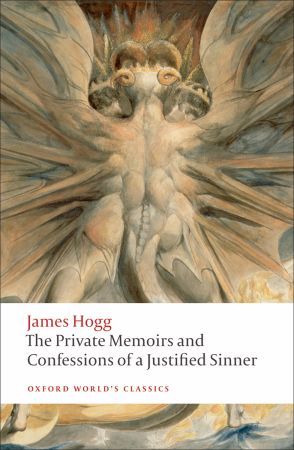
The Private Memoirs and Confessions of a Justified Sinner by James Hogg

The Private Memoirs and Confessions of a Justified Sinner My sister gave me a copy of this book saying it was one of the weirdest books she’d ever read and she thought I would love it. I’m not sure what that says about my reading tastes, but she was right anyway because I did love it!

The Private Memoirs and Confessions of a Justified Sinner, published in 1824, was written by the Scottish poet and novelist James Hogg. I had never come across Hogg and his work until now and was interested to learn that he was a shepherd who taught himself to read and write and became a friend of Sir Walter Scott. This, his most famous novel, is part horror story, part murder mystery and part gothic fiction, but it also incorporates elements of religion, Scottish folklore, the supernatural and even some humour and satire.

Robert Wringhim, the ‘justified sinner’ of the title, is a young man who has been raised by his adoptive father, a Calvinist, to believe he is one of the chosen few, destined for a place in Heaven regardless of the sins he commits in life. One day he meets a mysterious stranger who calls himself Gil-Martin and who seems able to change his appearance at will. Wringhim allows the stranger to convince him that it’s his duty to “cut sinners off with the sword” and that he doesn’t need to worry about committing murder as in this case it’s the right thing to do and he is sure to be saved by God anyway. In his Private Memoirs and Confessions, he describes how he falls under the spell of the sinister Gil-Martin and how, when he begins to have doubts about his new friend, he starts to descend into madness and desperation.

Robert Wringhim’s Confession is presented as an authentic document that has been discovered under unusual circumstances a century later. It is introduced by a Narrative written by a fictitious editor which gives a supposedly factual account of Wringhim’s life and the crimes he is involved in. The Editor’s Narrative also forms the third and final section of the novel and attempts to explain how the Confession was found and what it might mean. But instead of helping to clarify the story, the Editor actually makes things more confusing and sometimes even contradicts what Wringhim has said. Neither narrative seems to be very reliable and at the end of the novel, we have to decide for ourselves what really happened. For example, it’s not clear whether Gil-Martin is a product of Wringhim’s imagination or whether he is a real person or even the Devil.

This book kept me gripped from the first page, but it was quite a challenging story to read. There was a lot of Scottish dialect and while that’s not something I usually have a problem with, many of the words used here were unfamiliar to me and I was constantly turning to the glossary at the back of the book. There were also a large number of Biblical references on almost every page and again, I found that I kept needing to refer to the notes. It wasn’t completely essential to recognise or understand all of these references, but it was important to know how the various characters were interpreting them. Finally, there are no chapter breaks – the middle section, the Confession, forms one continuous chunk of over 100 pages, making it hard to find a place to stop reading.

However, it was definitely worth having to make a bit of extra effort; this is one of the most fascinating and original classics I’ve read and I can’t believe it isn’t better known. I thought it was much better than Robert Louis Stevenson’s Dr Jekyll and Mr Hyde, which is the book it reminded me of most. I’m also surprised that, as far as I’m aware, it has never been adapted for film or television. Some parts of the novel are very visual – the atmosphere of the dark wynds and closes of Edinburgh; the description of the rainbow seen by Robert Wringhim’s brother, George; and some of the scenes where Wringhim finds himself hounded and tormented by fiends and demons. I loved this book and am very grateful to my sister for recommending it!

The Small House at Allington by Anthony Trollope

The Small House at Allington This is the fifth of Anthony Trollope’s Chronicles of Barsetshire, a series of six novels set in the fictitious county of Barsetshire. I’ve read the first four and enjoyed them all, so I knew what to expect when I picked up The Small House at Allington. I have discussed Trollope’s writing style in my posts on the previous books in this series but will repeat that if you like Victorian authors who talk directly to the reader, who create well-rounded and nuanced characters and who fill the pages of their novels with gentle humour and insightful observations on human nature, then I would highly recommend trying the Barsetshire series.

The Small House at Allington (not to be confused with the adjacent Great House, home of the Squire of Allington, Christopher Dale) is where the Squire’s widowed sister-in-law, Mary Dale, lives with her two daughters, Bell and Lily. When Lily falls in love with Adolphus Crosbie, a friend of her cousin Bernard’s, he proposes and she accepts. After discovering that the Squire is not planning to give his niece a dowry, Crosbie begins to reconsider their engagement and during a visit to Courcy Castle he becomes engaged to another woman – Lady Alexandrina de Courcy, whose family, he hopes, will help him to rise in the world. Even after learning how she has been betrayed, Lily swears that she still loves Crosbie and will never marry anyone else, but will she change her mind when she discovers that she has another admirer?

The other man in love with Lily is Johnny Eames, a junior clerk who works at the Income Tax Office in London. At the beginning of the story, Eames is a shy, awkward young man described as a ‘hobbledehoy’ (isn’t that a great word?) and is apparently based on the young Trollope himself. As Johnny begins to gain more experience of the world and grows in confidence, will he ever find the courage to escape the clutches of his landlady’s daughter Amelia and propose to Lily?

Trollope devotes such a lot of time to introducing us to his characters – giving us every detail of their appearance and personality, describing their emotions and taking us through every step of their thought processes as they struggle to deal with the various dilemmas they find themselves facing. This has the effect of making his novels very long, but it also means that his characters feel like real, believable human beings. You won’t necessarily like all of them, but there will always be a few you can understand and identify with. Adolphus Crosbie, for example, could be seen as the ‘villain’ of the book, but he is also a complex and realistic character. He knows he’s doing the wrong thing but still can’t seem to stop himself from doing it and is punished by finding himself trapped in a loveless marriage to Lady Alexandrina.

One character I could not understand or identify with was Lily Dale! It was so frustrating that even after the way Crosbie treats her she insists that she loves him and forgives him and will think of herself as a widow for the rest of her life. I don’t know how her mother and sister managed to have so much patience with her (although being patient was maybe not the best way to deal with Lily – in Trollope’s day Lily might have seemed an admirable, romantic character but to me she came across as silly and irritating). There are some great female characters in the Chronicles of Barsetshire – Miss Dunstable, Mary Thorne, Eleanor Harding – but Lily is not one of them. I thought Bell, the other Dale sister, was a much more interesting heroine, although her storyline in which the Squire tries to convince her to marry her cousin Bernard, a man she likes but doesn’t love, is given less attention than Lily’s.

We also meet a variety of other interesting characters in this book; my favourites this time were the good-natured, well-meaning Earl de Guest, his sister Lady Julia, and the inhabitants of Mrs Roper’s boarding house in London. A few of our old friends from earlier in the series are here again too; Lady Dumbello (the former Griselda Grantly) appears in an amusing sub-plot involving Plantagenet Palliser, who I’m looking forward to reading more about in the Palliser series. There’s also a very brief appearance from Mr Harding, one of my favourite characters from The Warden and Barchester Towers, and I was disappointed that we didn’t see more of him.

It’s not often that Trollope surprises me (his plots are usually so predictable he sometimes even tells us in the first chapter what is going to happen in the rest of the book) but this time he did. While some of the characters got their happy ending – or unhappy ending in some cases – for others it felt that things had been left unresolved and so the story did not end in quite the way I would have expected at the beginning.

The Small House at Allington was apparently our former Prime Minister, John Major’s, favourite book. It isn’t mine, or even my favourite of the Barsetshire novels, but despite being irritated by Lily I did still love it and thought it was an improvement on the previous one, Framley Parsonage, which I had found slightly disappointing after the wonderful Barchester Towers and Doctor Thorne. I am now looking forward to reading The Last Chronicle of Barset and finishing the series!

A Long Fatal Love Chase by Louisa May Alcott

Until recently I hadn’t realised what a diverse writer Louisa May Alcott was. Like many people I read Little Women and its sequels as a child – and Little Women is still one of my favourite books – but I never thought about exploring her other fiction until now. A Long Fatal Love Chase is a suspense novel, written in 1866 but never published in Alcott’s lifetime (it was eventually published in 1995). I didn’t even know Alcott had written books like this, so I’m glad I have now been enlightened!

Rosamond Vivian, eighteen years old at the beginning of the novel, lives with her cold-hearted grandfather in a mansion on a remote island. Bored and lonely, feeling unloved by her grandfather, Rosamond longs for some adventure in her life. When she loses her temper with the old man one day and tells him she would gladly sell her soul to Satan for a year of freedom, it seems that her wishes are about to come true.

That same day, Phillip Tempest arrives (during a storm, of course) to do some business with Rosamond’s grandfather. Tempest, who we are told resembles a painting of the demon Mephistopheles, is handsome, charming and surrounded by an aura of mystery. Rosamond is instantly attracted to him and soon Tempest sweeps her away with him on his yacht. But Rosamond’s happiness doesn’t last for long. When she makes some shocking discoveries about Tempest she decides to leave him…but it seems Tempest is not prepared to let her go.

The rest of the story is, as the title suggests, a long and fatal love chase in which Rosamond flees across France, Germany and Italy from chateau to convent to asylum with Tempest never far behind. The tension builds and builds; almost every chapter ends on a cliffhanger as Rosamond finds herself in danger yet again. With Tempest growing more and more obsessed and increasingly devious in the methods he uses to track down her hiding places, will Rosamond ever be able to escape?

As you’ll be able to tell by now, A Long Fatal Love Chase is not like Little Women at all, but that shouldn’t be a problem as long as you’re not expecting it to be (which I wasn’t). Just be aware of its sensational nature and be prepared for something over-the-top and melodramatic. There’s a lot of symbolism too and as well as the Mephistopheles reference I mentioned earlier there are many other allusions to mythology, art and literature, particularly Shakespeare – with a character whose name is Tempest, I suppose that’s not surprising!

If you have read Little Women and remember Jo writing her novels, it’s easy to imagine Jo sitting in her garret writing a story like this and persuading Meg, Beth and Amy to act out some of the scenes with her! It wasn’t the best book of this type that I’ve read, especially in comparison to the more complex sensation novels written during the same period by Wilkie Collins, Mary Elizabeth Braddon or Ellen Wood, but it was still exciting, entertaining and also quite daring for its time, with its themes of obsession and stalking. It has a lot in common with early gothic novels by authors such as Ann Radcliffe too, though with the advantages that this one is easier to read and Rosamond is a stronger character than the heroines of Radcliffe’s books.

Apart from Rosamond, the other characters in the novel are less well-developed and tend to represent either the good side of human nature (the priest who becomes Rosamond’s friend and confidant) or the bad (Tempest). From the moment he first appears in the novel, Tempest is such an obvious villain and there are so many hints and so much foreshadowing, that it’s easy for us, as the reader, to know that he is not to be trusted. Rosamond is a young, naïve girl (though not without a lot of courage and spirit) being taken advantage of by a ruthless and manipulative older man, and it takes her a lot longer than it takes the reader to discover that something is not right. But despite so much of the plot being predictable, some of the twists did still take me by surprise and the ending was not quite what I had expected either!

If you’ve enjoyed this book, I would also recommend Nine Coaches Waiting by Mary Stewart – although they were written almost 100 years apart I thought they had a very similar feel.

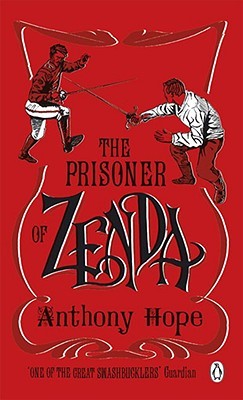
The Prisoner of Zenda by Anthony Hope

At the beginning of The Prisoner of Zenda, twenty-nine-year-old English gentleman Rudolf Rassendyll is leading a quiet, comfortable life in London, not working or doing anything at all, to the annoyance of his sister-in-law, Rose. To keep her happy, Rudolf agrees to accept a position working for the ambassador Sir Jacob Borrodaile, but finding himself with some free time before he starts his new job, he decides to visit the small European country of Ruritania to see the coronation of their new King.

Ruritania is almost, but not quite, a fantasy world. You won’t find it on a map – it’s a fictitious kingdom located somewhere in central Europe – and although there are no magical creatures, wizards, monsters or dragons, it is still a place where strange and unexpected things can and do happen. Soon after arriving there, Rassendyll meets his exact double – the man who is about to be crowned King of Ruritania, whose name also happens to be Rudolf. The likeness is explained by the fact that the two Rudolfs are distant cousins and both have the long, sharp, straight nose and dark-red hair that appear every few generations.

On the eve of his coronation, the King is drugged by his villainous half-brother, Black Michael, the Duke of Strelsau, who is hoping to steal both the King’s throne and the woman he is going to marry, the beautiful Princess Flavia. With the King unconscious and unable to appear at the coronation, his attendants persuade Rassendyll to impersonate the King at the ceremony. The coronation goes ahead as planned, but Rudolf’s impersonation doesn’t end there – the real King has been kidnapped and imprisoned in a castle in the town of Zenda. Rassendyll must continue to take his place until he is rescued, but things become more and more dangerous for Rudolf as he finds himself caught in the plots and schemes of Black Michael and his henchman Rupert of Hentzau. And as if life wasn’t already complicated enough, he also begins to fall in love with Princess Flavia…

I put this book on my list for the Classics Club, intending to read it at some point in the next few years, but I didn’t really know what it was about and was in no hurry to get to it. Then I read Lisa’s review and it sounded so exactly like the kind of book I would love that I was inspired to move it straight to the top of my list. Having somehow managed to go through life without seeing any of the film versions, I didn’t know anything about the plot, though as I read the book parts of it did feel familiar, maybe because it has been the inspiration for so many other adventure stories.

The Prisoner of Zenda was written near the end of the Victorian period, in 1894, though I found it a lot lighter and easier to read than most Victorian novels. It’s also a very short novel (only around 200 pages in the edition I read) but the kingdom of Ruritania, with its woods, castles and palaces, and the people who inhabit it are well developed and unforgettable. One of my favourite characters was Rupert, so I was pleased to discover there is a sequel, Rupert of Hentzau, which I’m looking forward to reading.

“One of the great swashbucklers” it says on the cover of the Penguin Classics edition of this book, and I would agree, although I did prefer Scaramouche by Rafael Sabatini and The Scarlet Pimpernel by Baroness Orczy, both of which I read this year and loved. 2012 seems to be turning into the year of the swashbuckler for me, doesn’t it? I did still enjoy this one though; it was entertaining, fast-paced and a lot of fun to read. I recommend saving it for a dull, dreary afternoon when you want nothing more than to be whisked away to a world of action, adventure, kings, princesses, evil brothers, mistaken identities, swordfights, romance, castles, kidnappings and daring escapes!

The English Monster by Lloyd Shepherd

Well, this was one of the most unusual books I’ve read for a long time! It got off to a great start and after reading the first few chapters (in which we witness six pirates being hanged at London’s Execution Dock, go on a midnight journey through the dark streets of 19th century Wapping, and meet a sea captain at an inn in Plymouth) I was beginning to feel very excited about this book. It seemed destined to become one of my favourites of the year, although by the time I finished it, I did feel a little bit less enthusiastic about it.

The novel consists of two alternating stories set in different time periods, but while they may appear to be entirely separate at first, there is in fact a link between the two of them. The way in which they are linked is not immediately obvious so I’ll leave you to discover the connection for yourself.

The first story, set in the Regency period, is based on a true crime which involved the killing of members of two different families in the Wapping area of London in December 1811. These deaths became known as the Ratcliffe Highway Murders. There was no official police force in England at that time and the way the case was handled was amateurish and incompetent. The English Monster introduces us to John Harriott, the magistrate of the Thames River Police Office, and Waterman-Constable Charles Horton as they attempt to investigate the murders.

The second thread of the novel, beginning in October 1564, is a good old fashioned swashbuckling adventure story following Billy Ablass, a young man who decides to go to sea to make his fortune and finds himself aboard a ship owned by Queen Elizabeth I, ready to embark on England’s first official slaving voyage. Or at least, I thought I was reading a good old fashioned adventure story – until I came to a very surprising and dramatic twist that made it obvious this was definitely not going to be a conventional historical fiction novel or a conventional murder mystery either. And of course I’m not going to tell you what the twist is – you’ll have to read the book yourself to find out.

When a novel has multiple timelines, I usually find I’m drawn to one period more than the other but with this book I think I can honestly say I enjoyed them both equally. The Ratcliffe Highway story was fascinating, especially the insights we are given into how useless and inadequate the investigation was. I found Charles Horton a very interesting character: a ‘detective’ working in an era when modern methods of detection were almost non-existent. I believe Horton and the magistrate John Harriott are going to reappear in Lloyd Shepherd’s next book and I’m looking forward to meeting them again.

The Billy Ablass sections of the novel were very compelling too, although some of the scenes that dealt with the cruelty and brutality of the slave trade were uncomfortable to read, as you might expect. Unfortunately though, slavery is part of our history and we can’t ignore the fact that it happened. A lot of real historical figures make an appearance throughout these chapters, such as Francis Drake (who is usually thought of as an Elizabethan hero but was also involved in the slave trade), the Welsh pirate Henry Morgan, the notoriously violent buccaneer L’Ollonais, and John Hawkyns, captain of England’s first slave ship. At the end of the book there’s an interesting note from the author in which, among other things, he explains how much of his portrayal of these characters is based on fact and how much is purely fiction.

As a first novel, I thought The English Monster was very impressive. I’m not sure I wouldn’t have preferred the straightforward historical fiction novel the book had initially seemed to be and that’s why some of my enthusiasm faded slightly as I got further into the story, but there’s no doubt Lloyd Shepherd has come up with something very different and very imaginative here. I’m already looking forward to the sequel, The Poisoned Island.

Thanks to Simon & Schuster for sending me a review copy of this book

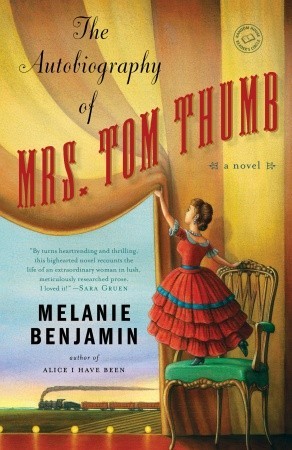
The Autobiography of Mrs Tom Thumb by Melanie Benjamin

Despite the title, this is not a real autobiography, but a fictional account of the life of Mercy Lavinia Warren Bump. Measuring only two feet eight inches tall, Vinnie is described as ‘a perfect woman in miniature’. Not content to spend her life living on her family’s farm in Middleborough, Massachusetts, she works briefly as a schoolteacher before leaving home to perform with Colonel Wood’s riverboat show. Wood, who claims to be a cousin, promises to make Vinnie famous as an entertainer but it soon becomes obvious that he has other plans for her and she returns home disillusioned.

Determined not to give up on her dreams, Vinnie contacts the great showman P.T. Barnum and soon becomes a celebrity, travelling the world and meeting presidents and royalty. Her wedding in 1863 to another small person, Charles Stratton, known as General Tom Thumb, captures the imagination of both the press and the public. But when her younger sister Minnie, who is even smaller than herself, is also drawn into the world of show business, Vinnie fears it could all end in tragedy.

I enjoyed Melanie Benjamin’s previous novel, Alice I Have Been, which told the story of the girl who inspired Lewis Carroll’s Alice’s Adventures in Wonderland, so I’ve been looking forward to reading more of her work. And I enjoyed this book too. There were plenty of things to admire about Vinnie – she had lots of courage, lots of confidence and dignity, and lots of ambition. Instead of staying in the safety of her home which would certainly have been the easiest thing to do, she wanted to get out and see the world, to have new experiences and to build a successful career for herself. I’ve never really stopped to think about how difficult – and even dangerous – everyday life can be for a person smaller than average in a world built for much taller people. Such simple things as opening a door, getting into bed, climbing up stairs and even walking through a crowded room were a challenge for Vinnie and I was impressed with how well she dealt with the situations she found herself in.

However, as the story continued I began to dislike Vinnie more and more. She was obsessed with fame and fortune, she had a very superior attitude and appeared to consider almost everyone else, including her husband and sister, to be less intelligent than herself. I found her relationship with Charles particularly sad to read about as it had the feel of a professional business arrangement rather than a happy marriage and Vinnie seemed to have very little affection or respect for him. Luckily, though, my dislike of Vinnie didn’t stop me from loving the book; it was still one of the most fascinating and original historical fiction novels I’ve read for a long time.

While Vinnie’s personal story is the main focus of this book, there are also lots of interesting facts of American history scattered throughout the novel. Vinnie lived through an eventful period that included the Civil War and the abolition of slavery, as well as the arrival of some exciting new inventions such as the electric light and the telephone. Information on all of these things and many others are provided in the form of short news articles during the ‘Intermissions’ between chapters. Some of these facts are relevant to the chapter that follows, while others are seemingly unrelated pieces of trivia – these don’t do anything to move the story forward, but they all give fascinating insights into the period.

I knew nothing about Lavinia Warren before reading this book so I can’t comment on the historical accuracy of the story, but it did appear to be very well researched. The real Vinnie never actually wrote an autobiography, but she left behind some travelogue-style journals and essays which Melanie Benjamin read as part of her research for the novel. She also includes some interesting photographs in the book, though I was disappointed that there weren’t more pictures illustrating some of the characters who appeared in the story. I was able to find some for myself online and seeing photos of Vinnie, Charles, P.T. Barnum and the others really helped bring the story to life!

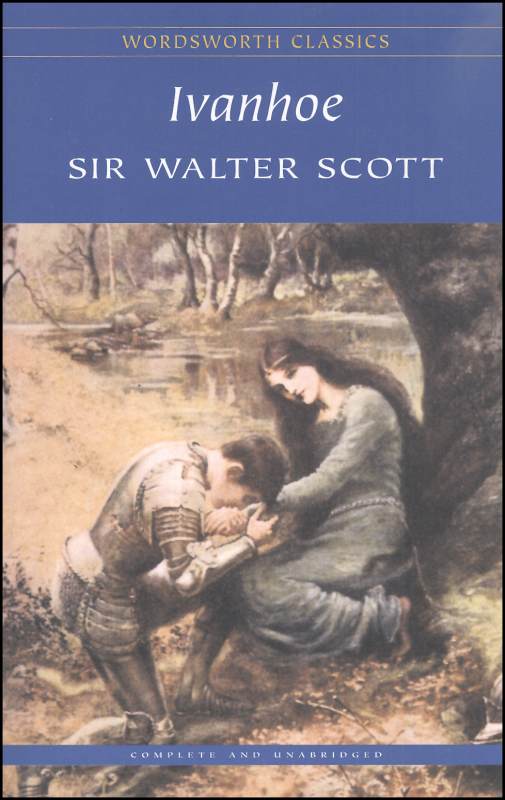
Ivanhoe by Sir Walter Scott

Sir Walter Scott is one of those authors who I’ve always felt intimidated by, for some reason assuming I would find him difficult to read. And yet, I had a feeling I would probably enjoy his books if I could just get around to actually reading them. I had no idea which book would be the best to start with, but as Ivanhoe is probably his best known novel I decided to try that one first.

Ivanhoe is set in England towards the end of the 12th century, during the reign of Richard the Lionheart, who has been away fighting in the crusades, leaving behind his brother Prince John plotting and scheming in his absence. The title character, Wilfred of Ivanhoe, banished and disinherited by his father, has just returned to England and on his return he becomes swept up in a series of adventures involving feuding Saxon and Norman noblemen, a beautiful Jewish girl, Robin Hood and a mysterious Black Knight.

Anyone with an interest in the medieval period and tales of chivalry will find that Ivanhoe has everything you would expect to see in this type of novel: jousting, sword-fighting, archery, tournaments, castles under siege, damsels in distress, bands of outlaws in the woods, and knights in shining armour. I loved it! I discovered that although Walter Scott’s writing is very descriptive and long-winded (lots of detailed descriptions of clothing and weapons etc) I didn’t have any problems understanding what was happening. The dialogue is written in an archaic style but it’s still readable and it all adds to the medieval atmosphere of the story.

I have no idea how much of the historical background is accurate but what does come across strongly is the resentment between the Saxons and the conquering Normans, as well as the tensions between Christians and Jews. Scott introduces us to characters from all four of these groups, which sets the scene for most of the conflict in the novel (the Saxons, for example, are represented by characters such as Cedric, Ivanhoe’s father, who still views the Normans as invaders more than a century after the Battle of Hastings and the Norman conquest). The attitudes of many of the characters towards the Jews are very negative, but I got the impression that this didn’t reflect Walter Scott’s own opinions. I thought he portrayed the Jewish characters themselves in quite a sympathetic way, which was good to see considering the time period in which this book was written. Rebecca, the daughter of Isaac the Jewish moneylender, was one of the strongest characters in the novel and much more interesting than the other heroine, Rowena.

I thought Ivanhoe himself was a bit of a disappointment. When he made his first appearance as the Disinherited Knight I thought he was going to be a great character, but he quickly seemed to fade into the background and was overshadowed by some of the other, more memorable characters – including the Black Knight, Wamba the Jester, Gurth the Swineherd, and the three villainous Norman knights, Front-de-Boeuf, de Bracy and Brian de Bois-Guilbert. I had never realised there was any connection between Robin Hood and Ivanhoe, but he appears in the novel under the name Locksley, and we also meet a friar living in a hermitage in the forest (Friar Tuck). Apparently Ivanhoe inspired the image of Robin Hood we have today and brought into popular use a lot of the elements of the Robin Hood legend.

So, now that I’ve read Ivanhoe and enjoyed it, which Sir Walter Scott book should I try next? Any recommendations are welcome!