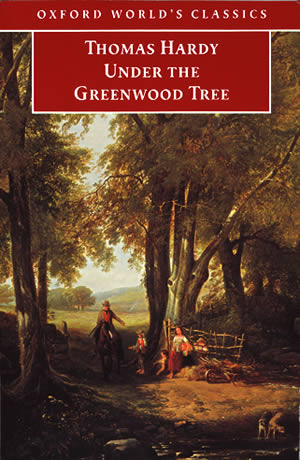
Under the Greenwood Tree by Thomas Hardy

Under the Greenwood Tree, set in the small village of Mellstock in Thomas Hardy’s fictional Wessex, is both a love story and a nostalgic study into the disappearance of old traditions and a move towards a more modern way of life. The book is divided into five sections, one for each of the four seasons of the year plus a final concluding section. The story begins in the winter, when we meet a group of villagers who play stringed instruments in the church choir. There’s a new vicar in Mellstock, the Reverend Maybold, and he has plans to replace the traditional choir with a new mechanical church organ. The organ will be played by another newcomer to the village, a pretty young schoolteacher whose name is Fancy Day.

The musicians are upset when they learn that they are going to be replaced, but one of them, Dick Dewy, finds himself falling in love with Fancy Day. However, unknown to Dick he has several rivals for Fancy’s love, including a rich local farmer and even the Reverend Maybold himself. The story of Dick and Fancy’s romance is played out over the course of a year, against a backdrop of the changing seasons and the changing landscape of Mellstock.

Hardy’s novels have a reputation for being bleak and depressing, but I can promise you that this one is neither. It’s actually quite an uplifting, optimistic story with an (almost) happy ending – very different from the other three Hardy books I’ve read (Tess of the d’Urbervilles, Jude the Obscure and A Pair of Blue Eyes). It doesn’t have the depth and complexity of Tess or Jude and to be honest, I do personally prefer Hardy’s tragedies, but I enjoyed this one too and it did make a nice change from the darker books I’ve been reading recently. The strengths of Under the Greenwood Tree are its gentle humour and its portrayal of life in 19th century rural England. As usual with Hardy, his pastoral descriptions are beautifully written and I love the way he paints four different portraits of country life appropriate to each season of the year, from singing carols and making cider in the winter to gathering nuts and collecting honey from beehives in the autumn.

Where the book was less successful, in my opinion, was with the characters of Dick Dewy and Fancy Day, because they just weren’t strong enough or interesting enough for me to really care about their romance. Fancy was actually quite an advanced and ‘modern’ character for the time and place, being well-educated and independent. However, she’s depicted here as being very silly and shallow and I felt that we never got to understand her properly. Dick was easier to like but his character wasn’t given a lot of depth either. I do think Hardy captured the naiveté of their relationship perfectly, but I would have preferred to have read more about the rest of the village community, with the love story pushed further into the background. Apparently Hardy had originally wanted to call the book “The Mellstock Quire” and it did seem to me that he was maybe more comfortable with that aspect of the book.

Although I’ve only read a few of Thomas Hardy’s novels he’s quickly becoming one of my favourite Victorian authors. I hope to read all of his books eventually, but I wish I’d left Under the Greenwood Tree until later as it’s turned out to be the first one I haven’t loved. There were a lot of things I liked about it, but it didn’t have the same emotional impact on me that the others had and it’s not a book I would want to read again and again.
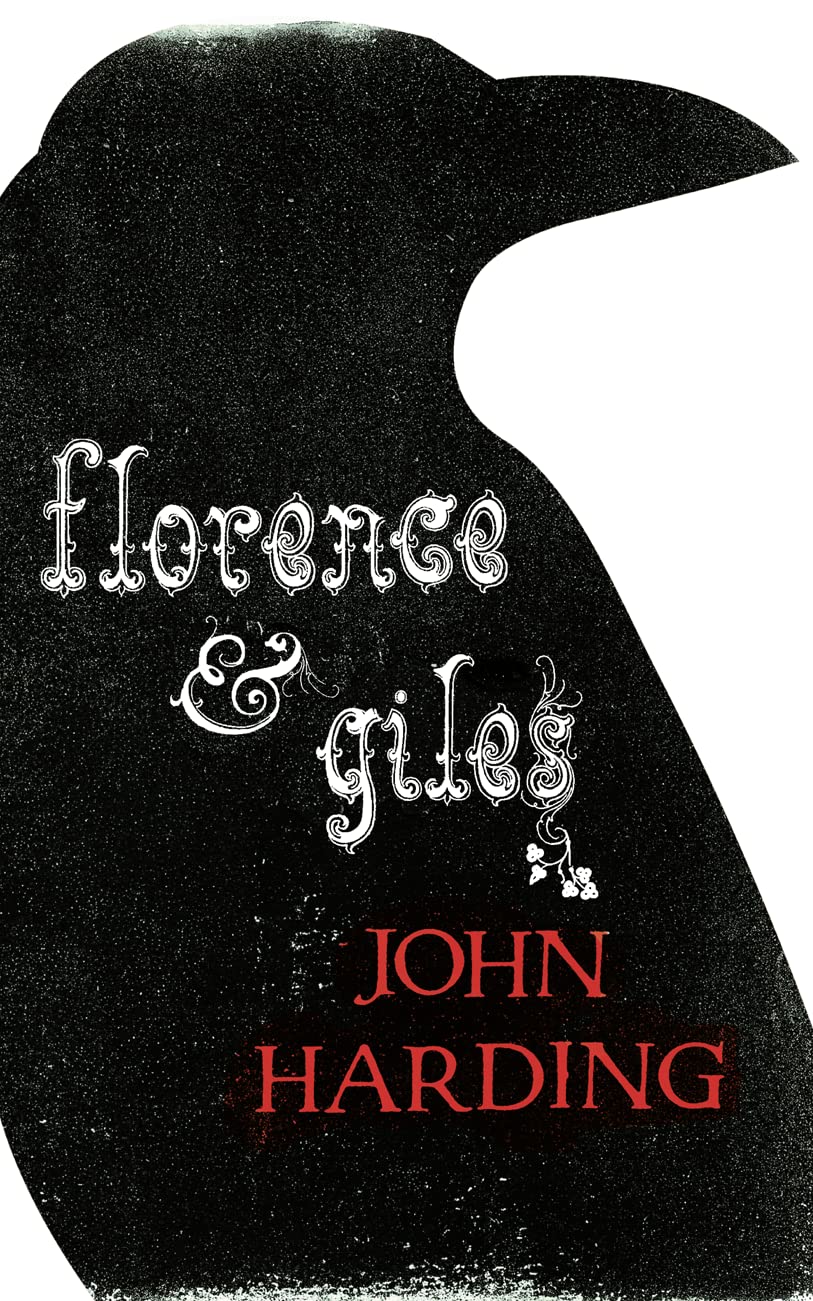
Florence and Giles by John Harding

I hadn’t even heard of Florence and Giles until recently but as soon as I saw that it had been described as a gothic thriller and compared to Henry James and Edgar Allan Poe I knew I wanted to read it – and it went straight onto my list for the RIP challenge!

Florence and Giles could be considered a loose retelling of The Turn of the Screw by Henry James (the first clue is in the title as the children in The Turn of the Screw are called Flora and Miles) but if you haven’t read the Henry James book yet it doesn’t matter at all because this is a great story in its own right.

The book is set in 1891 and the Florence and Giles of the title are two orphans who live at Blithe House, a mansion in New England. The house belongs to their uncle, but Florence and Giles never see him – he never comes to visit and prefers to leave the children under the care of the servants. Soon Giles is sent away to school and twelve-year-old Florence is left behind because her uncle disapproves of education for girls. After secretly teaching herself to read and write, Florence spends her days hiding in a forgotten tower room with books she’s smuggled out of the library.

This seems a good place to mention Florence’s narrative style, which is one of the most unusual I’ve ever come across. Although she’s been denied a formal education, she’s an intelligent and imaginative girl who has created her own private language with a very strange way of using nouns, verbs and adjectives! Here, for example, she describes Blithe House:

A house uncomfortabled and shabbied by prudence, a neglect of a place, tightly pursed (my absent uncle having lost interest in it), leaked and rotted and mothed and rusted, dim lit and crawled with dark corners, so that, even though I have lived here all of my life that I can remember, sometimes, especially on a winter’s eve in the fadery of twilight, it shivers me quite.

The whole story is written in this way. The ‘unbroomed’ library is a ‘dustery of disregard’, her bedroom becomes a ‘smugglery of books’ and she ‘lonelies’ her way around the big house. It did take me a few chapters to get used to Florence’s voice but I loved it because it was so creative and different.

Anyway, back to the story: when Giles is removed from his school after being bullied, a governess is appointed so he can continue his education at home. But as soon as Miss Taylor arrives at Blithe House some strange things begin to happen and Florence starts to believe that she and her brother could be in serious danger. Is Florence right? Can we trust her? We don’t know, but as she’s the book’s only narrator we have no choice but to read on.

Florence and Giles has a wonderfully dark and gothic feel and has everything this type of book should have: the spooky mansion, the mysterious guardian, the sinister governess…Even the quirkiness of Florence’s narrative voice adds to the unsettling feel. Not everything is explained or tied up at the end of the book, but I felt there’d been enough clues throughout the story for me to draw my own conclusions.

I can’t remember who it was that first brought this book to my attention, but as Florence might say, ‘I grateful them!’

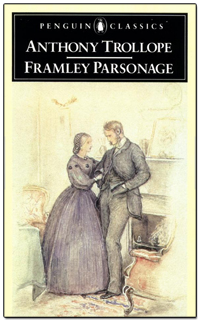
Framley Parsonage by Anthony Trollope

Framley Parsonage is the fourth novel in Anthony Trollope’s Chronicles of Barsetshire series. I’ve been slowly working my way through these books during the last year and in my opinion this one is neither the best nor the worst of the four I’ve read so far.

A common question asked by people new to Trollope is whether this series needs to be read in the correct order. Well, I don’t think it’s necessary at all and I’m sure this book could be enjoyed as a first introduction to Trollope, but personally I would recommend beginning with The Warden and reading each book in the series in turn. Framley Parsonage draws together a lot of characters from the first three books, including the Grantly and Proudie families from Barchester Towers and the Thornes and Greshams from Doctor Thorne, as well as some that I hadn’t expected to meet again, including one of my personal favourites, Miss Dunstable. I’m glad I chose to read the series in order because it’s nice to be able to recognise references to people, places and events and to feel that I’m getting to know the whole Barsetshire community.

Framley Parsonage consists of two main storylines. In the first, we follow Mark Robarts, the vicar of Framley. Mark became vicar at a younger age than would normally be expected, due to the influence of his friend, Lord Lufton, and his mother, Lady Lufton of Framley Court. He is still very ambitious and to Lady Lufton’s dismay he begins to mix with unscrupulous politicians whom he believes can help him further his career. When one of these politicians, Nathaniel Sowerby, persuades him to sign his name to a note for five hundred pounds, Mark finds himself getting deeper and deeper into debt – which is not the way a respectable clergyman should behave!

The second storyline involves Mark’s sister, Lucy Robarts, who comes to live at Framley Parsonage following the death of their father. Lucy falls in love with Lord Lufton, who soon proposes to her. However, Lucy is aware that Lord Lufton’s mother does not consider her a suitable wife for her son, so she vows not to marry him until she wins Lady Lufton’s approval – even though it means sacrificing her own happiness.

I found this book harder to get into than the previous three that I’ve read – it seemed to have a very slow start and didn’t really pick up until the character of Lucy Robarts made her first appearance. But as with all Trollope’s novels, once I did get into the story I became completely absorbed in the moral dramas and dilemmas taking place. Based on the first three Barsetshire books, I had a strong suspicion that all of Mark’s and Lucy’s problems would be resolved by the end, and yet this didn’t stop me from enjoying the book and wondering exactly how those problems would be resolved. As usual, Trollope’s characters feel completely believable with understandable motives and emotions. We can have sympathy with Mark Robarts because he is not a bad person – just young and naïve. And even when a character is cast as one of the villains of the book, such as Mr Sowerby, Trollope still asks us to remember that they do have some good qualities.

Although Anthony Trollope is not my favourite Victorian author (that would be either Wilkie Collins or Thomas Hardy) he does have a wonderful warm and observant writing style all of his own and if you haven’t tried one of his books yet then I highly recommend spending some time in Barsetshire soon.

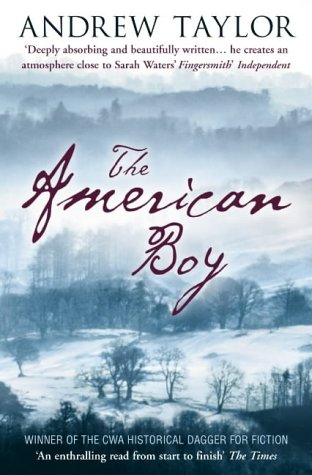
The American Boy by Andrew Taylor

After I read The Anatomy of Ghosts earlier in the year, I asked for opinions on Andrew Taylor’s other books. Well, I’d like to thank the three people who left comments recommending The American Boy (published in the US as An Unpardonable Crime) as I thought this one was even better than The Anatomy of Ghosts. As someone who loves classic sensation novels (Wilkie Collins, Mary Elizabeth Braddon, Ellen Wood etc) it’s maybe unsurprising that I enjoyed this book so much. It has all the elements of a sensation novel and although it was published in 2003 it almost feels as if it could have been written in the 19th century.

The American Boy is set in England during the final months of the reign of George III. The story begins in September 1819 when our narrator, Thomas Shield, is starting a new job as a teacher at a small private school in the village of Stoke Newington. One of the boys at the school is the ten-year-old Edgar Allan Poe, the ‘American boy’ of the title. Shield is given special responsibility for tutoring Edgar and his best friend, Charles Frant, and through the two boys he becomes acquainted with two rich banking families – the Frants and their cousins, the Carswells. He soon becomes caught up in the dramas that are unfolding within the Frant and Carswell families and when two murders take place it seems that Shield’s own life could also be in danger.

The plot is so intricate and complex I won’t even try to go into any more detail, but in addition to the murders, there’s also a disputed will, mistaken identities, family secrets, betrayal, revenge and even romance. Thomas Shield’s adventures take place in a variety of wonderfully atmospheric locations from the dark, foggy streets and over-crowded slums of London to the snowy landscape of the Carswells’ country estate in Gloucestershire, complete with an ice house and ruined abbey. Taylor made his settings feel vivid and real without going into pages and pages of description.

I should point out that although Edgar Allan Poe does have an important part to play in the story, he’s really just a minor character. I actually thought this whole aspect of the book was unnecessary as the plot would have been strong enough without it and a fictional character could easily have been used in his place. I’m not complaining as I do like Poe and found his brief appearances interesting, but I don’t want to mislead anyone into thinking this is a book about Poe because it really isn’t.

Although I hadn’t included this book on my list for the RIP challenge, I’m going to count it as my first book for RIP anyway (I don’t know why I bother making lists for challenges as I never, ever stick to them!) The American Boy isn’t what I would describe as a scary book, but it is a very dark and suspenseful mystery – a perfect book to curl up with and enjoy at this time of year.

I know it’s a cliché but I didn’t want to put this book down and the very short chapters made it even more tempting to keep reading. If it hadn’t been so long (500 pages) I could have read it all in one sitting. I also appreciated the author’s attempts to make the book feel like an authentic 19th century novel through his use of language and Thomas Shield’s narrative style. It won’t be for everyone though; you either like this type of book or you don’t, but for anyone who has enjoyed books such as The Quincunx by Charles Palliser, The Meaning of Night by Michael Cox or The Woman in White by Wilkie Collins, I can highly recommend this one.

The Observations by Jane Harris

After I read (and loved) Gillespie and I, I knew I would have to find a copy of the first book by Jane Harris, The Observations, as soon as possible. Luckily my library had a copy so I didn’t have to wait too long to read it! I found this book just as entertaining and enjoyable as Gillespie and I, which puts Jane Harris firmly on my list of favourite authors.

The Observations is set in Scotland during the 19th century. Bessy Buckley, a young Irish girl, is on the run from her troubled past when she arrives at the estate of Castle Haivers near the village of Snatter. The lady of the house, Arabella Reid, offers her a job as maid and Bessy jumps at the chance. But Bessy is puzzled by the series of bizarre tasks which Arabella orders her to perform – and when she discovers that a previous maid, Nora, may have died under suspicious circumstances, it becomes obvious that things at Castle Haivers are not quite what they seem.

The Observations is a long book but was so gripping I read it in half the time it would normally take me to read a book of similar length. What makes this novel so different from all the others I’ve read set in the Victorian era is Bessy Buckley herself. Bessy is a fabulous character and narrator: funny and witty, poorly educated but bright and intelligent, tough and outspoken yet sensitive and warm hearted. When you first begin to read you might come across some unusual language and slang, not to mention some unconventional grammar and punctuation, but don’t worry about that – it’s all part of Bessy’s unique voice and her narration was a delight to read. The only thing that irritated me slightly was seeing numbers written as figures rather than words (1/2 instead of ‘half’, for example).

The relationship between Bessy and her mistress forms a big part of the story, but there are a few other interesting sub-plots, as well as the story of Bessy’s own childhood which emerges slowly throughout the book. There are shades of other Victorian novels, as well as some elements of the gothic novel and the ghost story, but the overall result is something completely original. The one criticism I have is that, after a very strong start, the story seems to lose momentum in the second half and the ending was slightly disappointing in comparison to the rest of the book.

Finally, I want to say how impressed I am that Jane Harris could take two such different narrators as Bessy Buckley and Harriet Baxter (from Gillespie and I), who are complete opposites in almost every way imaginable, and make them both so convincing! That’s a sign of a talented author in my opinion.

The Taste of Sorrow by Jude Morgan

The Taste of Sorrow is a fictional retelling of the lives of Charlotte, Emily and Anne Brontë, beginning with their childhoods and ending just after Charlotte’s wedding. Before I started reading this book if you’d asked me how much I already knew about the Brontës, I would have said I knew very little. And yet a lot of the story felt familiar to me – their early attempts at writing stories set in the fantasy worlds of Angria and Gondal, their experiences of working as governesses, their brother Branwell’s alcoholism – so I must have known more than I thought.

Although The Taste of Sorrow does seem to stick to the historical facts as far as I could tell, it’s important to remember that this is a novel and not a biography. Jude Morgan brings the Brontë sisters to life by giving us insights into their feelings and emotions, their hopes and dreams. His fictional Brontës are realistic, complex and three-dimensional, and would have been interesting characters to read about even if they had not been based on real people. We can obviously never know exactly what thoughts would have gone through the minds of the real Charlotte, Emily and Anne, but I had no problem believing that they may really have said and done the things that Morgan has imagined them to have said and done. And that’s the highest praise I can give to an author writing this type of historical fiction.

The Taste of Sorrow, as the title suggests, is not the happiest of books. The Brontës had a lot of sorrow in their lives, beginning with the death of their mother and two elder sisters, Maria and Elizabeth. They also had to deal with the usual challenges and obstacles that came with being a woman in the 19th century. When Charlotte suggested that she would like to be an author she was discouraged by her father simply because she was female. Instead, Mr Brontë pinned all his hopes on his son, Branwell.

I had read very little about Branwell before I started this book, though I knew he had caused his family a lot of pain because of his drinking. I thought Morgan portrayed him quite sympathetically, attempting to show the pressures and disappointments that contributed to his downfall, and how his sisters struggled to reconcile their love for him with their despair in him. Although I couldn’t like Branwell, his character felt as real to me as the characters of Charlotte, Emily and Anne.

The book itself is very well written, although the style is unusual and takes a while to get used to, but the strong point of the book is the characterisation and each sister is shown as having her own distinct personality. Morgan does focus more on Charlotte than the other two, though I can see that as the sister who outlived the others it probably made sense to tell most of the story from her perspective. But my favourite Brontë book is Wuthering Heights (I love it even more than Jane Eyre, which I know puts me in a minority within the book blogging world) and for that reason, the sister I was most interesting in reading about was Emily. Although we don’t get to spend as much time with Emily as we do with Charlotte, I thought Morgan’s portrayal of her was excellent and I could easily believe that his Emily was the person who wrote Wuthering Heights.

I was also pleased to see that Morgan does give Anne a lot of attention and she is not shown as being in any way inferior or less important than her sisters. Personally I loved both of Anne’s books, The Tenant of Wildfell Hall and Agnes Grey, and I think it’s sad to see how often she is overlooked or dismissed.

The Taste of Sorrow will obviously be of particular interest to Brontë fans, but I think it would also be enjoyed by a wider audience as an interesting and compelling historical fiction novel in its own right. Now I just need to read the remaining two Brontë novels I still haven’t read: The Professor and Shirley.

Thérèse Raquin by Émile Zola

Thérèse is a young woman trapped in an unhappy marriage to her sickly cousin, Camille Raquin. On the surface she appears quiet and passive, never voicing an opinion of her own. But underneath Thérèse is a passionate person who longs to break away from her boring, oppressive existence. When Camille introduces her to an old friend, Laurent, the two begin an affair. Desperate to find a way in which they can be together, Thérèse and Laurent are driven to commit a terrible crime – a crime that will haunt them for the rest of their lives.

If you think I’ve given too much away then I can tell you that this crime takes place quite early in the story and is not the climax of the book. The point of the story is what happens afterwards when Zola begins to explore the psychological effects this action has on the characters.

Thérèse Raquin, as you will have guessed, is a very dark book which becomes increasingly feverish and claustrophobic with scenes of violence and cruelty. I haven’t read much 19th century French literature, apart from a few books by Alexandre Dumas and Victor Hugo, and one thing that struck me about Zola’s writing was how much more daring and graphic this book is than British novels from the same period. The reader becomes locked inside the tormented minds of Thérèse and Laurent, sharing their fear and terror, their nightmares and sleepless nights, their inability to enjoy being together because the horror of what they have done stands between them. If you’ve read Dostoevsky’s Crime and Punishment or Edgar Allan Poe’s The Tell-Tale Heart, there are some similarities here.

This book could be enjoyed just for the dramatic plot (it’s as tense and gripping as any modern thriller) but I also thought the four main characters – Thérèse, Laurent, Camille and Madame Raquin – were fascinating and very vividly drawn. Zola apparently said that his aim was to create characters with different temperaments and see how each of them reacted to the situation they were in.

As the first book I’ve read by Zola, I wasn’t sure what I could expect from Thérèse Raquin but I thought it was excellent and I’ll certainly be reading more of his books.