Review: A Moment of Silence by Anna Dean

A Moment of Silence is an entertaining murder mystery set in the early 19th century. It’s the first in a series of novels featuring the wonderful Miss Dido Kent.

The story begins when Dido is summoned to Belsfield Hall, the country estate of the Montague family. Her niece Catherine is engaged to Sir Montague’s son Richard – who has mysteriously disappeared during their engagement party. Dido agrees to help Catherine solve the mystery behind Richard’s disappearance, but events soon take a more sinister turn when a dead body is found in the shrubbery…

This was a light, easy read which should appeal to fans of Jane Austen due to the setting and the elegant, witty writing style – although I’m not a huge Austen fan and I still loved it! A Moment of Silence has all the elements of a classic English country house mystery: clues, red herrings and lots of possible suspects, with almost every one of the guests and family members concealing a secret of some kind. Although some of the clues were quite obvious, there were others that I didn’t figure out and the mystery was interesting enough to hold my attention right to the end.

But rather than the mystery itself, the main reason I loved this book was because of Miss Dido Kent, who is a wonderfully engaging character. She’s intelligent, observant and always speaks her mind, though usually in a good-natured way. Although we’re not told exactly how old she is (unless I missed it) she’s unmarried and her ‘spinster’ status gives her the freedom to investigate and to wander around the estate asking questions and interfering – always with the best intentions of course! I loved reading Dido’s letters updating her sister Eliza on the progress of her investigations (we never actually meet Eliza, but the letters are intended to allow us some insights into Dido’s private thoughts and musings).

I can’t wait to read more Dido Kent mysteries. This was a great start to the series and I’m looking forward to reading the second, A Gentleman of Fortune.

Recommended

Note: This book is published under the title Bellfield Hall in the US.

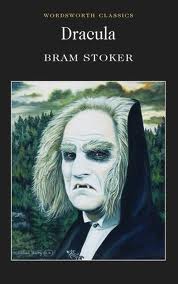
Review: Dracula by Bram Stoker

“My friend. – Welcome to the Carpathians. I am anxiously expecting you.”

When Jonathan Harker travels to Count Dracula’s castle in Transylvania to advise the Count on the subject of buying property in England, he quickly becomes aware that there’s something not quite normal about his host – and after making some terrifying discoveries, he finds himself imprisoned in the castle. Back in England, Harker’s fiancée Mina Murray is anxiously waiting in Whitby for news of Jonathan. But as if she didn’t already have enough to worry about, her friend Lucy Westenra becomes mysteriously ill, with inexplicable puncture wounds on her throat. Could Lucy’s illness have anything to do with the ship that was recently swept into the harbour during a storm?

Interspersed with the main storyline are Dr Seward’s medical notes on one of his patients, a man called Renfield who likes to eat flies and spiders – but what is the connection between Renfield, Lucy and Dracula? Dr Seward brings in his friend Van Helsing, an expert in unusual diseases, and with the help of Mina, Jonathan, Lucy’s fiance Arthur Holmwood and a friend, Quincey Morris, they attempt to solve the mystery and defeat Dracula.

Dracula was an obvious choice for me for the RIP challenge, particularly as it’s one of those books I feel as if I should have read years ago, yet never have (apart from a children’s version which doesn’t really count as it was so heavily abridged). Yet even though I had never read it, a lot of the story was familiar as it has become so firmly entrenched in popular culture. Dracula is not the first vampire story (a few weeks ago I wrote about John Polidori’s The Vampyre and Byron’s Fragment of a Novel) but it’s definitely the most famous.

The book is written in an epistolary style with the entire story being told through letters, journal entries, telegrams and newspaper reports. This structure kept the story moving forward and it was interesting to see so many different perspectives, but I did feel that some of the entries were too short and the story kept switching too abruptly from one person’s journal to another. I would have liked to have spent longer with one character before switching to the next. Some of the ‘voices’ were very similar, but I really liked the character of Mina, who was a strong, sensible, intelligent woman and although she was subjected to the usual Victorian attitudes of the time, she played an important role in the story. In comparison, Lucy is more of a typical Victorian heroine.

The opening section in Transylvania was my favourite part of the book. I loved the atmosphere Stoker created, with the snow falling and the wolves howling.

Though we were in shelter, we could hear the rising wind, for it moaned and whistled through the rocks, and the branches of the trees crashed together as we swept along. It grew colder and colder still, and fine, powdery snow began to fall, so that soon we and all around us were covered with a white blanket. The keen wind still carried the howling of the dogs, though this grew fainter as we went on our way. The baying of the wolves sounded nearer and nearer, as though they were closing round on us from every side. I grew dreadfully afraid, and the horses shared my fear.

When the story moved from Transylvania to Whitby, the pace slowed down and I started to get bored. I did enjoy all the descriptions of Whitby though, with its harbour and ruined abbey. Whitby is only a couple of hours’ drive from where I live, so we go there a lot, and it’s always nice to read about a place you know well.

I actually didn’t find the book very frightening, though maybe that’s just because I was already so familiar with the story. There were some very creepy scenes though, such as when Harker sees Dracula emerging through a window and crawling headfirst down the castle walls:

I was at first interested and somewhat amused, for it is wonderful how small a matter will interest and amuse a man when he is a prisoner. But my very feelings changed to repulsion and terror when I saw the whole man slowly emerge from the window and begin to crawl down the castle wall over the dreadful abyss, face down with his cloak spreading out around him like great wings…I saw the fingers and toes grasp the corners of the stones, worn clear of the mortar by the stress of years, and by thus using every projection and inequality move downwards with considerable speed, just as a lizard moves along a wall.

I’m glad I finally read Dracula, but it’s not going to become a favourite classic of mine. Although I didn’t love it, I thought it was surprisingly easy to read and the first few chapters were great, so if you have any interest at all in vampire stories or gothic horror novels, I think it’s worth reading at least once.

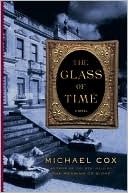
Review: The Glass of Time by Michael Cox

This is the sequel to Michael Cox’s The Meaning of Night, which I read earlier in the year. Although I don’t think it’s absolutely necessary to read the books in the correct order, it would make sense to do so. You’ll definitely get the most out of this book if you’ve read the previous novel first and are already familiar with the plot and the characters.

The way The Meaning of Night ended had left me feeling dissatisfied, but The Glass of Time provides the perfect continuation to the story. Our narrator is Esperanza Gorst, an orphan who has been raised in France by her father’s friend Madame L’Orme and her tutor Mr Thornhaugh. When she is nineteen years old, she is sent by her guardians to the beautiful estate of Evenwood in England, where she will work as lady’s maid to Emily Carteret, the 26th Baroness Tansor. At first Esperanza doesn’t know why she has been sent to Evenwood and is told only that it is part of Madame L’Orme’s ‘Great Task’. As she learns more about her mission, however, Esperanza begins to unravel the mysteries of both her own past and Lady Tansor’s.

I enjoyed The Meaning of Night but I loved The Glass of Time even more. I thought Esperanza was a more likeable character than Edward Glyver (the narrator of The Meaning of Night), and the story also seemed to move at a faster pace. I literally didn’t want to put this book down and finished it in two days (considering it’s over 500 pages long that should indicate how much I was enjoying it).

While I was reading this book there were times when I could almost have believed it really had been written in the 19th century, as the setting, atmosphere and language are all flawlessly ‘Victorian’. Charles Dickens was clearly one of Cox’s biggest influences. In my review of The Meaning of Night I mentioned the Dickensian names Cox gave his characters, and there are more of them in The Glass of Time, from Armitage Vyse and Billy Yapp to Perseus Duport and Sukie Prout. But this time I also noticed lots of similarities to Dickens’ Bleak House: the young orphan searching for the truth of her parentage; the noblewoman with a dark secret; the way the story moves between an idyllic country house and the dark, dangerous streets of Victorian London; the intricate plot and the cleverly interlocking storylines.

I could also recognise elements of various Wilkie Collins novels including Armadale and No Name (Esperanza Gorst is even seen reading No Name at one point). In both writing style and structure this book does feel very like one of Collins’ sensation novels, filled with cliffhangers and plot twists – and with parts of the mystery being revealed through letters, diary entries and newspaper clippings. I did find some of the twists very predictable but that didn’t matter to me, because it was actually fun to be one step ahead of Esperanza, waiting for her to discover what I had already guessed.

It’s so sad that there won’t be any more books from Michael Cox, as he died of cancer in 2009, but together these two novels are the best examples of neo-Victorian fiction I’ve read: complex, atmospheric and beautifully written.

Highly Recommended

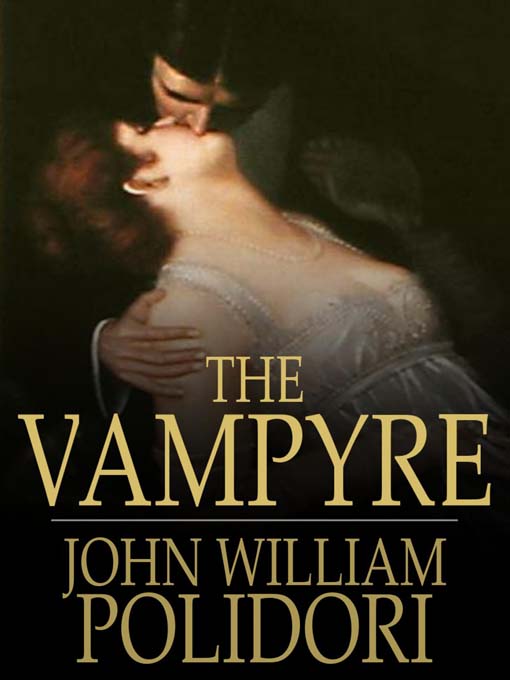
Short Story: The Vampyre by John Polidori

As I’m hoping to read Dracula soon, I thought it might be a good idea to also read one of Bram Stoker’s influences – John Polidori’s The Vampyre. This short story is considered to be one of the first vampire stories in literature and the first to portray a vampire in the way we would recognise today. I have actually been interested in reading this story since I read The Count of Monte Cristo by Alexandre Dumas and was intrigued by the references to the vampire Lord Ruthven. (If you’ve read The Count of Monte Cristo you might remember the scene where the Countess G- is remarking on the Count’s pale skin and nicknames him ‘Lord Ruthven’.)

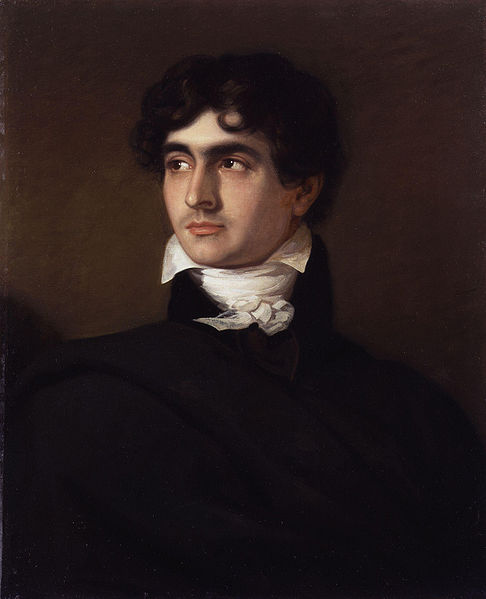
The origins of The Vampyre are fascinating. John William Polidori was Byron’s personal physician and in 1816, went with him to Switzerland. At the Villa Diodati, on Lake Geneva, Byron and Polidori were joined by the poet Percy Bysshe Shelley, his future wife Mary Wollstonecraft Godwin and her stepsister Claire Clairmont, and decided to amuse themselves by writing horror stories. Mary began work on what would become Frankenstein, and Byron wrote the beginning of a vampire story (which survives today as Fragment of a Novel) based on the various vampire myths and legends. Although Byron abandoned his vampire story, Polidori took inspiration from it and The Vampyre was the result. Unfortunately for Polidori, The Vampyre was wrongly attributed to Byron, despite Byron’s attempts to set the record straight.

As a story, it really isn’t very satisfying. Our narrator is a young Englishman called Aubrey, who travels to Rome with his acquaintance, the nobleman Lord Ruthven. The more time he spends with Ruthven, the more Aubrey begins to distrust him and to realise that Ruthven is not what he seems… The plot is so thin that there’s not much more I can tell you without spoiling it – although really, there’s nothing to spoil as the story is very predictable (for the modern reader anyway – I’m sure it would have been more compelling at the time when it was first published).

The Vampyre is interesting historically because of its portrayal of Lord Ruthven as a mysterious, pale-faced aristocratic figure who preys on innocent young ladies, which is the way many future vampires would be described (the vampires of folklore had generally been described as hideous-looking monsters). If you’re interested in how vampire stories began and how they evolved over the years, this is worth reading. If you’re just looking for a good short story to read, you might be disappointed with this one.

Read The Vampyre online here

Byron’s Fragment of a Novel is also available online and is so short it only takes a few minutes to read. It’s a shame he decided not to continue with this, as I think it had the potential to be much better than The Vampyre. I’ve read a few of Byron’s poems but this is my first experience of his prose and even based on such a short sample of his work I find his writing superior to Polidori’s.

Read Fragment of a Novel online here


John William Polidori (1795-1821)

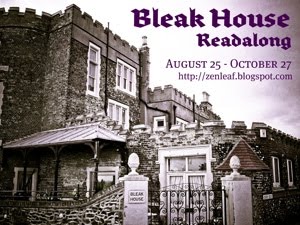
Bleak House Readalong: Chapters 1-7

Charles Dickens’ Bleak House is a book that, like Middlemarch by George Eliot, I have attempted to read before but abandoned after a few chapters. This summer I took part in a Middlemarch readalong and finally finished the book (and ended up loving it) so I’m hoping that this Bleak House readalong will be equally successful. I’ve read Chapters 1-7 this week and have now passed the point where I lost interest and stopped reading the last time.

In Bleak House, Dickens divides the narrative between an orphan called Esther Summerson and an unnamed omniscient narrator, which is an interesting technique but one that isn’t really working for me. The book begins by telling us about a long-running court case called Jarndyce and Jarndyce, which has gone on for so many years that the original parties in the suit are now dead and nobody can remember what it was about. In the opening chapter Dickens tells us about the fog that is enveloping London, which can be seen as a metaphor hinting that the court case and much of the following story is going to be shrouded in fog as well.

“Fog everywhere. Fog up the river, where it flows among green aits and meadows; fog down the river, where it rolls defiled among the tiers of shipping and the waterside pollutions of a great (and dirty) city. Fog on the Essex marshes, fog on the Kentish heights. Fog creeping into the cabooses of collier-brigs; fog lying out on the yards, and hovering in the rigging of great ships; fog drooping on the gunwales of barges and small boats…”

When Ada and Richard, two wards of court, are sent to live with John Jarndyce in his home, Bleak House, Esther is asked to accompany them. At the moment we don’t know why this is, or how Esther is connected with the Jarndyce suit. On their way to Bleak House, they meet a variety of interesting people including Mrs Jellyby, who seems more interested in Africa than in her own family, an eccentric old lady who has been closely following the Jarndyce case, and the old lady’s landlord, Mr Krook.

The first seven chapters are concerned with setting the scene and not much has happened yet. I’m not really a lover of long descriptive passages but most of those were confined to the first two chapters. From the third chapter onwards, when the story really began, I started to enjoy it.

We are introduced to a huge number of characters in the first seven chapters. So far I’ve found it easy enough to remember who they all are, but I suspect that it might get more confusing later. One of the problems I had on my first attempt at reading this book was that Esther irritated me – and unfortunately she’s still irritating me this time. I hope I’m going to like her more as the book continues. I also dislike Mr Skimpole. He takes money from Richard and Esther to pay his debts, but everyone seems to think that’s okay because he’s such a harmless, childlike person.

“When you come to think of it, it’s the height of childishness in you — I mean me —” said Mr Jarndyce, “to regard him for a moment as a man. You can’t make him responsible. The idea of Harold Skimpole with designs or plans, or knowledge of consequences! Ha, ha, ha!”

So far I’m undecided about this book. I’m not loving it yet, but I’m not hating it either. Although Bleak House is a very long book (over 700 pages in my edition) and I’m only around 80 pages into it, I don’t think I’ll have any trouble finishing it. I found with the Middlemarch readalong that making a long classic my secondary book to read alongside several shorter books is a method that works perfectly for me.

I’ll try to post another progress update next Wednesday, when I hope to be able to tell you that I’ve started to love the book!

You can see other participants’ thoughts at The Zen Leaf.

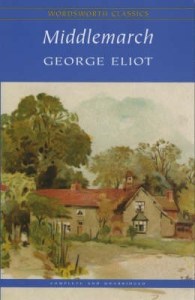
Readalong: Middlemarch by George Eliot

I have had two previous attempts at reading George Eliot’s Middlemarch but both times abandoned the book after a few chapters. When I saw that Nymeth was planning a readalong this summer, I thought this might give me the motivation to persevere and actually finish the book. I think part of the problem with my past attempts was that I found the book so long and slow-moving it didn’t hold my attention and I ended up being tempted by other books on my shelf. This time round I decided to do things differently. I started reading the book at the end of June alongside other books (something I don’t usually do – I prefer to concentrate on one book at a time) and worked slowly through it, interspersing it with an occasional shorter book. As it turned out, this was the perfect way for me to read Middlemarch, as it meant I could take my time and give it the attention it deserved. And this is a book that really benefits from being read slowly.

The plot is so layered, every sentence filled with so much meaning, that I’m sure there are a lot of things that I’ve missed and will have to pick up on a subsequent reading. It certainly is a book that you need to concentrate on. There are so many characters, who all seem to be related by marriage in some way, that I had to make notes as I was reading and would never have kept all the characters straight otherwise.  I highly recommend you do the same as I found my amateurish family trees became invaluable as I progressed through the book!

So what is Middlemarch about? Well, even after finishing the book I don’t really know how to describe the plot.  Middlemarch is the story, not just of one or two people, but of an entire town and its inhabitants. It portrays the atmosphere of life in a small community where everybody knows everybody else’s business and most people’s biggest concern is what their neighbours will think of them. The relationships and interactions between the characters are wonderfully complex and Eliot cleverly weaves their storylines together, so that the actions of one person may have unforeseen consequences on the life of another.

The prologue certainly seems to refer to Dorothea Brooke and at first it appears that the book is going to be about Dorothea and her marriage to the dry and scholarly Edward Casaubon.  Dorothea is an intelligent, sincere, idealistic girl who despite the warnings of her friends and family becomes determined to marry Mr Casaubon, insisting that he has a “great soul” and that nothing will give her greater happiness in life than assisting him with his studies.

“In this latter end of autumn, with a sparse remnant of yellow leaves falling slowly athwart the dark evergreens in a stillness without sunshine, the house too had an air of autumnal decline, and Mr. Casaubon, when he presented himself, had no bloom that could be thrown into relief by that background.”

Just as we’re becoming absorbed in her story, however, Dorothea disappears for several chapters and we are introduced to some new characters.  The first is a newcomer to Middlemarch: Tertius Lydgate, a young doctor with some new and radical ideas.  Soon after his arrival, Lydgate enters into a relationship with Rosamond Vincy, which proves to be just as difficult and disappointing as Dorothea’s marriage to Mr Casaubon.

“Lydgate could only say, “Poor, poor darling!” – but he secretly wondered over the terrible tenacity of this mild creature. There was gathering within him an amazed sense of his powerlessness over Rosamond. His superior knowledge and mental force, instead of being, as he had imagined, a shrine to consult on all occasions, was simply set aside on every practical question.”

We also follow Rosamond’s brother Fred Vincy as he tries to find his true vocation in life and to earn the respect of Mary Garth, the woman he loves.  These three storylines (and several other subplots) all run alongside each other, meeting and intersecting from time to time.

There are many things that make this book so impressive and so notable but the most striking, in my opinion, is the incredibly detailed characterisation. Every character Eliot introduces us to is interesting, nuanced and believable. She even gives her characters distinctive voices (literally!) – we are repeatedly told that Celia speaks “with a quiet staccato” and that Mr Brooke has a habit of repeating himself (“I thought you had more of your own opinion than most girls. I thought you liked your own opinion – liked it, you know”).

We see almost every conceivable personality type; we experience almost every imaginable human emotion. And most importantly, the characters develop throughout the book – they mature, they learn from their mistakes, they become better people.  I could find something to admire in almost all of the characters. They all have their own flaws and faults but also have some good qualities – this makes even less likeable people such as Mr Bulstrode interesting to read about and allows us to empathise with them.  There are plenty of characters who are very likeable, though.  I particularly loved Mary Garth and her father Caleb.

“Mary was fond of her own thoughts, and could amuse herself well sitting in twilight with her hands in her lap; for, having early had strong reason to believe that things were not likely to be arranged for her peculiar satisfaction, she wasted no time in astonishment and annoyance at that fact. And she had already come to take life very much as a comedy in which she had a proud, nay, a generous resolution not to act the mean or treacherous part. Mary might have become cynical if she had not had parents whom she honored, and a well of affectionate gratitude within her, which was all the fuller because she had learned to make no unreasonable claims.”

I am not usually very good at spotting themes in books, but I could find several in Middlemarch. The most obvious is marriage and how it often fails to live up to our expectations (i.e. Dorothea Brooke and Mr Casaubon; Rosamond Vincy and Tertius Lydgate). In her portrayals of these marriages, George Eliot never places the blame entirely on either the husband or the wife.  Instead, she shows how an unhappy or problematic marriage can be caused by personality differences, unrealistic idealism and a failure to understand the person we are married to.

“All these are crushing questions; but whatever else remained the same, the light had changed, and you cannot find the pearly dawn at noonday. The fact is unalterable, that a fellow-mortal with whose nature you are acquainted solely through the brief entrances and exits of a few imaginative weeks called courtship, may, when seen in the continuity of married companionship, be disclosed as something better or worse than what you have preconceived, but will certainly not appear altogether the same.”

Another theme is change: we should remember that although Middlemarch was published in the 1870s, it was set around forty years earlier at a time of great change: there were changes in politics (the Reform Bill of 1832); changes in transport (the arrival of the railway) and changes in medicine (as portrayed through Tertius Lydgate’s new ideas and theories).

There are so many other aspects of this book that I wanted to discuss here, but I have to stop somewhere!  I haven’t even mentioned Will Ladislaw, who is made to feel unwelcome in Middlemarch by his relative, Mr Casaubon; or Mr Farebrother, who is in love with Mary Garth; or Raffles, who is as close to a villain as we get in Middlemarch.

After reaching the final page I can now see why so many people love this book so much. I would recommend Middlemarch to all lovers of Victorian fiction who are prepared to invest the time it takes to read such a long and complex novel. I don’t think this book would be for everyone though. If you prefer faster-paced stories you may have trouble getting into it, as I did on my earlier attempts. My advice to you would be to stick with it, take your time and savour every word, and the story does become more compelling as it goes on.

If I’m going to be completely honest, there are a lot of classics that I’ve enjoyed a lot more than this one, but I can’t think of any that are greater in scope, more insightful or offer a more penetrating study of humanity. After spending the summer with Dorothea and Will, Tertius and Rosamond, Fred and Mary, and the others, I’m really going to miss them all.

I’ll leave you with some more quotes from the book:

“But indefinite visions of ambition are weak against the ease of doing what is habitual or beguilingly agreeable; and we all know the difficulty of carrying out a resolve when we secretly long that it may turn out to be unnecessary.”

“And certainly, the mistakes that we male and female mortals make when we have our own way might fairly raise some wonder that we are so fond of it.”

Please see this post at Things Mean a Lot for other bloggers’ thoughts on Middlemarch

Review: Poor Miss Finch by Wilkie Collins

You are here invited to read the story of an Event which occurred in an out-of-the-way corner of England, some years since.
The persons principally concerned in the Event are: – a blind girl; two (twin) brothers; a skilled surgeon; and a curious foreign woman. I am the curious foreign woman. And I take it on myself – for reasons which will presently appear – to tell the story.

Having read all four of Wilkie Collins’ best known books in my pre-blogging days (The Woman in White, Armadale, No Name and The Moonstone), I am now exploring his less popular novels. I recently reviewed Basil and A Rogue’s Life, two of his earlier books from the 1850s. This one, Poor Miss Finch, was published in 1872 and unlike most of the books that preceded it, is not really a ‘sensation novel’, although it does have certain sensational elements (mysterious strangers, theft, assault, letters being intercepted, mistaken identities etc). What it is is an interesting study into what it’s like to be blind since infancy and the emotions a person experiences on learning that there may be a chance of regaining their sight.

The story is told by a Frenchwoman called Madame Pratolungo, the widow of a South American political activist, who has just arrived in the village of Dimchurch in England to take up a position as companion to Lucilla Finch. Lucilla has been blind since she was a child and her blindness has led to a strange phenomenon – she has developed an irrational fear of darkness and dark colours. Even knowing that someone is wearing a dark purple dress, for example, sends her into a panic.

Oscar Dubourg and his twin brother Nugent are newcomers to Dimchurch. Soon after their arrival, Oscar suffers a fit and learns that he has epilepsy. In the 19th century a common cure for epilepsy was to take nitrate of silver. Unfortunately, a side effect of nitrate of silver consumption is that the skin turns blue. When Oscar and Lucilla fall in love, Oscar feels secure in the knowledge that Lucilla will never be able to see him and need never be told that his face is dark blue. However, when Nugent introduces them to the German oculist Herr Grosse, it appears that there could still be hope for Lucilla after all.

This book handles the topic of blindness in a sensitive and intriguing way. It’s obvious that Collins had done a lot of research into the subject and the results are fascinating. He discusses the theory that when a person is blind their other senses improve to compensate for their lack of sight and he weighs up the advantages and disadvantages there would be if this person then regained their sight. I had never even thought about some of the aspects of blindness that are mentioned in the book. For example, there’s an interesting moment when Madame Pratolungo realises why Lucilla shows little regard for normal Victorian conventions and proprieties.

What did it mean?
It meant that here was one strange side shown to me of the terrible affliction that darkened her life. It meant that modesty is essentially the growth of our own consciousness of the eyes of others judging us – and that blindness is never bashful, for the one simple reason that blindness cannot see.

The characters, as usual, are wonderful – most of them anyway. I didn’t find Lucilla very likeable (she has a tendency to throw foot-stamping tantrums when she doesn’t get her own way) but I loved Madame Pratolungo – she was such an amusing and engaging narrator!

I cast all feminine restraints to the winds. I sat down with my legs anyhow, like a man. I rammed my hands into the pockets of my dressing-gown. Did I cry? A word in your ear – and let it go no farther. I swore.

We also meet Reverend Finch, Lucilla’s father, who chooses to recite Hamlet at the most inappropriate moments, and his wife, Mrs Finch, who is ‘never completely dressed; never completely dry; always with a baby in one hand and a novel in the other’. With Lucilla’s little half-sister Jicks’, Collins even makes a three year old girl into an unusual and memorable character:

This amazing apparition advanced into the middle of the room, holding hugged under one arm a ragged and disreputable-looking doll; stared hard, first at Oscar, then at me; advanced to my knees; laid the disreputable doll on my lap; and, pointing to a vacant chair at my side, claimed the rights of hospitality in these words:
“Jicks will sit down.”

Although I thought parts of the plot felt contrived, the story did become very gripping towards the end. This was an interesting and thought provoking read, and if you have enjoyed any other Wilkie Collins books, then I suspect you might enjoy this one too.

Recommended