Death Comes as the End by Agatha Christie

This month’s prompt for Read Christie 2023 is a murder method: ‘a fall from height’. I’ve missed the previous two months of the challenge as I’ve been reading other things, but I decided to take part in this one as the suggested title – Death Comes as the End – was one I hadn’t read before and which has always sounded particularly intriguing to me.

First published in 1944, Death Comes as the End is the only historical novel Christie wrote. Unlike her other books, which are all set in the 20th century, this one takes place in Ancient Egypt, a setting that would have been familiar to Christie through her interest in archaeology. I’ve seen it described as the first full-length historical mystery, although I’m not sure if that’s true.

The novel is written mainly from the perspective of Renisenb, a young widow who, following her husband’s death, has returned to her family home by the Nile. Her father Imhotep, a mortuary priest, is away on business in the north, but Renisenb is reacquainted with the other members of the household: her older brothers Yahmose and Sobek and their wives; her younger stepbrother, Ipy; her grandmother, Esa; and several of the family’s servants, including Henet, the housekeeper and Hori, the scribe. There are already some tensions simmering below the surface, but when Imhotep returns with a new concubine, Nofret, things become much worse.

Nofret is a bitter, spiteful woman who seems determined to cause trouble for everyone else. She attempts to manipulate Imhotep into disinheriting his three sons and her plan seems to be working – until Nofret herself is found dead at the bottom of a cliff. As nobody had liked her, there are plenty of suspects, but the situation quickly becomes more complex when more deaths occur. Some of the family believe that Nofret’s spirit is taking her revenge, while others are convinced that a human hand is behind the murders. Renisenb isn’t sure what to think or who to trust, but she knows that if the murderer isn’t caught soon, her own life could be in danger.

I really enjoyed this book, although I felt that the absence of a detective made it difficult for the reader to solve the mystery as there’s no discussion of clues or questioning of witnesses to point us in the right direction. I’m sure you could still correctly identify the murderer if you were paying attention, though; looking back, there are two moments in particular that hint at who the culprit is, but I didn’t pick up on either of them while I was reading. The pool of suspects is considerably narrowed down by the end of the book as well – there’s such a high body count it started to remind me of And Then There Were None. There’s also a romantic element to the novel and although it only forms a small part of the story, I was pleased with the way it was resolved at the end. I would have made that choice myself!

I was surprised to read in Christie’s foreword that “Both places and time are incidental to the story. Any other place at any other time would have served as well.” On the one hand, I can see what she means, because the plot, the characters, and the relationships between the family members are very much what you would expect to find in one of her 20th century country house mysteries. On the other, it seems a strange thing to say because why choose a particular setting if any other would have done just as well? In any case, much as I love her Poirot and Miss Marple novels, I enjoyed being transported back to Thebes in 2000 BC for this one – it was something different and unusual!

This is book 9/20 of my 20 Books of Summer 2023

This is book 30/50 for the 2023 Historical Fiction Reading Challenge.

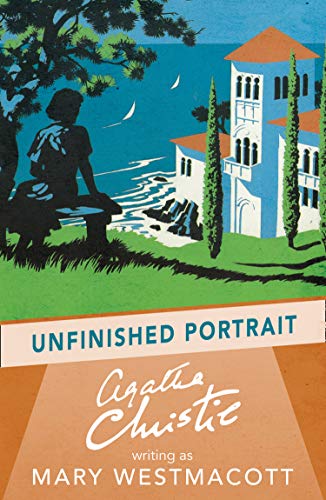
Unfinished Portrait by Mary Westmacott

May’s theme for the Read Christie 2023 challenge is ‘betrayal’ and the suggested title this month is Unfinished Portrait, a 1934 novel which is one of six books Christie published under the pseudonym of Mary Westmacott. Although I haven’t managed to take part in the challenge every month so far this year, I was particularly keen to join in with this one as I’ve previously only read one Westmacott novel – Giant’s Bread – and have been looking forward to reading more of them ever since.

Unfinished Portrait begins by briefly introducing us to Larraby, a portrait painter who is visiting an unnamed island when he comes across a woman sitting alone in a garden. Sensing that something is wrong, Larraby engages her in conversation and discovers that he is correct – she is intending to commit suicide. Not wanting to leave her alone, he accompanies her back to her hotel and listens as she tells him the story of her life and explains the sequence of events that have put such desperate thoughts into her head.

The woman’s name is Celia – at least that’s what Larraby calls her, as he doesn’t know her real name – and her story forms the main part of the novel. A lot of time is spent on Celia’s sheltered childhood, growing up in the late Victorian period in a comfortable home with servants and a nanny until the family’s financial position is affected by the early death of Celia’s father. I only know the basics about Agatha Christie as a person, but apparently Unfinished Portrait is semi-autobiographical, drawing on her own childhood memories to create Celia’s tales of inventing imaginary friends, time spent abroad due to her father’s poor health, the close relationships she had with her mother and grandmother and her first attempts at writing books. Later, Celia finds herself trapped in an unhappy marriage to Dermot, a man who is insensitive, controlling and eventually unfaithful – which again is based on Agatha’s own marriage to Archie Christie. If I’d been more familiar with Christie’s own life I would have appreciated the autobiographical element of the book a lot more, which would probably have added to my enjoyment of it, but I still found Celia’s story compelling in its own right.

After finishing the book, I could see how it fits the challenge topic for this month, exploring the theme of betrayal from several different angles: Dermot betrays Celia with another woman, Celia herself betrays a previous lover, and later in life she feels she has betrayed her daughter. All of these betrayals combine to cause the deterioration in Celia’s mental state that leads to her feeling so unhappy the day she meets Larraby. It’s a sad and emotional story – even sadder knowing that it was how Christie felt about her own situation at that time. Of course, the book was published in the 1930s and so it’s an ‘unfinished portrait’, leaving a lot of things in Celia’s life (and Christie’s) unresolved and incomplete.

I found this book quite different from Giant’s Bread, the only other Westmacott book I’ve read, and I think I preferred that one overall. I’m definitely more of a Christie fan than a Westmacott fan, but these are still great books and I’m looking forward to reading the other four.

Murder is Easy by Agatha Christie

April’s theme for the Read Christie 2023 challenge is poison, but I have read all of the suggested titles on the official challenge page, some quite recently. As I missed taking part last month, I decided to read the book I had planned to read in March instead – Christie’s 1939 novel Murder is Easy. There’s a new BBC adaptation coming later this year and I always prefer to read before watching, if possible!

Murder is Easy is one of the Christie novels that stars neither of her most famous detectives, Poirot or Miss Marple – although it does feature another of her recurring characters, Superintendent Battle. However, even he doesn’t appear until very near the end and plays no part in actually solving the mystery. Instead, almost the entire novel is written from the perspective of Luke Fitzwilliam, a retired police officer and amateur detective.

At the beginning of the novel, Luke has just returned to England from India and is taking a train to London, where he finds himself sharing a carriage with an old lady who introduces herself as Miss Pinkerton. She confides in him that she is on her way to Scotland Yard to report a serial killer in her village. Miss Pinkerton believes that this person – whom she doesn’t name – has murdered at least three people already and has chosen as their next victim the village doctor, Dr Humbleby. Luke assumes she has an overactive imagination, but the next day he reads in the newspaper that a Miss Pinkerton has been hit by a car and killed crossing the road outside Scotland Yard – and when news of the death of Dr Humbleby in the village of Wychwood-under-Ashe follows, he becomes convinced that she was telling the truth after all.

Determined to find out more, Luke heads for Wychwood, where he stays with a friend’s cousin, Bridget Conway, who happens to be engaged to the local lord of the manor. Luke is posing as an author researching a new book on witchcraft and superstition, but Bridget guesses the real reason for his visit and together they begin to investigate the recent deaths.

I really enjoyed this book and for once I correctly identified the murderer, though more through instinct than because I had spotted any particular clue. There are plenty of suspects ranging from the solicitor Mr Abbot and the late Dr Humbleby’s younger partner, Dr Thomas, to the widower Major Horton and the antiques dealer Mr Ellsworthy, who dabbles in black magic. We are told that the village of Wychwood has connections with witchcraft and the occult, but we don’t really explore that in any depth and the setting doesn’t have quite the same eerie atmosphere as the village in Christie’s The Pale Horse.

While Miss Marple doesn’t appear in this book, I found Miss Pinkerton a very Marple-ish character – an old lady with a shrewd mind and sharp observational skills – and was sorry she was killed so early in the story. Luke himself does very little detecting – despite interviewing all of the suspects, he doesn’t arrive at the right solution until somebody else reaches it first – but I still enjoyed following the progress of his investigations. And knowing that Christie often likes to work a nursery rhyme into the text or title of her novels, I was intrigued to come across the lines “I do not like thee, Doctor Fell; The reason why I cannot tell” – the same lines that are quoted in John Dickson Carr’s The Black Spectacles, which I coincidentally read just last week!

Although I didn’t choose Murder is Easy specifically to fit this month’s Read Christie theme, I was pleased to find that poison does feature in the plot, albeit in a small way. The May prompt is ‘betrayal’, if you want to take part.

Hickory Dickory Dock by Agatha Christie

February’s prompt for the Read Christie 2023 challenge is a murder method – the use of a blunt object. A lot of Christie’s novels involve murders carried out in this way and there were plenty of suggestions on the official challenge page this month. I chose a book I hadn’t read, Hickory Dickory Dock, which is a Poirot mystery first published in 1955.

The novel begins with the unthinkable – Poirot’s very efficient secretary, Miss Lemon, has made a mistake! Several mistakes, in fact, in a letter she has been typing. When Poirot asks her if something is wrong, she confesses that she’s worried about her sister, Mrs Hubbard, who has recently begun working at a student hostel on Hickory Road. Strange things have been happening at the hostel, Miss Lemon explains – a number of items have been stolen, but there seems to be no logic behind the thefts. A diamond ring, light bulbs, a stethoscope, lipstick, one shoe…what can be the connection? Finding an excuse to visit Hickory Road for himself, Poirot begins to investigate. At first it seems that there could be a fairly innocent explanation, but as these little incidents begin to take a more malicious turn, Poirot needs to discover the truth before somebody is killed.

This is one of several Christie novels that uses part of a children’s rhyme as its title, but apart from the name of the street, it doesn’t have any significance to the plot this time – unlike, for example, A Pocket Full of Rye or Five Little Pigs. That was a bit disappointing (surely a mouse or a clock could have been worked into the plot somehow!) but otherwise I enjoyed this book. I don’t think it’s one of the very best Poirot novels, but even a slightly weaker one is still fun to read. Although the crimes being committed seem quite trivial at the beginning, it gradually becomes clear that something more serious is going on in the background and once the murder takes place, the plot becomes much more compelling.

Setting the novel in a house full of students gives it a busy, bustling feel and means there’s a large cast of characters to provide both victims and suspects. The students are of all nationalities, some British, some French, with others from Africa, Jamaica, India and a whole range of other places. As the book was written in the 1950s, you can probably guess that the way these characters are portrayed is not always politically correct; there’s some racist language and some attitudes that aren’t considered acceptable today. However, for the most part, the students seem to mix together across racial and class boundaries, forming the usual friendships and rivalries you would find in any large group of young people.

I can’t really claim to have solved the mystery, as I worked out part of it but not all of it, but I don’t think it was one of Christie’s cleverest plots and the solution wasn’t as surprising as some of her others. Still, it was entertaining, as all of her books are, and I’m looking forward to reading more as Read Christie 2023 progresses. The March prompt is a motive – anger. I’m not sure yet whether I’ll be joining in with that one, but will see if I can fit it into my March reading.

Cards on the Table by Agatha Christie

A new year means the start of a new Agatha Christie challenge! Read Christie 2023 is hosted by the official Agatha Christie site and this year the focus is on methods and motives. The theme for January is jealousy and the chosen book is Sad Cypress. However, I read that one quite recently so I’ve gone with one of the alternative suggestions for this month, Cards on the Table.

Published in 1936, this is a Poirot novel, but it also features three of Christie’s other recurring characters, all of whom work together to solve the mystery. They are Superintendent Battle, the Scotland Yard detective; former Army officer and intelligence agent, Colonel Race; and Ariadne Oliver, the famous crime author. All three, along with Poirot, are invited to a dinner party hosted by Mr Shaitana, a wealthy man known as a collector of rare objects. He tells Poirot that he will also be inviting a collection of criminals – four people he believes have committed murder but never been caught.

During the party, the eight guests divide into two groups and sit down to play bridge. Several hours later, Mr Shaitana, who wasn’t participating, is found dead in his chair by the fire – stabbed with a small dagger by one of his guests while the others were engrossed in their game. The four sleuths can obviously be ruled out, but any one of the other four could be the murderer. To get to the truth, Poirot and his friends must investigate the background of each suspect to see whether Shaitana was correct and each of them had already killed before.

Cards on the Table begins with a foreword in which Christie explains that unlike most crime novels where the least likely suspect is usually the culprit, this book has four suspects who are all equally likely. They have all (allegedly) committed murder in the past, so all have a motive – fear that Shaitana will expose their previous crimes to the other guests. There’s Dr Roberts, who may or may not have been responsible for the death of at least one of his patients; Major Despard, whose expedition to the Amazon is shrouded in mystery; young Anne Meredith, who tries to cover up her reasons for leaving a previous job; and Mrs Lorrimer, an expert bridge player whose secrets prove particularly difficult to unearth. I suspected all of them at various points, but every time I thought I’d worked it out, Christie threw another twist into the story and I had to think again!

I loved the idea of having four different detectives working together in the same novel (it’s a shame Miss Marple and Tommy and Tuppence hadn’t been invited to the party too!) and each of them has a chance to contribute to the solving of the mystery. Colonel Race has a disappointingly small part, but we see a lot of Battle and Mrs Oliver – who is often described as a self-parody of Christie herself and provides an opportunity to comment on the writing of detective novels. Of course, it’s Poirot who correctly identifies the murderer in the end!

I enjoyed this book, but I think I would have enjoyed it even more if I’d had more knowledge of bridge, which is a game I don’t play and don’t really understand. Part of Poirot’s investigation revolves around the score cards and an analysis of each suspect’s playing style, so this meant very little to me. Luckily, though, it’s not completely essential to be able to follow all of this and there are other clues to piece together as well.

February’s Read Christie theme is ‘a blunt object’ and the group read will be Partners in Crime, which again is a book I’ve already read. I’ll wait until they reveal the alternative choices for the month and see if any appeal to me.

The Adventure of the Christmas Pudding by Agatha Christie

The December prompt for Read Christie 2022 is ‘a story containing precious jewels’ and the book chosen for the group read is Hercule Poirot’s Christmas. I read that one a few years ago, so decided to try The Adventure of the Christmas Pudding instead. This is a collection of six short stories and although only the first one contains precious jewels and has a festive theme, I thoroughly enjoyed reading all six of them!

Agatha Christie herself selected the stories for this collection and the first five in the book are Poirot mysteries. In the title story, The Adventure of the Christmas Pudding, Poirot joins the Lacey family at their country house, supposedly to experience a ‘typical English Christmas’. However, unknown to the family, he has another motive for attending their Christmas celebrations – he is hoping to track down a precious ruby stolen from a foreign prince. Although I felt that the title gave away part of the mystery – it’s obvious that the pudding is going to have some significance – there are still some twists before the full solution becomes clear. And I loved the Lacey children who decide to present Poirot with a murder as a special Christmas treat!

The Adventure of the Christmas Pudding was apparently inspired by Christie’s own memories of spending Christmas at Abney Hall, her sister’s home in Cheshire (presumably without the stolen jewels and murders). The other four Poirot stories in this collection are not set at Christmas, but are equally enjoyable to read. The Mystery of the Spanish Chest, in which a dead body is found in a chest after a party, is excellent. I had no idea who the culprit was or how the crime was carried out and I loved watching the plot unfold. The Under Dog, where Poirot investigates the death of a man who has been hit on the head with a club, is another good one. It’s quite complex and involved and I think it could easily have been developed into a full length novel.

The next two stories are quite unusual. In Four and Twenty Blackbirds, a man who usually dines in the same restaurant every Tuesday and Thursday without fail suddenly turns up on a Monday and asks for food he has never ordered before. Poirot is intrigued, particularly when he hears three weeks later that the man has died after an accidental fall downstairs. I found part of the solution easy to guess, but again there’s more to this story than it would seem at first! Then, in The Dream, Poirot is summoned by an elderly millionaire who is having a recurring dream in which he shoots himself with a revolver. When the old man does actually die a few days later in exactly the manner he has described, Poirot is called back to investigate. I loved this one – it’s very cleverly done!

After all of these Poirot mysteries, it was nice to see Miss Marple make an appearance in the final one, Greenshaw’s Folly. In this story, the elderly Miss Greenshaw, the current owner of the house known as Greenshaw’s Folly, is murdered in the garden just after making a new will. Miss Marple is brought into the mystery by her nephew Raymond West, whose niece has been working at the house, and through her usual methods – a knowledge of human nature and trying to decide who the various suspects remind her of – she proceeds to solve the mystery.

Overall, this is a great collection and I hope I’ve managed to give you a taste of each story without spoiling them too much. I’m looking forward to taking part in Read Christie 2023 next year!

4.50 from Paddington by Agatha Christie

This month’s theme for Read Christie 2022 is ‘a story featuring train travel’. I had already read most of the possibilities – The Mystery of the Blue Train, Murder on the Orient Express and The ABC Murders – but hadn’t yet read the Miss Marple novel 4.50 from Paddington, so that was my choice for this month.

The ‘train travel’ element of the story appears in the very first chapter, with the elderly Elspeth McGillicuddy taking a train to the village of St Mary Mead to visit her friend, Miss Jane Marple. Mrs McGillicuddy happens to glance out of the window just as her train passes another train running parallel in the same direction. At that moment, a blind flies open in the window of the other train and she is horrified to witness a man standing with his back to her strangling a woman. She reports the incident to the ticket collector and the police are informed, but when no dead body is found on the train Mrs McGillicuddy is dismissed as an old woman with an overactive imagination. Miss Marple, however, knows her friend is telling the truth and is determined not to let the matter drop.

Convinced that the body may have been thrown from the train as it passed the grounds of Rutherford Hall, Miss Marple enlists the help of Lucy Eyelesbarrow, a young woman she knows who has established a reputation for herself as a professional and efficient cook and housekeeper. Lucy’s skills mean she is very much in demand and never short of work, but Miss Marple persuades her to take a position at Rutherford Hall for a few weeks so that she can search for the body while she’s there. Settling into her new job, Lucy begins to get to know the residents of Rutherford Hall – the family patriarch Luther Crackenthorpe, his sons, daughter, in-laws and grandchildren – and begins to wonder whether their connection to the murder on the train really was a coincidence after all.

I found this a particularly enjoyable Miss Marple novel – probably in my top two or three. It seems that it has had some criticism due to the lack of clues and logical deductions and I do understand that complaint because we never find out exactly what leads Miss Marple to identify the correct suspect. However, I didn’t have a problem with this. The solution does make sense, even if we don’t know how she arrived at it, and the culprit was actually the person I suspected myself (again, not based on any real evidence – just a hunch!).

Although Miss Marple is the one who solves the mystery, we don’t really see very much of her in this book. Unable to infiltrate the Crackenthorpe household herself, she sends Lucy Eyelesbarrow in her place, which means a lot of the story is written from Lucy’s perspective. Luckily, Lucy is a great character – independent, intelligent and courageous. Several of the male Crackenthorpes are drawn to her and there’s a hint at the end of the book that she’s going to marry one of them. Which one she chooses is left for the reader to decide – although I’ve since discovered that Christie reveals Lucy’s choice in her Secret Notebooks, published in 2009.

There’s only one month left in this year’s Read Christie challenge and the December theme will be ‘a story containing precious jewels’. However, plans for Read Christie 2023 have already been announced and you can register your interest here: https://linktr.ee/OfficialAgathaChristie