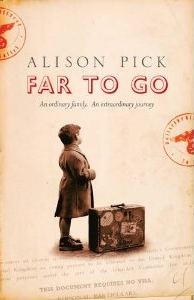
Something slightly different today: a guest post from author Alison Pick! You may remember that I recently posted my review of Alison’s new novel, Far to Go. Alison is visiting She Reads Novels today as part of her UK blog tour and here she tells us what inspired her to write Far to Go.
Growing up, there was a secret in my family. We went to Church, and celebrated Christmas, but we weren’t really Christians. We were hiding something. I didn’t know what.
I got older. There were clues. My great-grandparents had died in Europe. It had something to do with a camp, and with my grandmother’s pearls that she’d smuggled into Canada in a jar of cold cream.
I understood the truth in stages. My great grandparents were murdered in Auschwitz. Why? Because they were Jewish. Which meant their children, my grandparents, were Jewish too. Which meant, of course, that my father was the same.
I both knew this, and did not know it.
The reason for my psychic ambivalence was a moratorium on discussion. My grandmother forbid any and all questions about her parents, their deaths, or their backgrounds. In retrospect this makes perfect sense. Granny was a young woman when she arrived in Canada. Although culturally Jewish, she’d never practiced. Her own parents, who she had been very close to, were supposed to meet her in Canada, but they never made it out of Europe. It was out of a horrific lifelong grief that our family’s silence was sewn.
When my grandmother passed away in the year 2000 I was bereft. I wrote poems about her life following the Holocaust. Although she probably wouldn’t have liked the poems, they were my tribute to her.
Still, they weren’t enough. I grew as a writer, and the desire to write something bigger to honour my history grew too. Finally, in 2007, I began work on the novel that would become FAR TO GO. Paradoxically, I knew that the book would not tell my grandparents story in a literal sense. I wanted to write a gripping novel, one that would keep the reader turning the pages, and I didn’t want the constraint of “what really happened” to get in my way.
In other words, I wanted to forsake their particular story to tell one that was more universal.
Well, it’s done. FAR TO GO sold in five countries, won the Canadian Jewish Book Award for Fiction, and has been optioned for film. More importantly, it has given me incredible pleasure to write something for the family I never knew, and for my grandmother, who I did know and who I miss terribly. I’m not sure what she would have thought. Secrets die hard, especially ones like hers. I have a hunch, though, that she would have been proud.
As Jews around the world say on the anniversary of a loved one’s death: May her memory be for a blessing.
~
Thanks for visiting us today, Alison!
See what Alison said yesterday at Catherine, Caffeinated and don’t forget to visit Get On With It tomorrow to hear more from her!
For a full list of tour stops please see the blog tour button in my sidebar.
 She Reads Novels