My Commonplace Book: June 2016

A summary of this month’s reading, in words and pictures.

commonplace book
Definition:
noun
a notebook in which quotations, poems, remarks, etc, that catch the owner’s attention are entered

Collins English Dictionary

~

Daisy

“Do you know what, that does interest me. Not the fact that he was popular before he was arrested. He’s a good-looking man, there’s nothing remarkable in that. What fascinates me is the number of women who, by all accounts, write to him in prison. Why would they do that, do you think?”

“All notorious killers have a fan club,” he says.

Daisy in Chains by Sharon Bolton (2016)

~

Oh, there was pomp and pageantry and all the splendour of trumpets and gold brocade and wine flowing from the conduits, but there was something more that I can only think of as passion – the passion of a queen for her people and of the people for their queen. Already Elizabeth had the gift of investing the most ordinary action with an almost symbolic nobility, and, conversely, the ability to draw a touch of humanity from the most solemn ceremony.

The Virgin Queen by Maureen Peters (1972)

~

At heart he could not abide sense in women. He liked to see them as silly, as light-headed, as vain, as open to ridicule as possible, because they were then in reality what he held them to be, and wished them to be — inferior, toys to play with, to amuse a vacant hour, and to be thrown away.

Shirley by Charlotte Brontë (1849)

~

Katherine of Aragon

Katherine thanked him, drew the curtains and huddled back into her furs. She had found Prince Henry a little disturbing. He was a handsome boy, with undeniable charm, and even in those brief moments he had dominated the courtesies. Arthur had been reserved and diffident, and she could not stop herself from wondering how different things would have been had she been betrothed to his brother. Would she have felt more excited? More in awe? She felt disloyal even thinking about it. How could she be entertaining such thoughts of a child of ten? Yet it was so easy to see the future man in the boy. And it was worrying to realise how effortlessly Arthur could be overshadowed by his younger brother. Pray God Prince Henry was not overambitious!

Katherine of Aragon: The True Queen by Alison Weir (2016)

~

He claims to be himself the author of the nickname. Signor Pronto, he says, was a character in a popular farce, — a most obliging person who always turned up in the nick of time to arrange matters for everybody. The catch word of the farce was: Pronto will manage it! Some great lady was lamenting the difficulties of arranging charades at her country house party; ‘But,’ she cried, ‘I expect Mr. Lufton tomorrow and he will manage it for me.’ At which Crockett, who was present, said: ‘Oh ay! Pronto will manage it.’ After that they all called Lufton Pronto behind his back.

Troy Chimneys by Margaret Kennedy (1953)

~
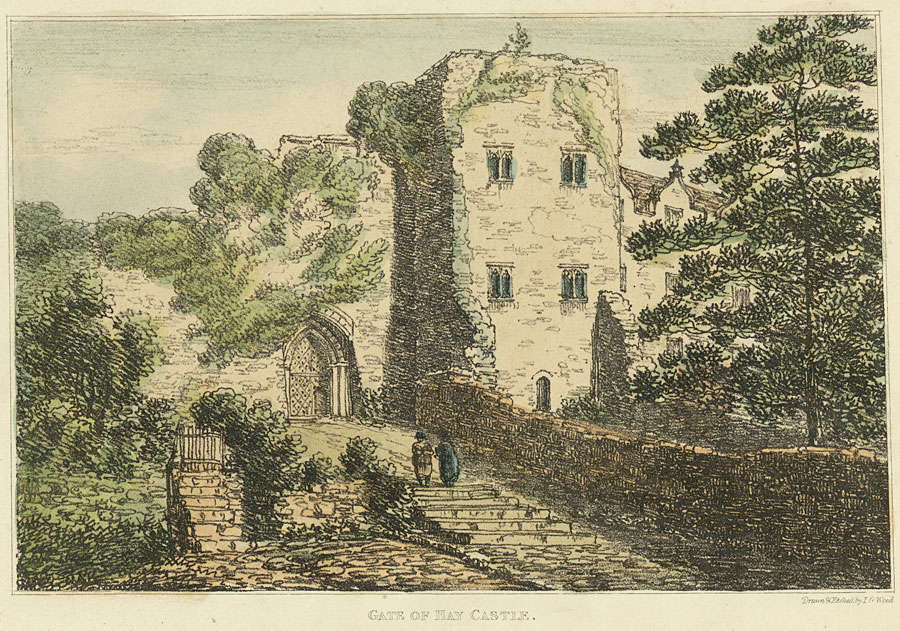
Gate_Of_Hay_Castle

Catrin woke and stared round in the dim light of a flickering fire. Her heart was pounding from the horror of the dream. The dream she had shared, did she but know it, with another woman; a dream she had dreamt recently, at home in Sleeper’s Castle. But she wasn’t at home. She pulled her cloak around her, shivering, confused as to where she was. Then she remembered.

Sleeper’s Castle by Barbara Erskine (2016)

~

She had not come to God with her wreath or with her sins and sorrows, not as long as the world still possessed a drop of sweetness to add to her goblet. But now she had come, after she had learned that the world is like an alehouse: The person who has no more to spend is thrown outside the door.

Kristin Lavransdatter by Sigrid Undset (1920)

~

Favourite books this month: Kristin Lavransdatter, Daisy in Chains and Troy Chimneys
The Marriage Game by Alison Weir

The Marriage Game Elizabeth I faces many challenges during her time on the throne of England: the threat of the Spanish Armada, for example, and the question of what to do about Mary, Queen of Scots. The most pressing issue for ‘the Virgin Queen’, however, is the need to secure the succession to the throne. Afraid of what might happen if their Queen was to die with no heir, her councillors advise her to marry and have children as quickly as possible. Elizabeth, though, has other ideas.

Month after month, year after year, Elizabeth promises to consider one suitor after another – her brother-in-law Philip of Spain, the Archduke Charles of Austria (son of the Holy Roman Emperor), Prince Eric of Sweden, and the Earl of Arran, just to name a few – and finds a reason to turn down every one of them. The most likely candidate, many people believe, is Robert Dudley, Elizabeth’s childhood friend and the man she truly loves. But Elizabeth prefers to keep the whole of Europe in suspense, using the possibility of marriage as her bargaining power…so Robert must wait with the rest of his rivals as Elizabeth continues to play ‘the marriage game’.

In Alison Weir’s new novel, The Marriage Game, she gives a fictional account of Elizabeth’s reign with a focus on the Queen’s marriage negotiations and her relationship with Robert Dudley. Although she does stick to the known facts where possible, there are some ‘unsolved mysteries’ that are left open to interpretation, such as the death of Robert’s wife, Amy Dudley (was she murdered or was it an accident?), the question of what exactly happened between the teenage Elizabeth and her stepmother’s husband, Thomas Seymour – and of course, the mystery of why the Queen was so reluctant to marry.

Historians can’t be completely sure as to why Elizabeth never married, but Weir gives several possible explanations in this book. The most obvious reason is that, as a female monarch, Elizabeth believes that if she takes a husband he will expect to rule as King and she will have to share her power. As a Protestant, she also needs to consider the religion of any potential husband. Then there’s the possibility that she is afraid of marriage and childbearing, having witnessed her father Henry VIII’s many unhappy marriages, the fate of her own mother and the deaths of Jane Seymour and Katherine Parr in childbirth. Of course, for Elizabeth’s advisers, none of these objections to marriage seem reasonable to them; the most important thing as far as they are concerned is to find Elizabeth a suitable husband and secure England’s future. And as for poor Robert Dudley, he simply wants to marry the woman he loves.

I don’t think I’ve read a fictional representation of Elizabeth yet that I’ve actually liked and this one was no different. At the beginning of The Marriage Game, I did feel that I might be able to like this version of Elizabeth: she seemed very human and I had sympathy for a young woman who had already suffered so much unhappiness in her short life, with her mother (Anne Boleyn) being beheaded and enduring months of imprisonment herself. As the story progressed, though, I began to feel as frustrated with her as everyone else in the novel did. When Robert Dudley decided that “He had had enough…He was weary of strife and the intrigues of the court, and Elizabeth’s endless, tortuous games” I knew exactly how he felt!

This was not a bad book and I enjoyed it more than the last Alison Weir novel I read, A Dangerous Inheritance. For readers new to Elizabeth-based historical fiction it will probably be a fascinating read, but if you have read about Elizabeth’s reign before you might feel, as I did, that there’s nothing very new or different here. The most interesting parts of the book for me were the scenes in which Elizabeth’s complex relationship with Mary, Queen of Scots is discussed, with Elizabeth torn between fear of the threat Mary poses to her throne and her desire to support a fellow queen. I wonder if Alison Weir will consider writing a novel about Mary at some point in the future.

I received a copy of this book for review from the publisher via NetGalley

A Dangerous Inheritance by Alison Weir

A Dangerous Inheritance The disappearance of the ‘Princes in the Tower’ (twelve-year-old Edward V of England and his younger brother Richard, Duke of York) remains a mystery to this day. Some believe that they were murdered by their uncle, Richard III, some suspect Henry VII or the Duke of Buckingham, and others prefer to think that one or both of the Princes managed to escape. My fascination with this mystery leads me to want to read everything I can find about it, even books like this one, written by an author whose views on the subject are entirely different from mine.

Alison Weir is an author of both historical fiction and non-fiction and A Dangerous Inheritance is one of her works of fiction. I had enjoyed a previous novel of hers, Innocent Traitor, which told the story of Lady Jane Grey, so I thought I would try this one despite knowing that Weir does not like Richard III at all and I was unlikely to agree with any conclusions she might come to.

Actually, this novel is only partly about Richard and the Princes; at least half of the book is set eighty years later and follows the story of Katherine Grey, the younger sister of the ‘nine-day queen’, Lady Jane Grey. After Jane’s very brief reign as Queen of England comes to an end when she is deposed by Mary I and beheaded, Katherine herself moves one step closer to the throne. To her disappointment, Mary is followed by Elizabeth I, who refuses to acknowledge Katherine as her heir and treats her badly. When Katherine marries the man she loves against Elizabeth’s wishes, she finds herself imprisoned in the Tower of London.

Katherine Grey’s story alternates with the story of another Katherine – Katherine Plantagenet (referred to as Kate to avoid confusion), an illegitimate daughter of Richard III. Kate loves her father and refuses to believe that he had any involvement in the disappearance of the two young princes. After Richard is defeated at Bosworth in 1485 and Henry Tudor takes his place on the throne, Kate’s loyalty to her father and her determination to clear his name could be considered treason. Several generations later, Katherine Grey discovers some letters written by Kate, learns of Kate’s connection with the princes and decides to continue investigating the mystery from within the Tower.

On the subject of the princes, I do find it fascinating that different authors and historians can begin with the same facts and come to entirely different conclusions! As nothing has ever been proven either way regarding the disappearance of the princes and the other controversies surrounding Richard III, I’m happy for it to remain a mystery. Having read quite a lot on the subject over the last few years, I personally find the pro-Richard viewpoint much more convincing than the anti-Richard one, but I can accept that we’ll probably never know the truth and that everyone is entitled to their own opinion.

For Alison Weir, although she states in her author’s note that she likes to keep an open mind, there is clearly no mystery: Richard was guilty of everything. As I was familiar with her views before beginning the book, I suppose I shouldn’t really complain! I was disappointed, though, that the main source Katherine uses in her investigations appears to be Thomas More (who was only seven years old at the time of Bosworth, is thought to have relied upon Richard’s enemy, Archbishop Morton, as his own primary source, and wrote his histories during the Tudor period, when it was obviously to his advantage to please the Tudor monarchs by discrediting their predecessors). However, as Weir explains in the author’s note, she could only use sources that would have been available to Katherine in the mid 16th century.

I did like the fact that this was a dual time period novel where both time periods were historical, rather than one being set in the present day, though I did sometimes feel that I was reading two separate stories that didn’t really belong in the same book. Apart from the fact that both main characters were Katherines and both suffered from being close to the throne, there was very little to link the two. It’s only in the final 100 pages of this 500-page book that Katherine Grey begins to investigate the mystery of the princes and parallels start to be drawn between the two storylines – some of them of a paranormal nature, which you may or may not appreciate!

Of the two, I enjoyed the Katherine Grey storyline the most. I found Katherine a much more engaging character, which is probably not surprising as she narrates in the first person while Kate doesn’t. Also, there is almost no historical information available on Kate Plantagenet, which meant that her sections of the book were largely fictional. I couldn’t help feeling that Katherine Grey’s life story would have been interesting enough to form the basis of a whole novel on its own without the addition of a second, imaginary storyline and without squeezing the Princes in the Tower into the same book as well.

Have you read anything about the Princes in the Tower? Who do you think was responsible for their disappearance?

Elizabeth of York: A Tudor Queen and Her World by Alison Weir

Elizabeth of York Elizabeth of York’s story is a fascinating one. As the eldest daughter of King Edward IV and Elizabeth Woodville (the alternate spelling of Wydeville is used in this book), Elizabeth lived during one of the most turbulent periods of English history, the Wars of the Roses. She was the sister of the two young princes who it is believed may have been murdered in the Tower of London, she married the first Tudor king, Henry VII, who defeated her uncle Richard III at the Battle of Bosworth, and she was also mother to another king, Henry VIII. Despite all of this, Elizabeth is not usually given as much attention as other figures of the period. This new biography, Elizabeth of York: A Tudor Queen and Her World, explores Elizabeth’s life and her historical significance.

Alison Weir is an author of both historical fiction and non-fiction. Although I have read one of her novels, Innocent Traitor, this is the first of her biographies I’ve read and I was very impressed. The book is written in a style that I found engaging and easy to read but it’s also a very thorough, long and detailed account of Elizabeth’s life. An incredible amount of research must have gone into the writing of this book and it contains an absolute wealth of information…I read it on my Kindle and was constantly bookmarking interesting facts and passages.

As well as taking us, in chronological order, through Elizabeth’s entire life from her birth to her death and its aftermath, we are also given lots of details on the social history of the period and what life was like for people who lived during that time: what they ate and drank, the clothes they wore, and the way children were treated and expected to behave. There are lists of dishes served at banquets, descriptions of the duties of ladies-in-waiting and even an appendix giving a full description of every known portrait of Elizabeth. Sometimes there’s too much detail (I didn’t really feel the need to know the names of the nurses of each of Elizabeth’s younger sisters, for example, and the lists of her privy purse expenses and all the gifts she bought and received were a bit overwhelming) but it all helps to build up a full and vivid picture of Elizabeth’s world.

Less is known about Elizabeth than other Tudor figures, so there are times when the focus of the book switches to important political events, conspiracies and other things taking place in the wider world, rather than on Elizabeth herself. The only drawback here is that with so few primary sources remaining to give us information on Elizabeth’s life, Weir can only assume what Elizabeth may have thought or how she felt. This is not really the author’s fault but it would have been interesting to know Elizabeth’s true thoughts on some of these issues, such as the pretenders to the throne who appeared during Henry VII’s reign claiming to be Elizabeth’s lost brothers.

Much as I enjoyed this book, I did have a problem with the portrayal of Richard III. I was aware before I started reading that Alison Weir has a negative opinion of Richard and believes him guilty of all the crimes that he has been accused of, but I still thought there was too much speculation and personal bias in her discussions of him. In the absence of any real evidence, we are told that ‘maybe Elizabeth hated him’ and ‘maybe Cecily was furious with him’, for example. These are not really historical facts, are they? The opinions of other authors and historians who take a more sympathetic view of Richard are dismissed as ‘wishful theories evolved by revisionists’. Anyway, this is just a small criticism of what is otherwise a wonderfully entertaining and informative book. For anyone interested in learning more about this important but often forgotten Tudor queen and her world, I would highly recommend reading Elizabeth of York. It really is a fascinating period of history and Elizabeth deserves to be remembered!

I received a copy of this book for review via Netgalley.

Innocent Traitor by Alison Weir

Alison Weir is best known for her non-fiction books but Innocent Traitor is her debut historical fiction novel from 2007 in which she tells the tragic story of Lady Jane Grey, the ‘Nine Day Queen’.

Jane was a great-niece of King Henry VIII. Her ambitious parents never bothered to hide their disappointment that she wasn’t the son they had hoped for – however, they immediately began plotting and scheming, first to marry Jane to Henry’s son, the young King Edward VI, and when this plan failed, to have the order of succession changed so that Jane would become heir to the throne in her own right. As Jane’s story unfolds, we are shown how terrible it must have been to be a girl born into the royal family in the 16th century and used as an innocent pawn in her parents’ selfish plans.

Much of the story is told from Jane’s point of view, but there are also sections narrated by her mother, Lady Frances Brandon, her nurse, Mrs Ellen, and several others, including Mary I, who is shown to have more compassion and humanity than she is usually given credit for – until, of course, she makes the final decision that will seal Jane’s fate. The use of multiple narrators to tell the various parts of the story worked very well. One minor criticism is that the early sections which are supposed to be narrated by a four-year-old Jane are not convincing at all, but I was able to overlook this. The book does focus more on the female perspective, but there are also one or two male narrators, the Duke of Northumberland (Jane’s father-in-law, John Dudley) being one of them.

I have no idea what Jane was supposed to be like in reality but Alison Weir has created a very engaging and sympathetic character. The sad thing is that under different circumstances Jane might actually have made a very good queen. She was intelligent and well-educated, courageous and dignified. Unfortunately when she came to the throne she was only fifteen, not old enough or strong enough to be able to deal with the unscrupulous, manipulative people around her. I found the portrayal of Jane’s husband, Guilford Dudley, interesting too. He’s shown as a cruel, unpleasant person who treats his wife badly, but like Jane he was also a pawn in his father’s ruthless plans and had no more control over his own destiny than Jane had over hers.

“If you don’t cry at the end you have a heart of stone” it says on the front cover of the book. Well, I’m pleased to report that I don’t have a heart of stone – the final pages of this novel are unbearably sad and yes, I did cry. I knew from the beginning how her story would end, but that didn’t make it any easier to read when it came. Despite already knowing what the outcome of the story would be, I couldn’t help wishing things would turn out differently for poor Jane. I’m not a big fan of the Tudor period as a subject for historical fiction, but I had never read a book about Lady Jane Grey before and am glad that I’ve now had the opportunity to learn more about this important but too often forgotten historical figure.