The Wolves of Willoughby Chase by Joan Aiken – #1962Club

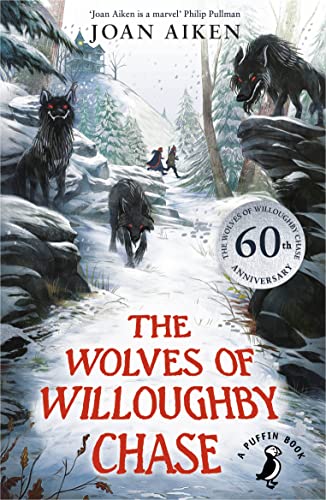
I’ve read and enjoyed several of Joan Aiken’s adult novels over the last few years – my favourite so far is Castle Barebane – but until now I’ve never read the book for which she’s most famous, The Wolves of Willoughby Chase. It was first published in 1962, which makes it a perfect choice for this week’s 1962 Club hosted by Simon and Karen.

This is obviously a book aimed at younger readers and I’m sure I would have loved it if I’d read it as a child; however, I was pleased to find that it also has a lot to offer an adult reader. I’m definitely planning to continue with the next book in the series.

The Wolves of Willoughby Chase is set in England in an alternate history where the Stuarts are still on the throne in the 19th century. It’s 1832, early in the reign of King James III, and a tunnel between Dover and Calais has recently been completed, allowing the migration of a large number of wolves from Europe. In reality, of course, the Channel Tunnel wouldn’t open until 1994, so Joan Aiken really was ahead of her time – although obviously the idea had existed in theory for much longer! Other than the tunnel and the presence of wolves, the world described in this book doesn’t seem very different from the real world of 1832, but I’m assuming the alternate history element becomes more significant later in the series.

Being a children’s book, the story is told from the perspectives of two children – Bonnie and Sylvia Green. Sylvia, an orphan, lives in London with her elderly Aunt Jane, but at the beginning of the novel she travels north by train to Willoughby Chase to stay with her cousin Bonnie. Bonnie’s parents, Sir Willoughby and Lady Green, are going abroad for health reasons and have engaged a governess, Miss Letitia Slighcarp, to take care of the children while they are away.

Left alone with Miss Slighcarp, the girls discover that their new governess is not what she claims to be and has another motive for coming to Willoughby Chase. Soon Bonnie and Sylvia are sent off to a horrible school for orphans run by the cruel Gertrude Brisket. Hungry and miserable, they begin to plan a daring escape, but will they succeed – and if so, where will they go? Will their friend, Simon the goose-boy, be able to help them? And what exactly is Miss Slighcarp planning to do now that she is in full control of Willoughby Chase?
Now that I’ve read this book I can see why it is considered a children’s classic and has been so popular with generations of younger readers over the years. It has an exciting plot, child protagonists to relate to, kindly adult characters to love and villainous ones to hate, and an atmospheric setting with snowy, icy landscapes and packs of wolves roaming the countryside. Speaking of the wolves, they play a big part in two memorable scenes near the beginning of the book, but are barely mentioned after that as the human ‘wolves’ come to the forefront of the story instead. The influence of Victorian literature on Aiken’s writing is also very obvious, from the Dickensian names of the characters – Letitia Slighcarp, Josiah Grimshaw, Mr Gripe, Mr Wilderness – to the portrayal of Mrs Brisket’s school, surely inspired by Lowood School in Jane Eyre.

I thoroughly enjoyed this book and just wish I hadn’t come to it so late! I’m already looking forward to reading the second one in the series, Black Hearts in Battersea.
This is book 41/50 for the 2023 Historical Fiction Reading Challenge.
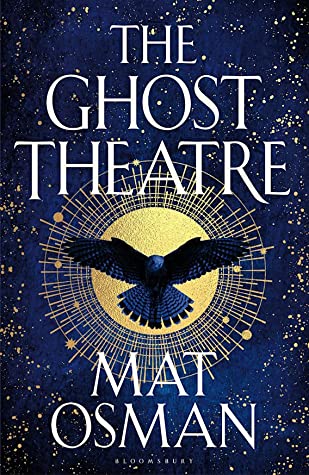
The Ghost Theatre by Mat Osman

The Ghost Theatre, Mat Osman’s second novel, is the story of two young people who meet on the rooftops of Elizabethan London. One of them is Shay, a teenage girl who dresses as a boy and belongs to a community of bird-worshippers. As the novel opens, Shay has released some caged birds from captivity in a shop and is being chased by the angry owner; with the instincts of a bird herself, she flees upwards to the roof and here she has her first encounter with Nonesuch. Taking his name from Henry VIII’s grand palace, Nonesuch claims to be the abducted son of a great lord, forced into performing at the Blackfriars Theatre, dressing as a woman to play leading female roles such as Cleopatra.

As Shay begins to fall in love with Nonesuch, she helps him to create the Ghost Theatre, a troupe of young actors who stage special plays in secret locations all over London. But it is another talent of Shay’s – her ability to tell fortunes – that brings her to the attention of Queen Elizabeth I and leads her into danger.

Mat Osman is the brother of the author and TV presenter Richard Osman and also the bassist in the British rock band Suede. I haven’t read his first novel, The Ruins, and had no idea what to expect from this one, but I can tell you it’s a very unusual book – not purely historical fiction but not quite fantasy either. It’s set in a city we can recognise as the London of the late Elizabethan period – there are outbreaks of plague, attempted rebellions, references to popular Elizabethan sports such as cock-fighting and bear-baiting – but there are also some imagined elements. As far as I know there was no community of Aviscultans living in Birdland and predicting the murmurations of starlings!

I have to be honest and say that this book wasn’t really for me. Perhaps because of the blend of alternate history with real history, it didn’t have the strong period feel I prefer – the dialogue was too modern, for example. I also found it quite difficult to focus on the plot; the imagery and descriptions were lovely but slightly distracting and sometimes I read several pages without really absorbing any of the words. If I had to compare this book to anything, it would be Megan Campisi’s The Sin Eater, another novel set in an alternate Elizabethan world and which I had some similar problems with. Incidentally, there is a sin eater in Osman’s novel too, although only mentioned in passing!

It would seem that Osman’s own love of music has influenced this story, with a lot of emphasis placed on the power of song, performing on stage and entertaining an audience. The novel as a whole is imaginative, creative, dreamlike and completely original. I wish I had been able to enjoy it more, but the right reader will love it.

Thanks to Bloomsbury Publishing for providing a copy of this book for review via NetGalley.

This is book 16/50 read for the 2023 Historical Fiction Reading Challenge.
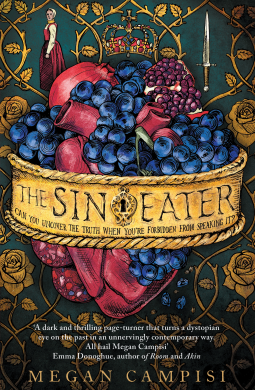
The Sin Eater by Megan Campisi

Megan Campisi’s unusual first novel is based around the historical concept of sin eating: the idea that a person close to death could call on a ‘Sin Eater’ to spiritually take on their sins. The dying person would do this by confessing to the Sin Eater, who would then consume a ritual meal consisting of a different type of food to represent each transgression. As you can imagine, this is not a pleasant job and certainly not something most people would want to do…but May Owens, the fourteen-year-old narrator of the novel, has no choice in the matter. After being arrested for stealing a loaf of bread, she is sentenced to live as a Sin Eater for the rest of her life.

With that sentence, everything changes for May. Overnight, she has become a social outcast. She is exiled to live alone on the edge of town and is forbidden to speak or be spoken to, except when listening to a confession. The heavy brass collar she is forced to wear around her neck, marked with an ‘S’, identifies her as someone to be avoided at all costs. It’s a lonely and miserable life, but May is a strong and resilient person and tries to carry out her work to the best of her ability.

Early in the novel, May accompanies another Sin Eater to the royal court to hear the deathbed confession of one of the Queen’s ladies. However, when the ritual meal is prepared, an extra item of food – the heart of a deer – is included, although it does not represent any of the sins confessed by the lady. What does the heart mean and who put it there? When another courtier falls ill and the same thing happens again, May decides to investigate.

By now you’re probably wondering about the time period in which this story is set. Well, it’s Elizabethan England – but not quite. Instead of Queen Elizabeth, Queen Bethany is on the throne, and her half-sister – the previous queen – was not Mary, but Maris. Bethany’s father did have six wives, but he was Harold II rather than Henry VIII. God is The Maker and England is Angland.

Megan Campisi states in her author’s note that the story is ‘spun out of fantasy’ and I can understand that using a fictitious setting rather than a real one would have given her more freedom to tell the story without needing to stick too closely to historical fact. It also gives the novel a bit of a fairy tale feel, as does the way most of the other characters are referred to not by names but by nicknames such as ‘Country Mouse’, ‘Willow Tree’ or ‘Fair Hair’. Sadly, though, I didn’t think any of these intriguing-sounding secondary characters really came to life; May herself was the only one who felt believable. And I’m afraid I found the thinly-disguised parallels with the Elizabethan court irritating; I think the story would have worked just as well set either at the real Elizabethan court or in an entirely fictional world.

Despite not enjoying this book as much as I’d hoped to, I do think the concept was fascinating and I can honestly say that I’ve never read anything quite like it!

Thanks to Pan Macmillan/Mantle for providing a copy of this book for review via NetGalley.

This is book 5/20 of my 20 Books of Summer.

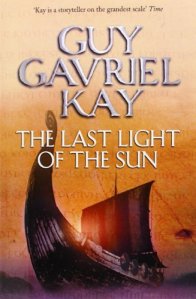
The Last Light of the Sun by Guy Gavriel Kay

The Last Light of the Sun I’m hoping to read Guy Gavriel Kay’s Under Heaven soon for the Once Upon A Time challenge, but first I need to tell you about another of his novels which I read a few weeks ago: The Last Light of the Sun.

This is the third book I’ve read by Kay and like the other two (Tigana and The Lions of Al-Rassan) it is set in a fantasy world that closely resembles a real historical one. A blue moon and a white moon shine in the sky, faeries wait to claim the souls of the dead, and ancient magical forces lurk in the forest, yet the world portrayed in The Last Light of the Sun can easily be identified as Northern Europe in the time of the Vikings, the Anglo-Saxons and the Celts.

In this re-imagined land, the Vikings have been renamed the Erlings, the Anglo-Saxons have become the Anglycn and the Celts have been transformed into the Cyngael. While the Erlings are sea-raiders who inhabit the islands in the far north, the Anglycn live in what is surely the country we now know as England, and the Cyngael live to the west, presumably in Wales. These lands of the Cyngael, on the western edge of the known world, are the last to see the light of the setting sun – and also form the final outpost of the new religion of Jad, the sun god.

Throughout the novel, we follow the adventures of three groups of characters from each of the three cultures I’ve described above. First, we meet Bern Thorkellson, a young Erling who has lost his lands and his freedom as a result of his father being exiled for murder. Desperate to escape and build a new life for himself, Bern joins a raiding party heading for the Anglycn shores. Meanwhile, in the Cyngael lands, two young princes called Alun and Dai happen to be spending the night at the home of a rival Cyngael warrior, Brynn ap Hywll, when it is attacked by another group of Erling raiders. Finally we get to know the family of the Anglcyn king, Aeldred, who has been trying to unite his people against the threat of the Erlings.

To describe the plot in any more detail would be difficult as it does become quite complex as the lives of each of these characters become entwined with all of the others. The author doesn’t really ‘take sides’ or favour one of the three cultures over the other two – perspectives and points of view are balanced fairly between the three and there are good people and bad within each group. Feuds and rivalries are formed, but so are friendships and loyalties as Erling, Anglcyn and Cyngael find that they need to adapt to a changing world.

One thing Kay does in this book, which I’m not sure I really like, is to occasionally leave his main characters behind for a while to explore the life of a completely new character who enters the novel for a few pages and then disappears, never to be mentioned again – as Kay himself describes it: “At the margins of any tale there are lives that come into it only for a moment. Or, put another way, there are those who run quickly through a story and then out, along their paths.” I can understand the reasons for this – to show us what is going on away from the central plot and the central characters – but I did find it slightly distracting.

This is a beautifully written novel, though, and as well as being an entertaining story, it’s also very thought-provoking in places. I particularly liked these two quotes:

“It happens this way. Small things, accidents of timing and congruence: and then all that flows in our lives from such moments owes its unfolding course, for good or ill, to them. We walk (or stumble) along paths laid down by people and events of which we remain forever ignorant. The road someone else never took, or travelled too late, or too soon, means an encounter, a piece of information, a memorable night, or death, or life.”

“A hard truth: that courage can be without meaning or impact, need not be rewarded, or even known. The world has not been made in that way. Perhaps, however, within the self there might come a resonance, the awareness of having done something difficult, of having done…something.”

I’ve loved all three of the Guy Gavriel Kay novels I’ve read so far and am looking forward to reading his others, beginning with Under Heaven. Have you read any of his books, and if so do you have a favourite?

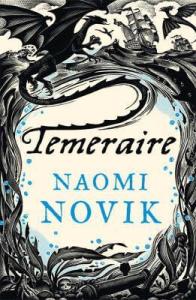
Temeraire by Naomi Novik

Temeraire Temeraire (also published as His Majesty’s Dragon) is the first in a series of nine books and is set during an alternate version of the Napoleonic Wars. This alternate world is exactly like our own in almost every detail, but with one very important difference – the existence of dragons. These dragons are intelligent creatures, capable of human speech and independent thought, and are used by both the British and French to provide aerial support to their navies. This first novel explores the beginning of a very special relationship between Captain Will Laurence and his dragon, Temeraire.

When we first meet Laurence he is a Captain in the Royal Navy and has just captured a French ship which happens to be carrying an unhatched dragon egg. The egg is very close to hatching and Laurence knows that if the dragon is to be tamed (and therefore of use to Britain’s Aerial Corps) it’s essential that it is harnessed and made to accept a human handler as soon as possible. The thought of becoming an aviator is not something that appeals to Laurence – as well as requiring total dedication, leaving little time for a family life, aviators are treated with scorn and contempt by the rest of the military. Unfortunately, the newly-hatched dragon refuses to accept any other handler so Laurence, after naming him Temeraire, reluctantly resigns himself to his new career and new way of life.

The rest of the novel follows the adventures of Laurence and Temeraire as they begin their training with the Aerial Corps in Scotland, learning all the flying manoeuvres and formations they will need to know before being called into service. This does feel very much like the first in a series and although Laurence and Temeraire do have the opportunity to take part in some action towards the end of the novel, the main purpose of the book seems to be to set the scene and introduce us to the concept of dragon warfare. This doesn’t mean that I thought the book was boring, though – quite the opposite: I found all the details of dragon training fascinating and now that I know how things work in the world of Temeraire I’m looking forward to continuing with the series.

I particularly enjoyed meeting all the other aviators and dragons who form the Aerial Corps including Captain Harcourt and her Longwing dragon, Lily (the presence of female aviators is something Laurence has to adapt to, having been used to the male-dominated Navy), Berkley and his Regal Copper, Maximus, and the training master, Celeritas, who is himself a dragon. One of my favourites was Levitas, a little dragon who has been neglected by his selfish captain and is desperate for some love and affection.

Most of all, I loved watching the relationship develop between Temeraire and Laurence as they come to trust and understand each other. There are some intriguing revelations about Temeraire at the end of the novel that make me want to pick up the second book in the series, Throne of Jade, as soon as possible!

I read Temeraire for Week 1 of the Forgotten Histories Reading Challenge.

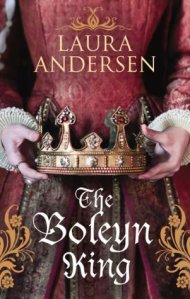
The Boleyn King by Laura Andersen

The Boleyn King We all know what happened to Anne Boleyn: having failed to give Henry VIII the son and heir he needed, the King turned his attentions to Jane Seymour and Anne was beheaded, leaving behind her only child, the future Elizabeth I. But what if Anne had given birth to a living son? What if that son grew up to become King of England? Laura Andersen takes that idea as her starting point for The Boleyn King and weaves a whole alternative history around it.

At the beginning of the novel, King Henry IX, better known as William (the fictional son of Anne and Henry), is approaching his eighteenth birthday. His uncle, Lord Rochford, has been acting as Lord Protector for the last few years but William is now almost ready to begin ruling in his own right. Rochford is a clever, ruthless man and he has not done a bad job of ruling the kingdom, but as William prepares to take over there are still several problems and potential conflicts to be dealt with.

First, there’s the threat posed by the Lady Mary, William’s half-sister, who many of England’s Catholics would prefer to see on the throne. Then there’s the prospect of war with France. Most worrying of all for William is news of a document known as The Penitent’s Confession which claims to throw William’s paternity into doubt and which, if it falls into the wrong hands, could lose him his throne.

Amidst all of this drama and danger, there are only three people whom William feels he can trust: his other sister, Elizabeth, and two more fictional characters, Dominic Courtenay and Minuette Wyatt. Dominic is his best friend and William has come to rely on his honesty and advice, while Minuette, the daughter of one of Anne Boleyn’s ladies, has been raised as a royal ward and is very close to William. Elizabeth, Dominic and Minuette are the people William turns to for help in ensuring the security of the kingdom – and locating the Confession before his enemies find it first.

The Boleyn King is part alternate history, part mystery and part romance. It was the history part that I enjoyed the most; the book raises some fascinating questions and although these weren’t explored in a lot of depth, it’s still very intriguing to think about all the different ways in which just one small change (the birth of one boy) could affect the future of England, Europe and maybe even the entire world. If there really had been a Henry IX, that must mean there would have been no Edward VI. Does that also mean that Lady Jane Grey would never have briefly taken the throne and then lost her life and that Mary would never have become Queen either? What if Henry IX had children of his own? Would the outcomes of wars have been changed? What about the implications for religion, culture, art, literature and exploration? The possibilities are endless.

The mystery storyline, which begins with the death of a friend of Minuette’s and ends with the search for the hidden document, was quite enjoyable too, but the romantic aspect of the book was of less interest to me. Elizabeth, as she apparently was in real life, is in love with Robert Dudley, while both William and Dominic develop feelings for the same woman – who happens to be Minuette. Their love triangle is not resolved in this book but as this is the first in a trilogy, I expect it will continue to play a big part in the next two books.

There was a lot to like about The Boleyn King, but I did have one big problem with it. William, Elizabeth, Minuette and Dominic could have been modern day teenagers – they never felt to me like people who could really have lived during the Tudor era. The way they spoke, the way they thought and the way they behaved just wasn’t right and there was no real sense of the time period. When I read historical fiction I like to feel completely immersed in another time and place but that never happened with this book.

The next two in the trilogy are The Boleyn Deceit and The Boleyn Reckoning. While I would be interested to know how the story develops, I’m not sure if I enjoyed this book enough to want to read two more. Maybe I’ll change my mind if I come across them in the library but at the moment I’m not planning to continue.

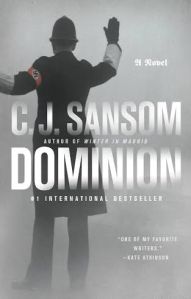
Dominion by C.J. Sansom

Dominion C.J. Sansom is probably best known for his Shardlake novels, a mystery series set in Tudor England. Dominion, however, is set in the twentieth century – but not the twentieth century that you and I are familiar with. Before we even finish reading the first chapter, we know that something is very wrong. In Sansom’s alternate world, Britain surrendered to Nazi Germany in 1940, changing the course of history as we know it.

As the novel opens in November 1952, we begin to see what a high price Britain has paid for peace with Hitler. Yes, the war was brought to a premature end, avoiding more deaths and devastation, but now the Gestapo are established in central London, Britain’s Jews are being rounded up and removed from the cities, and Winston Churchill, who never actually managed to become Prime Minister, has gone into hiding as the leader of the British Resistance.

The story is told from the perspectives of four characters, all with different backgrounds and beliefs. The first of these is David Fitzgerald, one of many people who are unhappy with the way things are in Britain. When he is approached by the Resistance movement, David agrees to use his position as a civil servant to provide them with confidential information. He decides to protect his wife, Sarah, by not telling her that he is working as a spy…but he is also hiding another, equally dangerous secret – one that nobody must ever discover.

Sarah Fitzgerald, David’s wife, has been a pacifist for many years, like her father and sister. She has always believed that signing a peace treaty in 1940 was the right thing to do in order to avoid more lives being lost. However, Sarah’s views are now beginning to change.

We also meet Frank Muncaster, a scientist and an old friend of David’s from university. Frank is now in a mental hospital after pushing his brother, Edgar, through a window during an argument. The Resistance believe that before they began to fight, Edgar – another scientist – may have given his brother some shocking information about his work in America. Finally, there’s Gunther Hoth, a German who is in London on a secret mission. Could Frank Muncaster have the information he needs?

Dominion is a chilling and thought-provoking novel, all the more frightening because the world C.J. Sansom describes is so realistic and believable. In many ways, the Britain of Dominion is not greatly different from the real Britain, but as the story unfolds we begin to see more and more subtle differences, more and more ways in which authoritarian rule has replaced the freedoms we take for granted.

As well as being an alternate history, this is also an exciting thriller. After a slow start I found it became very gripping and suspenseful, with some cliff hanger chapter endings and a few moments when I feared for the fates of some of the characters. The Great Smog of 1952 is incorporated into the novel and really adds to the oppressive atmosphere. There were some parts of the story, though, that felt superfluous and had little relevance to the main plot and this made the book feel longer than it really needed to be.

My favourite character was Frank Muncaster, who through no fault of his own finds himself at the centre of the conflict between the Germans and the British Resistance. We are given lots of flashbacks to Frank’s childhood when, as a shy and lonely boy, he was bullied at school, leaving him suffering from low self-esteem and finding it difficult to make friends. Of all the characters in the novel, I thought Frank was particularly well-written and I found myself warming to him in a way I never really did to any of the others.

Dominion is a disturbing and unsettling novel with a sinister vision of what our lives could have been like had just one or two different decisions been made at crucial moments in history. I thoroughly enjoyed this book, but when I reached the final page it was good to know that the world I was returning to was not quite the same as the one I had just finished reading about!

Dominion tour

I read Dominion as part of the Historical Fiction Virtual Book Tour. For more reviews, interviews and giveaways, please see the tour schedule.