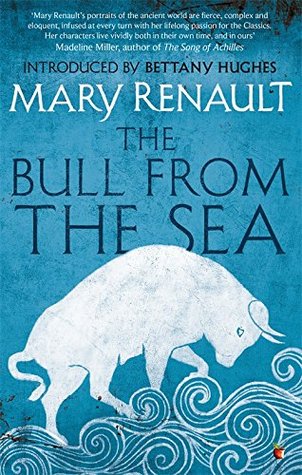
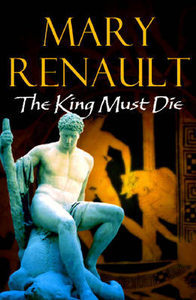
 Published in 1962, this is the second of Mary Renault’s two novels telling the story of Theseus. It’s been a few years since I read the first book, The King Must Die, and I was worried that I’d waited too long to read this one, but actually, although it does pick up where the first book left off, it wasn’t necessary to remember every little detail because The Bull from the Sea also works as a complete novel in its own right.
It begins with Theseus and his fellow bull-dancers returning to Athens from Crete, having defeated the Minotaur. Mistakenly believing Theseus to be dead, his father Aegeus has committed suicide, leaving Theseus to become the new king of Athens in his place. After his eventful time in Crete, Theseus finds it difficult to settle back into daily life, even with his new duties as king to occupy him. His restlessness soon leads him into a series of adventures with his friend Pirithoos, the pirate king of the Lapiths, and one of these journeys ends in a meeting with Hippolyta, the Amazon queen.
Theseus falls in love with Hippolyta and after challenging her to single combat and winning, he takes her back with him to Athens. A close and loving relationship develops between them, but Hippolyta can never become his wife – his people would not accept her as their queen, but in any case he is already promised in marriage to Phaedra, a princess of Crete. The fates of Hippolyta, Phaedra and the sons they bear Theseus are played out over the remainder of the novel.
Unlike The King Must Die which focused on only a few years in Theseus’ life, The Bull from the Sea covers a much longer period and as it’s not a particularly thick book, this means that several of the episodes in Theseus’ story are not explored in as much detail. His role in taming the bull of Marathon, for example, is dealt with relatively quickly without going into a lot of depth. Much more time is spent on his relationships with Hippolyta and Phaedra and their sons Hippolytos and Akamas, which was good because this was the part of the novel I found the most interesting. Having recently read For the Immortal by Emily Hauser which tells Hippolyta’s story from a feminine perspective, Mary Renault’s portrayal of her relationship with Theseus couldn’t be more different!
It’s the fact that different authors can take such different approaches to the same myths and legends that makes Ancient Greece so fascinating to read about. There is never just one version that everyone agrees on; so much is left open to interpretation. Mary Renault gives logical, realistic explanations for the various aspects of the myths rather than fantastical ones. I was intrigued by her representation of the Kentaurs (centaurs), for example, not as the half human/half horse creatures we would normally think of, but as a sort of ancient and primitive community of people who live in the wild and form close bonds with their horses.
It seems that most people prefer The King Must Die to this book, but I think I actually enjoyed this one more. This is probably because when I read the first novel in 2013 I had previously read very little about Ancient Greece and didn’t find the subject particularly appealing. Since then I’ve been dipping into the period more and more often and becoming more familiar with some of the myths, which could be why I found this book easier to get into and follow. I will be reading more by Mary Renault and am looking forward to starting her Alexander trilogy soon. I already have the first two books, Fire From Heaven and The Persian Boy, ready and waiting on my shelf.
 As discussed in a

 She Reads Novels