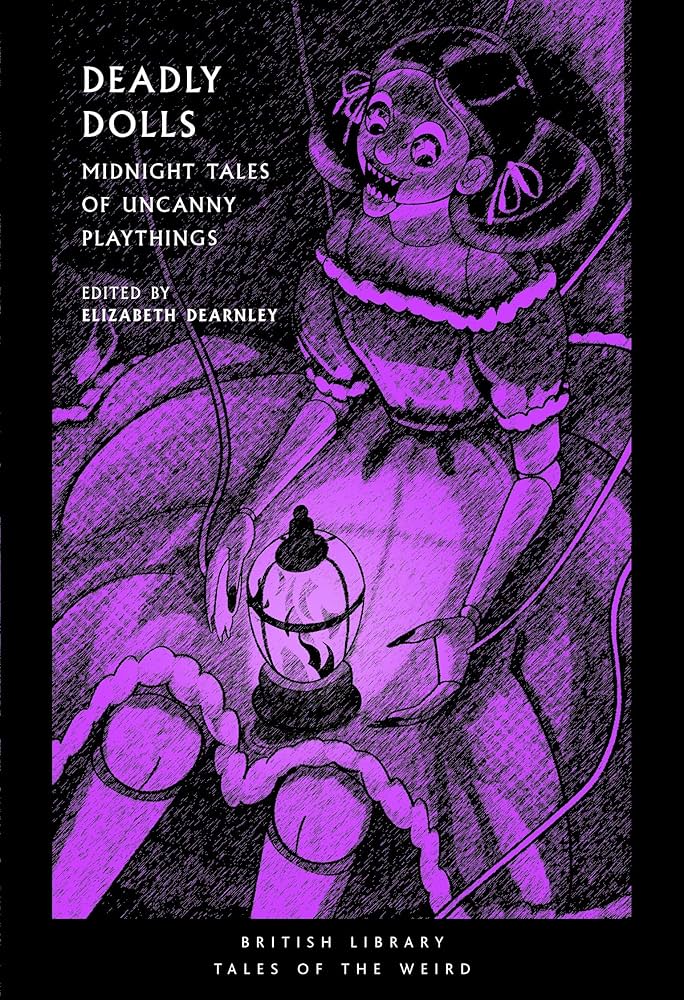
Deadly Dolls: Midnight Tales of Uncanny Playthings edited by Elizabeth Dearnley

Earlier this year I read Doomed Romances, a short story collection from the British Library’s Tales of the Weird series. I found it very mixed in quality – some great stories and some much weaker ones – but I was still interested in trying another one and I’m pleased to say that Deadly Dolls is much more consistent. As November is German Literature Month, I had initially planned to read the first story in the collection for now, which happens to be a German translation – ETA Hoffmann’s The Sandman – and leave the rest for later, but I then got tempted by the second story and read the whole book last weekend. The stories are all quite short, which made it a quick book to read!

This selection of fourteen stories is edited by Elizabeth Dearnley and as the title suggests, there’s a shared theme of dolls and toys. The Sandman, published in 1817 – and the story on which the ballet Coppélia was based – is the oldest story in the book, with the others spread throughout the 19th, 20th and 21st centuries. It’s a dark story – the Sandman of the title is a mythical character who steals the eyes of human children and takes them back to his nest on the moon to feed to his own children, an image which terrifies our young protagonist Nathanael so much that it haunts him for the rest of his life. I enjoyed it (my only other experience of Hoffmann is the entirely different The Life and Opinions of the Tomcat Murr) but I felt that others in the collection were even better.

A particular favourite was The Dollmaker by Adèle Geras, an author completely new to me. A dollmaker, known to the village children as Auntie Avril, opens a dolls’ hospital, repairing and restoring broken dolls. When three of the children notice that their dolls have been returned to them with alterations that seem unnecessary, they begin to question Auntie Avril’s motives. It seems Geras has been very prolific, writing many books for both children and adults, and I’m surprised I’ve never come across her before. I also enjoyed The Dancing Partner by Jerome K. Jerome (this time an author I know and love), in which a maker of mechanical toys decides to find a solution to the lack of male dance partners reported by his daughter and her friends. Although this is an entertaining story, it does have a moral: that we shouldn’t interfere with nature and try to play God.

At least two of the other stories have a similar message, despite having completely different plots. Brian Aldiss’ fascinating 1969 science fiction story, Supertoys Last All Summer Long, is set in a dystopian future where the rate of childbirth is controlled by the Ministry of Population. Meanwhile, in Ysabelle Cheung’s The Patchwork Dolls, a group of women literally sell their faces to pay the bills. Published in 2022, this is the most recent story in the book and I did find it interesting, if not quite as strong as most of the others. It’s one of only two contributions from the 21st century in this collection – the other is Camilla Grudova’s The Mouse Queen, an odd little tale that I don’t think I really understood and that I don’t feel belonged in this book anyway as it has almost nothing to do with dolls.

Joan Aiken is an author I’ve only relatively recently begun to explore, and as I’ve so far only read her novels it was good to have the opportunity to read one of her short stories. Crespian and Clairan is excellent and another highlight of the collection. The young narrator who, by his own admission, is ‘a very unpleasant boy’, goes to stay with an aunt and uncle for Christmas and becomes jealous when his cousin receives a pair of battery-operated dancing dolls. He comes up with a plan to steal the dolls for himself, but things don’t go quite as he expected! If I’d never read Aiken before, this story would definitely have tempted me to read more! The same can be said for Agatha Christie, whose The Dressmaker’s Doll is another one I loved. This story of a doll that appears to come to life when nobody is watching is maybe not what you would expect from Christie, as it’s not a mystery and there are no detectives in it, but it’s very enjoyable – as well as being very unsettling!

Unlike Doomed Romances, where the stories appeared in chronological order, adding to the unbalanced feel of the book, this one has the stories arranged by subject, which I thought worked much better. For example, two stories which deal with people in love with dolls are paired together – Vernon Lee’s The Doll and Daphne du Maurier’s The Doll. The latter is one I’ve read before (in du Maurier’s The Doll: Short Stories) but I was happy to read it again and be reminded of how good her work was, even so early in her career. There’s also a group of stories featuring dolls’ houses and of these I particularly enjoyed Robert Aickman’s The Inner Room, in which a girl is given a Gothic dolls’ house by her parents and develops an unhealthy fascination with it. In both this story and MR James’ The Haunted Dolls’ House, the houses and their inhabitants seem to take on a life of their own, but in different ways.

I think there are only two stories I haven’t talked about yet, so I’ll give them a quick mention here. They are The Loves of Lady Purple by Angela Carter and The Devil Doll by Frederick E. Smith. I’m not really a big Carter fan, but I’m sure those of you who are will enjoy this story about a puppeteer and his puppet, Lady Purple. I loved The Devil Doll, though. It’s a great story about a ventriloquist whose assistant suffers a terrible fate and is one of the creepier entries in the collection.

This is a wonderful anthology, with only one or two weaker stories, and if you’re interested in trying a book from the Tales of the Weird series I can definitely recommend starting with this one.

Doomed Romances: Strange Tales of Uncanny Love edited by Joanne Ella Parsons – #ReadIndies

This new short story collection, Doomed Romances: Strange Tales of Uncanny Love, is part of the British Library’s Tales of the Weird series. These books have been around for a few years now but I’ve let them pass me by as I’ve had enough to read with their Crime Classics series! I’m glad I’ve finally found time to try one as although this collection is a bit uneven I did find it entertaining.

The book contains twelve stories by different authors and includes an introduction by the editor, Joanne Ella Parsons. The stories were originally published between 1833 and 2022 and appear here in chronological order. All have a ‘doomed romance’ theme, with some being much darker than others. There are two that I’ve actually read before – one of them is Sheridan Le Fanu’s lesbian vampire novella, Carmilla, and the other is Angela Carter’s The Lady of the House of Love, also a vampire story, first published in The Bloody Chamber. I didn’t read Carmilla again as I just read it fairly recently, but I did re-read the Carter and was impressed again by the beautiful imagery and the atmospheric Gothic setting she creates.

The oldest story in the book is Mary Shelley’s The Invisible Girl, in which the narrator, out walking along the coast of Wales, finds a painting of a beautiful woman hanging on the wall inside a ruined tower. It was good to have the opportunity to try more of Shelley’s work, having only read Frankenstein so far, but I didn’t find this a particularly strong story. Two that I did enjoy were The Little Woman in Black by Mary Elizabeth Braddon and One Remained Behind by Marjorie Bowen. These are also authors I’ve read before; Braddon is a favourite Victorian author of mine and has a very readable writing style. Her story seemed as if it was heading in one direction, but then surprised me with an ending I wasn’t expecting at all! Bowen was a very prolific author of historical novels and supernatural tales – the story in this collection is a ghost story from 1936 and one of the highlights of the book for me.

Joanne Ella Parsons has clearly tried to include stories with a wide range of geographical settings, exploring different cultures, rather than just sticking with more traditional Gothic stories. Wilkie Collins, another Victorian author I usually enjoy, is represented here with Mr Captain and the Nymph, in which a ship’s captain lost on an unidentified Pacific island falls in love with the daughter of a local priest. It’s an interesting story, although not a good example of his best work. Alice Perrin’s The Tiger-Charm is set on safari in India, while Nalo Hopkinson’s The Glass Bottle Trick transposes the famous Bluebeard folktale to a Caribbean setting. The latter are two new authors for me and I found both stories entertaining, but I’m not sure if I would search out more of their work based on these.

Another highlight was Could You Wear My Eyes? by Kalamu ya Salaam, where a man whose wife has died agrees to have her eyes inserted into his face after her death, allowing him to see life from her perspective. It’s a strange story but a fascinating one! The collection is completed with another 19th century story, Ella D’Arcy’s White Magic, and two contemporary ones, I’ll Be Your Mirror by Tracy Fahey and Dancehall Devil by V. Castro.

Doomed Romances is a real mixed bag, then – there are some very strong stories and some much weaker ones, and including Carmilla seemed an odd decision to me, as it’s so much longer than any of the other stories and made the book feel unbalanced. I enjoyed the collection overall, though, and will probably consider reading more of them.

British Library Publishing publish a range of fiction and non-fiction including the Tales of the Weird, Crime Classics and Women Writers series. They are an independent publisher, so I’m counting this book towards #ReadIndies month, hosted by Kaggsy’s Bookish Ramblings and Lizzy’s Literary Life.

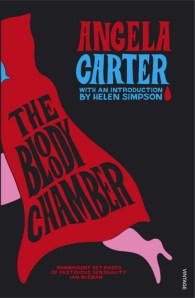
The Bloody Chamber by Angela Carter

ACW-badge-23 This week Caroline of Beauty is a Sleeping Cat and Delia of Postcards from Asia are hosting an Angela Carter Week. I have to admit that I had dismissed Angela Carter years ago as an author just not for me, based on one or two failed attempts at reading her novels as a teenager. Seeing the announcement of the Angela Carter Week and knowing that she is a beloved favourite of so many people, I decided it was time to give her another chance – with some short stories this time.

In The Bloody Chamber, Carter takes ideas and themes from fairy tales and legends – vampires and werewolves, Bluebeard and Puss in Boots, dark forests and gloomy castles – and works them into a collection of new short stories. There are ten in the book – The Bloody Chamber, The Courtship of Mr Lyon, The Tiger’s Bride, Puss-In-Boots, The Erl-King, The Snow Child, The Lady of The House of Love, The Werewolf, The Company of Wolves and Wolf-Alice. Some are quite long (The Bloody Chamber is more than forty pages long in this edition) while others are very short (less than two pages for The Snow Child) and all of them are steeped in feminism, violence and sexuality.

The Bloody Chamber I’m glad I chose this book to try again with, because I did enjoy it. However, I had quite an uneven reaction to the stories in this collection and found that I liked some of them much more than others – though I suppose that’s normal when reading short story collections. I was interested to read in the introduction by Helen Simpson that they should not actually be described as retellings because Carter herself said that her intention was to “extract the latent content from the traditional stories and to use it as the beginnings of new stories”.

By far the strongest, in my opinion, is the title story, The Bloody Chamber. The Gothic atmosphere and imagery in this story reminded me of Edgar Allan Poe. Inspired by the Bluebeard legends, it’s the tale of a young woman who travels to the castle of her new husband, a Marquis who has already been married and widowed three times before. When the Marquis goes away on business he leaves his wife with a bunch of keys and strict instructions not to unlock the door of one of the rooms. Not surprisingly, she is unable to resist the temptation and discovers something shocking within the forbidden chamber.

I also loved The Courtship of Mr Lyon, a romantic and beautifully written story based on Beauty and the Beast. I preferred this one to The Tiger’s Bride, which gives a completely different perspective on the same fairy tale. Puss-in-Boots, although not one of my favourites, stands out from the others in the book as it is written in a very different style. While most of the others, particularly The Bloody Chamber, are elegant and haunting with rich, elaborate descriptions, this one is a lively, amusing story narrated by the cat himself. The Snow Child is equally memorable, though for different reasons – for such a short story, it’s one of the most disturbing in the book.

The Erl-King and The Lady of the House of Love also deserve a mention, both for their atmospheric settings and the beauty of the language used. Interestingly, I think the stories I enjoyed least were the three final ones which incorporated elements from Little Red Riding Hood and werewolf folklore. I’m not sure why that should be, unless they just suffered from being last in the book.

I can see why Angela Carter’s books are so widely studied in schools and universities because her writing is packed with symbolism and imagery. I know I would have to read this whole collection again to even begin to fully appreciate everything she was trying to say in each of the ten stories.

Have you read this book? Which was your favourite story?